空调安装服务

Search documents
价格内卷与装备短板并存,“蜘蛛人”高空作业存安全隐患——“云端”讨生活 安全岂能“悬半空”?
Xin Hua Wang· 2026-01-08 23:28
Core Viewpoint - The article highlights the safety challenges faced by high-altitude workers, particularly "window cleaners," and emphasizes the need for improved safety measures, equipment standards, and industry regulations to protect these workers [1][5]. Group 1: Safety Concerns - High-altitude work is inherently risky, with frequent accidents occurring not solely due to workers' lack of safety awareness but also due to inadequate safety equipment and pressure from work conditions [3][4]. - Workers often bear the cost of their safety equipment, which can be as high as 2000 yuan for a complete set, leading to a disparity in safety standards among workers [3][5]. - The pressure to complete multiple jobs in a day can lead to unsafe practices, as workers may skip safety protocols to save time [4][5]. Group 2: Economic Factors - The pricing for high-altitude work varies significantly, with charges ranging from 100 yuan for lower floors to 600-1000 yuan for more dangerous tasks, reflecting the risk level involved [2][3]. - Many workers opt to work through platforms that provide job assignments, which can lead to a loss of control over their work schedules and increased financial pressure due to platform fees [2][4]. - The competitive nature of the industry has led to a race to the bottom in pricing, which further compromises worker safety and rights [5][6]. Group 3: Regulatory and Industry Recommendations - Experts suggest that companies should be mandated to provide adequate safety equipment and training for workers, as current practices often shift this responsibility onto the workers themselves [5][6]. - There is a call for industry associations and regulatory bodies to intervene and establish standardized safety protocols and fair pricing structures to protect workers' rights [5][6]. - The increasing emphasis on safety knowledge in training programs indicates a growing recognition of the importance of safety in high-altitude work [5][6].
混合销售和兼营行为傻傻分不清?一文读懂二者区别
蓝色柳林财税室· 2025-12-17 13:26
Core Viewpoint - The article discusses the tax treatment of mixed sales and the distinction between single sales behaviors and mixed operations, emphasizing the need for separate accounting for different tax rates in mixed operations [5][6]. Group 1: Definition and Characteristics - Mixed operations involve taxpayers engaging in both the sale of goods and the provision of services, which are subject to different tax rates [5]. - Key characteristics of mixed sales include the necessity for separate accounting of sales amounts for different tax rates, while single sales behaviors do not require such separation [7]. Group 2: Tax Treatment - Taxpayers must account for different tax rate projects separately; failure to do so results in applying the higher tax rate [6]. - In mixed sales, if a taxpayer sells goods and provides related services as a single transaction, the tax is applied based on the primary business activity [9]. Group 3: Case Studies - Case 1: A store sells an air conditioning unit with free installation as a package, treated as a mixed sale, taxed at 13% [10]. - Case 2: A store sells air conditioners separately from installation services, treated as mixed operations, requiring separate accounting for tax purposes, with air conditioners taxed at 13% and installation services at 9% [10]. Group 4: Special Provisions - Certain sales involving construction services must be treated as mixed sales, requiring separate accounting for goods and construction services, each subject to different tax rates [11][12].


小米汽车开始挣钱 卖一台车净赚6434元 雷军最新发声
2 1 Shi Ji Jing Ji Bao Dao· 2025-11-20 04:53
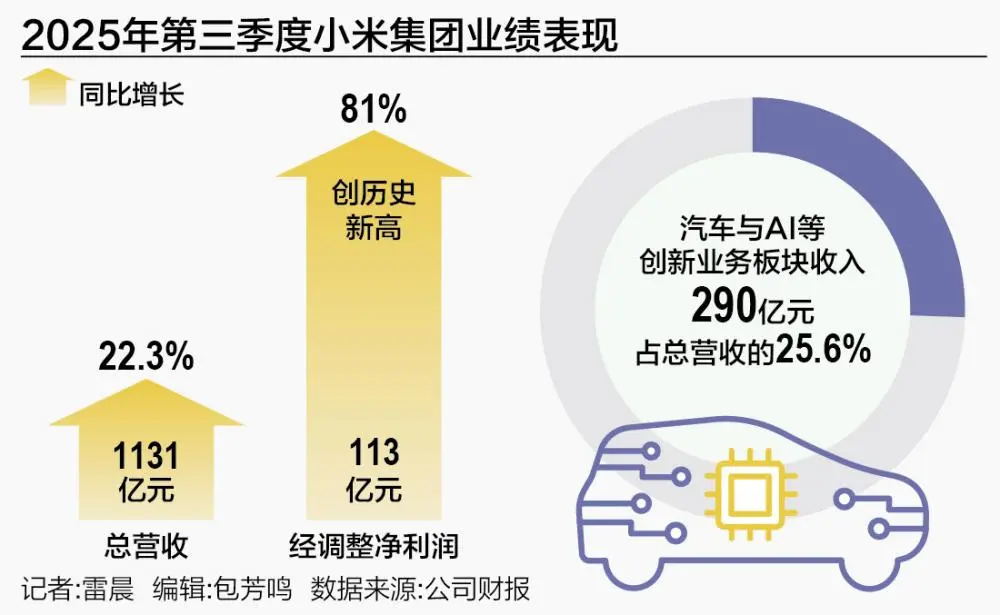
Core Insights - Xiaomi Group reported a total revenue of 113.1 billion yuan for Q3 2025, representing a year-on-year growth of 22.3%, with adjusted net profit reaching 11.3 billion yuan, up 81%, marking a historical high [1][4] - The company successfully transitioned between old and new growth engines, with innovative businesses like smart electric vehicles and AI achieving profitability for the first time in a single quarter, while the traditional smartphone business faced pressure due to rising memory costs [1][4] Financial Performance - The automotive business delivered 108,796 vehicles in Q3, with a total of 265,967 vehicles delivered in the first three quarters, and a monthly delivery of over 40,000 units in October, achieving profitability with a net profit of 6,434 yuan per vehicle sold [4][6] - The smartphone business faced challenges, with global shipments of 43.3 million units and revenue of 45.969 billion yuan, leading to a decline in gross margin to 11.1% due to rising costs of core components [6][5] Business Segmentation - Internet services generated revenue of 9.4 billion yuan in Q3, a 10.8% increase, primarily driven by strong advertising performance [7] - IoT business revenue reached 27.6 billion yuan, maintaining year-on-year growth for seven consecutive quarters, with a gross margin of 23.9% [9][8] R&D and Long-term Strategy - R&D expenditure in Q3 amounted to 9.1 billion yuan, a 52.1% increase, with total R&D investment for the first three quarters nearing last year's total, expected to exceed 30 billion yuan for the year [11][12] - The company is focusing on core technologies and frontier fields, with capital expenditure for the first three quarters at 13 billion yuan, reflecting long-term strategic investments [12][10] Market Outlook and Challenges - Despite achieving profitability in the automotive sector, the company anticipates challenges in 2026 due to reduced purchase tax subsidies and intensified competition [12] - The smartphone business continues to face long-term pressure from rising memory costs, while the IoT sector is experiencing a transitional phase in the domestic appliance market [12][6]

小米汽车开始挣钱,卖一台车净赚6434元,雷军最新发声
2 1 Shi Ji Jing Ji Bao Dao· 2025-11-20 04:53
Core Insights - Xiaomi Group reported a total revenue of 113.1 billion yuan for Q3 2025, representing a year-on-year growth of 22.3%, with adjusted net profit reaching 11.3 billion yuan, a significant increase of 81%, marking a historical high [1] - The financial report indicates a successful transition between old and new growth engines, with innovative businesses like smart electric vehicles and AI achieving profitability for the first time in a single quarter, while the traditional smartphone business faces pressure due to rising memory costs [1][3] - Xiaomi's partner and president, Lu Weibing, emphasized the importance of continuous capability building to enhance resilience against uncontrollable environmental factors [1] Innovative Business Performance - The smart electric vehicle and AI sectors became the core growth drivers, with Xiaomi delivering 108,796 vehicles in Q3 and a total of 265,967 vehicles in the first three quarters, achieving profitability for the first time with an operating profit of 700 million yuan [3] - The average profit per vehicle sold was 6,434 yuan, exceeding expectations and validating the product strength and business model of Xiaomi's automotive division [3] Smartphone Business Challenges - Xiaomi's global smartphone shipments reached 43.3 million units in Q3, generating revenue of 45.969 billion yuan, but the smartphone business faced a decline in gross margin to 11.1% due to rising costs of core components [5] - Lu Weibing noted that the current memory price increase is driven by strong demand for HBM (High Bandwidth Memory) from AI, leading to a long-term cost pressure on the smartphone segment [5] Internet Services Contribution - The internet services segment generated revenue of 9.4 billion yuan in Q3, reflecting a year-on-year growth of 10.8%, primarily driven by strong performance in advertising [6] IoT Business Growth - Xiaomi's IoT and lifestyle product revenue reached 27.6 billion yuan in Q3, maintaining year-on-year growth for seven consecutive quarters, with a gross margin of 23.9% [8] - The overseas market has become a significant growth driver for IoT, with record revenue achieved in Q3, and plans for further expansion in Southeast Asia and Europe [8] R&D Investment and Long-term Strategy - Xiaomi's R&D expenditure in Q3 amounted to 9.1 billion yuan, a 52.1% increase year-on-year, with total R&D investment for the first three quarters nearing last year's total [10] - The company aims to become a global leader in core technology through substantial investments in foundational technologies, particularly in AI [10] Future Challenges and Strategic Focus - Despite achieving profitability in the automotive sector, challenges are anticipated in 2026 due to reduced purchase tax subsidies and intensified competition [11] - The smartphone business continues to face long-term cost pressures, while the IoT sector is navigating a transitional phase in the domestic appliance market [11] - Xiaomi plans to focus on consolidating automotive profitability, advancing smartphone premiumization, and leveraging opportunities in AI to achieve high-quality growth [11]

小米汽车开始挣钱,卖一台车净赚6434元,雷军最新发声
21世纪经济报道· 2025-11-20 04:49
Core Insights - Xiaomi Group reported a total revenue of 113.1 billion yuan for Q3 2025, a year-on-year increase of 22.3%, with adjusted net profit reaching 11.3 billion yuan, up 81%, marking a historical high [1] - The company successfully transitioned between old and new growth engines, with innovative businesses like smart electric vehicles and AI achieving profitability for the first time in a single quarter, while the traditional smartphone business faced pressure due to rising memory costs [1][4] - Xiaomi's President Lu Weibing emphasized the importance of resilience through continuous capability building in response to uncontrollable environmental factors [1] Revenue and Profitability - The innovative business segment, including smart electric vehicles, delivered a significant turnaround, achieving a profit of 700 million yuan in Q3 after a loss of 300 million yuan in Q2, with an average profit of 6,434 yuan per vehicle sold [4] - The smartphone business faced challenges, with global shipments of 43.3 million units and revenue of 45.969 billion yuan, leading to a decline in gross margin to 11.1% due to prolonged cost pressures from core components [6] Business Segmentation - Internet services generated revenue of 9.4 billion yuan in Q3, reflecting a 10.8% year-on-year growth, primarily driven by strong performance in advertising [7] - The IoT business reported revenue of 27.6 billion yuan, maintaining a growth streak for seven consecutive quarters, with a gross margin of 23.9% [9] Strategic Initiatives - Xiaomi is increasing its R&D investment, with Q3 spending reaching 9.1 billion yuan, a 52.1% increase year-on-year, and total R&D expenditure expected to exceed 30 billion yuan for the year [11] - The company is focusing on high-end product strategies to counteract cost pressures, achieving a market share increase in the 4,000-6,000 yuan price segment by 5.6 percentage points to 18.9% [6] Future Outlook - Despite achieving profitability in the automotive sector, challenges remain, including reduced purchase tax subsidies and intensified competition expected in 2026 [12] - Xiaomi aims to solidify its automotive profitability, further penetrate the high-end smartphone market, and leverage opportunities in AI and physical world integration for long-term strategic goals [12]