纯债债基

Search documents
“专业基金买手”公募FOF最新选基布局出炉
Zheng Quan Ri Bao· 2026-01-26 16:43
Core Insights - The public FOF (Fund of Funds) market is experiencing increased attention and activity in 2025, particularly in the fourth quarter, as evidenced by the latest disclosures of public fund quarterly reports [1][2]. Group 1: Market Activity - The public FOF market maintained an upward trend in 2025, with significant growth in the fourth quarter. By the end of 2025, there were 550 public FOFs with a total management scale of 218.901 billion yuan, marking an increase of 49 funds and 31.655 billion yuan from the third quarter [2]. - In the fourth quarter of 2025, 43 new public FOFs were launched, raising 45.064 billion yuan, which represents an increase of 24 funds and 38.532 billion yuan compared to the previous quarter. Ordinary FOFs accounted for over 90% of both the number and scale of new products [2]. Group 2: Factors Driving Growth - Three main factors are driving the active new issuance market for public FOFs: 1. Market conditions are catalyzing demand for stable investment channels due to low interest rates and increased market volatility, leading to a decline in traditional investment attractiveness [3]. 2. Product capability upgrades have improved the research and investment systems of public FOFs, enhancing their multi-asset allocation capabilities and making them more competitive in terms of risk-return profiles [3]. 3. Increased investor awareness and acceptance of professional allocation tools like public FOFs are contributing to their growing popularity [3]. Group 3: Asset Allocation - Public FOFs emphasize multi-asset allocation, with a significant focus on bond funds. By the end of 2025, public FOFs held 56.522 billion yuan in pure bond funds, accounting for 45.22% of their total holdings. Index bond funds ranked second with a total of 17.207 billion yuan, representing 13.77% [4]. - The high allocation to pure bond funds is driven by their low volatility, which provides a stable return foundation and effectively hedges against equity asset risks. This aligns with the long-term wealth accumulation goals of public FOFs [4]. Group 4: Product Innovation - Public FOFs are continuously innovating their product offerings, introducing new forms such as FOF-LOF, QDII-FOF-LOF, and ETF-FOF. The ETF-FOF, in particular, has gained attention for its low fees and convenient rebalancing features [5][6]. - The design of public FOF products is increasingly aligned with market demands, addressing short-term speculative pain points by launching holding period-type FOFs that encourage long-term investment [5].
《国内资产管理行业报告(2025年三季度)》:股票型和混合型公募基金表现亮眼
Zhong Guo Jing Ying Bao· 2025-11-24 13:16
Core Insights - The report by CITIC Financial Holdings indicates that China's asset management industry reached a cumulative scale of 179.33 trillion yuan by the end of Q3 2025, reflecting an 8.21% growth compared to the end of the previous year [1] Industry Overview - The wealth management sector grew by 7.28% year-on-year, while public fund scale increased by 11.91%, indicating steady growth across major sectors [1] - The performance of major public fund indices showed divergence, with equity fund indices and stock-type fund indices performing strongly, both exceeding an annualized return of 135% [1] Fund Performance - In the first three quarters of the year, the number of ordinary stock-type funds reached 584, achieving a return of 181.57% [1] - The number of passive index stock funds and enhanced index stock funds was 2,259 and 432, with returns of 175.05% and 144.35%, respectively [1] - Flexible allocation funds and convertible bond funds had 1,352 and 40 products, yielding returns of 151.68% and 70.54% respectively [1]
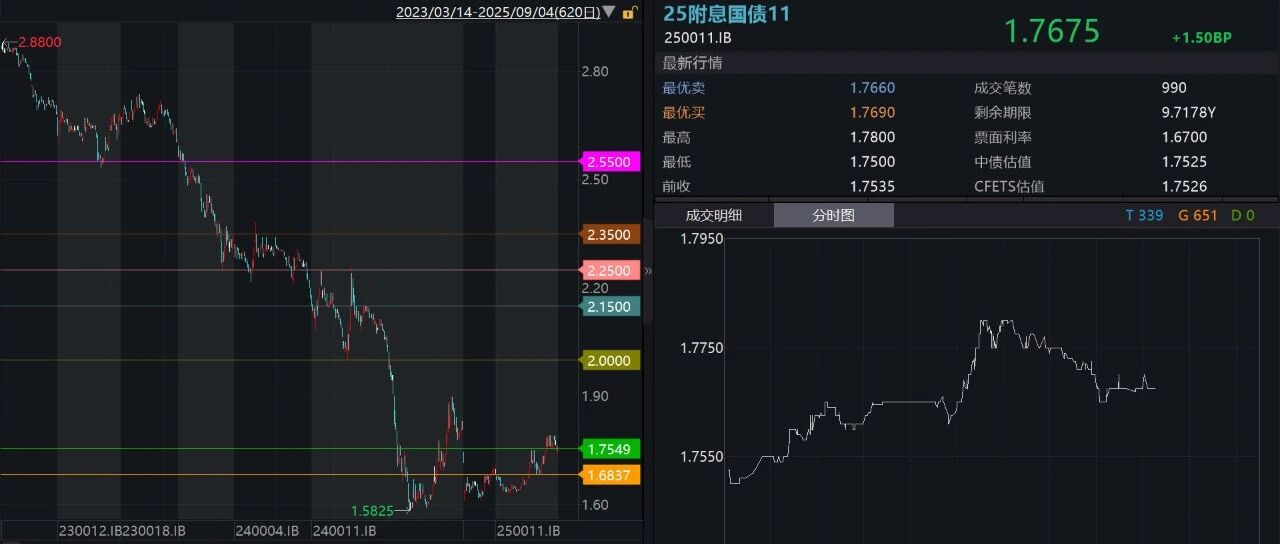
【笔记20250905— 反内卷 卷起债心酸】
债券笔记· 2025-09-05 11:18
Core Viewpoint - The article discusses the current market dynamics, highlighting a strong rebound in the stock market and the emergence of "anti-involution" trading strategies in commodities, while also noting a slight tightening in the funding environment [3][6]. Group 1: Market Overview - The stock market experienced a strong rebound, attributed to major institutions realizing profits at the end of the quarter [6]. - The funding environment showed slight tightening, with the central bank conducting a 1,883 billion yuan reverse repurchase operation, while 7,829 billion yuan of reverse repos matured, resulting in a net withdrawal of 5,946 billion yuan [3][4]. - The long-term bond yields saw a slight increase, with the 10-year government bond yield fluctuating around 1.7525% to 1.78% during the day [6][7]. Group 2: Interest Rates and Funding Rates - The funding rates remained stable, with DR001 around 1.32% and DR007 at approximately 1.44% [4]. - The weighted rates for repos showed minimal changes, with R001 at 1.36% and R007 at 1.46%, indicating a slight decrease in transaction volumes [5]. - The overall transaction volume in the repo market was 76,332.53 billion yuan, reflecting a decrease of 3,275.32 billion yuan [5]. Group 3: Commodity Market Dynamics - The commodity market saw a resurgence of "anti-involution" trading, with leading stocks like polysilicon hitting the upper limit, while government bond futures experienced a decline [7]. - The market sentiment regarding the "anti-involution" narrative appears mixed, as evidenced by the fluctuating performance of bond funds, with pure bond funds seeing negative net subscriptions after three days of small net purchases [7].