绿色能源设备

Search documents
德国总理痛批能源政策属战略性错误,气候变暖引爆了乌俄战争
Sou Hu Cai Jing· 2026-01-24 10:35
Group 1 - The core argument of the articles revolves around the dangers of global warming and the criticism of fossil fuel usage, which is portrayed as detrimental to humanity and the planet [1][2][4] - Germany's energy policy is facing significant strategic errors, as acknowledged by Chancellor Merz, highlighting the unsustainable high costs of energy and the reliance on federal subsidies for green energy [1][2] - The transition to green energy is criticized for its inherent instability and the substantial emissions produced during the manufacturing and distribution of green energy equipment [2][4] Group 2 - The European Union's dependency on Russian fossil fuels has increased, with countries like France and Spain significantly raising their imports of Russian liquefied natural gas by 18% and 27% respectively [4] - The ongoing purchase of Russian oil by Europe is seen as funding a war against themselves, contradicting their environmental goals [6] - The argument is made that reducing oil prices could potentially end the Ukraine-Russia conflict, suggesting that Europe's green policies inadvertently support Russia's economy [6]


21社论丨促进对话与合作,让世界更好分享“中国机遇”
21世纪经济报道· 2026-01-23 01:48
Group 1 - The World Economic Forum 2026 Annual Meeting in Davos focuses on establishing new collaborative mechanisms to address global challenges, emphasizing the need for dialogue to bridge divides and promote solutions to major global issues [1] - The 2026 Global Risks Report highlights that economic risks are rising rapidly, with 53% of chief economists expecting multiple uncertainties in the global economy over the next year, including asset revaluation and debt accumulation [1] - China has proposed initiatives such as the Global Development Initiative and Global Security Initiative, advocating for multilateralism and free trade, aiming to foster cooperation and consensus among nations [1] Group 2 - China aims to support free trade and promote inclusive economic globalization, while maintaining multilateralism and striving for a fair international economic order [2] - The country is committed to expanding domestic demand and becoming not only the "world's factory" but also the "world's market," enhancing imports to allow other nations to benefit from "China opportunities" [2] - China's technological innovations and green energy solutions have been beneficial for developing countries, showcasing its role in global development and earning international respect [2] Group 3 - China is positioned as a stabilizing force and a reliable source of global economic growth, emphasizing the importance of dialogue and cooperation for a stable world economy [3]

除了140万亿元 这些突破同样值得关注
Jing Ji Guan Cha Wang· 2026-01-19 15:21
Group 1 - In 2025, China's GDP is projected to reach 140.1879 trillion yuan, reflecting a year-on-year growth of 5.0%, showcasing the resilience and adaptability of the Chinese economy in a challenging global environment [1] - The total retail sales of consumer goods in 2025 are expected to exceed 50.12 trillion yuan, with a growth rate of 3.7%, and final consumption expenditure contributing over 50% to economic growth, an increase of 5 percentage points from the previous year [2] - Research and development (R&D) expenditure intensity is anticipated to reach 2.8%, surpassing the OECD average for the first time, indicating a shift towards quality improvement and increased funding for foundational research and key technological breakthroughs [2] Group 2 - New energy vehicles (NEVs) are projected to account for over 50% of domestic new car sales in 2025, with annual production and sales exceeding 16 million units, reflecting significant growth in green energy products [2] - The share of non-fossil energy in total energy consumption is expected to increase by approximately 2 percentage points compared to the previous year, indicating progress in the green transformation of traditional industries [2] - The focus on high-quality development is evident as China moves beyond mere GDP growth, achieving effective quality improvements and structural transformations in its economy [3]
全国外贸十强市又变了!这座小城一直在默默发财...
Sou Hu Cai Jing· 2025-08-07 05:35
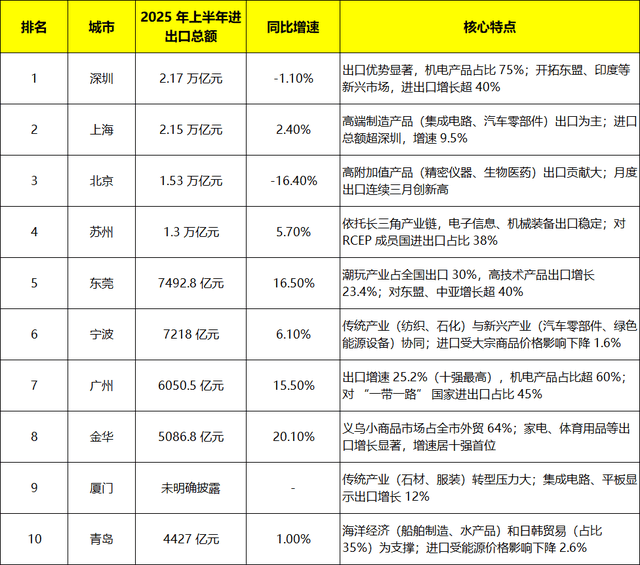
Core Insights - The top ten foreign trade cities in China for the first half of 2025 have been released, showcasing a stable position for leading cities while new contenders are emerging [1] Group 1: Trade Performance - Shenzhen ranks first with a total import and export value of 2.17 trillion yuan, accounting for 9.9% of the national foreign trade value, despite a slight decline of 1.1% year-on-year [2][3] - Shanghai follows closely with 2.15 trillion yuan, showing a year-on-year increase of 2.4%, with a notable 9.5% growth in imports [2][3] - Beijing's trade value is 1.53 trillion yuan, down 16.4% year-on-year, but it has seen three consecutive months of record-high exports [2][3] - Suzhou's trade reached 1.3 trillion yuan, growing by 5.7%, benefiting from the Yangtze River Delta industrial chain [2][3] Group 2: Sector Contributions - Dongguan's trade value is 749.28 billion yuan, with a significant year-on-year growth of 16.5%, driven by the trendy toy industry, which accounts for 30% of national exports [4][5] - Ningbo's trade reached 721.8 billion yuan, growing by 6.1%, with traditional industries collaborating with emerging sectors [4][5] - Guangzhou's trade value is 605.05 billion yuan, with the highest export growth rate of 25.2%, supported by machinery and electrical products [4][5] - Yiwu's trade reached 508.68 billion yuan, growing by 20.1%, with the small commodity market playing a crucial role [4][5] Group 3: Market Dynamics - The competition between Shenzhen and Shanghai for the top position is expected to continue, influenced by global demand recovery in the second half of the year [6] - The combined trade value of Shanghai, Suzhou, Ningbo, and Jinhua exceeds 4.7 trillion yuan, representing 21.6% of the national total [5][6] - Emerging markets are becoming the main growth drivers, with significant increases in trade with ASEAN and Central Asia [5][6]