
绿色航油

Search documents
2026央企重组“第一枪”,巨头崛起!
Zhong Guo Dian Li Bao· 2026-01-09 06:15
Core Viewpoint - The merger between Sinopec and China Aviation Oil marks a significant move in the energy sector, aiming to create a new giant in "green aviation fuel" while enhancing supply security and low-carbon competitiveness in the aviation industry [1][4]. Group 1: Merger Details - The merger was approved by the State Council on January 8, 2026, positioning Sinopec as the world's largest refining company and China Aviation Oil as Asia's largest aviation fuel service provider [1][2]. - China Aviation Oil has been involved in discussions regarding a merger since October 2025, with Sinopec identified as the potential acquirer of all its assets and operations [2][3]. - The merger is expected to streamline operations by reducing intermediaries and lowering supply costs, creating a strategic complementarity between the two companies [3][4]. Group 2: Market Context - The global aviation industry is experiencing a strong recovery, with aviation fuel demand projected to reach 389 million tons in 2025, a 3.9% increase year-on-year [2]. - By 2040, China's aviation fuel consumption is forecasted to grow from 3,928 million tons in 2024 to 7,500 million tons, highlighting the increasing demand for aviation fuel [3][4]. - The merger aims to enhance the competitiveness of China's aviation fuel sector, which currently faces challenges compared to integrated international oil companies like Shell and ExxonMobil [4][5]. Group 3: Green Transition - The merger is seen as a strategic move to strengthen the sustainable aviation fuel (SAF) industry, which is crucial for reducing carbon emissions in the aviation sector [5][6]. - Sinopec is recognized as a pioneer in SAF production in China, with its products already tested on domestic aircraft, offering a potential for over 50% reduction in carbon emissions compared to traditional aviation fuel [5][6]. - The collaboration between Sinopec and China Aviation Oil is expected to enhance R&D, industrialization, and international trade in SAF, promoting its adoption and continuous improvement [5][6].

“双碳”背景下现代煤化工产业创新发展会议:行业发展瞄准绿色低碳智能
Zhong Guo Hua Gong Bao· 2025-11-09 08:59
Group 1 - The modern coal chemical industry is focusing on high-quality development under the dual carbon goals, emphasizing green, low-carbon, and intelligent trends [1] - Experts suggest achieving green and low-carbon development through raw material lightening, low-carbon production processes, industrial clustering, green hydrogen industrialization, and resource utilization of waste and CO2 [1] - The new 15 million tons/year clean and efficient coal conversion demonstration project by Shaanxi Coal Group aims to produce high-value products, including battery electrolyte solvents and biodegradable plastics, leveraging low-rank coal [2] Group 2 - The development of diversified and high-end products is seen as the direction for upgrading coal-to-oil processes, with technologies like Fischer-Tropsch synthesis enhancing economic viability [2] - The "Guoning Furnace" gasification technology has been successfully applied in a 4 million tons/year indirect liquefaction project, yielding significant economic and social benefits [2] - Reports on renewable electricity production of green hydrogen and its conversion into low-carbon fuels and chemicals were presented, highlighting advancements in energy efficiency and intelligent development in the industry [3]
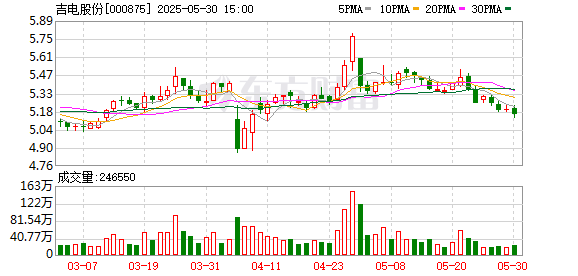
【高端访谈】聚焦“新能源+”、绿色氢基能源“双赛道” 塑造发展新动能——访吉电股份党委书记、董事长杨玉峰
Xin Hua Cai Jing· 2025-05-30 07:54
Core Viewpoint - Jilin Electric Power Co., Ltd. is transitioning from a traditional coal and electricity enterprise to a focus on renewable energy and green hydrogen, aiming for over 20% year-on-year growth in net profit attributable to shareholders in 2024, with clean energy revenue surpassing 50% of its main business for the first time [2][3]. Group 1: Renewable Energy Development - The company has increased its installed capacity from 850,000 kW in 2002 to over 14 million kW, with nearly 80% from renewable sources, establishing bases in five regions [3]. - Since the 14th Five-Year Plan, Jilin Electric has added over 6 million kW of renewable capacity, nearly doubling its previous figures, and increasing the renewable share by 14 percentage points [3]. - The company plans to enhance its leadership in renewable energy in Jilin Province while expanding its development scale in other regions such as Shandong, Jiangsu, and Xinjiang [3]. Group 2: Smart Operations and Efficiency - Jilin Electric has implemented "smart station" upgrades in 40 renewable energy stations over the past three years, reducing operational staff by 30% and achieving "无人值班" (unmanned operation) in 10 stations [4]. Group 3: Green Hydrogen Energy Initiatives - The company is focusing on green hydrogen energy, leveraging national policies to support the development of zero-carbon industries across various sectors [5]. - Jilin Electric is investing nearly 6 billion yuan in the world's largest green hydrogen production project, expected to produce 32,000 tons of green hydrogen and 180,000 tons of green ammonia annually [6]. - The company is also developing additional projects for green methanol and expanding its footprint in regions like the Middle East and North Africa [6]. Group 4: Research and Development - Over the past three years, Jilin Electric has invested 1.632 billion yuan in R&D, with an average annual intensity exceeding 3% [7]. - In 2024, the company plans to implement 62 research projects with a total R&D investment of 520 million yuan, increasing the R&D intensity to 3.29% [7].


全力确保“十四五”规划圆满收官
Zhong Guo Jing Ji Wang· 2025-03-10 23:10
Group 1: Innovation and Industry Development - The government work report emphasizes the need to develop new quality productivity and modern industrial systems tailored to local conditions [1][8] - Jiangsu's Yancheng focuses on integrating technological and industrial innovation, supporting traditional industries to adapt to new demands and technologies [1] - Yichun aims to strengthen its manufacturing sector by fostering emerging industries and enhancing traditional industries through technological upgrades [3][4] Group 2: Green Development and Environmental Protection - Shandong's Rizhao promotes ecological prosperity and aims to improve environmental quality through pollution prevention and ecological construction [2][4] - Anhui's Tongling emphasizes the establishment of a recycling system for renewable resources to support green and low-carbon development [5] - Jilin's focus on developing green hydrogen energy aligns with the goal of creating a new energy system [9] Group 3: Economic Growth and Consumer Demand - Shandong's Liaocheng aims to stimulate domestic demand by enhancing consumption and investment through high-quality supply [4][8] - The city plans to integrate offline sales with digital platforms to boost consumer engagement and market activity [4] Group 4: Urban and Rural Development - Ningxia's Guyuan focuses on urban-rural integration and enhancing county-level economies to promote balanced development [6][8] - The city aims to optimize production layouts and improve public services to support urbanization [6] Group 5: Technology and Research Integration - Dalian's Sun Yuanhua highlights the importance of integrating research and industry to enhance the conversion of technological achievements into productive forces [11][12] - The need for a robust collaboration mechanism between enterprises and research institutions is emphasized to foster innovation [11] Group 6: Regulatory Framework and Market Development - The development of a regulatory framework for the study tourism market is proposed to ensure healthy and orderly growth [10] - The establishment of a joint regulatory mechanism involving multiple departments is suggested to enhance safety and quality in the sector [10]