
罐装食品

Search documents
新闻分析丨美政府或削减钢铝关税?
Xin Hua Wang· 2026-02-14 10:58
Group 1 - The Trump administration is considering reducing tariffs on certain steel and aluminum products to alleviate concerns over rising prices ahead of the upcoming midterm elections [1][2] - The U.S. Department of Commerce and trade representatives believe that tariffs have increased prices on canned foods and beverages, negatively impacting consumers [1] - The U.S. government has previously raised tariffs on steel and aluminum imports to 50% to address "national security threats" and enhance domestic industry competitiveness [2] Group 2 - Approximately 95% of the tariff costs are borne by U.S. consumers due to rising prices of imported and domestically manufactured goods [2] - A study from the New York Federal Reserve indicates that about 90% of the additional costs from tariffs imposed by the U.S. government by 2025 will be shouldered by consumers and businesses [2] - The U.S. government has made multiple adjustments to its tariff policies, postponing increases on various products, including agricultural goods and imported furniture [2]
特朗普所言不实:食品杂货价格仍在上涨
Xin Lang Cai Jing· 2026-01-15 13:08
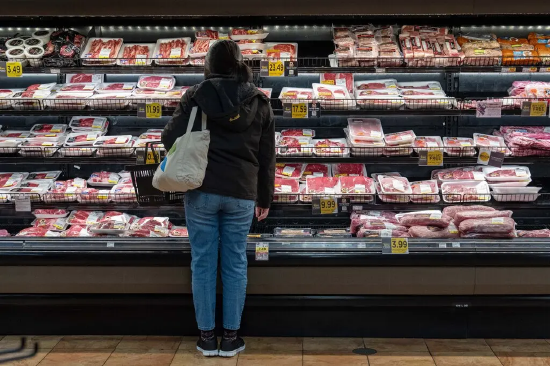
Core Insights - The core inflation rate in the U.S. for December increased by 2.6% year-on-year, which is lower than expected [1] - Food prices have significantly risen, contradicting claims from the Trump administration that grocery prices are decreasing [3][13] Food Price Trends - Over the past year, beef prices rose by 16.4%, coffee by 19.8%, lettuce by 7.3%, and frozen fish by 8.6% [3][13] - The overall cost of household food consumption increased by 2.4% in the past 12 months, with a monthly increase of 0.7% in December, marking the largest monthly rise since October 2022 [4][14] - Despite some food categories like eggs seeing a price drop of 20.9%, five out of six tracked food categories experienced price increases [5][15] Consumer Behavior Changes - Low-income consumers are prioritizing essential items and opting for cheaper alternatives, reducing their purchase quantities and increasing shopping frequency [5][15] - Middle-class consumers are also shifting their purchasing habits, focusing on promotions and store-brand products to save costs [5][15] Impact of Tariffs and Policies - Tariff policies have had a limited direct impact on most food prices, as the majority of food consumed in the U.S. is domestically produced [5][15] - Imported goods like coffee and tropical fruits have seen price increases due to tariffs, with bananas rising by 5.9% year-on-year in December [7][16] Labor Market and Agricultural Costs - Labor shortages in agriculture are exacerbated by tightened immigration policies, affecting the availability of workers for harvesting crops [10][20] - Agricultural labor costs are a significant driver of overall industry expenses, accounting for about 50% of total spending [20] - The U.S. Department of Agriculture projects a 2.3% increase in household food prices by 2026, maintaining a similar growth rate as in 2025 [19] Economic Outlook - The current inflation data suggests that while inflation is not spiraling out of control, the claims of decreasing food prices by the government are unfounded [4][14] - The ongoing labor shortages and rising costs of agricultural inputs may continue to pressure food prices in the near future [20]


Conagra(CAG) - 2026 Q2 - Earnings Call Transcript
2025-12-19 15:32
Financial Data and Key Metrics Changes - The company expects organic net sales growth in the second half of the fiscal year, with positive momentum observed in December [11][12] - Operating profit and margin performance in the first half of the year has been good, with favorable tariff timing and chicken inflation, although there are offsets with beef and pork [21][22] - The company maintains its inflation guidance of 7% for the year, with core inflation above 4% and gross tariff inflation around 3% [42][44] Business Line Data and Key Metrics Changes - The frozen and snacks segments are identified as growth domains, with snacks already showing robust growth and frozen aiming to reclaim market share lost due to previous supply constraints [31][32] - The company is focusing on high-quality promotional activities in the frozen segment, which were limited last year due to supply issues [32][33] Market Data and Key Metrics Changes - The company has seen a return to growth in the frozen and snacks categories, with strong marketing plans in place for the second half of the year [31][33] - The market share in frozen single-serve meals is approaching 53%, indicating a recovery in that segment [32] Company Strategy and Development Direction - The company is implementing Project Catalyst, which focuses on re-engineering core business processes using technology, particularly AI, to improve efficiency and effectiveness [25][26] - The company is committed to margin expansion, particularly in the frozen segment, through productivity improvements and supply chain resiliency investments [52][53] Management's Comments on Operating Environment and Future Outlook - Management acknowledges the volatility in the operating environment and has guided a wider range for EPS to navigate uncertainties [23][83] - The company is optimistic about the second half of the fiscal year, expecting strong underlying trends and promotional activities to drive growth [85] Other Important Information - The company has completed the baked chicken facility, which is expected to enhance production efficiency and margins [100][101] - An impairment charge was taken due to a sustained decline in stock price, which required a reassessment of goodwill and brand values [102][104] Q&A Session Summary Question: Expectations for organic sales growth in fiscal Q3 - Management expects positive organic net sales growth in the second half, with momentum building in December [11][12] Question: Clarification on annual outlook and EPS impact from Ardent - Management believes they can offset the shortfall from Ardent and maintain EPS guidance despite a wider range due to market volatility [22][23] Question: Insights on Project Catalyst and cost savings - Project Catalyst aims to automate core business processes, with expected costs and returns being evaluated as the project progresses [25][26] Question: Consumption trends and growth outlook for fiscal 2027 - Management sees potential for growth in frozen and snacks, with strong marketing plans and market share recovery [31][33] Question: Impact of competitors' price cuts on the company - The company has not rolled back prices to move volume but has maintained pricing to support promotional activities [40][41] Question: Inflation guidance and its implications - The company maintains its inflation guidance of 7% for the year, with expectations for inflation to normalize in the future [42][44] Question: Repatriation of production and margin improvement - The transition to in-house production is underway, with expectations incorporated into the fiscal guidance [100][101] Question: Details on impairment charge - The impairment charge was due to a decline in stock price, necessitating a reassessment of goodwill and brand values [102][104]
