
浴室柜

Search documents
悍高集团(001221) - 001221悍高集团投资者关系管理信息20260327
2026-03-27 08:54
Group 1: Company Performance - The company has achieved rapid growth in revenue and net profit, driven by product structure optimization and channel expansion [3] - The core hardware segment continues to lead in revenue growth, supported by strong performance in storage hardware and kitchen & bathroom hardware [3][4] - The company aims for steady growth and high-quality development, with specific performance targets to be disclosed in regular reports [3] Group 2: Product Development and Strategy - The company focuses on a dual strategy of "hit products and continuous iteration" for new product development [4] - High-value new products such as three-stage force hinges and high-end hidden tracks are being developed to enhance market competitiveness [4][5] - The bathroom product line is positioned as a second growth curve, with a comprehensive product matrix established [6] Group 3: Capacity and Production - Current production capacity utilization is high, with core categories nearing saturation [7] - A new production base, "Unicorn" hardware manufacturing base, is being developed with an investment of approximately 1 billion yuan to support future growth [7][12] Group 4: Market Expansion and Channel Strategy - The company is expanding its C-end channel network with differentiated store models, including community renovation stores and high-end experience stores [8] - The overseas business strategy is evolving from "product export" to "brand export," focusing on mid-to-high-end markets and enhancing global brand influence [9][10] Group 5: Financing and Governance - The company is progressing with a convertible bond issuance to address capacity bottlenecks and support growth [11][12] - There is a clear focus on core business and potential mergers or investments that can create synergies [12] - A shareholder dividend plan has been established for the next three years (2025-2027) to enhance investor returns [13]
新闻分析丨美政府或削减钢铝关税?
Xin Hua Wang· 2026-02-14 10:58
Group 1 - The Trump administration is considering reducing tariffs on certain steel and aluminum products to alleviate concerns over rising prices ahead of the upcoming midterm elections [1][2] - The U.S. Department of Commerce and trade representatives believe that tariffs have increased prices on canned foods and beverages, negatively impacting consumers [1] - The U.S. government has previously raised tariffs on steel and aluminum imports to 50% to address "national security threats" and enhance domestic industry competitiveness [2] Group 2 - Approximately 95% of the tariff costs are borne by U.S. consumers due to rising prices of imported and domestically manufactured goods [2] - A study from the New York Federal Reserve indicates that about 90% of the additional costs from tariffs imposed by the U.S. government by 2025 will be shouldered by consumers and businesses [2] - The U.S. government has made multiple adjustments to its tariff policies, postponing increases on various products, including agricultural goods and imported furniture [2]
约86亿元,Takara Standard 9个月销售额创历史新高
Xin Lang Cai Jing· 2026-02-04 12:20
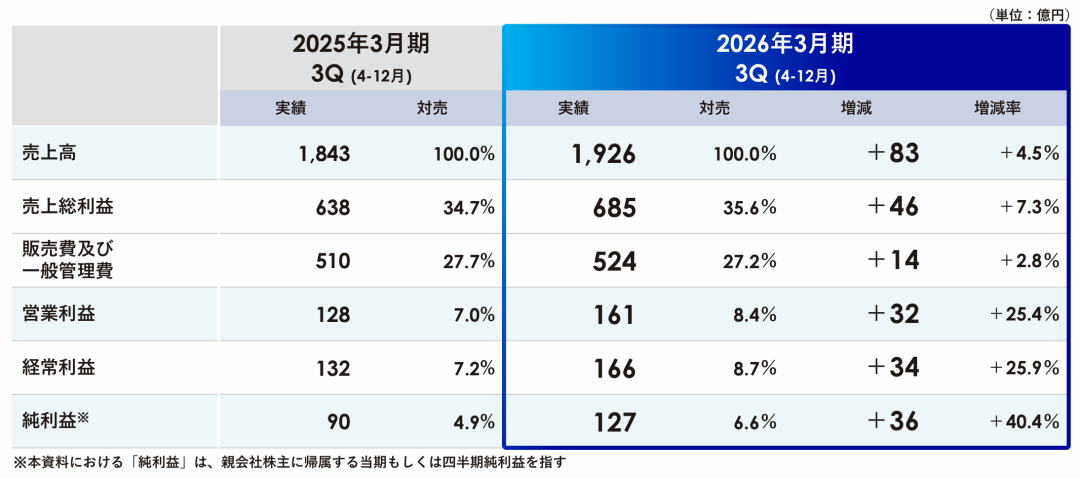
Core Viewpoint - Takara Standard reported record sales and net profit for the first three quarters of the 2025 fiscal year, but anticipates a decline in the upcoming quarter due to local building regulations [1][2][8]. Financial Performance - For the period from April to December 2025, Takara Standard achieved sales of 192.6 billion yen (approximately 8.598 billion RMB), a year-on-year increase of 4.5%, marking a historical high for nine quarters [2][8]. - Net profit reached 12.7 billion yen (approximately 567 million RMB), reflecting a significant year-on-year growth of 40.4% [2][8]. - Operating profit was 16.1 billion yen, up 25.4% year-on-year, while recurring profit was 16.6 billion yen, increasing by 25.9% [2][3]. Business Segments - The company operates primarily in three business segments: - Kitchen business generated sales of 117.3 billion yen, accounting for 60.9% of total sales, with a growth of 4.9% [4][10]. - Bathroom business sales reached 45.7 billion yen, representing 23.8% of total sales, with a growth of 4.2% [4][10]. - Vanity cabinet sales were 23 billion yen, making up 12.0% of total sales, with an increase of 8.1% [4][10]. Market Expansion - Takara Standard disclosed that it has 75 overseas stores, with 32 located in mainland China, which saw an addition of 2 stores in the past nine months [6][12]. - The company also reported a new business segment in glass frit, generating sales of 1.9 billion yen, a growth of 6.3% [6][11]. Future Outlook - The company revised its full fiscal year forecast, projecting total sales of 251 billion yen (approximately 11.205 billion RMB), a year-on-year increase of 3.1% [7][13]. - Despite the overall growth forecast, the company expects a decline in the fourth quarter (January to March 2026), with sales anticipated to drop by 1.3% and net profit expected to decrease by 56.2% [7][13].

浪鲸卫浴董事长霍成基走访终端门店 推动门店高质量发展
Sou Hu Cai Jing· 2026-01-23 03:15
Core Insights - The company is focusing on enhancing consumer experience and optimizing product display in its new flagship store to drive high-quality brand development [1][3][4] Group 1: Market Strategy - The chairman emphasized the importance of understanding consumer needs and pain points during discussions with dealers and store managers [3][4] - The company aims to provide high-quality, personalized bathroom solutions while enhancing pre-sale, in-sale, and after-sale service systems to build consumer trust [4][12] Group 2: New Store Concept - The newly opened flagship store in Guangdong Puning features a 350 square meter space that redefines bathroom experience through modern aesthetics and smart technology [7] - The store layout includes experiential design and scenario-based displays, showcasing a variety of products such as smart toilets and bathroom cabinets, catering to every detail of bathroom renovation [7][9] Group 3: Consumer Experience - The store offers a unique shopping experience that combines shopping, relaxation, and immersive consumption, allowing consumers to visualize their ideal bathroom setup [9][12] - The design encourages consumers to engage with products and enjoy a comfortable shopping environment, reflecting the company's commitment to quality and customer satisfaction [9][12] Group 4: Strategic Collaboration - The visit reinforced strategic collaboration with dealers, providing critical decision-making insights for market positioning by 2026 [12] - The company is actively exploring new marketing models and service experiences to adapt to industry changes and achieve breakthroughs [12]

美推迟上调部分进口家具产品关税
Shang Wu Bu Wang Zhan· 2026-01-09 06:47
Core Viewpoint - The U.S. government has postponed the increase of tariffs on certain imported furniture items from January 1, 2026, to January 1, 2027, to facilitate ongoing trade negotiations and ensure economic security and supply chain stability [1] Group 1: Tariff Changes - The announcement affects tariffs on upholstered chairs, cabinets, and bathroom cabinets [1] - The postponement is not a delay in imposing tariffs but rather a delay in increasing existing tariffs [1] Group 2: Impact on Exports - Wooden products exported to the U.S. will still be subject to existing tariffs of 10% and 25% under Section 232 [1]
轻工出口跟踪:美国推迟上调家具关税,持续推荐降息链
Changjiang Securities· 2026-01-07 09:16
Investment Rating - The industry investment rating is "Positive" and maintained [7] Core Viewpoints - The implementation date for the planned increase in tariffs on soft furniture from 25% to 30% and on cabinets and bathroom cabinets from 25% to 50% has been postponed by one year, reducing tariff pressure on furniture manufacturing export companies and alleviating subsequent inflation pressure in the U.S. furniture market [2][4] - The U.S. furniture industry is labor-intensive and heavily reliant on imports, with nearly 70% of imports coming from China, Vietnam, and Mexico. The previous tariff increases did not lead to a significant return of production capacity to the U.S. but rather shifted production to Southeast Asia [11] - The current tariff rates for U.S. furniture categories show that most countries face a 25% tariff, while China faces a 60% tariff on soft furniture and a 45% tariff on other furniture categories [11] - U.S. related companies' stock prices have rebounded significantly, with notable increases in stock prices for RH (up 8%), Wayfair (up 6%), and Williams-Sonoma (up 5%) [11] - The report continues to favor a rate cut chain, focusing on companies with established overseas production capabilities and absolute advantages in products or costs. The Federal Reserve's recent rate cuts are expected to further stimulate demand in the U.S. real estate and furniture markets [11] Summary by Sections Tariff Changes - The planned tariff increases on soft furniture and cabinets have been postponed to January 1, 2027, which is expected to ease the cost pressures on U.S. furniture manufacturers [2][4] Market Performance - The stock prices of U.S. furniture companies have shown significant rebounds following the tariff postponement, indicating positive market sentiment [11] Demand Recovery - The report anticipates a recovery in U.S. real estate and furniture demand due to the ongoing rate cuts, with potential for significant improvement in housing sales [11]
东吴证券:港股进入震荡上行期 把握上半年的科技成长行情
智通财经网· 2026-01-06 00:03
Core Viewpoint - Hong Kong stocks are showing strong performance at the beginning of the year, making them attractive for medium to long-term investment allocation. The expectation is that southbound funds will continue to increase their allocation to Hong Kong stocks, primarily driven by insurance and fixed income investments. The performance of Hong Kong technology stocks will be influenced by the pace of interest rate cuts overseas and the performance of US technology stocks, necessitating dynamic observation [1][2][3]. Group 1: Market Performance - In the week of December 29, 2025, to January 2, 2026, emerging markets rose by 2.3%, while developed markets fell by 0.6%. The Hang Seng Technology Index increased by 4.3%, the Hang Seng Index rose by 2.0%, and the Hang Seng Stock Connect gained 1.5%. The energy sector led the gains, with southbound funds primarily flowing into the financial sector and out of telecommunications [2]. - The report indicates that the current position of Hong Kong stocks is attractive for medium to long-term allocation, largely due to factors such as new year positioning and short covering [2][3]. Group 2: Investment Strategy - Short-term positioning in Hong Kong stocks should be controlled, with expectations for better performance around the Chinese New Year. Concerns exist regarding potential pullbacks in US technology stocks in January, which could indirectly affect Hong Kong stocks. Investors are cautious about upcoming earnings reports from US technology companies, focusing on capital expenditures and return on investment [2][3]. - The report emphasizes the importance of maintaining dividends as a base while capitalizing on the technology growth trend in the first half of the year. Southbound funds are expected to continue increasing their allocation to value dividends [3]. Group 3: Economic Indicators - The US manufacturing and services PMIs showed a slowdown, with the December Markit Composite PMI falling to 53, the lowest in six months, and both manufacturing and services PMIs below market expectations. This indicates a weakening economic growth momentum [3][4]. - The US job market remains resilient, with initial jobless claims dropping to 199,000, the lowest level in a year, and continuing claims also decreasing. The housing market is recovering, with a 3.3% month-on-month increase in the pending home sales index for November [4]. Group 4: Global Investment Trends - Global stock ETFs saw a net inflow of $30.976 billion, with a marginal inflow of $4.844 billion, while bond ETFs experienced a net inflow of $5.337 billion. The US stock ETFs had the highest net inflow at $19.64 billion, while Chinese stock ETFs led among emerging markets with a net inflow of $1.46 billion [7]. - The report highlights that institutional investors are reducing their gold holdings, while retail investors are slightly increasing theirs, indicating a shift in investment preferences [6][7].

美国一涨关税政策推迟1年
Xin Lang Cai Jing· 2026-01-02 04:04
Core Viewpoint - The U.S. government has postponed the planned increase in tariffs on soft furniture, kitchen cabinets, and bathroom cabinets, which was originally set to take effect on January 1, 2026, now delayed to January 1, 2027 [1] Industry Impact - The current tariff rate on these products is 25%, with the proposed increase to 50% for kitchen cabinets and bathroom cabinets, and to 30% for soft furniture [1] - Industry associations and media have indicated that the tariff increases would place additional pressure on U.S. consumers, homebuyers, and builders, who are already in sectors targeted for economic growth by the government [1] Economic Context - CNN reported that the imposition of tariffs on various goods has led to price instability, attracting increasing criticism [1] - Bloomberg noted that dissatisfaction among U.S. voters regarding price levels is expected to continue to grow [1]
关税突发!跨境汇款税生效
券商中国· 2026-01-02 01:41
Group 1 - The new tax measure on cross-border remittances in the U.S. will take effect on January 1, 2026, requiring a 1% tax on qualifying remittance transactions [1][2] - The tax applies to remittances funded by cash or similar payment instruments, while transactions funded through U.S. bank accounts or debit/credit cards are generally exempt [2] - This tax measure is part of the "Big and Beautiful" tax and spending bill promoted by the Trump administration, affecting both U.S. citizens and residents sending money abroad [2][3] Group 2 - The tax is expected to primarily impact individuals who rely on cash for remittances, particularly immigrant communities and families dependent on cross-border transfers [3] - The U.S. government has postponed planned increases in tariffs on imported soft furniture, kitchen cabinets, and bathroom cabinets, which were initially set to rise significantly on January 1, 2026 [3] - The current tariff rate on these products is 25%, with a proposed increase to 50% for cabinets and 30% for soft furniture, now delayed until January 1, 2027 [3] Group 3 - The U.S. Department of Commerce has reduced proposed tariff rates for 13 Italian pasta exporters, with rates adjusted to 13.89% for Garofalo and 2.26% for La Molisana, while the remaining companies will face a uniform rate of 9.09% [4][5] - This reduction in pasta tariffs coincides with the postponement of tariff increases on imported furniture [5]

美国疫情大暴发!刚刚,美国下调关税!美军发动突袭,特朗普:在委内瑞拉行动中摧毁一大型设施
Zhong Guo Ji Jin Bao· 2026-01-02 00:30
Group 1: Influenza Situation in the U.S. - The CDC reported a significant rise in flu activity across the U.S., with approximately 7.5 million cases, 81,000 hospitalizations, and 3,100 deaths since the start of the flu season [1] - The dominant strain this season is the H3N2 virus, with 89.5% of analyzed samples belonging to the K lineage [1] - The CDC has distributed about 130 million doses of the flu vaccine and recommends annual vaccination for individuals aged 6 months and older to reduce infection and severe illness risks [1] Group 2: Tariff Adjustments - The U.S. Department of Commerce announced a reduction in proposed tariff rates for 13 Italian pasta exporters, with rates dropping to 13.89% for Garofalo, 2.26% for La Molisana, and a uniform rate of 9.09% for the other 11 companies [2] - This tariff adjustment coincides with the postponement of additional tariffs on certain imported furniture [3] Group 3: Military Actions and Sanctions - The U.S. military conducted strikes against two vessels allegedly involved in drug trafficking, resulting in five fatalities, as part of the "Southern Strike" operation [5] - President Trump stated that a large facility was destroyed during military actions in Venezuela, although details were not disclosed [5] - The U.S. Treasury announced sanctions against four companies operating in the Venezuelan oil sector and froze four related oil tankers [7]