
老挝咖啡

Search documents
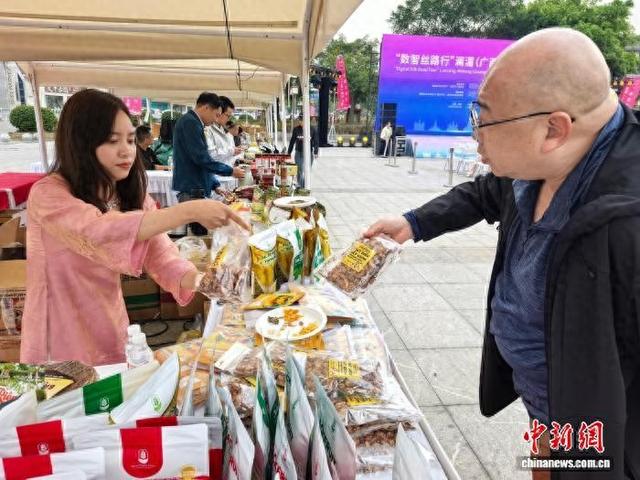
澜湄国家携特色农产品赴广西崇左“赶大集”
Zhong Guo Xin Wen Wang· 2026-01-16 13:19
Core Insights - The "Digital Silk Road: Lancang-Mekong (Guangxi) Agricultural Fair" was launched on January 16, showcasing agricultural products from Lancang-Mekong countries and Malaysia, Brunei, emphasizing smart agricultural cooperation [1][2] - The event highlights the growing demand for high-quality agricultural products and the potential for regional agricultural cooperation [2] Group 1: Event Overview - The fair featured a variety of agricultural products including Cambodian rice, Vietnamese nuts, Laotian coffee, Burmese tea, and Thai dried fruits, alongside products from Chinese provinces such as Guangxi, Guangdong, and Yunnan [1] - The event serves as a platform for agricultural trade and collaboration among countries in the Lancang-Mekong region [1][2] Group 2: Government and Diplomatic Perspectives - The Deputy Director of the Foreign Economic Cooperation Center of the Ministry of Agriculture and Rural Affairs of China emphasized the importance of the Lancang-Mekong region as a key agricultural trade partner and investment area for China [2] - Vietnamese and Thai consuls expressed hopes for expanding cooperation in smart agriculture and promoting their countries' unique agricultural products to Chinese consumers [2] Group 3: Economic Impact - By November 2025, agricultural exports from Lancang-Mekong countries to Guangxi are projected to reach 16.2 billion RMB, indicating significant growth [2] - Guangxi has become the largest distribution center for fruits from Lancang-Mekong countries in China [2]


咖啡香 飘老挝
Xin Lang Cai Jing· 2026-01-12 21:04
Core Viewpoint - Laos coffee has gained a significant position in the global coffee landscape due to its unique flavor and cultural significance, serving as an important symbol for rural development and national image [1] Group 1 - The aroma of coffee is prevalent in both urban cafes and vast plantations in the Bolaven Plateau of Laos [1] - Laos coffee is recognized for its distinct taste and cultural richness, contributing to its global reputation [1] - The coffee industry in Laos plays a crucial role in driving rural development [1]
老挝咖啡香飘海外
Jing Ji Ri Bao· 2026-01-10 22:00
Core Insights - The coffee industry in Laos has made significant progress over the past 30 years, gaining recognition in ASEAN countries and global markets for its quality [2] - Coffee has become a platform for promoting Laotian culture and traditions, with local coffee shops integrating traditional elements into their branding and customer experience [2] - The coffee sector is a key driver for rural revitalization in Laos, with former opium-growing areas now cultivating coffee, improving farmers' livelihoods [2] Industry Development - The Laotian government is actively promoting the coffee industry by expanding cultivation areas and advancing agricultural modernization while maintaining quality and safety standards [2] - A series of training programs covering production, processing, packaging, and marketing are being implemented to enhance farmers' skills and improve coffee quality [2] Economic Impact - The coffee industry is one of Laos's main export agricultural products, projected to export over 50,000 tons and generate more than $100 million in revenue in 2024 [3] - The coffee sector creates significant economic benefits and numerous job opportunities for local communities [3]
购在广西 链动东盟(环球热点)
Ren Min Ri Bao Hai Wai Ban· 2025-12-26 23:16
Core Viewpoint - The "Buy in China (Guangxi Station) and Guangxi Silk Road E-commerce Carnival" event showcases a variety of ASEAN products, highlighting Guangxi's role as a hub for cross-border e-commerce and its growing trade relationship with ASEAN countries [4][5]. Group 1: Event Overview - The event features a wide range of ASEAN specialty products, allowing visitors to experience a "shopping feast" at their doorstep [4]. - Guangxi's cross-border e-commerce import and export value exceeded 45 billion yuan, with over 30 billion yuan attributed to ASEAN trade, marking an 11.7% year-on-year growth [4]. Group 2: Digital and Policy Support - The efficiency of cross-border trade is enhanced by digital tools and supportive policies, with the fastest delivery of Vietnamese durians to Chinese households taking only 48 hours [5]. - Guangxi aims to become a key hub for digital trade innovation, supported by policies that facilitate cross-border e-commerce and live-streaming commerce [5][7]. Group 3: Logistics and Trade Facilitation - The China-ASEAN (Chongzuo) Fruit Trading Center has processed over 1.05 million cross-border orders, with a transaction value exceeding 21.5 billion yuan [6]. - Upgrades to the smart customs clearance system at the Friendship Pass have reduced the inspection time for fruit shipments by 75% [6]. Group 4: Talent Development - Guangxi has established programs to train e-commerce talent, with 21 universities offering ASEAN language courses and over 1,500 cross-border e-commerce professionals trained [8][9]. - The establishment of the "Guangxi-Hai Academy" aims to cultivate e-commerce talent in collaboration with educational institutions in ASEAN countries [9]. Group 5: Collaborative Efforts - The event marks the 15th anniversary of the China-ASEAN Free Trade Area, with Guangxi collaborating with various provinces to enhance e-commerce cooperation [10]. - Initiatives include resource sharing, industry collaboration, and joint talent cultivation to deepen "West + ASEAN" e-commerce partnerships [10].

第二十六届中国中部农博会签约销售超140亿元
Zhong Guo Xin Wen Wang· 2025-11-17 11:17
Core Insights - The 26th China Central Agricultural Expo concluded with a total signed sales amount of 134.16 billion RMB, alongside on-site sales exceeding 600 million RMB, attracting 189,000 visitors [1][1][1] Group 1: Event Overview - The expo lasted for four days and featured over 30,000 agricultural products from more than 100 foreign enterprises across 15 countries, as well as exhibitors from 17 provinces and regions in China [1][1] - Notable products included high-quality items such as Lao coffee, South African wine, Thai fragrant rice, and Vietnamese cashews, which sparked consumer enthusiasm [1][1] Group 2: International Participation - The Vietnamese pavilion reported on-site sales of 260,000 RMB and secured intention orders for cashews worth 54 million RMB [1][1] - The Lao pavilion's turmeric powder and coffee received positive attention from buyers and the public, with representatives expressing hopes to introduce more Lao products to the Chinese market [1][1] Group 3: Regional Agricultural Strength - Hunan, as the host of the expo, ranks first in China for rice area and production, with significant outputs in pigs, oil tea, vegetables, and aquatic products, providing stable and high-quality raw materials for agricultural development [1][1] - Hunan's agricultural product processing industry is robust, maintaining the highest export value in the central and western regions of China [1][1]
第八届进博会前瞻:分享中国机遇为全球南方“点亮坐标”
Zhong Guo Xin Wen Wang· 2025-11-03 17:20
Core Insights - The 8th China International Import Expo (CIIE) is set to enhance its role as an international public product by establishing a dedicated section for products from least developed countries (LDCs) and expanding the existing African products section [1][2] - The expo features participation from 123 enterprises from Belt and Road Initiative countries, a 23.1% increase year-on-year, and 163 enterprises from LDCs, a 23.5% increase year-on-year, with African enterprises seeing an 80% increase in participation [1] - The event aims to promote global economic resilience and sustainable agricultural development through dedicated forums [1][2] Group 1 - The establishment of a dedicated section for LDC products at the CIIE reflects China's commitment to supporting these countries in accessing the Chinese market [1][2] - The expo has facilitated the entry of products like Lao coffee and Ethiopian leather into Chinese supermarkets for the first time, showcasing the expanding market opportunities for developing countries [2] - The CIIE has implemented measures such as free standard booths and logistics subsidies to lower barriers for LDC participation, enhancing their ability to engage with the Chinese market [2] Group 2 - The CIIE serves as a bridge for global cooperation, contrasting with the isolationist tendencies of some countries, emphasizing the importance of shared progress [3] - The event aligns with China's global development initiative, which aims to ensure that no country or individual is left behind, reinforcing the value of high-level openness in promoting global development [2][3]
老挝啤酒成中老铁路进口明星单品 上半年进口量增58%
Zhong Guo Xin Wen Wang· 2025-07-31 14:46
Core Insights - Laos beer has emerged as a star product in the import sector via the China-Laos Railway, with an import volume of 1.672 million liters in the first half of 2025, marking a 58% year-on-year increase [2] Group 1: Import Performance - The import volume of Laos beer through the China-Laos Railway reached 1.672 million liters in the first half of 2025, representing a 58% increase compared to the previous year [2] - The China-Laos Railway has facilitated the import of various Southeast Asian specialty agricultural products, including Thai frozen shrimp, Laos coffee, and tropical fruits, enhancing the diversity of consumer choices in the Chinese market [2] Group 2: Logistics and Transportation - The logistics company reported that all imported beer is transported via the China-Laos Railway, with a transit time of only 72 hours from the Laos Vientiane factory to Kunming supermarkets [2] - Railway transportation offers strong capacity, minimal weather-related disruptions, and nearly zero product loss, which helps reduce operational costs and improve market competitiveness for companies [2] Group 3: Overall Trade Statistics - In the first half of this year, the total import and export cargo volume via the China-Laos Railway exceeded 3 million tons, with a total value surpassing 12.8 billion yuan, both setting historical records for the same period [2] - The value of imported agricultural products reached 4.27 billion yuan, reflecting a 35% year-on-year growth [2]