
股基

Search documents
在牛市里,如何吃到熊市级别的跌幅?
表舅是养基大户· 2026-01-20 07:23
Core Viewpoint - The article discusses the recent market trends in A-shares, highlighting significant sell-offs in growth sectors and the implications of financing regulations on market behavior [5][6][8]. Group 1: Market Trends - A-shares experienced a notable index-level pullback, primarily affecting growth sectors [5]. - Financing positions recorded their first net sell-off in 26 years, indicating a shift in market sentiment [6]. - The recent financing regulations, which increased margin requirements from 80% to 100%, may have contributed to this sell-off [6]. Group 2: ETF Activity - Broad-based ETFs saw substantial net sell-offs, with over 58 billion sold in a single day, and a total of over 240 billion in three days [8]. - The trading volume of major ETFs has decreased compared to previous days, suggesting a cooling off in market enthusiasm [8][10]. Group 3: Sector Performance - The satellite and commercial aerospace sectors have experienced significant declines, with the satellite industry index dropping over 20% from its peak [11]. - The article attributes this decline to speculative trading and the influence of e-commerce and content platforms promoting high-risk investments [14]. Group 4: Investment Platforms - WeBank, a leading internet bank, offers advantages for personal investors, including T+0.5 redemption for funds, enhancing capital efficiency [19][20]. - New users of WeBank can benefit from discounted fund purchases by completing a financial literacy course [21]. - WeBank's stringent volatility control for financial products is seen as beneficial for clients [22].


2026年保险投资官调查:九成投资官认为股市机会大于风险,超半数倾向提高权益配置
证券时报· 2026-01-14 03:29
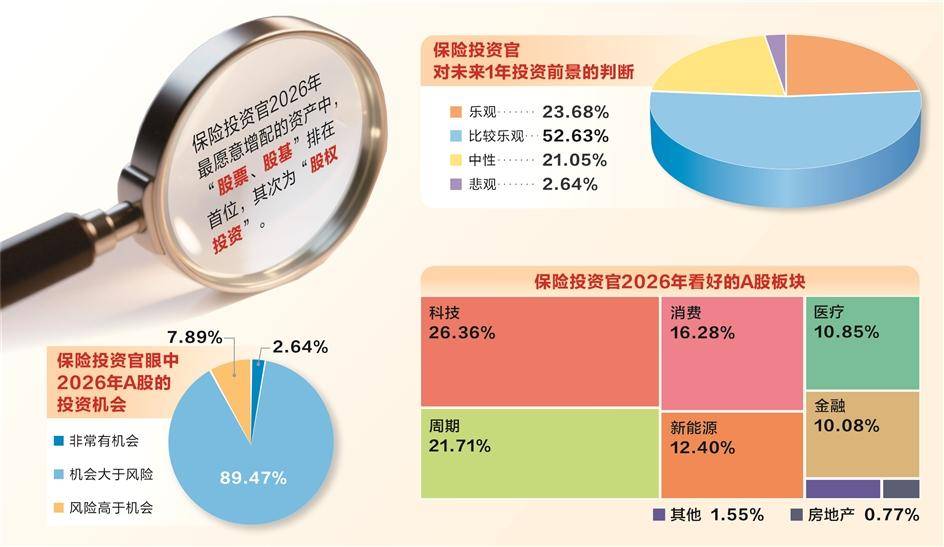
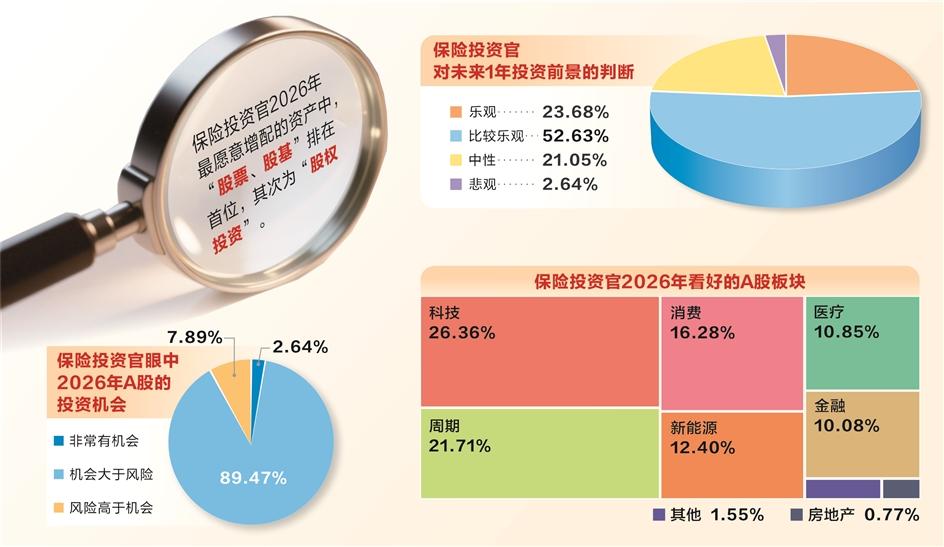
Core Viewpoint - The insurance investment officers are generally optimistic about the investment outlook for 2026, with over 70% expressing a "optimistic" or "relatively optimistic" sentiment, indicating a significant improvement in investment sentiment compared to early 2025 [3][4][5]. Group 1: Investment Outlook - Over 70% of insurance investment officers believe the investment outlook for 2026 is "optimistic" or "relatively optimistic," with 52.63% indicating "relatively optimistic" and 23.68% "optimistic" [3][4]. - The majority of investment officers expect to increase their allocation to equity assets, with 70% indicating a tendency to "increase" their equity investments [2][16]. - The anticipated return targets for insurance funds over the next 1-3 years are expected to remain stable, with 60% of investment officers favoring a "maintain steady" approach [8]. Group 2: Investment Environment - There is a divergence in views regarding the investment environment for 2026 compared to 2025, with 36.84% believing it will be worse, while 23.68% think it will be better [6][7]. - The primary concerns for investment officers include geopolitical factors, international market conditions, and domestic economic situations, with 41.03% citing geopolitical issues as the biggest uncertainty [9][10]. Group 3: Asset Allocation Preferences - The most favored asset class for increased investment remains "stocks and stock funds," with 29.63% of investment officers indicating this preference, followed by equity investments at 18.52% [15]. - Over 70% of investment officers plan to continue increasing their allocation to equity assets, with 68.42% expecting a "slight increase" [16]. Group 4: Sector Preferences - Investment officers are particularly optimistic about sectors such as technology, cyclical, and consumer, with 26.36% favoring technology, 21.71% cyclical, and 16.28% consumer sectors [17]. - More than half of the insurance investment officers still see significant investment value in dividend assets, driven by low interest rates and the scarcity of income-generating assets [18]. Group 5: Market Sentiment - Despite concerns about stock market volatility, 89.47% of investment officers believe that opportunities in the A-share market outweigh risks [13]. - The sentiment towards Hong Kong stocks has improved, with 63.16% of investment officers viewing them as having significant opportunities, particularly due to favorable valuations compared to A-shares [19].

2026年保险投资官调查:九成投资官认为股市机会大于风险,超半数倾向提高权益配置
券商中国· 2026-01-13 23:38
Core Viewpoint - The insurance investment officers are optimistic about the investment outlook for 2026, with over 70% expressing a "optimistic" or "relatively optimistic" sentiment, indicating a significant improvement compared to early 2025 [1][3][4]. Group 1: Investment Outlook - Over 70% of insurance investment officers believe the investment outlook for 2026 is "optimistic" or "relatively optimistic," with 52.63% indicating "relatively optimistic" and 23.68% "optimistic" [3][4]. - The majority of investment officers (89.47%) believe that the opportunities in the A-share market outweigh the risks, with 34 out of 38 expressing this view [13]. - The anticipated increase in equity asset allocation is supported by 70% of investment officers, with 68.42% expecting a "slight increase" and 2.63% a "significant increase" [15][16]. Group 2: Asset Allocation Preferences - The most preferred asset for increased allocation in 2026 is "stocks and stock funds," receiving 29.63% of votes, followed by "equity investments" at 18.52% [14]. - Nearly 70% of investment officers still see significant investment value in dividend assets, with over half believing they remain attractive due to low interest rates [17]. - The preference for equity assets is driven by expectations of a slow bull market and structural opportunities, with a focus on technology, cyclical, and consumer sectors [15][17]. Group 3: Investment Environment and Challenges - There is a notable divergence in opinions regarding the investment environment for 2026 compared to 2025, with 36.84% believing it will worsen, while 23.68% expect improvement [5][6]. - The primary concern for investment officers regarding uncertainties in 2026 is "geopolitical risks," with 41.03% highlighting this factor as the most significant [10]. - The most significant investment risk identified for 2026 is "stock market volatility," with 55.26% of investment officers expressing concern [11]. Group 4: Market Segments and Opportunities - A significant number of investment officers (63.16%) view Hong Kong stocks as having considerable investment opportunities, particularly due to their valuation advantages compared to A-shares [18]. - The technology sector is seen as a key area for investment, driven by emerging industries such as AI and robotics, with 26.36% of investment officers highlighting it as a promising sector [17]. - The outlook for dividend assets remains positive, with over half of the investment officers believing in their continued investment value, despite some concerns about increased investment difficulty [17].

投资前景预期偏乐观 权益资产继续受青睐
Sou Hu Cai Jing· 2026-01-13 23:10
Core Viewpoint - The insurance investment officers are generally optimistic about the investment outlook for 2026, with over 70% expressing a positive sentiment, indicating a significant improvement compared to early 2025 [5][8]. Investment Sentiment - 38 insurance investment officers participated in the survey, managing over 26 trillion yuan in assets, which accounts for more than 70% of the total insurance funds [5]. - 34 out of 38 officers believe that the opportunities in the A-share market outweigh the risks, with 89.47% holding this view [11]. - The majority of investment officers expect to increase their allocation to equity assets, with 68.42% anticipating a slight increase and 2.63% expecting a significant increase [22]. Sector Preferences - The sectors that insurance investment officers are most optimistic about for 2026 include technology (26.36%), cyclical (21.71%), and consumer sectors (16.28%) [25]. - The investment officers also see potential in renewable energy (12.40%) and healthcare (10.85%) sectors [25]. Investment Environment - There is a divergence in opinions regarding the investment environment for 2026 compared to 2025, with 36.84% of officers believing it will weaken, while 23.68% expect it to improve [10]. - Concerns about geopolitical risks are prevalent, with nearly 40% of officers identifying it as the biggest uncertainty for 2026 [15]. Risk Factors - The primary concern for investment officers is stock market volatility, with over 50% indicating it as their top risk [17]. - Credit risk remains a significant concern, with 23.68% of officers highlighting it as a worry, particularly in the context of local debt and small financial institutions [17]. Future Earnings Targets - About 60% of investment officers plan to maintain stable investment return targets over the next 1-3 years, while 31.58% are considering adjustments [12][14]. Investment Opportunities in Hong Kong - A growing number of investment officers view Hong Kong stocks favorably, with 63.16% believing there are significant opportunities, particularly due to favorable valuations compared to A-shares [26].
2026年中国保险投资官调查显示:投资前景预期偏乐观 权益资产继续受青睐
Zheng Quan Shi Bao· 2026-01-13 19:17
Core Viewpoint - The insurance investment officers are optimistic about the investment outlook for 2026, with over 70% expressing a "optimistic" or "relatively optimistic" sentiment, indicating a significant improvement compared to early 2025 [5][7]. Investment Preferences - The most favored asset class for increased allocation in 2026 is "stocks and equity funds," followed by "equity investments" [6][19]. - A significant majority of insurance investment officers (over 70%) plan to increase their allocation to equity assets, with 68.42% expecting a "slight increase" and 2.63% anticipating a "significant increase" [22][23]. Sector Outlook - The sectors viewed as having the most potential in A-shares for 2026 include technology (26.36%), cyclical (21.71%), and consumer sectors (16.28%) [26]. - Nearly 70% of insurance investment officers still see value in dividend-paying assets, driven by a low-interest-rate environment [26]. Market Sentiment - 89.47% of investment officers believe that the opportunities in the A-share market outweigh the risks, citing factors such as corporate profit improvement and structural opportunities [10]. - The overall sentiment towards the investment environment for 2026 is mixed, with 36.84% of officers believing it will weaken compared to 2025, while 23.68% expect it to improve [9]. Geopolitical Concerns - Geopolitical issues are identified as the primary uncertainty for 2026, with around 40% of investment officers highlighting this as a major concern [15]. - Concerns about the international market environment and domestic economic conditions also rank high among investment officers [15][16]. Risk Factors - The primary risk identified by investment officers is stock market volatility, with over 50% expressing concern about this issue [17]. - Credit risk remains a significant concern, particularly in light of potential defaults and liquidity issues [17]. Investment Strategy - Investment officers are increasingly diversifying their asset allocation, with a notable interest in alternative investments such as real estate investment trusts (REITs) [21]. - The focus on maintaining a balanced approach to equity investments is emphasized, with a need to optimize the investment structure while keeping the overall proportion stable [23][24].
12.4债市午盘,利率债大幅下跌,投资者心凉意冷
Sou Hu Cai Jing· 2025-12-05 22:20
Group 1 - The bond market is experiencing a significant downturn, with the yield on 10-year government bonds rising over 3 basis points in the morning, indicating a bearish sentiment among investors [1][3] - Various types of bonds, including government bonds, credit bonds, and interbank certificates, are all trending downward, while the stock market remains relatively stable with a slight increase of 0.04% in the Shanghai Composite Index [3] - The liquidity in the market is tightening, as evidenced by the weighted average rate of DR007 being around 1.42% at the beginning of the month, and a net withdrawal from the open market for five consecutive trading days, shifting sentiment from loose to neutral [3] Group 2 - There is a noticeable increase in transaction volume, signaling a significant sell-off of government bonds, with banks and insurance companies taking the opportunity to increase their positions while funds and brokerages are primarily selling [4] - The trading sentiment is declining, with both government and credit bond transaction ratios falling below 50%, indicating a lack of enthusiasm in the market [5] - The performance of pure bond funds is generally poor, particularly with 30-year government bonds experiencing significant volatility, while mixed bond funds show a mixed performance, suggesting a shift in market dynamics [7][9]

创五年最佳 九成FOF业绩飘红
Zheng Quan Shi Bao Wang· 2025-08-17 05:06
Core Insights - Publicly offered funds of funds (FOFs) have achieved their best performance in five years, primarily due to heavy investments in equity funds, particularly in the pharmaceutical and technology sectors [1] - The shift from bond funds to equity funds has become a new growth highlight for public FOFs, with over 90% of FOFs showing positive returns this year [1] - The top 10 FOFs in the market have significantly increased their allocations to high-volatility equity funds while reducing their investments in bond funds and conservative balanced funds [1] Performance Metrics - The best-performing FOF product has recorded a return of 34.28% year-to-date, a stark contrast to the best return of only 0.29% in the 2022 fiscal year [1] - The overall market performance indicates a strong recovery and positive sentiment towards equity investments among FOFs [1]
创历史新高!债基继续“扛旗”
券商中国· 2025-07-26 14:45
Core Viewpoint - The total net asset value of public funds in China reached a historical high of 34.39 trillion yuan as of June 30, 2025, with significant contributions from bond funds and a mixed performance in equity funds [1][3][4]. Fund Size Growth - As of June 30, 2025, there are 164 public fund management institutions in China, managing a total net asset value of 34.39 trillion yuan, marking a growth of 651.9 billion yuan from the end of May [3][4]. - The public bond fund size increased by 507.8 billion yuan in June, reaching 7.28 trillion yuan, with a year-to-date growth trend observed over four consecutive months [6][5]. Bond Fund Performance - Bond funds were the main contributors to the overall growth, with a monthly increase exceeding 500 billion yuan in June [5]. - The bond market is expected to remain bullish in the second half of the year, supported by favorable fundamentals and liquidity conditions, although there are concerns regarding high leverage and duration risks in a low volatility environment [8][7]. Equity Fund Performance - The A-share market showed positive performance in June, with the Shanghai Composite Index rising by 2.9%, leading to an increase in the size of equity funds [9]. - Stock funds and mixed funds saw increases of 148.3 billion yuan and 121.3 billion yuan, respectively, with growth rates of 3.24% and 3.4% [10]. New Fund Issuance - In June, 110 new equity funds were established, raising a total of 51.6 billion yuan, accounting for approximately 40% of the total new fund issuance [11]. - The outlook for the A-share market remains optimistic, driven by sectors such as AI, military, and innovative pharmaceuticals, alongside supportive domestic policies [11]. QDII Fund Growth - QDII funds experienced a growth of approximately 4.51%, reaching a total size of 683.7 billion yuan by the end of June, benefiting from strong inflows and favorable market conditions [12][13].

【头条评论】 从大咖卸任高管回归基金经理说开去
Zheng Quan Shi Bao· 2025-04-21 22:08
Core Viewpoint - The public fund industry is experiencing a notable shift where several senior fund managers are choosing to step down from executive roles to focus on their investment responsibilities, indicating a new phase in the industry's development [1][2][4]. Group 1: Changes in Executive Roles - Senior fund managers, particularly those at the vice president level, are increasingly resigning from their executive positions to return to their roles as fund managers, as seen with notable figures like Yang Gu from Nuon Fund and others from various firms [1][2]. - This trend reflects a broader industry movement towards prioritizing investment expertise over management roles, as the dual responsibilities can lead to burnout and hinder effective investment decision-making [2][4]. Group 2: Implications for Investment Performance - The return of these senior managers to investment roles is expected to enhance the investment capabilities of their firms, as their focus will shift back to research and investment performance, which is crucial for the success of actively managed funds [4]. - The industry is recognizing that without strong investment performance, even large fund sizes can lead to dissatisfaction among investors, emphasizing the importance of performance over scale [4]. Group 3: Industry Trends and Future Outlook - The shift away from dual roles is seen as a response to the increasing importance of professional investment in the public fund industry, as passive investment products like ETFs gain popularity [4]. - The trend also highlights a need for better talent cultivation and incentives within the industry, ensuring that core investment personnel are respected and adequately compensated for their expertise [4].