春季攻势

Search documents
公募基金总规模连续10个月刷新历史纪录
Zheng Quan Ri Bao· 2026-02-27 16:17
Group 1 - The total net asset value of public funds in China reached 37.77 trillion yuan as of January 2026, marking a slight increase from 37.71 trillion yuan at the end of 2025, and has maintained above the 37 trillion yuan mark for three consecutive months [1] - The public fund industry in China has seen a steady expansion, with the total scale increasing by over 5 trillion yuan in the past year [1] - As of January 2026, money market funds and bond funds each exceeded 10 trillion yuan in scale, reaching 15.27 trillion yuan and 10.53 trillion yuan respectively [1] Group 2 - In January 2026, bond funds and stock funds experienced a decline in both scale and share, with bond funds decreasing by 405.21 billion yuan and stock funds by 343.82 billion yuan compared to December 2025 [2] - Conversely, mixed funds saw the largest growth in January 2026, increasing by 330.23 billion yuan, while money market funds also grew by 237.91 billion yuan [2] - The number of public funds has increased, particularly in equity funds, with 52 new stock funds and 33 new mixed funds added [2] Group 3 - Analysts believe that the outlook for the A-share and Hong Kong stock markets post-Spring Festival is optimistic, with expectations of a new upward trend [3] - Factors supporting the A-share market include a decline in risk-free returns, ongoing capital market reforms, and favorable domestic demand policies [3] - Emerging technologies are expected to remain a key investment theme, alongside value stocks which are anticipated to have a resurgence [4]
今天,超4000只个股上涨
Sou Hu Cai Jing· 2026-02-25 12:10
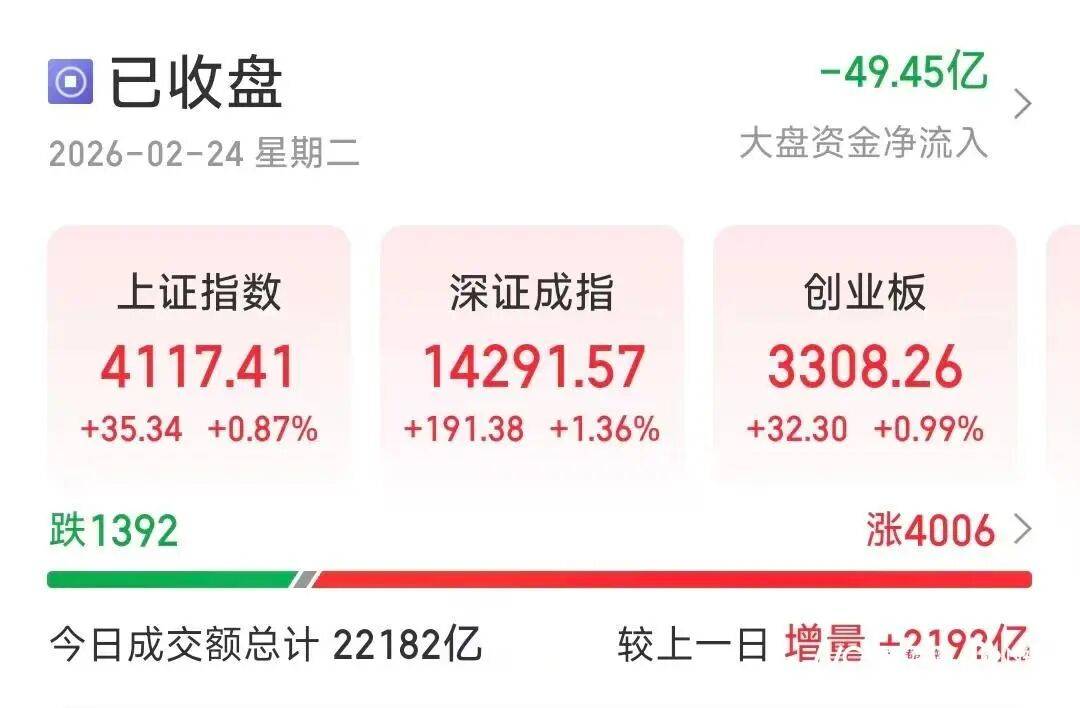
Market Performance - The A-share market opened positively on the first trading day of the Year of the Horse, with all three major indices closing higher. The Shanghai Composite Index closed at 4117.41 points, up 0.87%, the Shenzhen Component Index at 14291.57, up 1.36%, and the ChiNext Index at 3308.26, up 0.99% [1] - The total trading volume in the Shanghai and Shenzhen markets reached 22,182 billion yuan, an increase of 2,192 billion yuan compared to the previous trading day, with over 4,000 stocks rising [1] Sector Performance - The oil and gas extraction and services, precious metals, cultivated diamonds, and coal mining sectors saw significant gains, while the film and television, AI applications, and computing power leasing sectors experienced declines [3] - In the oil and gas sector, Keli Co. led with a 26.03% increase, while Tongyuan Petroleum and Qianeng Hengxin hit the daily limit. Other stocks like Zhongman Petroleum and CNOOC also saw substantial gains [3] - The precious metals sector was led by Xiaocheng Technology with a 15.19% increase, and several stocks in this sector reached the daily limit [3] Geopolitical Influence - The rise in the oil and precious metals sectors is attributed to geopolitical risks, particularly the U.S. military buildup in the Middle East and President Trump's consideration of limited military action against Iran [3] Market Outlook - According to Industrial Securities, the A-share market is expected to enter a high-probability window post-holiday, supported by macroeconomic catalysts and the resolution of U.S. tariff issues [4] - Citic Securities noted that the rise of AI coding capabilities is leading to exponential growth in global code volume, with A-shares likely to be less affected by AI disruptions compared to U.S. and Hong Kong stocks, suggesting a continuation of the spring market rally [4] Investment Trends - Qianhai Kaiyuan Fund's chief economist Yang Delong indicated that as household savings shift towards capital markets, both A-shares and Hong Kong stocks are expected to maintain a slow bull market trend. An estimated 50 trillion yuan in fixed deposits will mature by 2026, potentially driving investors towards equity assets [5] - The issuance of new funds has shown a significant recovery this year, supporting the capital market's strength in 2026 [5]

杨德龙:马年春季攻势行情悄然启动
Xin Lang Cai Jing· 2026-02-25 10:39
Group 1 - The A-share market has started the year positively, with expectations for a spring rally following the Spring Festival [1][8] - The technology sector, particularly the humanoid robot segment, remains a key focus, with significant improvements noted compared to previous years [1][9] - The AI robot industry is transitioning from the initial development phase to a more advanced stage, indicating strong investment potential [1][9] Group 2 - The robot and AI robot sectors have experienced different phases, with 2025 characterized by speculative investments and 2026 expected to focus on order acquisition [2][9] - The upcoming year will see a performance verification phase, where only companies that can deliver results will continue to thrive [2][9] - Short-term market fluctuations should not deter long-term investment perspectives, as the market can behave unexpectedly [2][9] Group 3 - Approximately 50 trillion yuan in fixed deposits are maturing this year, leading to a potential shift of funds into capital markets as deposit rates decline [3][10] - The real estate market is currently in a correction phase, which may further encourage savings to flow into equity markets [3][10] - The trend of household savings moving towards capital markets is gradually strengthening, contributing to a sustained bullish market [3][10] Group 4 - In 2025, technology stocks are expected to outperform, with other sectors like non-ferrous metals and military industries also showing promise [4][11] - Traditional blue-chip stocks may see recovery opportunities in 2026, as market dynamics evolve [4][11] - The recent bullish market signals a positive outlook, but investors should remain cautious of potential short-term adjustments [4][11] Group 5 - The gold market has surged past $5,000 per ounce, reflecting a trend of de-dollarization and a reassessment of the dollar's credibility [5][12] - The expected interest rate cuts by the Federal Reserve may support the performance of non-ferrous metals, although demand remains a concern [5][12] - The actual demand for non-ferrous metals has not significantly increased despite price surges, indicating a need for careful monitoring [5][12] Group 6 - The current capital market in China is in a mid-stage of a slow bull market, with opportunities for value investing in undervalued companies [6][13] - Companies with declining profit growth due to macroeconomic factors may rebound as the economy recovers, while those facing industry decline should be approached with caution [6][13] - The technology sector is expected to experience differentiation, with leading companies likely to perform well while speculative stocks may face declines [6][13]
A股市场运行周报第77期:春季攻势“结构变化”,继续坚持“两法应对”-20260124
ZHESHANG SECURITIES· 2026-01-24 07:00
Core Insights - The market has shown signs of "cooling down," with major broad indices exhibiting divergence. The weight indices, such as the Shanghai Composite and CSI 300, have fallen below the 20-day moving average, entering a phase of consolidation, while most growth indices remain above the 20-day line, indicating continued upward potential [1][4][54] - The current market state is characterized by "strong small caps and weak large caps," with weight indices in a consolidation phase and growth indices remaining active. This trend is expected to persist in the short term, while the overall nature of a "systematic slow bull" remains unchanged for the quarter [1][4][54] Market Overview - The market experienced a "cooling down" period from January 19 to January 23, 2026, with a noticeable decline in trading volume. The Shanghai Composite Index rose by 0.83%, while the Shanghai 50 and CSI 300 fell by 1.54% and 0.62%, respectively, both breaking below the 20-day moving average. In contrast, growth indices such as the CSI 500, CSI 1000, and National 2000 saw increases of 4.34%, 2.89%, and 3.33%, respectively, continuing to reach new highs in this bull market [2][12][53] - Sector performance showed that 24 out of 31 primary industries rose, with cyclical sectors like construction materials, oil and petrochemicals, steel, and real estate experiencing significant gains of 9.23%, 7.71%, 7.31%, and 5.21%, respectively. Meanwhile, the financial sector weakened, with banks and non-banking financials declining by 2.70% and 1.45% [15][53] Market Sentiment and Capital Flow - The average daily trading volume in the Shanghai and Shenzhen markets was 2.7 trillion yuan, reflecting a decrease compared to the previous week. The main futures contracts showed a premium, indicating a bullish sentiment among investors [21][27] - The latest margin trading balance was 2.69 trillion yuan, down by 0.24% from the previous week. In terms of ETFs, the most significant inflow was seen in the non-ferrous metals sector, while the coal sector experienced the largest outflow [27][32] Valuation Insights - The dynamic valuation model indicates that the valuation levels of major indices have increased. As of January 23, 2026, the PE-TTM for the Shanghai Composite Index was 17.1, at the 97.03 percentile, while the Shenzhen Component Index was at 33.31, at the 87.97 percentile. The ChiNext Index had a PE-TTM of 42.98, at the 35.39 percentile [44][45] Strategic Recommendations - Based on the assessment of "market cooling, index divergence, and the dominance of growth," it is recommended to maintain medium-term positions without fear of short-term fluctuations and to participate in the upcoming market momentum. Short-term positions should be cautious of volatility and avoid chasing highs [5][55] - The strategy includes balancing medium-term positions across sectors with high economic prospects and relatively reasonable stock prices, particularly in the "two electric and non-mechanical" sectors (electronics, new energy, chemicals, non-banking, and machinery). Additionally, consider the CSI 500, CSI 1000, and National 2000 indices for relative returns [5][55]
证监会:启动实施深化创业板改革!创业板ETF天弘成交额超1亿元,机构:春季攻势有望贯穿春节前后
2 1 Shi Ji Jing Ji Bao Dao· 2026-01-19 08:54
Group 1 - The three major indices opened lower but turned positive during the day, with sectors like power grid equipment and charging piles seeing gains [1] - The ChiNext Index rose by 0.48%, with individual stocks such as BlueFocus and Teruid gaining over 5% [1] - The ChiNext ETF Tianhong (159977) saw a net inflow of 10.53 million yuan on January 16, indicating active trading [1] Group 2 - The Sci-Tech Innovation Index increased by 0.40%, with stocks like Okoyi and Aiko Optoelectronics leading the gains [1] - The Sci-Tech Innovation Index ETF Tianhong (589860) recorded a real-time trading volume exceeding 20 million yuan, with a turnover rate over 8% [1] - The China Securities Regulatory Commission emphasized the need for reforms to enhance the quality and adaptability of the multi-level equity market, including the deepening of ChiNext reforms [2] Group 3 - Guotai Junan Securities predicts a "transformation bull" market in 2026, expecting higher, steadier, and longer growth [2] - The recent market cooling is expected to change the upward slope but not the overall upward potential, with a focus on technology growth sectors [2] - The emphasis is on sectors such as hard technology, AI applications, and industries with favorable valuation-performance matching, including non-ferrous metals, chemicals, and power equipment [2]

天量资金,动向延续
Zhong Guo Ji Jin Bao· 2026-01-19 04:17
Core Viewpoint - On January 16, the A-share market experienced a decline, with a net outflow of over 85.5 billion yuan from the stock ETF market, indicating a continued trend of capital withdrawal [2][3]. Group 1: Market Performance - The three major indices in the A-share market closed lower, with the Shanghai Composite Index down 0.26%, the Shenzhen Component Index down 0.18%, and the ChiNext Index down 0.2% [3]. - The semiconductor industry chain saw significant gains, particularly in advanced packaging and memory sectors, while the cultural media and short drama gaming sectors experienced adjustments [3]. Group 2: ETF Fund Flows - As of January 16, the total scale of 1,308 stock ETFs in the market was approximately 4.9 trillion yuan, with a reduction of 15.365 billion units in fund shares, leading to a net outflow of 85.505 billion yuan [3][4]. - Industry-themed ETFs and strategy-style ETFs saw substantial inflows, amounting to 19.118 billion yuan and 1.768 billion yuan, respectively [4]. - The ETF tracking the semiconductor materials and equipment index had the highest single-day net inflow of 2.995 billion yuan [4]. Group 3: Notable Inflows - A total of 57 ETFs had net inflows exceeding 1 billion yuan on January 16, with the top three being the non-ferrous metals ETF, semiconductor equipment ETF, and electric grid equipment ETF, which saw net inflows of 1.811 billion yuan, 1.785 billion yuan, and 1.562 billion yuan, respectively [4]. - Leading fund companies continued to attract net inflows, with E Fund's semiconductor equipment ETF and artificial intelligence ETF each receiving over 600 million yuan [4]. Group 4: Market Outlook - The broad-based ETFs experienced the largest net outflow, totaling 106.907 billion yuan, with the CSI 300 index products seeing a net outflow of 58.007 billion yuan [6]. - Market analysts expect a "spring offensive" driven by ample liquidity and improved risk appetite, particularly as 2026 marks the beginning of the "14th Five-Year Plan" [6].

天量资金,动向延续
中国基金报· 2026-01-19 04:09
Group 1 - On January 16, the A-share market opened high but closed lower, with all three major indices declining. The stock ETF market continued to experience net outflows, with a total outflow of over 85.5 billion yuan on that day [2][4]. - As of January 16, the total scale of 1,308 stock ETFs in the market was approximately 4.9 trillion yuan. The number of fund shares decreased by 15.365 billion, leading to a net outflow of 85.505 billion yuan based on average pricing [4][5]. - Industry-themed ETFs and strategy-style ETFs saw significant inflows, amounting to 19.118 billion yuan and 1.768 billion yuan, respectively. ETFs tracking the semiconductor materials and equipment index had the highest single-day inflow of 2.995 billion yuan [5]. Group 2 - On January 16, 57 ETFs had net inflows exceeding 1 billion yuan, with the top three being the non-ferrous metals ETF (1.811 billion yuan), semiconductor equipment ETF (1.785 billion yuan), and electric grid equipment ETF (1.562 billion yuan) [5][6]. - The top 20 stock ETFs by net inflow included the non-ferrous metals ETF, semiconductor equipment ETF, and electric grid equipment ETF, with respective inflows of 1.811 billion yuan, 1.785 billion yuan, and 1.562 billion yuan [6]. - Conversely, broad-based ETFs experienced significant net outflows, totaling 106.907 billion yuan, with the CSI 300 index products seeing a net outflow of 58.007 billion yuan [8][9]. Group 3 - The fund manager from E Fund indicated that January is a traditional "opening red" window for credit issuance, expecting the market to enter a "spring offensive" driven by ample liquidity and improved risk appetite [10]. - ICBC Credit Suisse Fund anticipates that more industrial policy details will be implemented in 2026, particularly in technology innovation and green transformation, with monetary policy likely to remain moderately loose [11].

今天,A股破历史纪录
Nan Fang Du Shi Bao· 2026-01-12 09:52
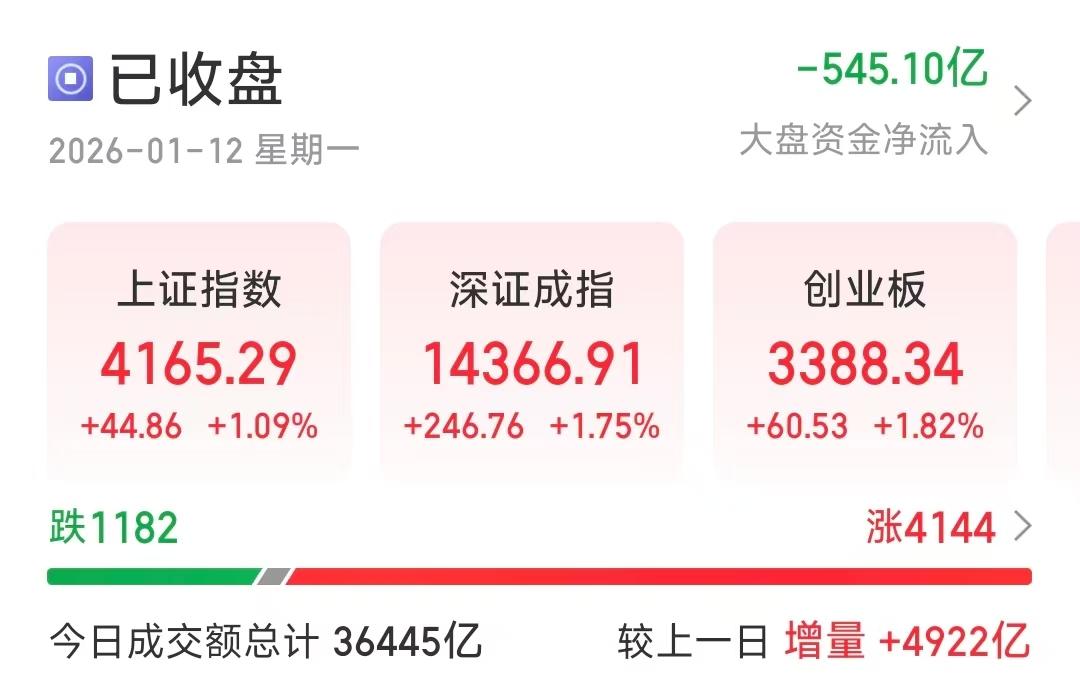
Market Overview - The Shanghai Composite Index has achieved a 17-day consecutive rise, closing at 4165.29 points, up 1.09% [1] - The total trading volume in the Shanghai and Shenzhen markets reached 3.6 trillion yuan, an increase of 478.7 billion yuan from the previous trading day, setting a historical record [1][3] - Experts indicate that the market has entered a phase of simultaneous increase in volume and price, marking the beginning of a spring rally [1][3] Sector Performance - The commercial aerospace, Sora concept, and AI intelligent agent sectors showed significant gains, with multiple stocks hitting the daily limit of 30% [3] - Notable performers in the commercial aerospace sector included Tianrun Technology and Xingtu Mapping, while in the AI sector, stocks like Zhongcheng Technology and Liujin Technology also reached the daily limit [3] Future Market Outlook - Yang Delong, Chief Economist at Qianhai Kaiyuan Fund, believes that the bull market logic for 2026 remains unchanged, with expectations for a transition from a cross-year market to a spring offensive [3][4] - January is typically a month with the highest credit issuance, estimated between 3 trillion to 5 trillion yuan, which may lead to increased capital inflow into the stock market [3] - The current strong market performance is expected to suppress bearish sentiment and enhance investor confidence [3] Long-term Projections - Yang Delong anticipates a slow bull market lasting 3 to 5 years, with the 2026 market expected to expand beyond technology and banking stocks to include consumer blue chips, new energy leaders, and military industries [4] - Industry analysts from Industrial Bank predict a continued positive outlook for the A-share market in 2026, with technology remaining a core focus [4] - Global economic conditions are favorable, with major economies showing steady growth and a low-risk macroeconomic environment, which supports the capital market [4] Valuation Insights - According to a report from GF Securities, the valuation of the A-share market has seen restrained growth over the past two years, with the changing competitive landscape between China and the U.S. providing a safety margin for valuations [5] - There is an expectation that A-share valuations may break historical patterns and continue to rise for three consecutive years [5]

量价齐升!沪指17连阳 A股成交额3.6万亿元破历史纪录
Nan Fang Du Shi Bao· 2026-01-12 08:17
Market Overview - The Shanghai Composite Index has achieved a 17-day consecutive rise, with the total trading volume in the Shanghai and Shenzhen markets reaching 3.6 trillion yuan, marking a record high [1] - The Shanghai Composite Index closed at 4165.29 points, up 1.09%, while the Shenzhen Component Index and the ChiNext Index rose by 1.75% and 1.82%, respectively [1] Sector Performance - The commercial aerospace, Sora concept, and AI intelligent agent sectors have shown significant gains, with multiple stocks in these sectors hitting the daily limit of 30% [2] - Notable performers include Tianrun Technology, Xingtum Mapping, and Liujin Technology in the commercial aerospace sector, and Zhongcheng Technology and Liujin Technology in the AI sector [2] Economic Outlook - The chief economist of Qianhai Open Source Fund, Yang Delong, indicates that the current bull market is gaining strength, with a transition from a cross-year market to a spring offensive [2] - January is typically a month with the highest credit issuance, estimated between 3 to 5 trillion yuan, which is expected to flow into the capital markets, enhancing investor confidence [2] Long-term Market Projections - The market outlook for A-shares in 2026 is optimistic, with expectations of a slow bull market lasting 3 to 5 years, expanding into various sectors including consumer staples, new energy, and military industry [3] - The global macroeconomic environment remains favorable, with major economies showing steady growth and low overall risk, which is beneficial for capital markets [3] - The valuation of A-shares is expected to break historical patterns, with a potential continuous increase over three years, particularly if adjustments occur in small and mid-cap stocks in late January 2026 [3]
A股“13连阳”,散户、机构都在入场
第一财经· 2026-01-06 15:45
Core Viewpoint - The article highlights the increasing enthusiasm of investors in the A-share market, with a significant rise in new account openings for both individual and institutional investors, indicating a bullish sentiment in the market as the Shanghai Composite Index continues to rise [3][10]. Summary by Sections Investor Participation - In 2025, the total number of new A-share accounts reached 27.4369 million, a year-on-year increase of 9.75%. Individual investors accounted for 27.3324 million new accounts, up 9.67%, while institutional investors opened 10,453.9 thousand accounts, marking a 34.91% increase [5][6]. Monthly Account Openings - December 2025 saw 2.5967 million new A-share accounts opened, a month-on-month increase of 9% and a year-on-year increase of 30.55% compared to December 2024 [5]. The monthly trend showed a peak in March 2025 with 3.0655 million new accounts, followed by a decline in April to 1.9244 million, which was a 59.3% decrease from March [6][7]. Market Performance - The A-share market experienced a bullish trend in 2025, with the Shanghai Composite Index rising by 18.41%, an increase of nearly 6 percentage points compared to 2024 [10]. The index reached a new high of 4083.67 points on January 6, 2026, following a strong performance after the New Year [11]. Future Market Outlook - Analysts predict that the A-share market will continue to exhibit a structural bullish trend, supported by favorable policies and improving economic indicators. The focus will be on sectors such as technology, industrial metals, and consumer services, with an emphasis on performance disclosures in January [12][13][14].