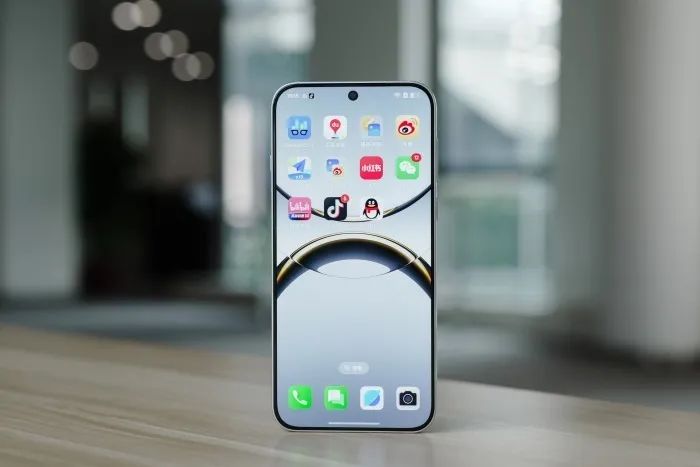
荣耀Magic7

Search documents
【业界】荣耀前CEO赵明将出任千里科技联席董事长
Sou Hu Cai Jing· 2026-02-13 15:34
Core Insights - Zhao Ming will serve as the co-chairman of Qianli Technology, focusing on advancing the AI business model and its closed-loop strategy [2][3] - Zhao Ming's extensive experience in the mobile and communication industry, spanning over 20 years, has led him to believe that AI is the next significant area for investment over the next two decades [2] - Both Qianli Technology's chairman, Yin Qi, and Zhao Ming have confirmed this development, expressing enthusiasm for the collaboration and the potential of the AI business [3] Company Developments - Zhao Ming's appointment is seen as a strategic move to leverage his expertise in mobile technology for AI applications [2] - The partnership aims to create a robust AI business ecosystem that can sustain growth and innovation over the next decade [3] Industry Implications - The shift towards AI by established figures in the mobile industry indicates a broader trend of integrating AI into traditional sectors [2][3] - This move may attract further investments and interest in AI-driven technologies within the telecommunications and mobile sectors [2]


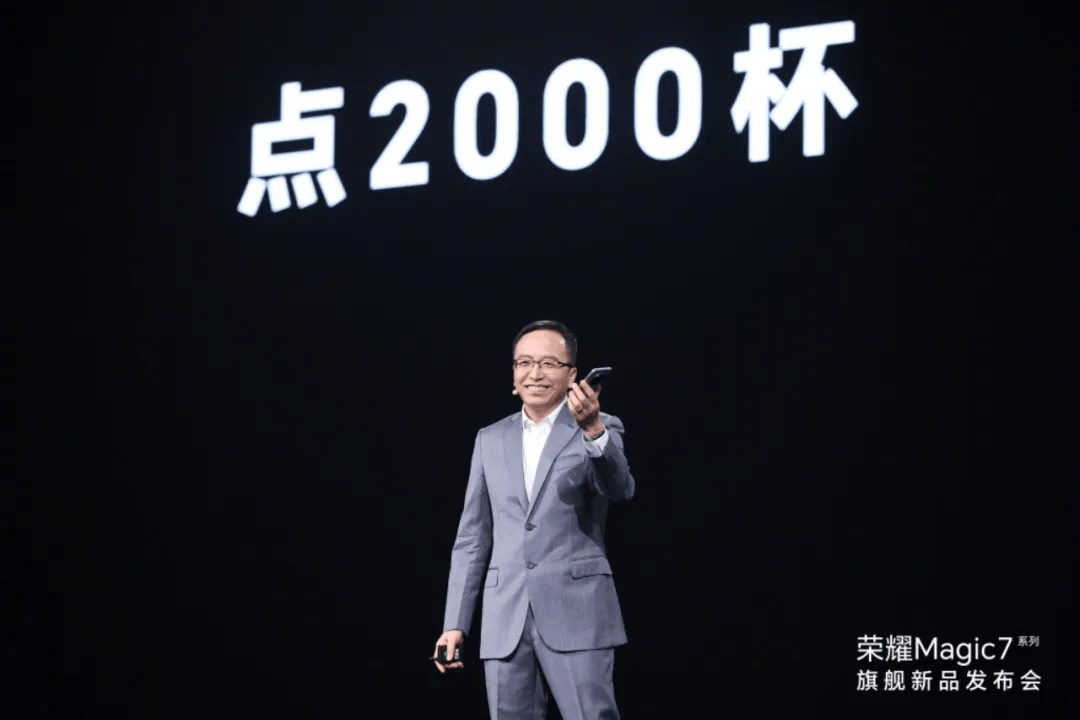
高端难破低端受压 荣耀Q3销量降幅在主流厂商中最大
Xi Niu Cai Jing· 2025-11-12 00:34
Core Insights - The Chinese smartphone market is experiencing a contraction, with a reported 0.5% year-on-year decline in shipments for Q3 2025, totaling approximately 68.46 million units [4] - Honor's smartphone sales have decreased by 8.1% year-on-year, marking the largest decline among mainstream manufacturers, resulting in a market share drop to 14.4%, placing it fifth in the domestic market [1][4] - Despite launching multiple new models in 2025, including the Honor 400 series, the "flooding the market" strategy has not effectively countered the overall sales decline [4][10] Market Performance - Honor's market share has been on a downward trend for several quarters, failing to rank among the top five in Q2 2025 [1][4] - The Honor Magic 8 series, launched on October 15, has seen disappointing sales, with only 120,000 units sold in the first five days, which is 65% of the previous generation's performance [5][7] - The brand's user retention rate is low at 18.8%, indicating challenges in maintaining customer loyalty compared to competitors [10] Competitive Landscape - Honor faces intense competition in the mid-range market from models like OPPO Reno, Huawei Nova14, and Vivo S30, which are gaining traction [4][5] - The high-end market remains elusive for Honor, as its flagship Magic 7 model did not secure a top-three position in the Chinese market for devices priced above $600 [5][7] - The brand's lack of proprietary technology in key areas such as imaging algorithms and system ecosystems limits its ability to compete with established players like Huawei and Apple [7][10] Strategic Adjustments - In response to market challenges, Honor has adjusted its marketing strategy, including appointing popular artist Xiao Zhan as a brand ambassador to enhance brand visibility [10] - The company has also announced its integration with the DeepSeek large model, positioning itself as the first Android manufacturer to do so [10]

iPhone系列降幅高至2500元 专家称刺激效果有限
Zhong Guo Jing Ying Bao· 2025-05-14 09:44
Core Viewpoint - The price reduction of the iPhone 16 series by Apple ahead of the "6·18" shopping festival is aimed at boosting sales in the Chinese market and responding to competitive pressures from domestic smartphone brands [2][6][7]. Pricing Strategy - Apple has issued a price adjustment notice to its channel partners, with the iPhone 16 Pro and iPhone 16 Pro Max seeing price cuts exceeding 1,000 yuan across all storage versions [2][3]. - The iPhone 16 Pro starts at 6,499 yuan, while the Pro Max starts at 8,599 yuan, with reductions of 1,500 yuan and 1,400 yuan respectively compared to official prices [3]. - The iPhone 16 and iPhone 16 Plus have also seen price reductions of 1,000 yuan, with additional government subsidies available [3][5]. E-commerce Promotions - Major e-commerce platforms like Tmall and JD.com have launched their "6·18" promotions early, with significant discounts on the iPhone 16 series, particularly the Pro versions [4][5]. - Tmall's official Apple Store is offering the iPhone 16 Pro 128GB at a promotional price of 5,499 yuan after a 2,000 yuan discount and a 500 yuan government subsidy [5]. Market Context - The "6·18" shopping festival is a critical sales period for smartphone manufacturers, with Apple aiming to leverage this event to enhance its market performance [4][6]. - Despite the price cuts and promotional efforts, Apple's performance in the Chinese market has been declining, with a reported 9% drop in shipments year-on-year in Q1 2025 [7]. Competitive Landscape - The price reductions are also a strategic move to counter the competitive pressure from domestic brands, as Android manufacturers are also launching their own promotions during the "6·18" festival [8][9]. - Other brands like Vivo and OPPO are offering substantial discounts and subsidies, indicating a highly competitive market environment [8][9].

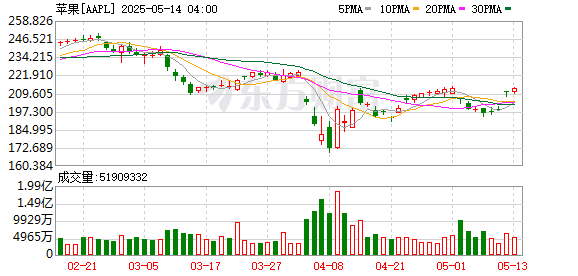
荣耀跌出前五:手机江湖再无“替身红利”
创业邦· 2025-05-12 03:13
Core Viewpoint - The smartphone industry is experiencing a competitive landscape where brand recognition and user perception are crucial for survival, and Honor faces significant challenges in establishing its identity post-separation from Huawei [6][17][18]. Group 1: Market Position and Performance - In Q1 2024, Honor achieved a 17.1% market share in China, surpassing Huawei, but by Q4 2024, its share dropped to 13.7%, ranking fifth [4]. - The smartphone market is expected to recover in 2024, with a 5.6% increase in shipments compared to 2023, particularly in the Android segment [5]. - By Q1 2025, Honor fell out of the top five smartphone brands, with a 12.8% year-on-year decline in shipments [5]. Group 2: Historical Context and Brand Evolution - Honor was initially a sub-brand of Huawei, targeting young consumers with cost-effective products, and gained recognition with models like Honor 3C/3X and Honor 6 [7][8]. - Following Huawei's sanctions, Honor became an independent brand, inheriting talent and resources from Huawei, which allowed it to maintain some competitive advantages [9][10]. - The separation from Huawei has led to a shift from a complementary relationship to direct competition, complicating Honor's market positioning [14][15]. Group 3: Challenges and Strategic Direction - Honor struggles with brand identity and lacks a compelling narrative to differentiate itself from Huawei, leading to a perception of being a "substitute" brand [18][24]. - The company's product line, while extensive, lacks standout models in each price segment, resulting in consumer confusion and a diluted brand message [22][23]. - Honor's strategy of releasing multiple models has become less effective in a market characterized by performance saturation and intense competition [22][24]. Group 4: Future Opportunities and Innovations - AI is identified as a potential breakthrough area for Honor, with initiatives like the "Alpha Strategy" aimed at creating a seamless ecosystem of interconnected devices [28][29]. - Despite some innovative features, Honor's technological advancements have not yet established a significant competitive edge compared to rivals like Huawei and Apple [24][25]. - International expansion is a focus for Honor, with new leadership experienced in overseas markets, but challenges remain due to global competition and supply chain pressures [31][32].
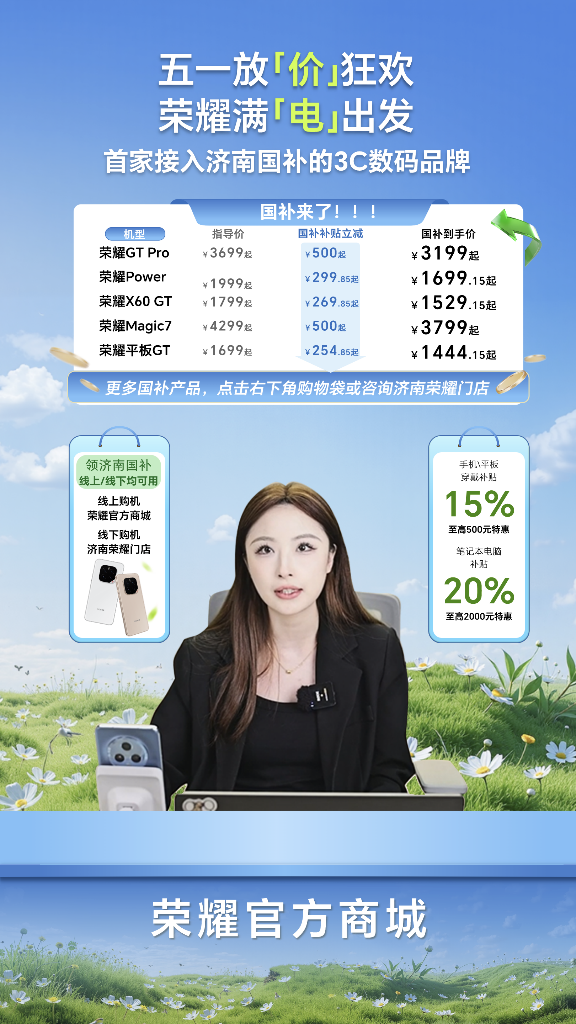
五一消费季来袭荣耀领航济南市3C数码以旧换新国补行动
Qi Lu Wan Bao· 2025-04-30 04:56
Core Viewpoint - The upcoming May Day holiday is expected to trigger a consumption peak across the country, with local governments launching subsidy activities to stimulate consumer spending. Jinan City has introduced a "Home Appliance Trade-in Government Subsidy Program," which includes a range of products from the 3C digital brand Honor, marking its recognition and anticipation among consumers in Shandong Province [1][2]. Group 1: Government Subsidy Program - Jinan's government subsidy program for home appliances includes a trade-in initiative that covers consumers throughout Shandong Province [1]. - Honor has been selected as the first 3C digital brand to participate in this subsidy program, reflecting the government's support and consumer interest in its products [2]. - The subsidy program offers discounts of up to 20% on various products, including smartphones, tablets, and smartwatches [4][6]. Group 2: Product Offerings and Pricing - The subsidy program features several Honor products, such as the Honor Power with an 8000mAh battery, priced at ¥1999, which drops to ¥1699.15 after the subsidy [5]. - The Honor GT Pro, equipped with the Snapdragon 8 Gen 2, has a starting price of ¥3699, reduced to ¥3199 with the subsidy [5]. - The flagship Honor Magic7 series is available at a starting price of ¥4299, with a post-subsidy price of ¥3799 [5]. Group 3: Consumer Engagement and Accessibility - The subsidy can be accessed both online and offline, allowing consumers to purchase through the Honor official store or local Jinan stores [6]. - The program aims to reach a wide audience, including consumers in rural and remote areas, maximizing the benefits of the subsidy [6]. - The initiative is designed to enhance consumer experience, particularly for those planning to travel during the holiday, by offering AI-driven travel assistance and enhanced photography features [5][10].
直屏回归,小屏当道,国产手机厂商开始听劝了
3 6 Ke· 2025-03-27 12:59
Core Insights - The smartphone market is witnessing a shift from curved screens to flat screens, driven by consumer demand for practicality and usability [1][3][5] - There is a growing interest in small-screen smartphones (below 6.3 inches), as recent models have begun to overcome previous performance and battery life limitations [11][13][15] - The trend towards flat screens and small screens reflects a more mature consumer perspective, prioritizing functionality and ease of use over aesthetic appeal [17] Flat Screen Trend - Since Q4 of the previous year, flagship smartphones have predominantly adopted flat screen designs, with notable examples including Honor Magic7 and OPPO Find X8 [3] - Flat screens offer several advantages over curved screens, such as higher durability, lower production costs, and reduced accidental touches [5] - The upcoming OPPO Find X8 Ultra is set to feature a flat screen, marking a significant departure from traditional design norms for Ultra models [7] Small Screen Resurgence - The introduction of mini models, such as the vivo X200 Pro mini, has reignited interest in small-screen smartphones, which are now being recognized for their flagship-level performance [11][13] - The "impossible triangle" of performance, battery life, and imaging capabilities has been addressed in recent small-screen models, making them more appealing to consumers [11][15] - Upcoming models like OPPO Find X8s and OnePlus 13 mini are expected to further enhance the small-screen segment, providing consumers with more options [15] Consumer Preferences - The return to flat and small screens indicates a shift in consumer preferences towards practical and user-friendly designs [17] - Flat screens are perceived to have lower touch error rates and better durability, while small screens are appreciated for their portability and ease of handling [17] - Overall, the industry is moving towards products that align with consumer demands for usability and reliability [17]