药品制剂

Search documents
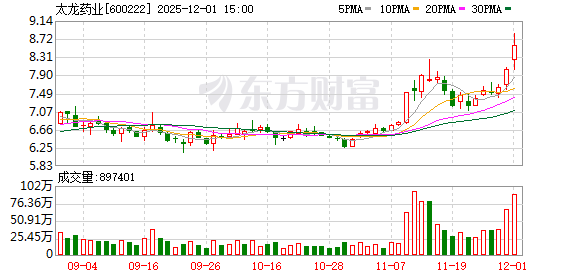
乐普医疗预计2025年净利润为8亿—12亿元
Bei Jing Shang Bao· 2026-01-28 11:41
Group 1 - The core business of cardiovascular interventional products has shown steady revenue growth, while the inventory clearance in the retail channel of the pharmaceutical segment is nearly complete, leading to double-digit revenue growth for Lepu Medical [1] - Lepu Medical forecasts a net profit attributable to shareholders of 800 million to 1.2 billion yuan for 2025, representing a year-on-year growth of 223.97% to 385.95% [3] - The net profit after deducting non-recurring gains and losses is also projected to be between 800 million to 1.2 billion yuan, with a year-on-year increase of 261.29% to 441.93% [3]


贸易逆差降至2009年以来最低水平,特朗普关税初见端倪
Sou Hu Cai Jing· 2026-01-14 11:06
Group 1 - The U.S. trade deficit unexpectedly narrowed to $29.4 billion in October, the lowest level since June 2009, primarily due to a sharp decline in imports and moderate growth in exports [1] - U.S. imports fell by 3.2% to $331.4 billion, with goods imports dropping 4.5% to $255 billion, marking the lowest level since June 2023 [1] - The decline in imports is attributed to the impact of tariffs imposed by the Trump administration, which have increased import costs and forced companies to adjust their supply chains [1] Group 2 - The significant drop in pharmaceutical imports, which fell by $14.3 billion to the lowest level since July 2022, is a major contributor to the overall decline in imports [1] - The decrease in consumer goods imports by $14 billion, the lowest since June 2020, indicates weakening domestic consumer demand in the U.S. [1] - The uncertainty surrounding tariffs has led to fluctuations in U.S. trade data, but the long-term trend suggests a potential "declining cycle" for the trade deficit [1] Group 3 - The reduction in the U.S. trade deficit is a complex situation for China, presenting both risks and opportunities, as China's manufacturing capabilities span across various sectors [8] - China's competitive pricing allows for significant exports, with projections indicating that it will produce one-third of the world's industrial goods by 2024 and achieve a trade surplus exceeding $1 trillion by 2025 [8] - The decrease in U.S. trade deficit and dollar liquidity could negatively impact global trade dynamics, particularly affecting China's export potential [10] Group 4 - The trade protectionism under the Trump administration aims to fragment globalization, pushing companies to relocate production to regions like Southeast Asia and Mexico, which may lead to a loss of manufacturing orders for China [6] - The shrinking trade deficit could lead to a decline in globalization, making it more challenging for countries like China to maintain previous levels of dollar earnings from exports [14] - The reliance on the U.S. dollar as a global currency is critical, and any reduction in U.S. trade deficits could diminish the liquidity that supports global trade [9][10]

进口“断崖”:美国10月贸易逆差创14年新低,关税效应下GDP预测飙升至5.4%
智通财经网· 2026-01-09 01:01
Core Insights - The U.S. trade deficit unexpectedly narrowed significantly in October, reaching its lowest level since 2009, primarily due to a sharp decline in imports, especially in pharmaceuticals [1] - The October trade deficit for goods and services decreased by 39% from the previous month, falling to $29.4 billion, which was below all economists' expectations [1] - The decline in total imports by 3.2% reflects a drop in pharmaceutical and non-monetary gold imports, with pharmaceutical imports hitting their lowest point since July 2022 [1] Group 1: Trade Dynamics - The sharp reduction in imports is attributed to a "tariff avoidance" effect, where companies stockpiled goods in anticipation of a 100% tariff on imported pharmaceuticals that was ultimately delayed [1] - Many companies negotiated with the government to lower drug prices, thereby circumventing the anticipated tariff [1] - Trade data has shown significant monthly fluctuations due to U.S. tariff policies, particularly affecting non-monetary gold and pharmaceutical trade volumes [1] Group 2: Economic Indicators - The increase in computer and accessory imports suggests strong signs of growth in other economic sectors amid the AI development boom [2] - The U.S. third-quarter labor productivity growth accelerated to its fastest pace in two years, with expectations for further enhancement due to increased investment in AI [2] - Following the latest trade report, the Atlanta Fed's GDPNow model predicts that net exports will contribute nearly 2 percentage points to fourth-quarter economic growth, raising the GDP growth forecast to 5.4% [2] Group 3: Regional Trade Patterns - The trade deficit with Ireland has sharply narrowed, as many large U.S. pharmaceutical companies have outsourced production to Ireland due to its favorable tax environment [2] - The trade deficit with Mexico and China has widened, while the deficit with Canada has decreased, indicating shifts in trade dynamics [3] - Canadian statistics show that due to a surge in computer and electronic product imports, Canada’s trade balance has reverted to a deficit, with exports to the U.S. dropping to 67.3%, the lowest level since 1997, excluding the pandemic period [3]
美国数据:10月贸易逆差骤降至2009年中以来最低,不及预期一半
Xin Lang Cai Jing· 2026-01-08 14:56
Core Viewpoint - The U.S. trade deficit significantly narrowed in October to its lowest level since mid-2009, primarily due to a decline in imports, which could potentially boost economic growth in the fourth quarter if the trend continues [1][4]. Trade Deficit Summary - The trade deficit decreased by 39.0% to $29.4 billion, the lowest since June 2009 [1][4]. - Economists had previously expected the deficit to widen to $58.9 billion [5]. Import and Export Analysis - Imports fell by 3.2% to $331.4 billion, with goods imports dropping 4.5% to $255.0 billion, the lowest since June 2023 [5]. - The decline in imports may be linked to the broad tariffs implemented by former President Trump and a softening domestic demand [5]. - Industrial goods imports decreased by $2.7 billion, reaching the lowest level since February 2021, primarily due to a $1.4 billion drop in non-monetary gold imports, which do not count towards GDP [5]. - Consumer goods imports fell by $14.0 billion to the lowest level since June 2020, largely driven by a $14.3 billion decrease in pharmaceutical preparations [5]. - Capital goods imports increased by $6.8 billion, supported by computer parts, communication equipment, and computers, potentially linked to investments in artificial intelligence [5]. - Exports rose by 2.6% to a record $302.0 billion, with goods exports surging 3.8% to $195.9 billion, also a historical high, driven by non-monetary gold and other precious metals [5]. Economic Growth Projections - The Atlanta Federal Reserve currently projects a 2.7% annualized growth rate for GDP in the fourth quarter, following a 4.3% growth in the third quarter [3][7].
小方制药:12月19日召开董事会会议
Mei Ri Jing Ji Xin Wen· 2025-12-19 10:55
Group 1 - The company, Xiaofang Pharmaceutical, announced the convening of its second board meeting on December 19, 2025, to discuss adjustments to its 2025 restricted stock incentive plan [1] - For the year 2024, the company's revenue composition is projected to be 99.93% from pharmaceutical preparations and 0.07% from other businesses [1] - As of the report, Xiaofang Pharmaceutical has a market capitalization of 4.6 billion yuan [1]
金荣中国:美初请失业金人数高于预期,金价破位走高大幅收涨
Sou Hu Cai Jing· 2025-12-12 01:45
Group 1: Gold Market - International gold prices saw a significant increase on Thursday, with an opening price of $4,193.70 per ounce, a high of $4,261.59, a low of $4,181.96, and a closing price of $4,255.96 [1] - Gold prices fluctuated throughout the day, reaching a peak of $4,286 before stabilizing around $4,279, marking three consecutive days of gains [8] - The daily chart indicates a bullish trend, with the moving averages showing a clear upward divergence, while the RSI indicates overbought conditions [8] Group 2: Employment Data - Initial jobless claims in the U.S. rose by 44,000 to 236,000 for the week ending December 6, marking the largest weekly increase since March 2020 [3] - The number of continuing claims decreased to 1.84 million, reflecting fluctuations typically seen around holiday periods [3] - Concerns about the labor market have negatively impacted consumer confidence, with a majority of respondents in a recent survey expecting an increase in unemployment over the next year [3] Group 3: Trade Deficit - The U.S. trade deficit unexpectedly narrowed in September, decreasing nearly 11% to $52.8 billion, the smallest level since mid-2020 [4] - Exports increased by 3%, reaching the second-highest level on record, driven primarily by non-monetary gold and pharmaceutical preparations [4] - The trade data is expected to help economists refine their estimates for third-quarter GDP [4] Group 4: Geopolitical Developments - The Trump administration imposed new sanctions on three nephews of Venezuelan President Maduro and six companies involved in transporting Venezuelan oil [5] - Following the seizure of a tanker carrying Venezuelan crude, the U.S. is preparing to intercept more vessels, increasing pressure on Maduro's regime [5] - Shipping sources indicate that the recent seizure has made operators reconsider their plans to navigate Venezuelan waters [5] Group 5: Federal Reserve Outlook - According to CME's FedWatch, the probability of a 25 basis point rate cut by the Federal Reserve in January is 24.4%, while the probability of maintaining the current rate is 75.6% [6] - By March, the cumulative probability of a 25 basis point cut rises to 40.4%, with a 52% chance of no change [6]

美国贸易逆差意外收窄 至2020年以来最小
Xin Lang Cai Jing· 2025-12-11 15:09
Core Insights - The U.S. trade deficit unexpectedly narrowed in September to its smallest level since mid-2020, driven by an increase in exports [1][3] - The trade deficit for goods and services decreased by nearly 11% from the previous month, reaching $52.8 billion, while economists had forecasted a deficit of $63.1 billion [1][3] - U.S. exports rose by 3%, reaching the second-highest level on record, primarily supported by non-monetary gold and pharmaceutical preparations, while imports increased only modestly by 0.6% [1][3] Economic Impact - The fluctuations in trade due to U.S. tariff policies have caused significant monthly volatility in trade data, which in turn affects government economic activity indicators, particularly GDP [1][3] - The September trade data will assist economists in adjusting their estimates for third-quarter GDP [1][3] Adjusted Figures - According to the Atlanta Fed's GDPNow forecast, net exports contributed 0.86 percentage points to third-quarter growth [2][4] - After adjusting for inflation, the September goods trade deficit narrowed to $79 billion, marking the smallest level in nearly five years [2][4] - Adjusted for price changes, consumer goods exports reached a record high [2][4]
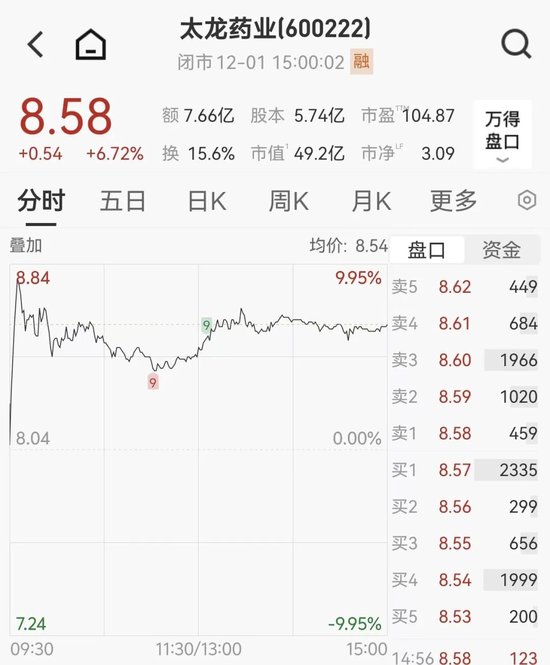
盘中涨停!太龙药业控制权拟变更,明起停牌
Zhong Guo Zheng Quan Bao· 2025-12-01 14:53
Core Viewpoint - TaLong Pharmaceutical is undergoing a potential change in control as its major shareholder, Zhengzhou TaiRong Industrial Investment Co., Ltd., is planning to transfer shares, leading to a suspension of trading starting December 2, 2023 [1][2]. Group 1: Shareholder Changes - Zhengzhou TaiRong Industrial Investment Co., Ltd. currently holds 82.44 million shares, accounting for approximately 14.37% of TaLong Pharmaceutical, making it the largest shareholder [4]. - The actual controller of TaLong Pharmaceutical is the Zhengzhou High-tech Zone Management Committee [4]. - The share transfer was previously completed on January 24, 2022, at a price of 9.7 yuan per share, totaling around 800 million yuan [4]. Group 2: Business Overview - TaLong Pharmaceutical's main business includes drug manufacturing and research services, focusing on traditional Chinese medicine, CXO, and health sectors [5]. - The company reported a revenue of 1.187 billion yuan for the first three quarters of 2025, a year-on-year decrease of 11.47%, and a net profit of 25.3255 million yuan, down 12.36% [5]. - The decline in revenue is attributed to the ongoing standardization work for its main products in the national collection of traditional Chinese medicine, which has not yet fully covered the market [5]. Group 3: Future Strategies - The company is working on the standardization of products selected for the national collection, with plans to manage inventory effectively during the peak sales season for respiratory medications in the fourth quarter [6]. - TaLong Pharmaceutical aims to enhance operational efficiency and expand market share by improving supply chain management and controlling raw material costs [6].

盘中涨停!这家公司控制权拟变更,明起停牌
Zhong Guo Zheng Quan Bao· 2025-12-01 14:45
Core Viewpoint - Tai Long Pharmaceutical (600222) is undergoing a potential change in control due to the share transfer plan by its controlling shareholder, Zhengzhou Tai Rong Industrial Investment Co., Ltd. [1] Group 1: Share Transfer and Control Change - Zhengzhou Tai Rong Industrial Investment Co., Ltd. is planning to transfer shares, which may lead to a change in the company's control [1] - The stock of Tai Long Pharmaceutical was suspended from trading starting December 2, with an expected suspension period of no more than two trading days [1] - As of September 30, 2025, Tai Rong holds 82.44 million shares, accounting for approximately 14.37% of the company, making it the largest shareholder [1] Group 2: Financial Performance - For the first three quarters of 2025, Tai Long Pharmaceutical reported revenue of 1.187 billion yuan, a year-on-year decrease of 11.47%, and a net profit attributable to shareholders of 25.33 million yuan, down 12.36% year-on-year [2] - The decline in revenue is attributed to the company's main products participating in the national collection of traditional Chinese medicine, which has not yet fully covered the bidding work [2] Group 3: Business Operations and Strategy - Tai Long Pharmaceutical's main business includes drug manufacturing and research services, focusing on traditional Chinese medicine, drug formulations, and drug circulation [2] - The company aims to enhance its capabilities in funding, resources, and industrial integration through Tai Rong, promoting strategic development in traditional Chinese medicine, CXO, and health sectors [2] - The company is currently advancing the bidding work for selected products in the national collection of traditional Chinese medicine, with plans to manage inventory and supply chain effectively during the peak sales season for respiratory medications [3]
盘中涨停!这家公司控制权拟变更 明起停牌
Zhong Guo Zheng Quan Bao· 2025-12-01 14:44
Core Viewpoint - TaLong Pharmaceutical is undergoing a potential change in control due to the share transfer plan by its controlling shareholder, Zhengzhou TaiRong Industrial Investment Co., Ltd. [2] Group 1: Share Transfer and Control Change - Zhengzhou TaiRong Industrial Investment Co., Ltd. is planning to transfer shares, which may lead to a change in the company's control [2] - As of September 30, 2025, TaiRong holds 82.44 million shares, accounting for approximately 14.37% of the total shares, making it the largest shareholder [2] - The actual controller of TaLong Pharmaceutical is the Zhengzhou High-tech Zone Management Committee [2] Group 2: Financial Performance - For the first three quarters of 2025, TaLong Pharmaceutical reported revenue of 1.187 billion yuan, a year-on-year decrease of 11.47% [3] - The net profit attributable to the parent company for the same period was 25.3255 million yuan, down 12.36% year-on-year [3] - The decline in revenue is attributed to the ongoing standardization work for the company's main products in the national Chinese medicine procurement, which has not yet fully covered the market [3] Group 3: Business Operations and Strategy - TaLong Pharmaceutical's main business includes drug manufacturing and research services, focusing on Chinese medicine oral preparations and covering various therapeutic areas [3] - The company is actively working on the national Chinese medicine procurement process, with plans to manage inventory and supply chain effectively during the peak sales season for respiratory medications [4] - Strategies include enhancing supply chain management, controlling raw material costs, and expanding market share through multi-channel cooperation [4]