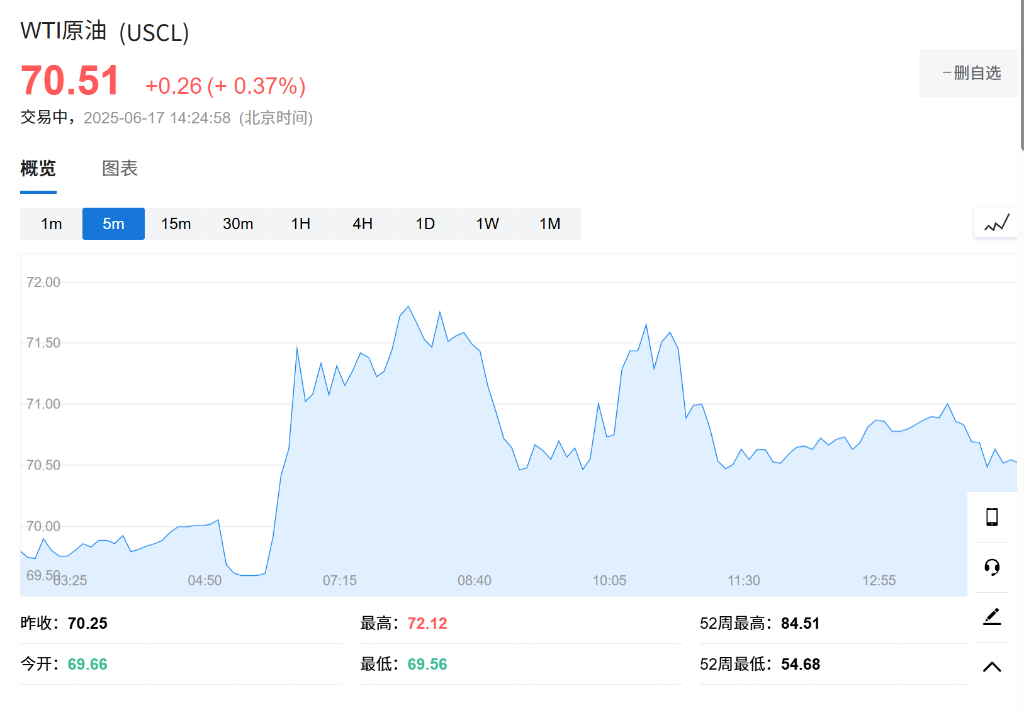
西德克萨斯中质油

Search documents
亚洲能源股下跌
Jin Rong Jie· 2026-01-16 00:30
Group 1 - Asian energy stocks declined following reports that the U.S. has postponed actions against Iran, leading to a significant drop in oil prices [1] - West Texas Intermediate crude oil fell by 4.6%, closing around $59 per barrel, after a previous week increase of 10% [1] - Early Friday trading saw Australian Woodside and Santos both down by 1.6%, while Japan's Inpex dropped by 2.6% and South Korea's S-Oil fell by 2.5% [1]

油价上涨,委内瑞拉不确定性主导市场情绪
Ge Long Hui A P P· 2026-01-06 15:41
格隆汇1月6日|油价收复失地,交易员正设法应对委内瑞拉原油产出前景的不确定性。布伦特原油和西 得州中质油在盘中稍早下跌后均上涨0.7%,分别报每桶62.21美元和每桶58.75美元。德国商业银行的分 析师表示:"委内瑞拉正在出现的政权更迭对石油供应有不同的影响。""短期内不确定性可能仍将很 高。"在接受NBC News采访时,美国总统特朗普暗示,美国可以补贴能源公司重建委内瑞拉石油产业 的努力,扩大后的业务将在不到18个月的时间内"投入运营"。 ...
高盛:2035年油价及俄乌局势影响:研究和交易视角
Goldman Sachs· 2025-12-04 15:36
Investment Rating - The report indicates a bearish outlook for oil prices in the short term, with expectations of a price decline due to oversupply, while a long-term recovery is anticipated post-2027, with Brent crude projected at $80 and WTI at $76 [2][6]. Core Insights - Current oversupply in the oil market is significant, with global visible inventories increasing by approximately 400 million barrels, averaging an increase of 1.8 million barrels per day [2][6]. - The geopolitical situation, particularly the Russia-Ukraine conflict, is influencing market dynamics, with potential negotiations being affected by external participants and battlefield stability [3][5]. - If sanctions against Russia persist, Brent crude prices are expected to range between $52 and $56 per barrel in 2026, with Russian oil production declining from 10 million barrels per day to 9 million barrels per day by 2027 [4][6]. - The market is currently not fully pricing in geopolitical risks, particularly regarding potential resolutions to the Russia-Ukraine conflict, which could significantly alter market conditions [5][6]. Summary by Sections Oil Price Forecast - Short-term oil prices are expected to decline due to a significant supply wave, with Brent and WTI averaging $56 in 2026. From 2027, prices are projected to recover to long-term estimates of $80 for Brent and $76 for WTI [2][6]. - The market is currently experiencing a supply surplus of about 2 million barrels per day, which is expected to continue unless there are major supply disruptions or significant OPEC cuts [2][6]. Geopolitical Impact - The ongoing Russia-Ukraine conflict is entering a negotiation phase, influenced by external factors, particularly the U.S. push for reconciliation and the diminishing external account surplus for Russia [3][4]. - Key negotiation areas include security guarantees and NATO expansion, which remain critical to the resolution process [3]. OPEC Strategy - OPEC is assessing its maximum sustainable capacity to ensure fair contributions from member states to market stability, with current spare capacity estimated at 2.5 to 3 million barrels per day, primarily in Saudi Arabia and the UAE [7]. - The organization aims to suppress non-OPEC supply and encourage demand to prepare for a tighter market in the future [7]. Investment Recommendations - Investors are advised to express views on the oversupply in 2026 by shorting summer time spreads. Producers should hedge against potential price declines in 2026, while consumers are encouraged to take measures to mitigate future price increases [8]. - Specific companies with potential include Valero, SLB, FTI, Chevron, and Suncor, each with unique strengths and strategies to navigate the current market environment [9][11].
特朗普和巴铁突然达成石油协议,是为了对抗中国、也向印度施压?
Sou Hu Cai Jing· 2025-08-04 15:57
巴基斯坦经济本来就摇摇晃晃,外债高,外汇储备少,靠中国贷款和投资过日子。现在美国来了,说帮你开发石油,还能吸引投资,这对巴基斯坦来说是块 肥肉,能分散风险。专家分析,这协议不光是油,还包括矿产、IT、加密货币等领域合作,等于美国在南亚重塑影响力,拉巴基斯坦入伙,免得它完全倒向 中国那边。 巴基斯坦的石油储备到底咋样?特朗普说"巨量",但数据可没那么夸张。根据美国能源信息署的估算,巴基斯坦探明石油储备大概在2.3亿到3.5亿桶之间, 天然气24万亿立方英尺,全球排名50开外。相比之下,印度石油储备有45亿桶左右,天然气1.3万亿立方米,中东那更是天文数字。巴基斯坦国内石油产量 只够需求的15-18%,天然气60%,剩下全靠进口,尤其是从中东,花了110亿美元一年,占进口总额的20%。 美国总统特朗普前几天突然扔出个大新闻,说跟巴基斯坦签了个协议,一起开发巴方那些所谓的巨量石油储备。时间是2025年7月30日,他自己在社交平台 上发的,语气还挺兴奋的,提到美国能源公司会带头干这活儿,甚至开玩笑说以后巴基斯坦没准儿能卖油给印度。这消息一出,南亚那边就炸锅了,尤其是 印度那边,觉得这是在给自己上眼药。巴基斯坦那边呢, ...

以伊冲突还在打,市场却已经翻篇了!
Hua Er Jie Jian Wen· 2025-06-17 07:48
Core Insights - The recent geopolitical tensions between Israel and Iran have led to surprising market reactions, with gold prices falling and U.S. Treasury yields rising, indicating a "risk-on" environment [1] - Historical data suggests that oil prices often anticipate conflicts and that significant increases in oil prices are required to trigger a recession in the West [2] - The S&P 500 index typically experiences a short-term decline following geopolitical shocks but tends to recover fully within a few weeks [4] Group 1: Market Reactions - Gold prices have decreased while U.S. Treasury yields have increased, reflecting a shift towards riskier assets [1] - The performance of stocks relative to long-term bonds has reached its strongest level since Trump's inauguration [1] - Oil prices have not surged despite the conflict, remaining significantly lower than their January peak [1] Group 2: Historical Context - Historical patterns indicate that oil prices need to double to potentially cause a recession, with current prices far below this threshold [2] - The S&P 500 index has historically shown resilience, with a median recovery time of 16 trading days after geopolitical events [4] Group 3: Risks and Considerations - Experts warn against complacency in the market, highlighting the potential for tail risks, including Iran's nuclear capabilities [5] - Probability analyses suggest varying outcomes from the conflict, with a notable risk of Iran achieving nuclear armament [5] Group 4: Bitcoin's Performance - Bitcoin has demonstrated characteristics of a safe-haven asset during the crisis, outperforming gold [6][8] - The perception of Bitcoin as a strategic asset is growing, influenced by regulatory developments and institutional interest [8]