西贝莜面村

Search documents
西贝命悬一线:贾国龙卸任CEO、大幅关店裁员丨36氪独家
36氪· 2026-03-06 09:56
Core Viewpoint - The article discusses the significant challenges faced by Xibei, a Chinese restaurant chain, including leadership changes, layoffs, and store closures, as well as the need for strategic adjustments to survive in a competitive market [7][12][24]. Group 1: Leadership Changes - Before the Spring Festival, Jia Guolong stepped down as CEO of Xibei, with former CEO Dong Junyi returning to the position, indicating a shift back to experienced leadership [7][8]. - Dong Junyi is perceived as more in touch with frontline operations, which may stabilize the company during turbulent times [7]. Group 2: Layoffs and Store Closures - Xibei announced significant layoffs due to a sharp decline in business volume, with plans to reduce the number of headquarters employees from over 500 to around 200 [9][10]. - The company has closed approximately 150 out of 350 stores, with discussions ongoing about further closures to ensure survival [11][12]. Group 3: Financial Strategies - Xibei is implementing cost-cutting measures, including reducing employee salaries and downsizing office space, as part of a broader effort to stabilize finances [14][19]. - The company is seeking to raise funds from investors, offering more favorable valuations than in the past, and has initiated internal fundraising among employees with profit-sharing incentives [19][22]. Group 4: Operational Adjustments - Xibei is shifting its operational focus, reducing the average customer spending by 20% and moving food preparation from central kitchens to individual stores to enhance service quality [23]. - The company is also adjusting its menu and marketing strategies to better align with consumer preferences, although challenges remain in achieving positive results [23][24]. Group 5: Market Position and Consumer Perception - Xibei's pricing strategy has come under scrutiny, with consumers perceiving the brand as expensive compared to competitors, which has affected customer satisfaction [34][45]. - The company has historically maintained high-quality ingredients, but this has not translated into consumer loyalty, highlighting a disconnect between cost and perceived value [39][46]. Group 6: Future Outlook - Investors express cautious optimism about Xibei's potential for recovery, noting the need for the company to focus on core business operations and improve cost management [63][64]. - The company faces a critical juncture where it must adapt to changing consumer demands and market conditions to ensure long-term viability [65][66].


西贝命悬一线:贾国龙卸任CEO、大幅关店裁员|独家
36氪未来消费· 2026-03-06 08:51
Core Viewpoint - The article discusses the challenges faced by Xibei, a Chinese restaurant chain, highlighting its significant operational struggles, management changes, and the need for strategic adjustments to survive in a competitive market [5][11][29]. Group 1: Management Changes - CEO Jia Guolong stepped down, and former CEO Dong Junyi returned to stabilize the company, indicating a shift towards experienced leadership [5][6]. - Xibei announced layoffs and a reduction in headquarters staff from over 500 to approximately 200, reflecting the company's dire financial situation [7][9]. - The company is closing stores aggressively, with reports indicating that 150 out of 350 stores have already shut down, and further closures are anticipated [10][11]. Group 2: Cost-Cutting Measures - Xibei is implementing cost-saving strategies, including reducing employee salaries and downsizing office space, as part of its efforts to manage expenses [12][13]. - The company is also seeking to raise funds from investors, offering more favorable terms than in previous rounds, indicating a desperate need for capital [20][21]. - Xibei's operational adjustments include a focus on reducing menu prices by 20% and shifting food preparation from central kitchens to individual stores to cut costs [28]. Group 3: Financial Struggles - The company has faced significant cash flow issues, with expenditures such as a 300 million yuan consumer voucher program exacerbating its financial strain [26]. - Xibei's net profit margin is reported to be between 3% and 5%, which is considerably lower than competitors like Haidilao and Yum China, indicating challenges in cost management [44][45]. - The company has been criticized for high operational costs, including expensive ingredients and employee wages, which have not translated into higher customer satisfaction or sales [46][56]. Group 4: Market Position and Consumer Perception - Xibei's pricing strategy has come under scrutiny, with consumers perceiving the brand as expensive without corresponding value, leading to declining customer traffic [52][59]. - The company has struggled to adapt to changing consumer preferences, particularly in a market increasingly focused on value and affordability [78][79]. - Despite past successes, Xibei's inability to align its offerings with current market demands has led to a significant decline in its competitive position [36][38].
新荣记入局!西贝获新一轮融资
Sou Hu Cai Jing· 2026-01-22 07:04
Group 1 - The core point of the article is that Inner Mongolia Xibei Catering Group Co., Ltd. has completed its Series A financing round, raising its registered capital by approximately 13.1% from 89.90 million RMB to 101.68 million RMB [2][4] - The financing round attracted diverse investors, including Taizhou Xinrongtai Investment Co., Ltd. and Hangzhou Zhouxuan Equity Investment Management Partnership, which may enhance Xibei's operational structure and digital transformation efforts [4] - Following the financing, the shareholding ratio of founder Jia Guolong and related parties has been diluted to about 26.16%, although he remains the actual controller and legal representative of the company [4] Group 2 - Xibei was founded in October 2017 in Hohhot, Inner Mongolia, and operates in various sectors including restaurant management and food sales, with a focus on the catering industry chain [3] - The company has registered multiple trademarks, including "Xibei" and "Xibei Small Beef Braised Rice," to strengthen its brand positioning in the food and catering sectors [3] - Xibei plans to achieve an IPO by 2026, aiming to become a company with a market value of 100 billion RMB [4]
来了,西贝A轮融资
Sou Hu Cai Jing· 2026-01-22 02:12
Core Insights - Inner Mongolia Xibei Catering Group Co., Ltd. has recently completed its Series A financing round, with new investors including Taizhou Xinrongtai Investment Co., Ltd. and others [2] - The registered capital of Xibei Catering has increased from 89.902896 million to 101.680175 million yuan, reflecting a growth of approximately 13.1% [2] - The founder, Jia Guolong, and some existing shareholders have seen their ownership percentages decrease to about 26.16% following the new investment [2] - Xibei plans to undergo a brand renewal in 2025, with Jia Guolong taking on the role of CEO and emphasizing the brand's core values [3] - The company aims to open its first overseas store in Los Angeles in 2025, marking the beginning of its globalization efforts [3] - Xibei has plans for an IPO in 2026, as stated by Jia Guolong [4] Financing Details - Xibei has completed three previous financing rounds before the recent Series A, including an angel round in October 2017 and a strategic round in July 2021 [6] - The specific amounts for the previous financing rounds have not been disclosed [6] - The latest financing round is part of a broader strategy to enhance the company's market position and prepare for future growth [2][6] Company Overview - Founded in October 2017, Xibei Catering Group is the successor to a restaurant business established in 1988 [2] - By 2025, Xibei is projected to operate nearly 400 stores across 62 cities in China, employing approximately 17,000 people [2] - The company operates several brands, including Xibei Youmian Village and Xibei Seafood, with over 380 direct-operated stores and annual sales exceeding 6 billion yuan [2]

2026年,西贝还能上市吗?
Sou Hu Cai Jing· 2026-01-16 11:32
Group 1 - The core point of the article revolves around the recent announcement by Xibei's founder, Jia Guolong, regarding the closure of 102 stores, which represents about 30% of the total stores, affecting approximately 4,000 employees [6][7] - Xibei's revenue exceeded 6.2 billion yuan in 2023, and as of November 11, 2025, the number of stores had reached 354 [4] - The controversy began when a public figure criticized Xibei's food quality and pricing, leading to a public relations crisis for the company, which Jia Guolong attempted to address through various self-rescue measures [4][6] Group 2 - Jia Guolong's ambition for Xibei to go public by 2026 and achieve a market value exceeding 100 billion yuan is now in question following the recent turmoil [12][13] - Historically, Jia Guolong had expressed a strong stance against going public, stating "Xibei will never go public," but this position has evolved due to changing economic conditions and the need for capital [8][10] - The article suggests that Jia Guolong's personality traits, including stubbornness and pride, may have contributed to the current challenges faced by Xibei, potentially jeopardizing its future as a public company [15][19]
华与华创始人华杉称西贝“被人算计”,罗永浩回怼:谁算计了
YOUNG财经 漾财经· 2025-11-26 04:37
Core Viewpoint - The ongoing controversy surrounding the West Be restaurant brand involves accusations of manipulation and miscommunication between its brand consultant, Hua Yu Hua, and public figures like Luo Yonghao, highlighting the complexities of crisis management in the food industry [2][3][5]. Group 1: Controversy and Responses - Hua Yu Hua, founder of Hua Yu Hua Marketing Consulting, claims that West Be is "being manipulated" amidst discussions about employee salary increases [3]. - Luo Yonghao responded to Hua's claims by questioning who is manipulating the situation and threatened to disclose recordings if clarity is not provided [3]. - The controversy has reignited public interest, especially following a previous incident in September regarding West Be's "pre-made dishes," where Hua defended the brand's integrity against accusations [5][6]. Group 2: Brand Consulting and History - Hua Yu Hua has been a brand consultant for West Be since 2013, contributing to various marketing strategies and brand identity initiatives, including the creation of the "I♥莜" symbol and the simplification of the menu from over 100 dishes to 44 [6][7]. - The firm specializes in corporate image planning and marketing strategy, with Hua Yu Hua holding a 53% stake in the company [7].
谁投资了西贝?
经济观察报· 2025-09-18 12:10
Core Viewpoint - The article discusses the recent developments surrounding Inner Mongolia Xibei Catering Group Co., Ltd. and its chairman, Jia Guolong, particularly in light of the ongoing dispute with internet celebrity Luo Yonghao regarding prepared dishes, which has drawn significant attention from the capital market [1][3]. Group 1: Shareholding Structure - Xibei's registered capital is 89.9029 million yuan, and it was established on October 10, 2017. The company has 11 executives, including 8 directors and 3 supervisors, with Jia Guolong serving as both chairman and general manager [6]. - Jia Guolong is the actual controller of Xibei, holding over 80% of the shares, with the main shareholders being Beijing Xibei Enterprise Management Co., Ltd. (40.61%), Jia Guolong (29.59%), and others [7][8]. - The shareholding structure includes 34 limited partnership enterprises as employee stock ownership platforms, allowing core executives and outstanding employees to share in the company's benefits while ensuring the founder's control remains unaffected [8][9]. Group 2: External Investment and Acquisition - The acquisition of Chengdu Xinchao Media Group Co., Ltd. by Focus Media (分众传媒) for 8.3 billion yuan will indirectly make Jiang Nan Chun, the media tycoon, a shareholder of Xibei, as Xinchao holds a 1% stake in Xibei [2][3][12]. - The acquisition is still pending completion, and once finalized, Focus Media will become the indirect shareholder of Xibei, further complicating the ownership structure [3][12]. - The external investment institutions include Qingdao Jingheng, Beijing Jingheng, and Xinchao Media, with the latter being a significant player in the media industry [12][13].


谁投资了西贝?
Jing Ji Guan Cha Wang· 2025-09-18 06:09
Core Viewpoint - Fenjiu Media is set to become a shareholder of Xibei, with Jiang Nan Chun indirectly becoming a shareholder through the acquisition of Chengdu Xinchao Media Group for 8.3 billion yuan [2][11]. Group 1: Acquisition Details - The acquisition of Chengdu Xinchao Media Group by Fenjiu Media is valued at 8.3 billion yuan, and the deal is not yet finalized [2]. - Chengdu Xinchao Media holds a 1% stake in Xibei, making Fenjiu Media an indirect shareholder of Xibei upon completion of the acquisition [2][11]. Group 2: Xibei's Ownership Structure - Xibei, founded by Jia Guolong, has a registered capital of 89.9 million yuan and has been operating for over 20 years [3]. - Jia Guolong is the actual controller of Xibei, holding over 80% of the shares, with a total of 10 shareholders [3][4]. Group 3: Shareholder Composition - The major shareholders of Xibei include Beijing Xibei Enterprise Management Co., Ltd. (40.61%), Jia Guolong (29.59%), and several limited partnerships [4][5]. - Xibei has established a complex ownership structure with 34 limited partnerships to incentivize employees and maintain control [6][7]. Group 4: External Investors - External investors in Xibei include Qingdao Jingheng, Beijing Jingheng, and Xinchao Media, with Xinchao Media being a significant player in the acquisition [9][11]. - The actual controller of Beijing Jingheng is Liu Yongyan, who has a background in fund management [10].

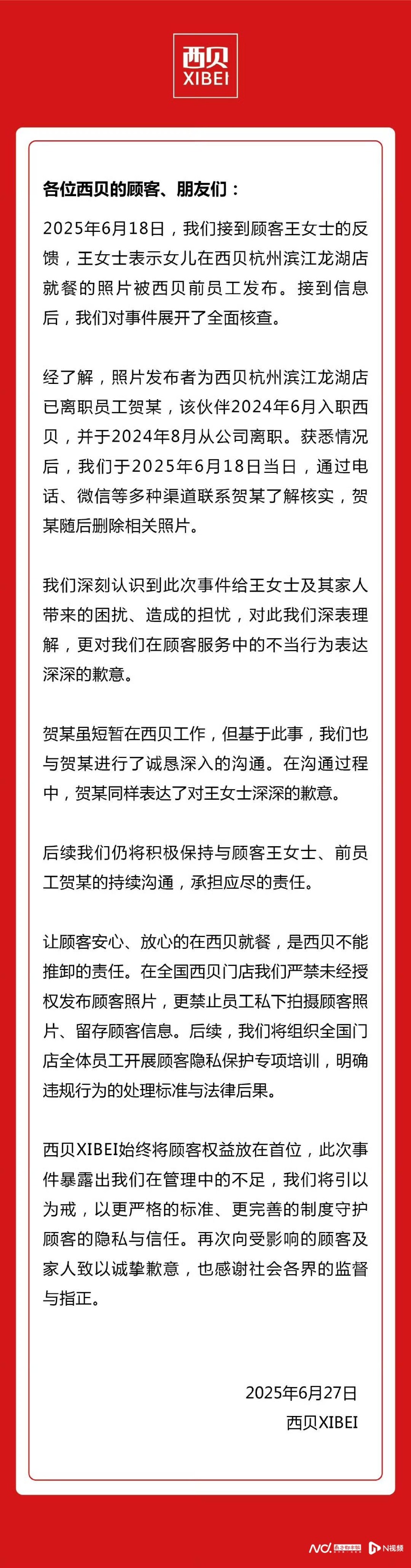
员工拍摄就餐小朋友照片并发在社交平台上,西贝道歉了
Nan Fang Du Shi Bao· 2025-06-27 07:54
Core Viewpoint - The incident involving a former employee of Xibei taking unauthorized photos of a child in the restaurant has raised significant concerns about customer privacy and trust in the brand [1][2][5]. Group 1: Incident Details - A customer reported that a male employee at Xibei's Hangzhou Binjiang store took a photo of her child and used it as his social media background [1]. - The employee, who has since left the company, apologized and deleted the photo after the customer requested its removal [2][4]. - The customer expressed her dissatisfaction with the handling of the situation and stated she would no longer dine at Xibei [1]. Group 2: Company Response - Xibei issued a public apology and stated that they are conducting a thorough investigation into the incident [2][5]. - The company emphasized that unauthorized publication of customer photos and private information is strictly prohibited in all its locations [5]. - Xibei plans to implement privacy protection training for all employees to prevent similar incidents in the future [5]. Group 3: Company Background - Xibei Catering Group was founded in 1998 and operates multiple brands, including Xibei Youmian Village and Xibei Seafood [6]. - As of May 2025, Xibei has nearly 400 locations nationwide and has been focusing on children's meals, with over 20 million children's meals sold in 2024, generating over 500 million yuan in sales [6].
贾国龙没学好任正非
Sou Hu Cai Jing· 2025-06-19 07:22
Core Insights - The article discusses the challenges faced by Xibei, a restaurant chain founded by Jia Guolong, as it navigates a significant downturn in 2024 after a strong performance in 2023 [3][6] - Jia Guolong's decision to return as CEO in 2024 is a response to the company's struggles, marking a pivotal year in his nearly 40-year entrepreneurial journey [4][5] Company Performance - In 2023, Xibei achieved record revenue exceeding 6.2 billion yuan, with Xibei Youmian Village generating 2 billion yuan in net sales and serving 37.66 million customers [6][8] - However, in 2024, the company faced a drastic decline in customer traffic and overall performance, leading to what Jia described as the "most difficult year" since its establishment [3][6] Market Environment - The domestic restaurant industry in 2024 is characterized by complex challenges, including increasingly diverse consumer demands and intensified competition from emerging brands [8][30] - Xibei's struggles are compounded by its past strategic decisions, including a focus on multiple sub-brands that have not yielded expected returns [9][29] Strategic Decisions - After stepping down as CEO in 2015, Jia Guolong attempted to explore new growth avenues through various sub-brands, but most of these initiatives failed, leading to significant financial losses [9][11] - In response to the current challenges, Jia has refocused on Xibei's core business, eliminating underperforming sub-brands and emphasizing the main brand strategy [26][28] Brand Evolution - Xibei has undergone significant brand evolution, including a name and logo change to simplify its identity and enhance brand recognition [27] - The company has implemented a new incentive structure for employees, shifting from quarterly to daily rewards to boost morale and performance [28] Historical Context - Xibei's journey began in 1988, with Jia Guolong's unconventional approach leading to its rise as a prominent brand in the Chinese restaurant industry [14][16] - The company's early success was driven by strict standardization in service and food quality, which has been a key factor in its growth [18][19] Challenges and Future Outlook - The article highlights the risks associated with Xibei's over-reliance on Jia Guolong's personal vision, which may not align with evolving market demands [29][31] - The shift towards an IPO strategy reflects a significant change in the company's approach to capital and growth, with plans to complete the IPO by 2026 [32]