豆包输入法

Search documents
AI时代,为什么我极力推荐你开始写日记?
虎嗅APP· 2026-03-03 10:28
Core Viewpoint - In the AI era, keeping a diary serves as a genuine anchor for one's existence in the world, emphasizing the importance of documenting personal experiences and thoughts to maintain a sense of self amidst the overwhelming influence of AI [9][50][62]. Group 1: Importance of Diary Keeping - The act of diary writing is highlighted as a necessary practice, transforming from a good habit to an essential one in the AI age, where the cost of neglecting it increases over time [50][51]. - The author reflects on the fleeting nature of daily experiences and the need to capture them, as unrecorded life can feel as if it never happened [63][70]. Group 2: Methods of Recording - A simple method for diary keeping is proposed: using voice memos instead of traditional writing, which reduces psychological pressure and encourages spontaneity [30][38]. - The recommendation is to record thoughts and feelings verbally, allowing for a more authentic expression without the editing process that comes with writing [39][41]. Group 3: The Role of AI - AI is acknowledged for its capabilities in content generation, but it raises questions about the authenticity of personal expression and the risk of losing one's unique voice [52][56][60]. - The author suggests that while AI can assist in reviewing and summarizing diary entries, the original content must come from the individual to retain its authenticity [46][47]. Group 4: Personal Reflection and Growth - The diary serves as a tool for self-reflection, helping individuals recognize patterns in their emotions and experiences over time [46][74]. - By documenting daily life, one can combat the homogenization of experiences and appreciate the uniqueness of each day, fostering a deeper connection to personal history [73][74].


AI时代,为什么我极力推荐你开始写日记?
数字生命卡兹克· 2026-03-02 02:52
Core Viewpoint - In the AI era, keeping a diary serves as a genuine anchor for one's existence in the world, emphasizing the importance of documenting personal experiences and thoughts to maintain a sense of self amidst the overwhelming influence of AI [6][57]. Group 1: Importance of Diary Keeping - Two influential figures, Ma Boyong and Luo Zhenyu, have recently emphasized the need to keep a diary, highlighting that memory is unreliable and that documenting daily experiences is essential [5][6]. - The author reflects on the past three years, noting that despite being busy and producing content, very few personal experiences were documented, leading to a sense of lost time [6][72]. - The act of writing a diary is seen as a way to combat the compression of time and to capture the unique moments of daily life, which might otherwise be forgotten [71][72]. Group 2: Methodology for Diary Keeping - The recommended method for diary keeping is to use voice recording instead of writing, which reduces psychological pressure and allows for more spontaneous expression [15][20]. - The author suggests using a simple voice memo app to record thoughts and experiences, making the process more accessible and less daunting [18][20]. - The distinction between speaking and writing is emphasized, as speaking allows for a more authentic expression of thoughts without the interference of editing [23][28]. Group 3: The Role of AI - AI can assist in reviewing and summarizing diary entries, helping individuals identify patterns and insights from their recorded experiences [36][39]. - However, the original content must be personal and authentic; otherwise, the essence of the individual's voice may be lost [39][56]. - The article warns against relying too heavily on AI for content creation, as it can blur the lines of personal expression and authenticity [51][56].

AI语音输入法,人类进入「不打字」时代
36氪· 2026-01-30 13:35
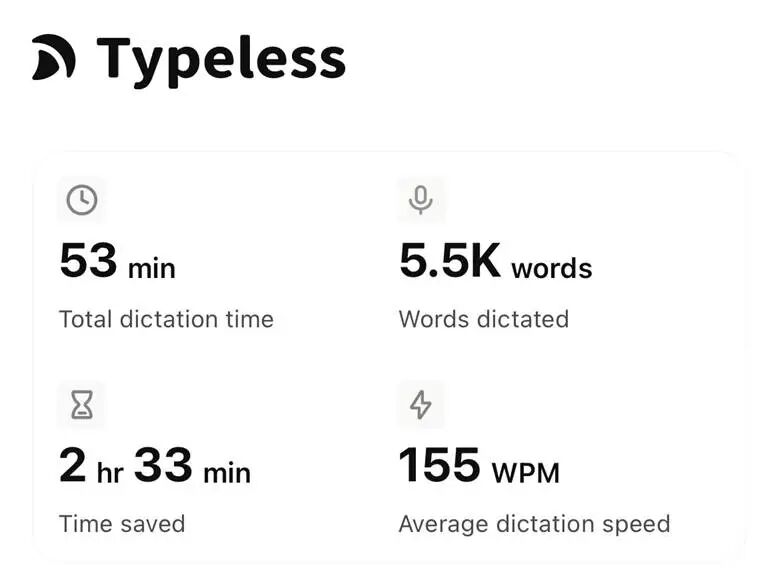
Core Insights - The article discusses the rapid rise of AI voice input technology, highlighting its potential to revolutionize the way people interact with devices, moving from traditional typing to voice commands [6][21][32]. Group 1: Industry Trends - Starting from the second half of 2025, AI voice input methods are expected to become a significant trend, with major players like Sogou and emerging startups like Typeless leading the charge [6][21]. - Sogou's voice input boasts a recognition rate of 98% and an average daily usage of nearly 20 billion times, indicating its dominance in the industry [6][15]. - The financing of Wispr Flow has reached $81 million, with a valuation of $700 million, showcasing investor interest in this sector [6]. Group 2: Performance Metrics - AI voice input methods are reported to be significantly faster than traditional typing, with speeds reaching up to 250 words per minute for voice input compared to 130 words per minute for top typists [12][15]. - Studies indicate that voice input is approximately three times faster than typing, with error rates for voice input at 6.67% compared to 17.73% for keyboard input [14][15]. - Newer voice input technologies, such as those from Typeless and LazyTyper, claim to be four to seven times faster than typing, with accuracy rates around 97.8% [15][18]. Group 3: User Experience - Users report a significant shift in their input habits, with many transitioning from typing to voice input within a short period, citing time savings and increased efficiency [7][34]. - Voice input can function effectively even in low-noise environments, with Sogou claiming a 97% accuracy rate at sound levels as low as 20 decibels [18]. - The technology allows for more natural interaction, enabling users to express complex thoughts in a single voice command rather than multiple typed inputs [35][36]. Group 4: Future Outlook - The article suggests that AI voice input could evolve into a "super entry point" for applications, potentially integrating across different platforms and enhancing user interaction [22][23]. - There is a belief that voice input will eventually replace traditional typing methods, as it aligns more closely with natural human communication [27][32]. - The anticipated advancements in AI voice technology could lead to a future where dedicated input methods are no longer necessary, as systems become more intuitive and capable of understanding user intent [26][36].

马化腾不看好的「豆包手机」,杀出「围剿」丨36氪独家
36氪· 2026-01-29 13:31
Core Viewpoint - The article discusses the emergence of AI-driven innovations in the smartphone industry, focusing on the challenges and strategies of Doubao Phone, a product by ByteDance, in navigating competitive pressures and technological advancements [6][8]. Group 1: Doubao Phone's Challenges and Responses - Tencent's CEO, Ma Huateng, criticized Doubao Phone for its cloud data handling practices, highlighting security concerns [6]. - Doubao Phone faced significant backlash shortly after its launch in December 2025, leading to a near-total shutdown of its AI functionalities due to restrictions imposed by major internet companies [7]. - Despite these challenges, ByteDance is moving forward with the Doubao Phone Assistant project, with a new model expected to launch in Q2 2026 [9]. Group 2: Strategic Partnerships and Negotiations - To avoid further restrictions, Doubao Phone is negotiating with mainstream application developers to secure necessary permissions for its AI functionalities [10]. - The strategy includes maintaining its system-level GUI Agent approach while also exploring partnerships with various smartphone manufacturers [10][11]. - For major manufacturers like OPPO and vivo, the collaboration focuses on technical integration, while for smaller brands, Doubao aims to embed its AI directly into their devices [11][12]. Group 3: Market Dynamics and Competitive Landscape - The Chinese smartphone market is characterized by a few dominant players, with the remaining brands sharing a small market segment [14]. - Doubao's strategy includes leveraging partnerships with lesser-known brands to create a competitive edge, potentially allowing it to penetrate the market more effectively [14][15]. - The article notes that Doubao's AI capabilities could provide a significant advantage to smaller manufacturers struggling in a challenging market environment [15]. Group 4: Future Hardware Developments - ByteDance is also exploring additional hardware options, including AI glasses and headphones, which will integrate Doubao's AI capabilities [16][17]. - The AI glasses are set to launch in late 2026, with features aimed at enhancing user interaction through hands-free operation [16][17]. - The overarching goal is to establish Doubao's AI as a standard feature across various hardware, enhancing user engagement and ecosystem stickiness [18]. Group 5: International Expansion and Competitive Positioning - Doubao is in discussions with international manufacturers to expand its presence in overseas markets, aiming to integrate its assistant into their devices [19]. - ByteDance possesses strong capabilities in models, talent, and data, positioning Doubao as a suitable vehicle for leveraging these assets in the hardware space [20]. - The company is prepared to invest heavily in exploring new opportunities in the AI hardware landscape, reflecting a bold approach to market challenges [21].

预计Q2中晚期发布!豆包手机卷土重来:从“被围剿”,到“反围剿”
3 6 Ke· 2026-01-29 06:55
Core Insights - Tencent's CEO Ma Huateng criticized Doubao Phone for its cloud data handling, labeling it "extremely unsafe and irresponsible" [1] - Doubao Phone faced significant challenges shortly after its launch, including a blockade from major internet companies due to its AI Agent's impact on their core data [1] - Despite setbacks, Doubao Phone is set to release a new version in Q2 2026, with expectations for improved performance [2] Group 1: Doubao Phone's Challenges and Responses - Doubao Phone's initial AI features were severely restricted by major apps like WeChat and Meituan, leading to a near-total shutdown of its AI capabilities [1] - The company is negotiating with mainstream app developers to secure necessary permissions for its AI functionalities [3] - Doubao Phone's strategy includes using a system-level GUI Agent to bypass API authorization challenges, allowing it to operate independently of app developers [3] Group 2: Partnerships and Market Strategy - Doubao Phone is pursuing two types of partnerships: technical collaborations with major brands like OPPO and aggressive negotiations with smaller brands to embed its AI directly into their devices [4][5] - The company aims to charge phone manufacturers for technology licensing and AI service subscriptions, indicating a clear monetization strategy [5] - Doubao Phone's approach to smaller manufacturers includes embedding its AI as a standard feature, potentially increasing its market penetration [6][7] Group 3: Future Hardware Developments - Doubao is expanding beyond smartphones, with plans for AI glasses and headphones, indicating a broader vision for integrating AI across various hardware [8][9] - The AI glasses are expected to launch in late 2026, with a focus on seamless user interaction and hands-free operation [9] - Doubao's ambition is to make its AI capabilities a standard feature across all hardware, enhancing user engagement and ecosystem stickiness [10][11] Group 4: Competitive Landscape - Doubao's competitive positioning is strengthened by its extensive data and brand recognition, making it a formidable player in the AI hardware space [11] - The company is also exploring international partnerships to expand its AI assistant capabilities in overseas markets [10]
豆包手机卷土重来:从“被围剿”,到“反围剿”丨智能涌现独家
3 6 Ke· 2026-01-29 05:10
Core Viewpoint - Tencent's CEO Ma Huateng criticized Doubao Phone for its cloud data handling, emphasizing security concerns, which highlights the challenges faced by Doubao Phone in the competitive landscape of mobile technology [1][2]. Group 1: Doubao Phone's Development and Challenges - Doubao Phone's AI Agent faced significant backlash shortly after its launch in December 2025, leading to a near-total shutdown of its AI functionalities due to restrictions imposed by major internet companies [1]. - Despite initial setbacks, Doubao Phone is set to launch its second-generation device in late Q2 2026, with expectations for substantial improvements over the first generation [2]. - The team behind Doubao Phone is negotiating with mainstream application developers to secure necessary permissions, while maintaining its original system-level GUI Agent approach to avoid reliance on API access [3][4]. Group 2: Strategic Partnerships and Market Position - Doubao Phone is pursuing two types of partnerships: technical collaborations with major manufacturers like OPPO and vivo, and more aggressive negotiations with smaller brands to embed Doubao AI directly into their devices [4][5]. - The competitive landscape shows that the top six smartphone manufacturers in China have nearly equal market shares, leaving smaller brands to share the remaining market space, which Doubao aims to penetrate [7][8]. Group 3: Future Hardware and Ecosystem Expansion - Doubao is diversifying its hardware offerings beyond smartphones, with plans for AI glasses and headphones, aiming to integrate its AI capabilities across various devices [9][10]. - The goal is to create a seamless user experience where interactions with Doubao AI can occur through multiple hardware interfaces, enhancing user engagement and ecosystem stickiness [10][12]. - Doubao's strategy includes exploring international markets by negotiating with manufacturers like vivo to incorporate Doubao Phone Assistant into their overseas models [10][12].
AI语音输入法,人类进入“不打字”时代
3 6 Ke· 2026-01-29 04:13
Core Insights - The rise of AI voice input methods is transforming user behavior, with significant advancements in speed and accuracy compared to traditional typing methods [1][4][12]. Group 1: Industry Trends - Starting from the second half of 2025, AI voice input methods have become a new trend, with major players like Doubao and Zhipu launching competitive products [1][4]. - Sogou's voice input claims a recognition rate of 98% and an average daily usage of nearly 2 billion times, leading the industry [1]. - New entrants like Typeless have gained traction, achieving high rankings on platforms like Product Hunt and raising significant funding [1][4]. Group 2: Performance Metrics - AI voice input methods can achieve speeds of up to 250 words per minute, significantly surpassing traditional typing speeds, which average around 90 words per minute [6][8]. - Studies indicate that voice input is approximately three times faster than typing, with error rates for voice input being significantly lower than for keyboard input [7][8]. - Companies like Sogou and Zhipu report accuracy rates of 98% and 97.8%, respectively, validating the effectiveness of these technologies [8]. Group 3: User Experience - Users report a shift in their writing habits, with voice input allowing for more flexibility and comfort, enabling writing in various settings [25]. - Voice input is seen as a more natural form of communication, aligning with human behavioral patterns, as it is rooted in the historical use of spoken language [17][18]. - The technology is evolving to not only transcribe speech but also understand context and intent, enhancing the overall user experience [8][12]. Group 4: Future Outlook - The potential for AI voice input to serve as a "super entry point" for applications is being explored, suggesting a shift towards system-level AI assistants that could integrate across various platforms [14][16]. - The ongoing development in AI voice recognition technology indicates that voice input may eventually replace traditional typing methods, although full replacement is not expected in the short term [23][24].
输入法“变笨”了吗?
经济观察报· 2026-01-11 07:29
Core Viewpoint - The article discusses the challenges faced by input method applications in the era of AI, highlighting user frustrations with accuracy and excessive advertisements, despite significant investments from major tech companies in enhancing these tools [2][4][14]. Group 1: User Experience Issues - Users are increasingly dissatisfied with input methods, reporting issues such as inaccurate word predictions and excessive advertisements, which detract from the overall user experience [2][4]. - A specific case is mentioned where a long-time user of Sogou Input Method uninstalled the app due to frequent incorrect suggestions, indicating a decline in basic functionality despite advanced AI features [4]. - Complaints about the voice recognition capabilities of input methods have also surfaced, with users noting that corrections often take longer than typing the text directly [4]. Group 2: AI Integration and Competition - Major input method providers, including Sogou, Baidu, and iFlytek, are engaged in a competitive race to integrate advanced AI capabilities into their products, aiming to enhance user experience and functionality [2][8][9]. - The input method market is characterized by a concentrated structure, with leading companies holding a combined market share of 84.4% as of July 2025, indicating a competitive landscape [8]. - Input methods are evolving from simple typing tools to becoming the primary interface for AI interactions, with companies aiming to position their products as essential gateways to AI capabilities [9][10]. Group 3: Commercialization and Privacy Concerns - Input methods face challenges in monetization, struggling with a "high traffic, low value" dilemma, which complicates their ability to generate revenue despite having a large user base [15][16]. - Privacy concerns are paramount, as input methods have been criticized for collecting unnecessary personal information, leading to regulatory scrutiny and the need for companies to adapt their data collection practices [16]. - Companies are implementing features that allow users to choose between different modes of data collection, balancing functionality with privacy protection [16]. Group 4: Future Directions - The future of input methods is seen as a shift towards becoming intelligent agents that can understand user intent and context, moving beyond basic text input to more complex interactions [12]. - Companies are exploring multi-modal input methods that incorporate voice, text, and images, which require sophisticated algorithms and technology to manage effectively [17].



输入法“变笨”了吗?
Jing Ji Guan Cha Wang· 2026-01-11 03:41
Core Insights - The article discusses the challenges faced by input method applications, particularly focusing on Sogou Input Method, as it approaches its 20th anniversary in 2026. Despite advancements in AI capabilities, user experience has deteriorated, leading to complaints about inefficiency and inaccuracies in word prediction and voice recognition [2][3][5]. User Experience Issues - Users express frustration over the declining accuracy of input methods, with complaints about incorrect word suggestions and excessive advertisements disrupting their experience [3][5][6]. - A long-time user of Sogou Input Method reported issues with common character suggestions, indicating a failure to learn user habits despite repeated corrections [4][5]. AI Integration and Competition - Major input method companies, including Tencent's Sogou, Baidu, and iFlytek, are engaged in a competitive race to integrate advanced AI features into their products, aiming to enhance user experience and functionality [3][9][10]. - The input method market is characterized by a concentrated structure, with leading companies holding a combined market share of 84.4% as of July 2025, indicating a fierce competition for user engagement and AI capabilities [9]. Future Development Goals - Sogou Input Method aims to evolve into a "super entrance" for AI, allowing users to interact with AI agents through the input method, which is seen as a key direction for future development [10][11]. - Baidu Input Method also seeks to position itself as a reliable smart entry point for user expression, leveraging AI to enhance communication and collaboration [11][12]. Commercialization Challenges - Input methods face a "high traffic, low value" monetization dilemma, struggling to effectively convert user engagement into revenue [16][17]. - Privacy concerns have led to increased scrutiny and regulatory challenges, prompting companies to adapt their data collection practices to ensure user safety and compliance [18][19]. Technological Limitations - Despite advancements in AI algorithms, challenges remain in accurately understanding user intent, particularly in word prediction, due to the variability in user language habits and the quality of training data [13][19]. - The complexity of multi-modal interactions, where users input data through various means, requires sophisticated algorithms and technology to ensure seamless processing [19].
亲身体验后,我们总结了全网首份AI语音输入法红黑榜|锦秋AI实验室
锦秋集· 2026-01-08 14:57
Core Viewpoint - The article evaluates seven AI voice input tools across five real-life scenarios to determine which can accurately transcribe spoken language into written text, focusing on their ability to maintain the integrity of the original message and avoid misinterpretations [1][3][36]. Group 1: Evaluation Methodology - The evaluation involves a comparative analysis of seven AI voice input tools, assessing their performance in various scenarios such as casual conversations and meeting minutes [2][6]. - The assessment criteria include text consistency, local quality (handling of homophones, numbers, and punctuation), and overall user experience [11][28]. Group 2: Performance Results - In the first round of testing, tools like Sogou, iFly, and Doubao demonstrated high accuracy in transcribing casual conversations, maintaining key information effectively [10][19]. - The second round focused on meeting minutes, where Typeless and Doubao excelled in structuring information clearly, while Sogou and iFly struggled with critical errors that could lead to miscommunication [17][25]. - The third round tested mixed-language input, revealing that Doubao and Typeless maintained accuracy in technical terms, while Sogou and iFly faced significant issues with misinterpretation [26][30]. Group 3: Key Findings - The analysis concluded that the ability to accurately transcribe and maintain the original meaning of spoken language is crucial, especially in professional settings where errors can lead to serious misunderstandings [36]. - Typeless emerged as the top choice for structured documentation, while Doubao was recognized for its overall reliability in various scenarios [38][40]. - Tools like Sogou and Flash Talk were deemed unsuitable for high-stakes environments due to frequent critical errors that could compromise communication [40].