超省系列

Search documents
大润发首交“三年路线图”:欲将近5成业绩转型线上
Hua Er Jie Jian Wen· 2025-11-12 11:33
Core Viewpoint - The retail sector, particularly traditional supermarkets, continues to face significant pressure, with high competition and weak consumer demand leading to declining revenues for companies like Gao Xin Retail, the parent company of RT-Mart [1][2]. Financial Performance - Gao Xin Retail reported a revenue of 30.502 billion yuan for the six months ending September 30, a year-on-year decline of 12.1%, with merchandise sales down 12.4% [1]. - The company recorded a loss of 127 million yuan in the first half of the 2026 fiscal year, following a brief profitability in the 2025 fiscal year [2]. Strategic Initiatives - Following the acquisition by Dehong Capital, RT-Mart introduced a "three-year strategy" focusing on enhancing product differentiation and cost advantages through national procurement and private label upgrades [3]. - The company established a dual-brand matrix for its private label products, featuring the "Super Savings" series and "RT-Mart Selected" to cater to different customer segments [3]. Store Optimization - RT-Mart is optimizing its store layout to enhance customer experience, including changes like shorter shelves, reduced shelf height, and creating fresh food areas for immediate consumption [4]. - The new generation of large supermarkets will have a controlled area of 6,000 to 7,500 square meters, with a streamlined product range of approximately 15,000 SKUs [5]. Online Sales Growth - Online sales are expected to be a significant growth driver, with the company launching a front warehouse project in five cities, averaging 500 square meters per warehouse and daily sales of about 50,000 yuan [6]. - Gao Xin Retail aims to increase the online sales contribution to 40-50% over the next three years, although current online sales show a trend of increasing volume but decreasing prices [7]. Brand Contribution and Comparisons - As of September 30, the combined sales contribution from RT-Mart's dual brands was over 2% [8]. - In comparison, Yonghui Supermarket, which has been implementing similar brand strategies, reports a sales contribution from its private labels ranging from 5% to 15% [9]. Future Plans and Challenges - The company plans to complete over 30 store renovations by the end of the 2026 fiscal year and over 200 by the end of the 2027 fiscal year, which may lead to short-term financial pressures [10].
高鑫零售中期营收305亿元 未来聚焦三大核心方向
Zhong Guo Jin Rong Xin Xi Wang· 2025-11-12 04:35
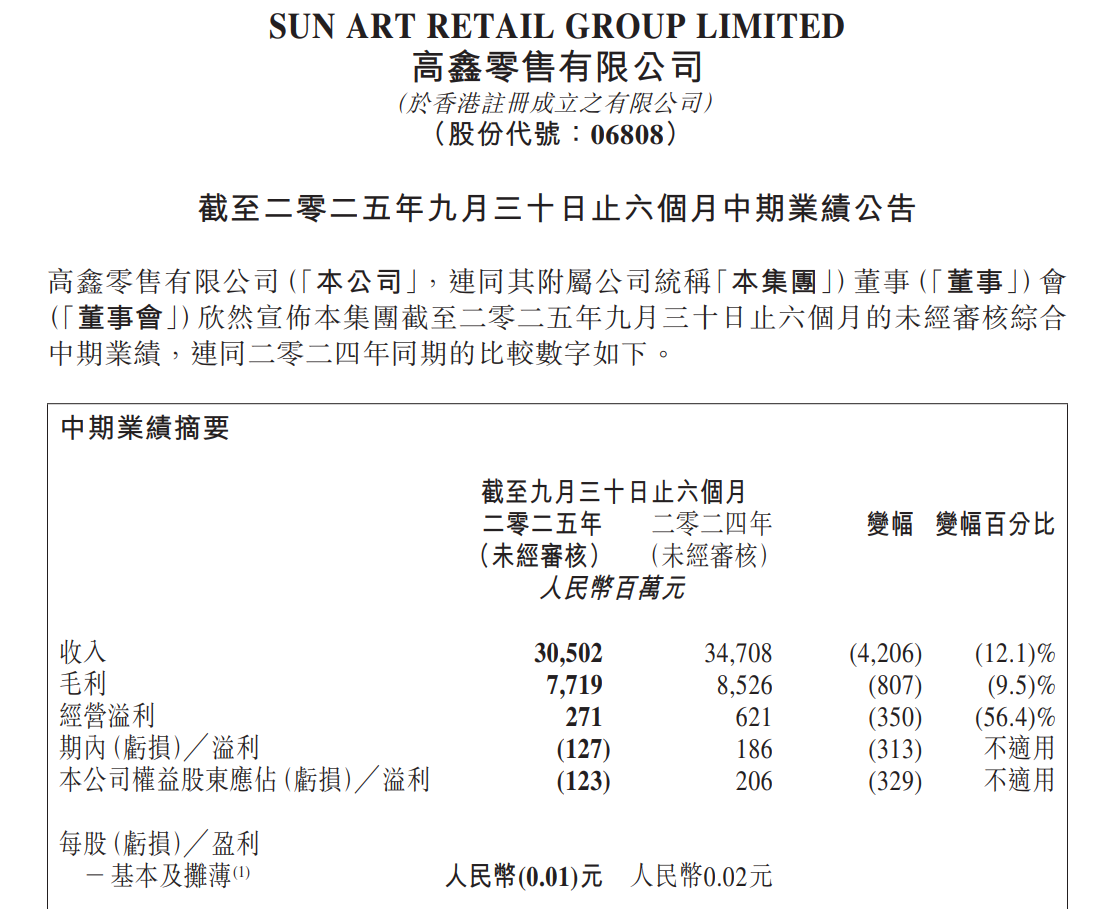
Core Viewpoint - Gao Xin Retail's interim performance report for the six months ending September 30, 2025, shows a decline in revenue and profit, but the company is focusing on online growth and operational efficiency to drive future performance [1][2][3] Financial Performance - The company reported revenue of RMB 30.502 billion, a decrease of 12.1% compared to RMB 34.708 billion in the same period last year [2] - Gross profit was RMB 7.719 billion, down 9.5% from RMB 8.526 billion year-on-year [2] - Operating profit fell significantly by 56.4% to RMB 271 million from RMB 621 million [2] - The company recorded a net loss of RMB 127 million, compared to a profit of RMB 186 million in the previous year [2] Business Operations - Online B2C business showed robust performance with a same-store order growth of approximately 7.4%, contributing to a same-store sales increase of about 2.1% [2][3] - The company initiated a front warehouse project aimed at exploring new growth points in online business, leveraging existing resources for efficient local delivery [3] - The self-owned brand strategy was upgraded with the launch of a "1+1 dual brand matrix," contributing over 2% to overall performance [3] Strategic Focus - The company plans to focus on three core areas: streamlining and differentiating products, enhancing store modifications to improve customer experience, and accelerating the front warehouse network expansion to capture online market growth [3] - Following the sale of Gao Xin Retail to Dehong Capital, which now holds a 79.16% stake, the company is entering a new phase of transformation away from Alibaba [3]

高鑫零售发布2026财年上半年财报,预计下财年之前完成逾200家门店调改
Yang Zi Wan Bao Wang· 2025-11-11 15:21
Core Insights - Gao Xin Retail Co., Ltd. reported a revenue of RMB 30.502 billion for the six months ending September 30, 2025, with a gross margin of 25.3%, an increase of 0.7 percentage points year-on-year, and a net cash position of RMB 11.958 billion [1] Group 1: Financial Performance - The company's revenue reached RMB 30.502 billion, reflecting a solid financial performance [1] - The gross margin improved to 25.3%, indicating enhanced profitability [1] - The net cash position stood at RMB 11.958 billion, showcasing strong liquidity [1] Group 2: Business Operations - Online B2C business showed robust performance with a same-store order growth of approximately 7.4%, contributing to a same-store sales increase of about 2.1% [3] - The company initiated a front warehouse project to achieve efficient local delivery and attract online users, with warehouses established in five locations [3] - Significant advancements were made in national procurement to reduce costs and enhance efficiency, alongside an upgrade of the private label strategy [3] Group 3: Private Label and Logistics - The company leveraged national supply chain resources to build a comprehensive quality control system and pricing advantages for its private label products [5] - The "Chao Sheng" series focuses on direct factory connections to eliminate intermediaries, while the "Run Fa Zhen Xuan" series emphasizes health trends and local flavors [5] - The logistics chain was optimized by reducing external warehouse numbers and introducing competitive bidding for storage services, expected to save over RMB 100 million in costs over the next few years [5] Group 4: Store Development - The company is focusing on store renovations as a key development direction, with new stores in Jiangsu and Anhui serving as models for the next generation of hypermarkets [5] - The sales proportion of fresh and processed goods in the new stores exceeded 30%, significantly higher than the overall average [5] - Plans are in place to complete over 30 store renovations or regional adjustments within the current fiscal year, with an expectation to finish over 200 renovations before the next fiscal year [5]

高鑫零售2026财年上半年收入305.02亿元,预计下财年之前完成逾200家门店调改
Cai Jing Wang· 2025-11-11 14:10
Core Insights - Gao Xin Retail reported a revenue of 30.502 billion yuan for the six months ending September 30, 2025, with a gross margin of 25.3%, an increase of 0.7 percentage points year-on-year, and a net cash position of 11.958 billion yuan [1] - The company's online B2C business showed robust performance, with same-store order volume growing approximately 7.4%, leading to a same-store sales increase of about 2.1% [1] - The group initiated a front warehouse project to achieve efficient local delivery and acquire online incremental users, establishing front warehouses in five locations by September 2025 [1] Business Developments - The "Chao Sheng" private label series aims to connect directly with factories, eliminating intermediaries and brand premiums, while "Run Fa Zhen Xuan" promotes healthy eating from conceptualization to practical application [1] - The company plans to accelerate store renovations, with over 30 stores targeted for complete or regional renovations in the current fiscal year, and over 200 stores expected to be renovated before the next fiscal year [2] - New stores in Jiangsu and Anhui have adopted a comprehensive store renovation approach, with fresh and processed goods sales accounting for over 30% of total sales [2]
高鑫零售2026财年中期业绩公布:净现金近120亿元,加速门店调改与线上业务布局
Huan Qiu Wang· 2025-11-11 13:29
Core Insights - Gao Xin Retail Co., Ltd. reported a revenue of 30.502 billion RMB for the first half of the fiscal year 2026, with a gross margin of 25.3%, an increase of 0.7 percentage points year-on-year [1] - The company has a net cash position of 11.958 billion RMB, providing strong support for business operations and strategic initiatives [1] Business Performance - The online B2C business showed steady performance, with same-store order growth of approximately 7.4%, leading to a same-store sales increase of about 2.1% [3] - The company initiated a front warehouse project, establishing a low-cost model in cities such as Shanghai, Jiangyin, Luoyang, Jinan, and Qingyuan, leveraging resources from large supermarkets to enhance fulfillment efficiency and customer acquisition [3] - Gao Xin Retail is advancing a national joint procurement model, utilizing a four-in-one management system to reduce procurement costs and optimize product hierarchy and display standardization, thereby improving overall operational efficiency [3] - The company has developed a "1+1 dual brand matrix" for its private label products, with the "Chao Sheng" series directly connecting to factories to minimize intermediaries, while "Run Fa Zhen Xuan" focuses on health and local specialties, contributing over 2% to sales in September [3] Logistics and Store Development - Significant logistics optimization has been achieved through the integration of warehousing resources and the introduction of a market-based bidding mechanism, with expected cumulative savings exceeding 100 million RMB over the next few years, enhancing supply chain resilience [3] - Store renovations are a key focus for Gao Xin Retail, with new stores in Jiangsu Kunshan and Anhui Wuwei serving as models for the next generation of large supermarkets, where fresh and processed goods account for over 30% of sales [3] - The company plans to complete over 30 store renovations in the current fiscal year and aims to renovate more than 200 stores cumulatively before the next fiscal year [3] Future Strategy - Over the next three years, Gao Xin Retail will focus on "healthy products + enjoyable experiences + attentive service," targeting families and young customers within a three-kilometer radius, to enhance both experience and efficiency in its retail model, thereby unlocking operational resilience and long-term value [4]
大润发自有品牌升级,未来将持续推进自有品牌1+1双品牌战略
Xin Lang Ke Ji· 2025-10-13 02:26
Core Insights - Dazhonghua launched a "Private Brand Festival" across nearly 500 stores nationwide, coinciding with its 28th anniversary, aiming to stimulate consumer spending through its private label offerings [1] Group 1: Private Brand Strategy - The company is implementing a dual-brand strategy with "Super Savings" and "Runfa Selection" series, focusing on price competitiveness and quality [1] - The "Super Savings" series connects directly with factories to eliminate middlemen, emphasizing cost-effectiveness while maintaining product quality at or above national standards [1] - The "Runfa Selection" series targets consumer demands for high quality at affordable prices, addressing health trends and local flavors [1] Group 2: Product Offerings and Goals - By September 2025, the company plans to launch nearly 500 SKUs across over 50 categories, including snacks, beverages, grains, condiments, and household cleaning products [1] - The initiative aims to transform healthy eating from a conceptual idea into practical solutions for consumers, establishing trust in the brand as a reliable partner in daily life [1]
月饼风波背后的铁腕改革:德弘资本能否重塑大润发?
凤凰网财经· 2025-10-02 12:34
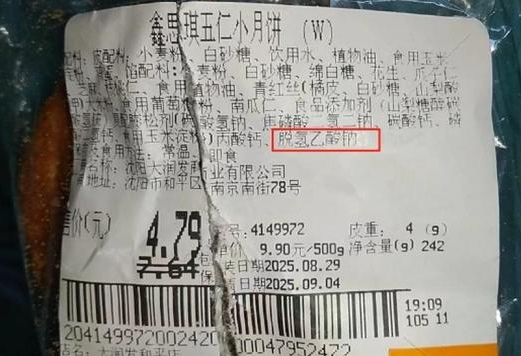
Core Viewpoint - The article discusses the recent issues faced by RT-Mart, particularly regarding the use of a banned food additive in mooncakes, highlighting systemic problems in supplier management and internal quality control following a management overhaul by Dehong Capital [3][9][10]. Group 1: Food Safety and Regulatory Compliance - A consumer reported that a mooncake purchased from RT-Mart contained the banned additive sodium dehydroacetate, which is prohibited in mooncakes and baked goods as per the new food safety standards effective from February 2025 [4][6]. - RT-Mart's response to the issue was that it was an operational error, as the product label was copied from the previous year without removing the banned additive, although they claimed the product did not contain it [7][8]. - The incident raises concerns about RT-Mart's compliance with food labeling regulations, which could lead to penalties under the Food Safety Law if deemed a labeling defect [8]. Group 2: Management Changes and Corporate Governance - Following Dehong Capital's acquisition in February, RT-Mart underwent significant management changes, including the resignation of its founder and the appointment of new executives, indicating a shift in corporate governance [10]. - The investigation of a senior executive related to supply chain issues has drawn industry attention, suggesting potential corruption linked to the traditional supermarket's reliance on various fees from suppliers [10][11]. - The management changes are seen as part of Dehong Capital's efforts to address historical issues and reform RT-Mart's outdated profit model [11]. Group 3: Financial Performance and Strategic Adjustments - RT-Mart reported a revenue decline of 1.4% year-on-year, with a net profit of 405 million RMB, marking a significant turnaround from a loss the previous year, primarily due to cost-cutting measures [16][17]. - The company has closed underperforming stores and restructured its operations, focusing on smaller store formats like RT-Mart Super and M Membership stores to adapt to changing consumer preferences [11][13]. - Despite the financial recovery, the article emphasizes that the improvements are largely due to cost control rather than revenue growth, posing challenges for sustainable long-term success [18][19].

月饼风波背后的铁腕改革:德弘资本能否重塑大润发?
Guan Cha Zhe Wang· 2025-10-01 07:13
Core Viewpoint - The recent controversy surrounding the mooncake ingredients at RT-Mart highlights systemic issues in supplier management and internal quality control within the company [6][4]. Company Issues - RT-Mart faced scrutiny after a consumer discovered the banned food additive sodium dehydroacetate listed in the ingredients of a mooncake product [1][4]. - The company attributed the issue to an employee error in copying last year's product information, claiming that the product did not actually contain the banned additive [4][5]. - The incident raises concerns about the accuracy of product labeling and potential regulatory penalties for misleading consumers [5][6]. Management Changes - Following the acquisition by Dihong Capital, RT-Mart underwent significant management changes, including the resignation of founder Huang Mingduan and the appointment of new executives [7]. - The company is currently facing investigations related to its supply chain practices, particularly concerning the collection of various fees from suppliers, which has historically impacted profitability [7][8]. Financial Performance - In the fiscal year ending March 31, 2024, RT-Mart reported a revenue of 71.552 billion RMB, a decline of 1.4% year-on-year, but achieved a net profit of 405 million RMB, a significant turnaround from a loss of 1.605 billion RMB the previous year [14][15]. - The improvement in profitability is attributed to substantial reductions in sales and marketing expenses, including the closure of unprofitable stores [14][15]. Strategic Adjustments - Dihong Capital has implemented cost-cutting measures and is restructuring RT-Mart's operations, including downsizing from five operational regions to four and closing underperforming stores [8][15]. - The company is shifting focus towards developing mid-sized supermarkets and membership stores, aiming to compete with established players like Sam's Club and Costco [8][10]. Market Challenges - RT-Mart faces intense competition in the retail sector, particularly from community-focused supermarkets and other membership-based stores [10][15]. - The success of RT-Mart's new membership store format will depend on its ability to differentiate its product offerings and enhance customer value perception [10][13].
营运长悄然离职、快消部老大退休,据传多位店总被调查……从阿里到德弘,谁在重塑大润发的权力地图
3 6 Ke· 2025-09-12 02:50
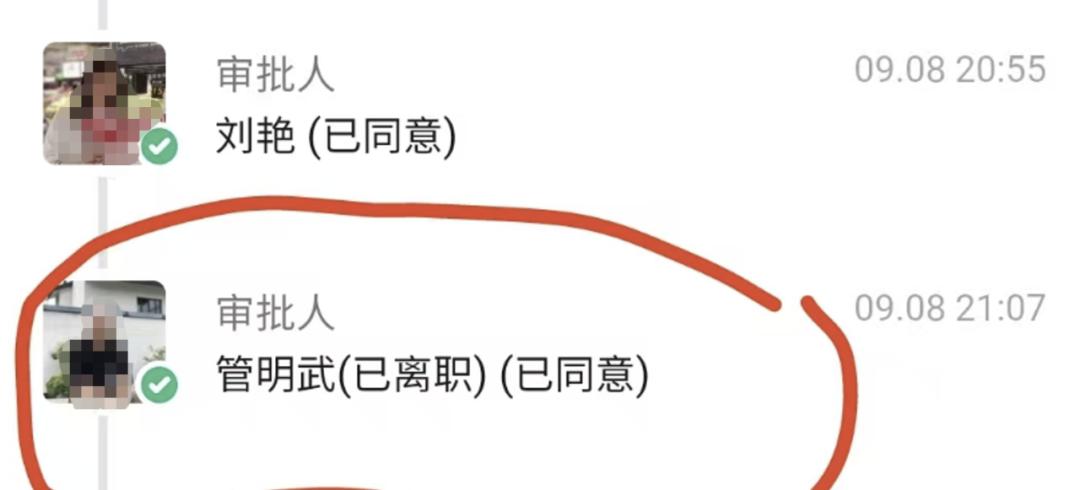
Core Insights - The article discusses the significant management changes and restructuring at RT-Mart following its acquisition by DeHeng Capital, highlighting the intertwining of anti-corruption efforts and organizational overhaul [1][6][10] Management Changes - The departure of key executive Guan Mingwu, who was referred to as the "operational director," has raised speculation about the internal shake-up related to anti-corruption measures [1][3] - Following the acquisition, the management structure has undergone multiple adjustments, with new appointments and promotions, including Shen Hui becoming CEO and Guan Mingwu taking on the role of operational director [3][6] - The retirement of veteran executive Lv Guoming marks a significant transition in the management team, allowing for new leadership and ideas to emerge [5][10] Financial Performance - RT-Mart reported a revenue of 71.552 billion yuan for the fiscal year ending March 31, 2025, a slight decrease of approximately 1.4% year-on-year, but managed to achieve a net profit of 386 million yuan, reversing a previous loss of 1.6 billion yuan [10][11] - The profit was largely attributed to cost-cutting measures, including a reduction in sales and operational expenses by 2.95 billion yuan, which is a 16.2% decrease [11][12] Strategic Adjustments - The company is focusing on regaining its price advantage through a "Everyday Low Price" strategy and launching its private label "Super Savings Series" with competitively priced products [12][14] - RT-Mart is also restructuring its business model by emphasizing new retail formats, such as medium-sized community supermarkets and warehouse membership stores, while phasing out less profitable formats [14][15] Organizational Restructuring - The organizational structure has been streamlined, reducing the number of operational regions from five to four, aiming for improved efficiency [8][9] - The board of directors has seen a complete overhaul, with new members appointed by DeHeng Capital, indicating a strong commitment to reshaping the governance structure [6][7] Future Outlook - The management is exploring innovative retail strategies, including learning from successful models in the industry, to adapt to the competitive landscape and consumer preferences [15]