
跨境人民币贷款

Search documents
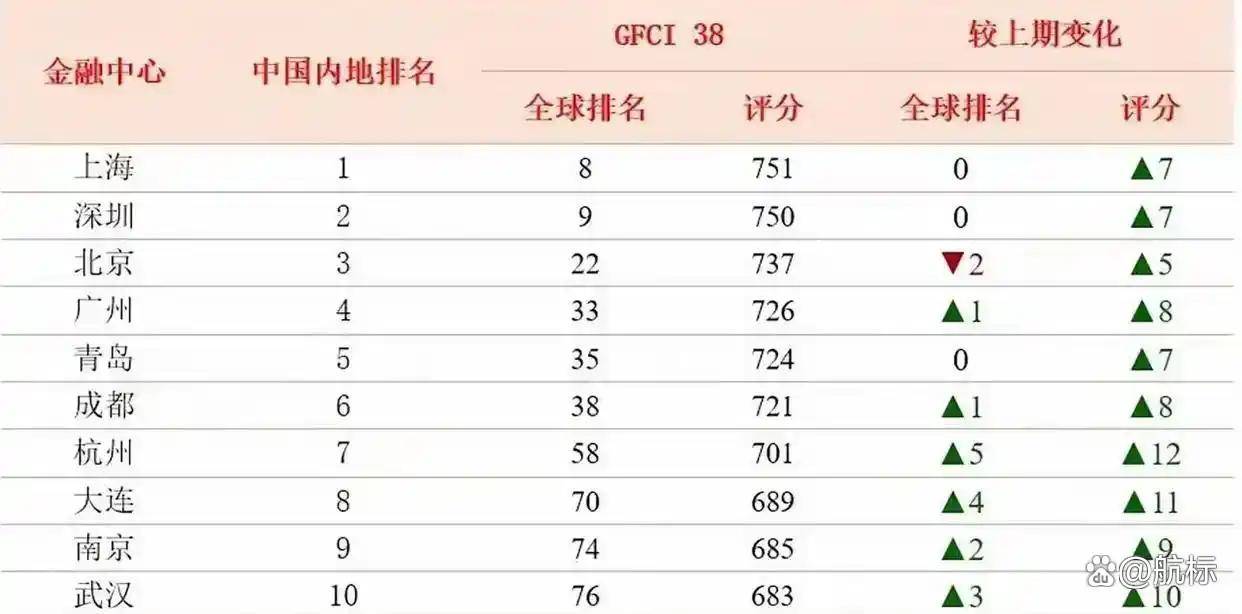
最新金融榜:内地10城横扫全球前列,深圳距上海1分、成都超杭州20名、南京685分登第九
Sou Hu Cai Jing· 2026-01-04 17:51
Core Insights - The GFCI 38 report highlights the rise of ten cities in mainland China, showcasing a collective advancement in global financial rankings, particularly in the Pearl River Delta, Yangtze River Delta, and Chengdu-Chongqing regions [1] Group 1: Rankings and Scores - Shanghai ranks 1st in mainland China and 8th globally with a score of 751, while Shenzhen follows closely at 2nd in mainland China and 9th globally with a score of 750, both cities showing an increase of 7 points from the previous period [2] - Beijing ranks 3rd in mainland China and 22nd globally with a score of 737, while Guangzhou, Qingdao, Chengdu, Hangzhou, Dalian, Nanjing, and Wuhan follow in respective positions, with notable movements in rankings and scores [2] Group 2: Factors Contributing to Rankings - Shenzhen's rapid ascent is attributed to its "innovation and finance" synergy, with flexible cross-border financial regulations in the Qianhai area facilitating over 100 billion yuan in capital flow last year [3] - Chengdu's rise to 38th globally is supported by its role as a "Western gateway," with over half of the financial settlements for the China-Europe Railway Express occurring there, alongside a strong output of financial talent and green finance initiatives [5] - Nanjing's ranking improvement to 9th in mainland China and 74th globally is linked to its blockchain technology applications in supply chain finance and significant issuance of green bonds for ecological restoration projects [7] Group 3: Overall Trends - The overall trend indicates that financial cities in mainland China are not merely relying on policy support but are leveraging geographical advantages, industrial strengths, and service capabilities to enhance their global standings [7]

第一财经携手中国银行,共同发布重磅白皮书《金融助力中国企业“走出去”》
Di Yi Cai Jing· 2025-11-07 16:04
Core Insights - The global economic landscape is undergoing significant transformation due to geopolitical conflicts, rising protectionism, and accelerated restructuring of supply chains, challenging the existing framework of economic globalization [1] - Chinese enterprises are shifting from "bringing in" to "going out," leveraging their advantages in manufacturing, supply chains, and technology to expand into overseas markets, becoming increasingly important players in global investment and innovation [1] - The need for financial services to support Chinese enterprises in their internationalization process has become more critical than ever, especially in the context of rising uncertainties in the external environment [1] Group 1: Financial Institutions' Support Mechanisms - Chinese financial institutions are enhancing their overseas network, with major state-owned banks establishing branches in 64 and 49 countries and regions, creating a global service system [2] - There is a continuous effort to integrate domestic and international resources, with commercial banks supporting Belt and Road projects and securities firms facilitating financing and mergers in global capital markets [2] - Financial institutions are innovating their product and service offerings, including specialized loans for overseas infrastructure and customized services for cross-border e-commerce [2] Group 2: Technological Advancements and Risk Management - Emerging technologies are widely applied, with digital solutions upgrading cross-border financial services, such as the "Cross-border e-commerce" platform significantly increasing transaction volumes [3] - Large state-owned banks have established country risk management and stress testing mechanisms to address uncertainties in overseas operations, while policy insurance companies provide credit investigations and risk analysis [3] Group 3: Future Recommendations for Financial Services - Recommendations include optimizing overseas layouts by establishing regional headquarters in ASEAN, Latin America, and Africa to better serve Chinese enterprises [4] - A multi-tiered overseas financial service system is suggested, leveraging the strengths of various financial institutions to comprehensively meet the financial needs of Chinese enterprises [4] - Financial institutions are encouraged to innovate products and services, such as forming syndicate loans with local banks and offering diverse financing tools for outbound enterprises [4] Group 4: Integration and Risk Management Strategies - The integration of domestic and international services is emphasized, with banks streamlining processes and exploring global fund management models [5] - Expanding the use of cross-border RMB is recommended, with banks increasing credit limits for RMB loans to support project financing and acquisitions [6] - A comprehensive cross-border risk management system is proposed, utilizing macro and industry data to develop intelligent risk assessment platforms [6] Group 5: Collaboration with Local Governments - Financial institutions are advised to leverage their connections with local governments and organizations to provide market consulting and policy training for new outbound enterprises [6] - The report highlights the importance of financial services in supporting the globalization journey of Chinese enterprises, marking a new chapter in the global financial service landscape [6]

应收账款“活”起来 工行湖州分行创新动产融资破解资金难题
Sou Hu Cai Jing· 2025-10-24 02:41
Core Insights - The Industrial and Commercial Bank of China (ICBC) Huzhou Branch successfully provided a loan of 20 million yuan to a leading motor manufacturing enterprise, addressing the company's cash flow challenges [1] - The enterprise is recognized as a national high-tech company and a "little giant" specializing in specific and innovative sectors, holding 111 patents and operating 12 intelligent production lines with an annual production capacity of 15 million units [1] - The bank leveraged its advantages as a state-owned institution to enhance credit availability and facilitate cross-border financing, thereby supporting the company's raw material procurement and expanding its production scale [1] Financing Model - The financing was achieved through accounts receivable pledge financing, which effectively resolved the company's liquidity issues [1] - The company primarily used commercial acceptance bills under supply chain financing for settlements, which had higher discount rates compared to working capital loan rates [1] - The bank provided an additional credit line of 50 million yuan by utilizing a unified registration platform for movable property financing, breaking down information barriers [1] Future Plans - ICBC Huzhou Branch aims to continue innovating in movable property financing services, activating accounts receivable in the industry chain, and converting dormant receivables into development momentum [1] - The establishment of cross-border financing channels is expected to enhance the company's ability to integrate domestic and international capital flows [1]
深化“一带一路”建设金融服务
Jin Rong Shi Bao· 2025-08-08 07:55
Core Viewpoint - The Bank of Communications has played a significant role in supporting the Belt and Road Initiative (BRI) by providing comprehensive financial services and support for economic development in BRI countries over the past decade [1]. Group 1: Financial Services Provided - The Bank of Communications offers diverse financial services, leveraging its integrated operations in both domestic and international markets to create comprehensive service solutions for BRI projects, including loans, cross-border payments, trade settlements, and foreign exchange hedging [2]. - In 2024, the bank provided the first cross-border RMB loan for the São Simão Hydropower Station in Brazil, introducing an innovative business model that combines domestic loans with cross-border RMB payment systems [2]. Group 2: Market Infrastructure Development - The bank actively promotes the construction of RMB financial infrastructure and factor markets in BRI countries, enhancing the use of RMB in financing and trade settlements for BRI projects [3]. - In 2024, the bank acted as a market maker for RMB against the currencies of 14 BRI countries, participating in over 100 billion USD in currency transactions [3]. Group 3: International Financial Cooperation - The Bank of Communications strengthens collaboration with international financial organizations and multilateral institutions to build a complementary financing system for BRI projects [3]. - The bank provides funding support to various multilateral financing institutions and underwrites BRI-themed bonds in overseas markets, effectively broadening financing channels for BRI projects [3]. Group 4: Policies and Measures for Investment Flow - The bank has established a clear and functional overseas banking network to support BRI initiatives, with a focus on local economic structures and resource endowments [4]. - The Dubai International Financial Center branch opened in November 2024, marking the bank's first branch in the Middle East and enhancing its service capabilities for BRI projects [4]. Group 5: Future Support for BRI - The bank aims to focus on practical cooperation projects, utilizing various financial instruments to support both landmark and smaller-scale projects under the BRI [6]. - It plans to enhance cross-border and offshore financial services, expanding applications in areas like the China-Europe Railway Express and the New Land-Sea Corridor [6]. - The bank will actively support green innovation and sustainable development projects aligned with international standards for green investment [6][7].


银行业为“全球南方”共谋高质量发展积蓄力量
Jin Rong Shi Bao· 2025-07-11 01:52
Group 1: Core Perspectives - The Chinese Premier Li Qiang emphasized the importance of strengthening strategic cooperation between China and Egypt as key members of the "Global South" to promote peace and prosperity [1] - The "Global South" now accounts for over 40% of the global economy and contributes 80% to global economic growth, becoming a crucial force in maintaining world peace and driving development [1] Group 2: Financial Cooperation and Infrastructure Development - Financial cooperation is a key area for win-win collaboration among "Global South" countries, with Chinese financial institutions optimizing services to support high-quality development [2][3] - The Belgrano freight railway in Argentina saw its capacity increase to 235% post-renovation, funded by the China Development Bank, showcasing successful infrastructure projects [2] - Ecuador's first national ultra-high voltage transmission line, financed by the Export-Import Bank of China, has significantly improved the country's power supply capacity [2] Group 3: Policy Support and Investment - The Chinese government has announced a $10 billion trade financing quota to support African exports and established financing windows totaling 350 billion RMB to support Belt and Road projects [3] - The establishment of a research center for the "Global South" and the continued use of a $20 billion funding window for developing countries highlight China's commitment to deepening practical cooperation [3] Group 4: Trade and Project Cooperation - The rise of the "Global South" has led to increased economic and trade exchanges, with China supporting its enterprises to invest abroad while welcoming foreign investments [4] - Chinese financial institutions are actively involved in major projects in Brazil, creating significant economic, social, and environmental value [5] Group 5: Financial Services and Cross-Border Transactions - Agricultural Bank of China plans to provide nearly $100 billion in financing services for trade between China and "Global South" countries in 2024, supporting over 100 Chinese enterprises [6] - The promotion of cross-border RMB loans and payment systems is enhancing trade facilitation and financial stability among "Global South" nations [7][8]

银行业为构建中拉命运共同体新篇章添“金”彩
Jin Rong Shi Bao· 2025-05-19 01:51
Group 1: China-Latin America Cooperation - The fourth ministerial meeting of the China-Latin America and Caribbean Community Forum was held in Beijing, where President Xi Jinping announced the launch of five major projects to promote development and build a community of shared future between China and Latin America [1] - The establishment of a comprehensive cooperative partnership between China and Latin America is significant and has far-reaching implications, enhancing practical cooperation in trade, investment, finance, technology, and infrastructure [1] - China's financial sector has actively supported cooperation with Latin America, contributing to the deepening of South-South cooperation and adding new dimensions to the comprehensive partnership [1] Group 2: Financial Cooperation and Initiatives - Brazilian President Lula's recent visit to China resulted in multiple cooperation agreements aimed at deepening economic and trade cooperation between China and Brazil, with Bank of Communications actively supporting this financial collaboration [2] - Bank of Communications established its Brazilian subsidiary in 2016, which now holds a full banking license and provides various financial services to over 60 Chinese enterprises in Brazil [2] - The China Development Bank has financed significant infrastructure projects in Argentina and Peru, enhancing transportation and energy supply capabilities, thereby improving local competitiveness and service levels [4][5] Group 3: RMB Internationalization - The demand for cross-border use of the RMB is increasing as the Belt and Road Initiative progresses, with Chinese banks providing comprehensive financial services to Latin American enterprises [6] - China Bank has facilitated RMB settlement services for major companies in Chile, enhancing the financial support for Chinese enterprises operating in Latin America [6] - Bank of Communications has introduced an innovative cross-border RMB loan model, providing a full range of financing, settlement, and currency risk management services [7]
打造高水平 对外开放“门户标杆” 前海书写中国自贸区开放引领的“深圳样本”
Shen Zhen Shang Bao· 2025-04-26 17:06
Core Viewpoint - The Shenzhen Qianhai Shekou Free Trade Zone has become a model for high-level opening-up in China, showcasing significant institutional innovations and economic growth since its establishment in 2015 [1][2]. Group 1: Economic Growth and Trade - The total import and export value of the Qianhai Shekou Free Trade Zone surged from 71.2 billion to 537.98 billion yuan, achieving an average annual growth rate of over 25% [2]. - The area has seen the establishment of new business models such as "bonded + new retail," leading to the completion of China's first cross-border e-commerce "offline direct purchase" operation [2][3]. - In 2022, the introduction of 18 measures by the General Administration of Customs further accelerated the convenience of goods trade in Qianhai [2]. Group 2: Institutional Innovation - Qianhai has ranked first in the institutional innovation index among China's free trade zones for three consecutive years from 2022 to 2024 [4]. - The implementation of the "30 measures to support finance in Qianhai" has led to the creation of 14 national firsts in cross-border financial innovations [4]. - Qianhai has established a comprehensive legal service environment, with 254 legal institutions, including arbitration and mediation services, enhancing its legal framework [5]. Group 3: Cross-Border E-commerce and Supply Chain - Qianhai has attracted over 175 cross-border e-commerce enterprises, including major platforms like Amazon and Pinduoduo, achieving an import and export value of 121.03 billion yuan, a growth of 104% [3]. - The establishment of a public service platform for storage wafer testing has optimized the supply chain for major chip manufacturers [2]. Group 4: Hong Kong-Mainland Cooperation - Qianhai has focused on deepening cooperation with Hong Kong, facilitating the integration of legal and regulatory frameworks, and enhancing infrastructure connectivity [6][7]. - The establishment of the "Hong Kong-Macau e-Station" allows for 372 government services to be accessed conveniently by Hong Kong residents [7]. - Initiatives like "Shenzhen-Hong Kong Easy Registration" have simplified business registration processes for Hong Kong investors [8]. Group 5: Innovation and Entrepreneurship - The Qianhai Shenzhen-Hong Kong Youth Dream Factory has incubated 1,450 entrepreneurial teams, with 943 from Hong Kong, promoting innovation and entrepreneurship [8]. - The introduction of the "1510" new development model aims to support Hong Kong youth and enterprises with various incentives, including a 5 billion yuan fund [8].