车载光通信

Search documents
中国公司全球化周报|腾讯出行服务支持20个国家和地区境外打车/比亚迪正式进入埃及市场
3 6 Ke· 2026-02-14 02:16
Group 1: Events and Forums - The "Dubai Business Forum - China" will take place in Shenzhen on May 14, 2026, focusing on economic collaboration and investment opportunities between China and Dubai [2] - A closed-door sharing session on Japanese robot market entry will be held in Shenzhen on March 12, organized by JETRO and 36Kr [3] Group 2: Company Developments - Tencent's ride-hailing service has integrated with Uber, supporting services in 20 countries and regions, including Hong Kong and Japan [4] - Temu has partnered with DEKRA to enhance product safety compliance for electronic goods on its platform [4] - BYD has officially entered the Egyptian market in collaboration with Mansour Group, showcasing three new car models [4] - AITO announced its entry into the UAE market through a partnership with Abu Dhabi Motors [5] - FAW Jiefang signed a strategic agreement with a Saudi dealer for the first batch of 500 vehicles [5] - Junlian Zhixing showcased its intelligent automotive solutions at Volkswagen's global headquarters [5] Group 3: Financing and Investments - Qunche Intelligent has completed a multi-hundred million yuan Series A financing round, with participation from several overseas funds [8] - Hexin Power has secured several million yuan in angel round financing, focusing on agricultural intelligent solutions [8] - Bee Technology, a subsidiary of Zhiyuan Robotics, has completed several hundred million yuan in seed and angel round financing [8] - MossCode, an AI smart sports wear brand, has completed several million yuan in angel round financing, planning to launch in the European and American markets in 2026 [9] - Starry Dream House has completed a total of 80 million yuan in financing, with significant orders secured in Australia [9] Group 4: Market Trends and Policies - The surgical robot market is expected to grow significantly, with AI enabling autonomous operations and enhancing remote surgery capabilities [10] - By 2025, global humanoid robot shipments are projected to reach 17,800 units, with Chinese manufacturers leading the market [11] - China is deepening trade cooperation with South Africa and Kenya, aiming for zero-tariff access for products [12] - China's digital trade surplus is expected to double by 2025, driven by rapid growth in cloud computing and AI sectors [12]




均联智行携全系智能化方案亮相大众总部技术交流展
3 6 Ke· 2026-02-12 02:58
Core Viewpoint - Junsheng Electronics, through its subsidiary Junlian Zhixing, showcased its full range of automotive intelligent solutions at the global headquarters of Volkswagen Group in Germany, emphasizing its advancements in the era of "AI-defined vehicles" [1] Group 1: Technology Solutions - The exhibition highlighted core solutions such as central computing units, regional controllers, and vehicle optical communication [1] - The focus areas included mature technological achievements in intelligent assisted driving, smart cockpits, intelligent connectivity, and vehicle body and safety [1]

决胜2026:科技出行十大战略技术趋势
3 6 Ke· 2026-01-26 05:09
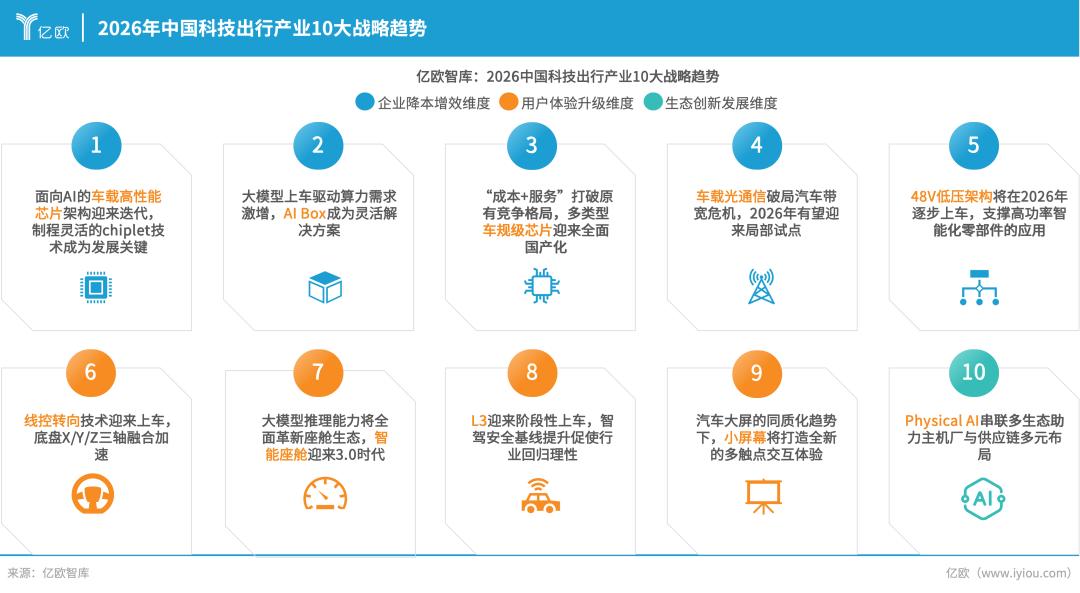
Core Insights - The report "2026 China Technology Mobility Industry 10 Strategic Technology Trends Outlook" aims to provide a key action guide for decision-makers in the industry chain, focusing on cost reduction, enhanced user experience, and ecological collaborative innovation [1][1] - The Chinese technology mobility industry is undergoing a profound systemic transformation driven by the accelerated integration of intelligence, electrification, and artificial intelligence technologies [1][1] - The industry is transitioning from a phase of incremental expansion to a high-quality development stage centered on efficiency, scale, and systemic capabilities amid intensified global automotive competition and evolving profit models [1][1] Trend Summaries - **Trend 1: Chiplet Restructuring Vehicle Chip Architecture** The traditional single-chip SoC is inadequate for L3+ autonomous driving and advanced cockpit requirements. Chiplet architecture is emerging as a mainstream solution for high-performance intelligent driving chips, enabling cost optimization and demand-driven scalability [4] - **Trend 2: AI Box Decoupling Computing Power Deployment** AI Box is becoming a key transitional solution for OEMs to achieve flexible computing power expansion, supporting local AI capabilities without major changes to vehicle electronic architectures [6] - **Trend 3: Accelerated Localization of Automotive Chips** Driven by supply chain security and cost optimization, communication chips and power semiconductors are leading the way in domestic chip localization, transitioning from technical feasibility to large-scale implementation [10] - **Trend 4: Optical Communication in Vehicles** Optical communication is moving from technology validation to mass production, addressing bandwidth limitations and electromagnetic interference in traditional vehicle networks, with significant advancements expected by 2026-2027 [13] - **Trend 5: 48V Low-Voltage Architecture** The 48V architecture is becoming essential for high-power intelligent components in electric vehicles, with initial applications in high-end models expected to scale by 2026 [15] - **Trend 6: Nearing the Inflection Point for Steer-by-Wire** With the maturation of technology and regulatory frameworks, steer-by-wire systems are transitioning from small-scale validation to mass production, becoming critical for advanced driving capabilities [19] - **Trend 7: Large Models Driving Intelligent Cockpits** The evolution of large models is transforming intelligent cockpits into system-level intelligent entities, enhancing user interaction and service optimization [22] - **Trend 8: Phased Implementation of L3 Autonomous Driving** L3 autonomous driving will be introduced gradually under regulatory constraints, focusing on safety and responsibility alignment, with commercial applications expected to begin in 2024-2025 [25] - **Trend 9: Redefining Interaction with Small Screens** The shift from centralized large screens to distributed small screens in vehicle interfaces aims to enhance user experience and reduce cognitive load during driving [28] - **Trend 10: Physical AI Driving Second Growth Curve** Physical AI capabilities are evolving into transferable competencies, enabling automotive technologies to extend across various intelligent terminals, fostering ecosystem collaboration [30] Overall Industry Outlook - The trends indicate a systemic restructuring in the Chinese technology mobility industry, focusing on integrated systems engineering and collaborative efficiency, with a shift from isolated performance to comprehensive system capabilities [32][34] - The next phase of competition will favor organizations that can build replicable, scalable, and evolvable system capabilities, marking 2026 as a pivotal year for technological scaling and global competitive landscape reshaping [34]
亿欧智库:2026中国科技出行产业10大战略技术趋势展望
Sou Hu Cai Jing· 2026-01-22 11:41
Core Insights - The report by Yiou Research Institute outlines ten strategic technology trends in China's technology mobility industry for 2026, focusing on autonomous driving, mobility technology, and new energy sectors, providing insights for industry players and investors [1][9]. Group 1: Cost Reduction and Efficiency - Chiplet technology is expected to become the standard for vehicle high-performance computing (HPC) by 2026, addressing the challenges of traditional SoC in terms of cost and power consumption [2][13]. - AI Box is projected to become a market breakout solution in 2026, providing flexible computing power without altering existing vehicle architectures, initially focusing on smart cockpits and later expanding to intelligent driving and body control domains [2][16]. - The domestic production of automotive-grade chips is advancing, with a focus on cost-effective, stable delivery, and local service, leading to a competitive landscape between international giants and local manufacturers [2][20]. - The 48V low-voltage architecture is set to be adopted in more flagship models by 2026, supporting high-power intelligent components, transitioning from initial partial adoption to a main distribution structure over time [2][26]. Group 2: User Experience Enhancement - Vehicle optical communication is expected to begin pilot projects in 2026, offering advantages such as high bandwidth and low latency, potentially replacing traditional vehicle Ethernet [3][23]. - The smart cockpit is entering its 3.0 era, evolving from a functional tool to a system-level intelligent entity capable of task planning and cross-domain collaboration, supported by an integrated "end-cloud-vehicle" architecture [3][31]. - The L3 autonomous driving technology is anticipated to enter a "small-scale, conditional" commercialization phase in 2026, with a focus on safety features like AEB becoming central to industry efforts [3][36]. - Small screens are emerging as a new interaction point in the cockpit, reducing cognitive load during driving and shifting the interaction logic from centralized to multi-screen collaboration [3][42]. Group 3: Ecological Innovation and Development - Physical AI technology is facilitating multi-ecosystem layouts, allowing automotive manufacturers to transition from vehicle integrators to cross-terminal AI capability platforms, promoting a second growth curve in the industry [5][39].