
通信基础设施

Search documents
刚回法国,马克龙就喊话中国帮欧洲;警告若贸易失衡持续,将对中国加税
Sou Hu Cai Jing· 2025-12-09 23:53
Group 1 - European industry is at a critical juncture, requiring investment and technology from China, as stated by Macron [2][6] - Macron warns of potential tariffs on Chinese goods if trade imbalances are not addressed, indicating a shift towards a more confrontational stance [3][16] - The narrative of blaming China for Europe's industrial decline is seen as a diversion from internal issues, such as high energy prices and factory relocations [7][12] Group 2 - The call for Chinese investment is not merely a plea for help but a strategic move to regain power and influence in the global market [5][20] - Macron's desire for China to invest in Europe reflects a longing for a past where Western companies dominated the value chain [13][14] - The current situation highlights a shift in power dynamics, with China now holding technological advantages and a complete supply chain [15][41] Group 3 - The interconnected global supply chain means that imposing tariffs on Chinese goods would primarily impact European consumers, leading to inflation [17][18] - The products exported from China are increasingly high-tech and not easily replaceable, complicating the tariff strategy [19][42] - Macron's warnings serve as a negotiation tactic to encourage Chinese investment along specific lines, such as green industries [20][21] Group 4 - Internal divisions within Europe regarding China policy hinder a unified approach, with different countries having varying dependencies on Chinese investment [22][24] - The simplification of complex internal issues into a narrative of "Chinese threat" serves to distract from Europe's structural problems [27][28] - The ongoing power shift in the global economy is causing discomfort in Europe, as it struggles to adapt to a new reality where it is no longer the dominant force [30][32] Group 5 - Future relations between Europe and China are expected to be characterized by competition and cooperation, with potential for both conflict and collaboration [51][52] - The narrative of who will "save" whom is outdated, as both sides are focused on self-improvement rather than reliance on the other [54][60] - Europe's industrial decline will continue if it does not address its internal challenges and instead focuses on external blame [58][61]


外派非洲,是份好工作吗?
首席商业评论· 2025-12-07 04:50
Core Viewpoint - The article discusses the complexities and realities of working in Africa, particularly for Chinese expatriates, highlighting both the financial incentives and the challenges faced in this environment [4][6][32]. Group 1: Historical Context and Development - The article traces the history of Chinese involvement in Africa, starting from the 1960s with the construction of the TAZARA railway, where nearly 50,000 Chinese engineers were sent to assist [9][12]. - The shift from political aid to economic cooperation is noted, with Chinese enterprises increasingly engaging in infrastructure projects across Africa since the 1980s [12][14]. - Huawei's expansion into Africa is highlighted as a significant example of this trend, achieving major milestones in telecommunications [14][15]. Group 2: Financial Aspects of Expatriate Work - Expatriate positions in Africa often offer salaries that are significantly higher than those in major Chinese cities, with average monthly salaries for engineering roles being over double that of Beijing [18][19]. - A specific example illustrates that an expatriate could earn around 990,000 yuan annually, including bonuses and allowances, making it financially attractive despite the challenges [19][20]. - The cost of living in Africa is discussed, noting that many expatriates have their basic needs covered, which allows for substantial savings [20][22]. Group 3: Challenges Faced by Expatriates - The article outlines the demanding nature of expatriate work in Africa, where employees often face long hours and high expectations [27][28]. - Health risks are significant, with Africa being a hotspot for diseases like malaria, and the medical infrastructure can complicate health issues [28][30]. - Security concerns are prevalent, with reports of crime and violence affecting expatriates, particularly in certain regions [30][31]. Group 4: Personal Experiences and Perspectives - The emotional toll of working in Africa is discussed, with feelings of isolation and cultural disconnection being common among expatriates [31][32]. - The article emphasizes that while some view expatriate work in Africa as a lucrative opportunity, others find it challenging and unappealing [36][37].

外派非洲,是份好工作吗?
3 6 Ke· 2025-11-26 06:37
Core Viewpoint - The article discusses the experiences and challenges faced by Chinese expatriates working in Africa, highlighting the high salaries and potential for savings, but also the difficulties related to living and working in challenging environments [2][4][14]. Group 1: Expatriate Experiences - A Chinese individual named Kong Tao was awarded a chieftain title in Nigeria, reflecting the growing presence of Chinese workers in Africa due to initiatives like the Belt and Road [2][4]. - The trend of Chinese expatriates in Africa has increased significantly over the years, with many individuals taking on roles in engineering and construction projects [4][9]. - Expatriates often face a challenging work environment, with high demands and expectations from employers, leading to a perception that they must work harder for their high salaries [29][30]. Group 2: Financial Aspects - Expatriate positions in Africa typically offer salaries that are significantly higher than those in major Chinese cities, often two times or more [16][18]. - For example, expatriates in engineering roles can earn annual salaries exceeding 99,000 yuan, including bonuses and allowances [19][21]. - The cost of living in Africa can be lower for expatriates due to provided accommodations and limited spending options, allowing for greater savings [23][24][25]. Group 3: Challenges Faced - Expatriates encounter numerous health risks, including high rates of infectious diseases, which can complicate medical care [30][31]. - Security concerns are prevalent, with reports of crime and violence against expatriates in certain regions, adding to the stress of living abroad [33][34]. - The emotional toll of isolation and cultural differences can lead to feelings of loneliness among expatriates, making the experience more challenging [37][38]. Group 4: Broader Implications - The article emphasizes the dual nature of expatriate work in Africa, where high rewards come with significant risks and challenges, making it a complex decision for individuals [40][41]. - The evolving landscape of Africa presents both opportunities and obstacles for companies looking to expand, with factors like political instability and economic challenges affecting operations [44][45].

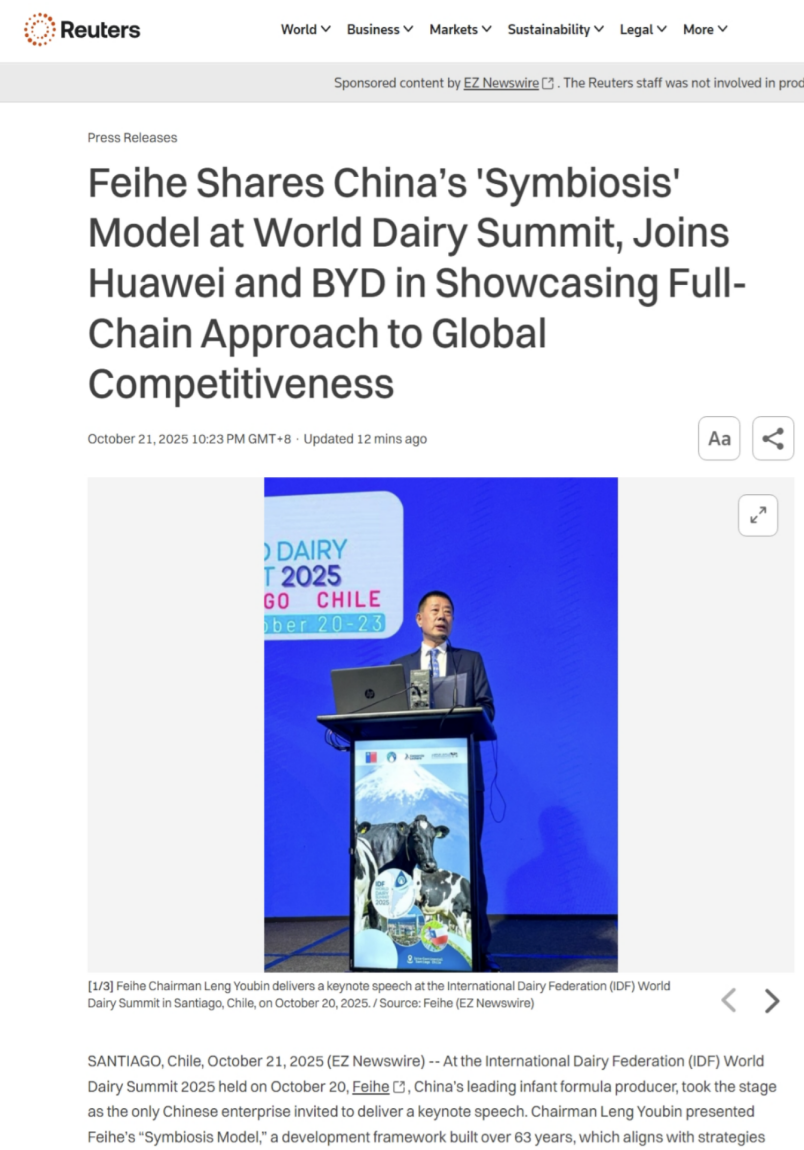
从华为、比亚迪到飞鹤,中国企业“全链共生”战略引全球媒体瞩目
Zheng Quan Shi Bao Wang· 2025-10-23 10:33
Core Insights - The 2025 International Dairy Federation World Dairy Summit was held in Santiago, Chile, where China Feihe's Chairman, Cold Youbin, presented the "Symbiotic Model" as a solution to the challenges faced by the global dairy industry, attracting significant media attention [1][4]. Group 1: Feihe's Achievements and Strategies - Feihe is the only Chinese brand invited to deliver a keynote speech at the summit, highlighting its unique position in the global dairy sector [4]. - The "Symbiotic Model" proposed by Feihe emphasizes the importance of coexisting with the industry foundation, global wisdom, and future environments to address the dual challenges of growth and sustainability in the dairy sector [4][5]. - Feihe's success in becoming the top-selling infant formula brand globally is attributed to its continuous exploration and implementation of the "Symbiotic Model" over its 63 years of existence [5]. Group 2: Industry Trends and Comparisons - The "Symbiotic Model" is not an isolated case; other leading Chinese companies like BYD and Huawei are also integrating their entire supply chains to enhance resilience and ensure self-sufficiency amid global supply chain uncertainties [5][7]. - BYD's vertical integration strategy in the electric vehicle sector has allowed it to maintain production stability and expand capacity despite global chip shortages [7]. - Huawei's comprehensive ecosystem and investment in core technologies have established significant barriers to entry, ensuring its strategic autonomy and innovation capabilities [9]. Group 3: Feihe's Operational Excellence - Feihe has implemented a fully integrated supply chain model in the dairy industry, establishing a principle of "building farms before markets," which has led to a complete "farm-milk-factory" integration [10]. - The company operates 13 modern core factories, 13 large self-owned pastures, and over 115,000 high-quality dairy cows, achieving 100% self-control of farms, pastures, and milk sources [10]. - Feihe's commitment to technological innovation and sustainability is evident through partnerships with over 20 prestigious universities and institutions globally, as well as the establishment of the largest ecological recycling project in China's cold regions [13]. Group 4: Broader Implications for Chinese Enterprises - Feihe's participation in the summit symbolizes the overall enhancement of Chinese enterprises' capabilities, showcasing a shift from "leading in China" to "leading globally" [13]. - Companies like Feihe, Huawei, and BYD are exporting their robust supply chain management models and cutting-edge technological standards as part of a systematic "Chinese wisdom" and "Chinese solutions" for sustainable global development [13].

日海智能跌2.03%,成交额1.12亿元,主力资金净流出855.93万元
Xin Lang Cai Jing· 2025-09-22 06:01
Company Overview - 日海智能科技股份有限公司 is located in Shenzhen, Guangdong Province, established on November 14, 2003, and listed on December 3, 2009 [2] - The company's main business includes wireless communication modules (65.95% of revenue), communication engineering services (18.41%), communication infrastructure equipment (13.65%), and other businesses (1.98%) [2] - The company belongs to the communication equipment industry, specifically in communication terminals and accessories, and is involved in sectors such as Beidou navigation, small-cap stocks, drones, blockchain, and core networks [2] Financial Performance - For the first half of 2025, 日海智能 reported revenue of 1.314 billion yuan, a year-on-year decrease of 18.51%, and a net profit attributable to shareholders of -43.49 million yuan, a decrease of 14.40% year-on-year [2] - The company has cumulatively distributed 178 million yuan in dividends since its A-share listing, with no dividends distributed in the last three years [3] Stock Performance - As of September 22, 日海智能's stock price was 11.56 yuan per share, with a market capitalization of 4.328 billion yuan [1] - The stock has increased by 47.45% year-to-date, but has seen a decline of 6.02% over the last five trading days and 4.54% over the last twenty days [1] - The company has appeared on the龙虎榜 (a stock trading list) eight times this year, with the most recent appearance on August 13, where it recorded a net buy of 6.6694 million yuan [1] Capital Flow - On September 22, the net outflow of main funds was 8.5593 million yuan, with large orders buying 12.343 million yuan (11.02% of total) and selling 18.583 million yuan (16.59% of total) [1] - The stock's trading volume on September 22 was 112 million yuan, with a turnover rate of 2.57% [1] Shareholder Information - As of June 30, the number of shareholders was 44,100, a decrease of 2.95% from the previous period, with an average of 8,491 circulating shares per shareholder, an increase of 3.03% [2]

日海智能跌2.05%,成交额2.89亿元,主力资金净流出47.47万元
Xin Lang Cai Jing· 2025-09-18 06:47
Group 1 - The core viewpoint of the news is that 日海智能's stock has experienced fluctuations, with a year-to-date increase of 52.42% but a recent decline of 6.79% over the past five trading days [1] - As of September 18, 日海智能's stock price is reported at 11.95 yuan per share, with a total market capitalization of 4.474 billion yuan [1] - The company has seen a net outflow of 474,700 yuan in principal funds, with significant buying and selling activity from large orders [1] Group 2 - 日海智能, established on November 14, 2003, and listed on December 3, 2009, is primarily engaged in wireless communication modules, communication infrastructure, and engineering services [2] - The revenue composition of 日海智能 includes 65.95% from wireless communication modules, 18.41% from communication engineering services, and 13.65% from communication infrastructure [2] - As of June 30, the number of shareholders is reported at 44,100, a decrease of 2.95% from the previous period [2] Group 3 - For the first half of 2025, 日海智能 reported a revenue of 1.314 billion yuan, a year-on-year decrease of 18.51%, and a net profit attributable to shareholders of -43.49 million yuan, a decrease of 14.40% [2] - Since its A-share listing, 日海智能 has distributed a total of 178 million yuan in dividends, with no dividends paid in the last three years [3]