
酥皮点心

Search documents
来口青海老点心
Xin Lang Cai Jing· 2026-02-27 22:33
Group 1 - The core idea of the articles revolves around the revival and popularity of traditional Qinghai pastries, particularly during the festive season, highlighting their cultural significance and evolving consumer preferences [1][2][3] - The Tai Xing De pastry shop in Xining, Qinghai, offers a variety of traditional pastries, with the best-selling item being the Qinghai-style flaky pastry, which features a simple appearance but rich flavors [1] - The shop's sales manager noted that the flaky pastry is favored for its delicate texture and diverse fillings, appealing to both traditional tastes and modern consumers [1] Group 2 - Cheng Huiqin, a master pastry chef with nearly 40 years of experience, emphasizes the importance of traditional handcrafting methods in preserving the authentic flavors of the pastries, which has become a driving force for the business [2] - The company has expanded to four branches, becoming a notable player in Qinghai's cultural tourism sector, while also adapting recipes to attract younger consumers [2] - Qinghai province has been actively promoting its traditional food products, exemplified by the 2026 Qinghai Old Brand Carnival, which aims to enhance cultural heritage and consumer engagement through various festive activities [2]
新华深读丨向油腻饮食说不
Xin Hua Wang· 2025-12-22 00:48
Core Viewpoint - The article highlights the rising health concerns associated with excessive oil consumption in China, where daily cooking oil intake significantly exceeds recommended levels, leading to various health issues including obesity and chronic diseases [10][13][15]. Group 1: Current Consumption Trends - The average daily cooking oil intake in China is 43.2 grams, which is about 33% higher than the recommended 25-30 grams [13][14]. - The total daily fat intake per person is 79.1 grams, exceeding the recommended 50-70 grams [13][14]. - In 2024, the estimated consumption of edible vegetable oil in China is projected to be 37.08 million tons, translating to an average per capita consumption of approximately 26.3 kilograms [13]. Group 2: Health Implications - Excessive oil consumption is linked to increased risks of hypertension, diabetes, and various cancers, with obesity being a significant public health issue in China [15][16][18]. - The prevalence of overweight and obesity among children and adults is alarming, with rates of 6.8% and 34.3% respectively [18][19]. - Long-term high oil intake can lead to metabolic diseases, including non-alcoholic fatty liver disease and type 2 diabetes [16][19]. Group 3: Cultural and Behavioral Factors - The preference for high-oil foods is deeply rooted in Chinese culinary traditions, where oil is seen as essential for enhancing flavor [21][22]. - Many consumers rely on intuition rather than measurement for oil usage, with 65% using personal experience to determine oil amounts [22][23]. - The shift from limited oil availability in the past to an abundance today has contributed to the current high consumption levels [24][25]. Group 4: Industry Response and Initiatives - A nationwide "reduce oil" campaign is being promoted, with guidelines suggesting daily oil intake should not exceed 25-30 grams [30][31]. - The food and restaurant industry is responding by offering smaller portion sizes and healthier cooking options, such as low-oil meals [33][35]. - Initiatives are being taken to educate consumers about healthier cooking practices and the importance of balanced oil consumption [30][31][38].

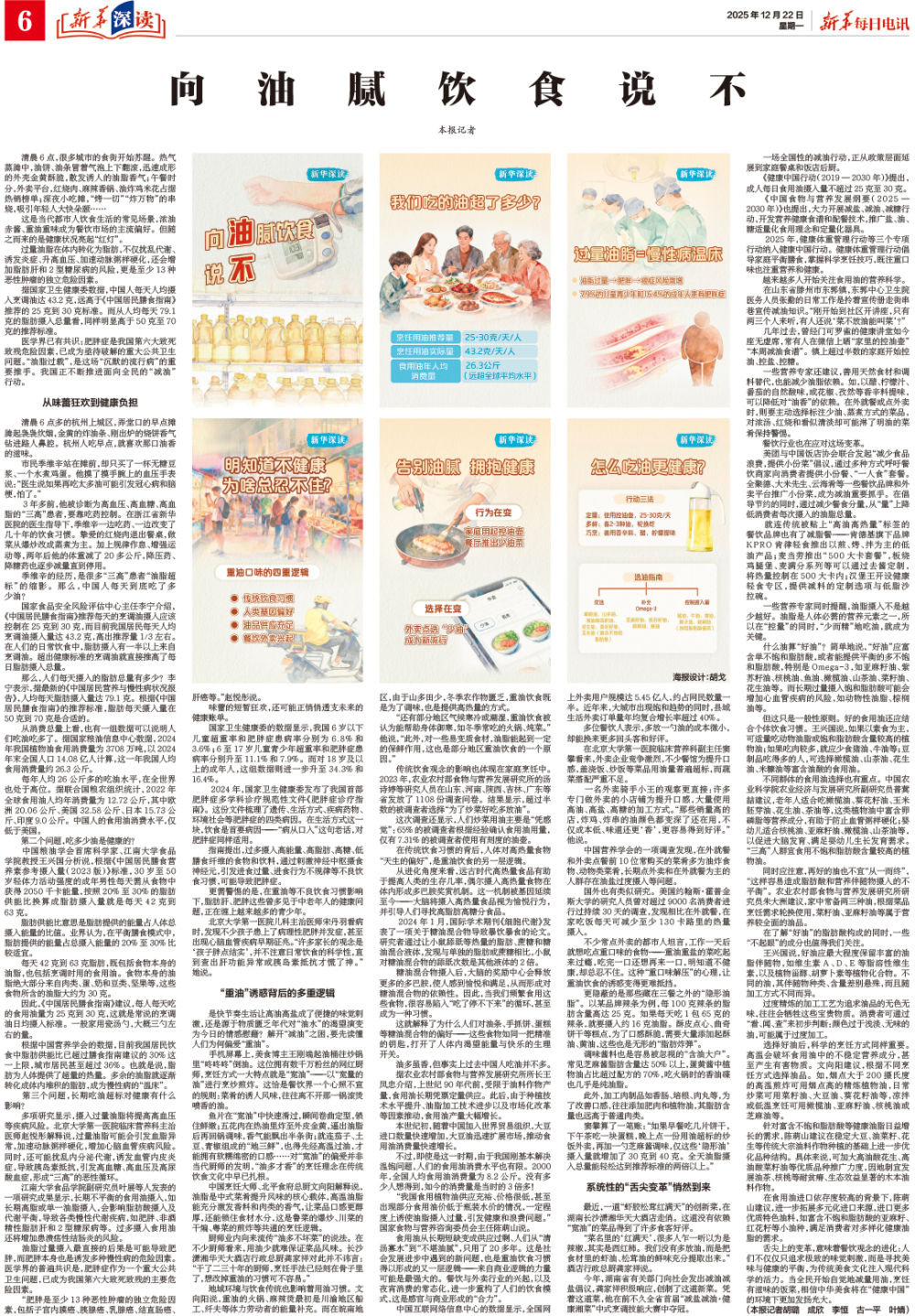
向油腻饮食说不
Bei Jing Ri Bao Ke Hu Duan· 2025-12-21 22:45
Core Viewpoint - The article highlights the growing concern over excessive oil consumption in China, which is linked to various health issues, including obesity and chronic diseases. The current average daily cooking oil intake is significantly above recommended levels, prompting a nationwide "reduce oil" initiative to address this public health challenge [1][3][17]. Group 1: Current Consumption and Health Risks - The average daily cooking oil intake in China is 43.2 grams, exceeding the recommended 25-30 grams by approximately one-third [3][4]. - The total daily fat intake per person is 79.1 grams, which is also above the recommended range of 50-70 grams [3][4]. - Excessive oil consumption is linked to serious health risks, including hypertension, diabetes, and various cancers, with obesity being a major public health issue in China [6][7][12]. Group 2: Dietary Trends and Cultural Influences - Traditional cooking practices favor high oil usage, with many consumers believing that more oil enhances flavor, leading to a cultural preference for "heavy oil" dishes [9][10]. - The rise of fast-paced lifestyles and the convenience of high-oil foods have contributed to the normalization of excessive oil consumption [8][14]. - The food delivery industry has further reinforced these trends, with many popular dishes being high in oil, salt, and sugar [14][19]. Group 3: Government Initiatives and Public Awareness - The Chinese government has initiated campaigns to promote reduced oil consumption, including guidelines that recommend daily oil intake not exceeding 25-30 grams [17][18]. - There is a growing public awareness regarding the health implications of high oil consumption, with more individuals adopting healthier cooking practices and dietary habits [18][19]. - The food and nutrition sector is responding to these changes, with restaurants and food services beginning to offer lower-oil options and smaller portion sizes [19][22]. Group 4: Future Directions and Recommendations - Experts suggest a balanced approach to oil consumption, emphasizing the importance of choosing healthier oils rich in unsaturated fats while reducing overall intake [20][21]. - There is a call for diversification in oil sources, promoting the cultivation of high-quality oilseed crops to meet the demand for healthier oils [22]. - The shift towards healthier eating habits is seen as a necessary evolution in Chinese culinary practices, aiming to balance taste and health [22].