
曲奇饼干

Search documents
小麦变身记
Ren Min Ri Bao· 2026-02-27 05:57
Core Insights - Wheat is a staple food in China, with a planting area of 350 million acres and an annual production exceeding 130 million tons, accounting for 17% of global production and consumption, making China the largest producer and consumer of wheat [1][2] Group 1: Wheat Production and Quality - The quality of wheat is crucial for various food products, with specialized wheat varieties being developed to meet specific needs, such as "烟农1212" which has high flour yield and strong flavor [4] - Specialized flour now accounts for 30% of total wheat flour production, indicating a trend towards more refined product categorization [4] - Technological innovations have improved flour yield from 68%-72% to 75%-78%, with energy consumption reduced by over 7% and key nutrients increased by 10% [5] Group 2: Agricultural Practices and Challenges - Wheat cultivation faces challenges from weather variability, with significant efforts required for successful harvests, particularly in major production areas like the Yellow River and Huai River regions [6][7] - The average wheat yield in China is 1.6 times the global average, with ongoing efforts to enhance production through modern breeding techniques [8] Group 3: Economic Impact and Value Chain - The wheat economy is expanding across food, culture, and industrial sectors, with innovative products like "川麦98" series mooncakes achieving significant sales [10] - By integrating various agricultural and processing techniques, the wheat industry is creating diverse economic opportunities, with total output value in regions like 延津 reaching 15.2 billion yuan [11]


海南 春节免税市场销售额创新高
Shang Hai Zheng Quan Bao· 2026-02-23 18:37
Core Insights - The Hainan duty-free market has seen a significant increase in consumer traffic during the 2026 Spring Festival, with notable activity at the CDF Sanya International Duty-Free City and newly opened daily consumer goods duty-free stores [1][2] Group 1: Consumer Behavior - Visitors to the CDF Sanya International Duty-Free City have increased noticeably compared to previous years, with temporary parking and shuttle services implemented to accommodate the surge in visitors [1] - Shoppers are actively purchasing a variety of products, including gold jewelry, beauty products, and sportswear, indicating a strong demand for luxury and lifestyle items [1] - Local residents are benefiting from the convenience of purchasing imported goods at competitive prices, with some reporting savings of several dozen yuan compared to online prices [2] Group 2: Sales Performance - From February 17 to 22, Sanya's duty-free stores recorded daily sales exceeding 200 million yuan for six consecutive days, with a peak sales day on February 22 reaching 229 million yuan, marking an 11.4% increase compared to the same day in 2025 [2] - During the first five days of the Spring Festival holiday (February 15 to 19), the total shopping amount in Hainan's offshore duty-free market reached 1.38 billion yuan, with 177,000 shoppers, reflecting a year-on-year growth of 19% in spending and 24.6% in visitor numbers [2]
任何来路不明的赠品都别碰 警惕果冻曲奇巧克力等伪装毒品
Xin Lang Cai Jing· 2026-01-15 13:17
Core Viewpoint - The article highlights the increasing sophistication of drug-related crimes, particularly the use of disguised drugs in the form of common food items targeting the youth demographic [1] Group 1: Drug Disguise Techniques - Criminals are disguising drugs as jelly, cookies, chocolates, and milk tea powder to facilitate covert distribution through social media and logistics [1] - These disguised drugs often contain synthetic cannabinoids and cathinones, which can lead to severe health issues including memory loss, agitation, organ damage, and long-term immune system deterioration [1] Group 2: Target Demographic and Risks - The youth population is particularly vulnerable, with statistics indicating that nearly half of minors exposed to drugs do so through "gifts" from friends [1] - There is a strong warning against accepting unknown gifts or food items, emphasizing the importance of rejecting products without proper labeling or unclear ingredients [1]
新华深读丨向油腻饮食说不
Xin Hua Wang· 2025-12-22 00:48
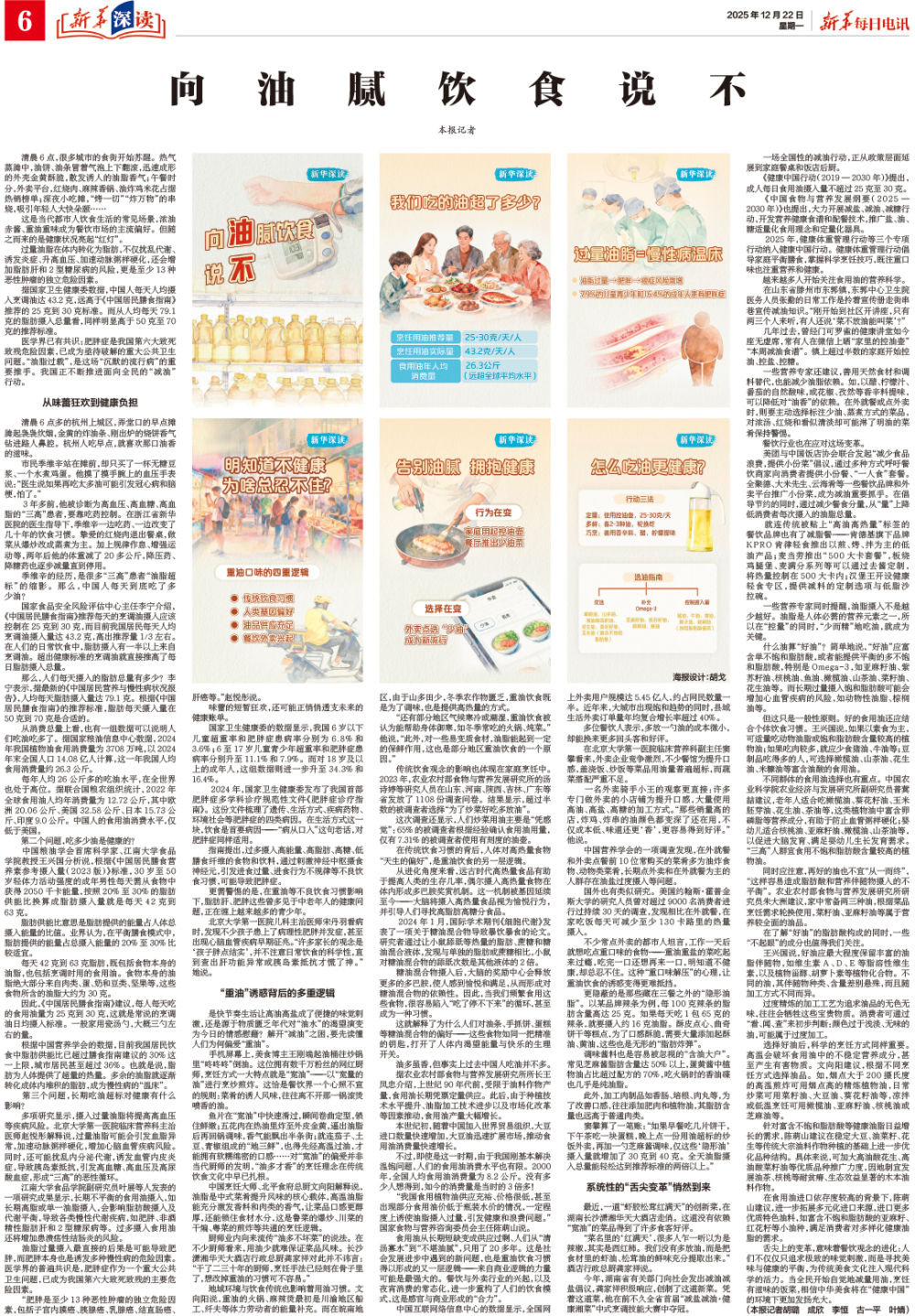
Core Viewpoint - The article highlights the rising health concerns associated with excessive oil consumption in China, where daily cooking oil intake significantly exceeds recommended levels, leading to various health issues including obesity and chronic diseases [10][13][15]. Group 1: Current Consumption Trends - The average daily cooking oil intake in China is 43.2 grams, which is about 33% higher than the recommended 25-30 grams [13][14]. - The total daily fat intake per person is 79.1 grams, exceeding the recommended 50-70 grams [13][14]. - In 2024, the estimated consumption of edible vegetable oil in China is projected to be 37.08 million tons, translating to an average per capita consumption of approximately 26.3 kilograms [13]. Group 2: Health Implications - Excessive oil consumption is linked to increased risks of hypertension, diabetes, and various cancers, with obesity being a significant public health issue in China [15][16][18]. - The prevalence of overweight and obesity among children and adults is alarming, with rates of 6.8% and 34.3% respectively [18][19]. - Long-term high oil intake can lead to metabolic diseases, including non-alcoholic fatty liver disease and type 2 diabetes [16][19]. Group 3: Cultural and Behavioral Factors - The preference for high-oil foods is deeply rooted in Chinese culinary traditions, where oil is seen as essential for enhancing flavor [21][22]. - Many consumers rely on intuition rather than measurement for oil usage, with 65% using personal experience to determine oil amounts [22][23]. - The shift from limited oil availability in the past to an abundance today has contributed to the current high consumption levels [24][25]. Group 4: Industry Response and Initiatives - A nationwide "reduce oil" campaign is being promoted, with guidelines suggesting daily oil intake should not exceed 25-30 grams [30][31]. - The food and restaurant industry is responding by offering smaller portion sizes and healthier cooking options, such as low-oil meals [33][35]. - Initiatives are being taken to educate consumers about healthier cooking practices and the importance of balanced oil consumption [30][31][38].
向油腻饮食说不
Bei Jing Ri Bao Ke Hu Duan· 2025-12-21 22:45
Core Viewpoint - The article highlights the growing concern over excessive oil consumption in China, which is linked to various health issues, including obesity and chronic diseases. The current average daily cooking oil intake is significantly above recommended levels, prompting a nationwide "reduce oil" initiative to address this public health challenge [1][3][17]. Group 1: Current Consumption and Health Risks - The average daily cooking oil intake in China is 43.2 grams, exceeding the recommended 25-30 grams by approximately one-third [3][4]. - The total daily fat intake per person is 79.1 grams, which is also above the recommended range of 50-70 grams [3][4]. - Excessive oil consumption is linked to serious health risks, including hypertension, diabetes, and various cancers, with obesity being a major public health issue in China [6][7][12]. Group 2: Dietary Trends and Cultural Influences - Traditional cooking practices favor high oil usage, with many consumers believing that more oil enhances flavor, leading to a cultural preference for "heavy oil" dishes [9][10]. - The rise of fast-paced lifestyles and the convenience of high-oil foods have contributed to the normalization of excessive oil consumption [8][14]. - The food delivery industry has further reinforced these trends, with many popular dishes being high in oil, salt, and sugar [14][19]. Group 3: Government Initiatives and Public Awareness - The Chinese government has initiated campaigns to promote reduced oil consumption, including guidelines that recommend daily oil intake not exceeding 25-30 grams [17][18]. - There is a growing public awareness regarding the health implications of high oil consumption, with more individuals adopting healthier cooking practices and dietary habits [18][19]. - The food and nutrition sector is responding to these changes, with restaurants and food services beginning to offer lower-oil options and smaller portion sizes [19][22]. Group 4: Future Directions and Recommendations - Experts suggest a balanced approach to oil consumption, emphasizing the importance of choosing healthier oils rich in unsaturated fats while reducing overall intake [20][21]. - There is a call for diversification in oil sources, promoting the cultivation of high-quality oilseed crops to meet the demand for healthier oils [22]. - The shift towards healthier eating habits is seen as a necessary evolution in Chinese culinary practices, aiming to balance taste and health [22].
连州省级示范项目签约落地,赋能水库移民农产品深加工升级
Nan Fang Nong Cun Bao· 2025-12-18 11:30
Core Viewpoint - The signing of the provincial-level demonstration project for the deep processing and upgrading of agricultural products from reservoir immigrants in Lianzhou marks a significant step towards enhancing the local agricultural industry and supporting economic development in the region [2][12]. Group 1: Project Overview - The signing ceremony took place at the Lianzhou Agricultural and Rural Bureau, involving Lianzhou's Agricultural and Rural Bureau, Lianzhou Mianan Agricultural Development Co., Ltd., and Lianzhou Lianfu Food Co., Ltd. [2][3] - The project aims to accelerate the upgrading of the agricultural processing industry for reservoir immigrant villages [4][12]. Group 2: Geographic and Agricultural Context - Lianzhou is located at the intersection of Guangdong, Hunan, and Guangxi provinces, benefiting from fertile soil, excellent water quality, and significant temperature variations [6]. - The region is known for high-quality agricultural products, including Lianzhou cabbage, crystal pears, and Dongbi cured meats, and has received multiple honors such as "Hometown of Crystal Pears" and "National Demonstration Base for Selenium-rich Agriculture" [7][8][9]. Group 3: Economic Impact and Projections - The city has five nationally protected geographical indication products, 18 certified green food enterprises, and aims to achieve a comprehensive output value of 4.4 billion yuan in 2024, with an annual growth rate of 18.7% [10][12]. - The provincial-level demonstration project has a total investment of 23 million yuan, with specific allocations for land acquisition, construction, and equipment [13][14][17]. - The project is expected to generate an annual output value of 60 million yuan and contribute 1.8 million yuan in tax revenue, while also promoting the development of upstream and downstream industries related to raw material transportation and sales [18][19].


第138届广交会闭幕
Zhong Guo Xin Wen Wang· 2025-11-04 12:48
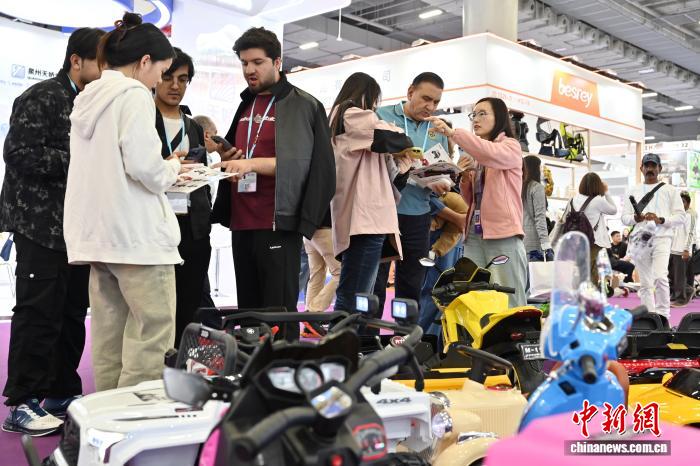
Group 1 - The article highlights the participation of overseas buyers at the Canton Fair, showcasing a variety of products including toys, food, and clothing [1][4][7] - There is a notable interest in food products, with chocolate and cookies experiencing high sales at the fair [6] - The event serves as a platform for international buyers to engage with exhibitors, indicating a robust demand for diverse product categories [2][8] Group 2 - The presence of overseas buyers reflects a growing trend in global trade, particularly in consumer goods [1][4] - The Canton Fair continues to be a significant venue for business negotiations and product showcases, enhancing trade relationships [2][7] - The variety of products on display, from toys to smart massage chairs, illustrates the fair's role in promoting innovation and consumer engagement [1][6][8]
第七届中国—北欧经贸合作论坛拓展合作新空间—— “坚定了我们长期扎根、深耕发展的决心”
Ren Min Ri Bao· 2025-10-15 22:06
Core Insights - The "Global Import Boutique Exhibition" in Wuhan attracted significant consumer interest, showcasing over 300 selected products from more than 50 European brands, particularly highlighting Nordic specialties [1][2] - The China-Nordic Economic and Trade Cooperation Forum, held in Wuhan, featured participation from over 200 Fortune 500 companies and emphasized the long-standing trade relationships between China and Nordic countries [2][3] - Hubei province is positioning itself as an international consumption center, with a retail sales total of 1.7 trillion RMB in the first eight months of the year, reflecting a growth rate of 5.7%, surpassing the national average [3] Company Highlights - IKEA has established a comprehensive value chain in China over the past 27 years, with its Wuhan store attracting 5 million visitors annually, indicating strong local consumer engagement [1] - Maersk has maintained a presence in Wuhan since 1999, providing integrated logistics services, and expresses confidence in the Chinese market's potential for European businesses [1][2] Trade and Investment Data - In the first eight months of this year, trade between China and the five Nordic countries reached 37.96 billion USD, with a year-on-year growth of 7.1%, significantly outpacing the growth of trade between China and Central Europe [2] - Cumulative direct investment from Nordic countries in China exceeds 15 billion USD, with Sweden and Denmark each contributing over 5 billion USD, ranking them among the top European investors [2]