
酷睿Ultra 3系列处理器

Search documents
PC CPU市场格局,生变
半导体行业观察· 2026-01-24 02:39
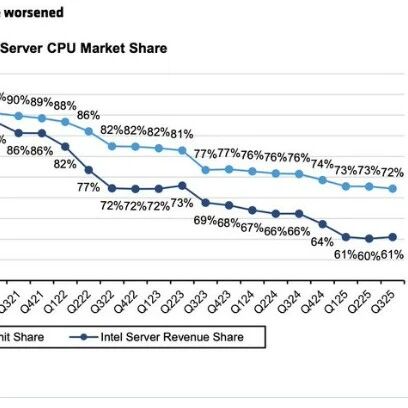
Core Viewpoint - Intel's market share has significantly declined from approximately 90% to 60% over the past eight years, primarily due to competition from AMD and Apple's transition to self-designed Arm architecture processors [1][3]. Market Share Analysis - AMD has steadily been gaining CPU market share, with recent analyses indicating that Apple's notebook CPU sales are now nearly on par with Intel's, each holding about 20% of the market [3]. - Since 2018, AMD and Apple have collectively reduced Intel's market share by over 20% in both the desktop and notebook CPU markets [3]. - Prior to 2018, Intel dominated the desktop CPU market with around 90% share and over 80% in the notebook CPU market; currently, it retains about 60% in both segments [3]. Competitive Landscape - AMD's fourth-generation Zen processors have accelerated its market share growth, while Intel's consumer-grade CPUs have stagnated due to stability issues and a lack of effective response to AMD's 3D V-Cache technology [11]. - AMD's CPUs now account for over 40% of Steam users, indicating strong adoption among gamers [11]. - Apple's M series processors have maintained a stable 10% share in the desktop market since their launch in 2022, reflecting a shift among users favoring Mac computers over Intel models [11]. Future Outlook - Intel's recent launch of the Core Ultra 3 series processors aims to counter the increasing competition from AMD's Ryzen AI 400 series and Apple's M5 processors [12]. - The impact of emerging players like Qualcomm and NVIDIA in the Arm CPU market is anticipated, with Qualcomm set to release a series of Arm-based Windows laptop processors in 2024 [12].


电子行业周报:英伟达Rubin平台正式发布,台积电2025全年营收创新高-20260112
Donghai Securities· 2026-01-12 09:38
Investment Rating - The report suggests a positive outlook for the semiconductor industry, highlighting structural opportunities in AI computing, AIOT, semiconductor equipment, key components, and rising storage prices [6][7]. Core Insights - The semiconductor industry is experiencing a comprehensive recovery in demand, with TSMC reporting a December revenue of approximately NT$335 billion, a year-on-year increase of 20.4%, and a full-year growth of 31.6%, marking a historical high [6][12]. - NVIDIA's Rubin platform, which integrates six core chips, has been fully mass-produced, significantly reducing the cost of generating tokens to about one-tenth of the previous generation [6][12]. - The report emphasizes the ongoing recovery in the electronics sector, with storage chip prices rising and domestic production efforts exceeding expectations [6][7]. Summary by Sections Industry Overview - The electronics sector is witnessing a strong recovery, with NVIDIA showcasing its Rubin platform at CES 2026, which includes six chips designed for optimal collaboration, enhancing AI deployment efficiency [6][12]. - TSMC's December revenue reflects robust demand driven by AI applications, with a high capacity utilization rate indicating a sustained recovery in the semiconductor industry [6][12]. Market Performance - The report notes that the electronics industry outperformed the broader market, with the Shenzhen and Shanghai 300 Index rising by 2.79% and the Shenwan Electronics Index increasing by 7.74% [21][23]. - Various sub-sectors within the electronics industry showed significant gains, particularly semiconductors (+10.61%) and electronic chemicals (+15.95%) [23][27]. Investment Recommendations - The report recommends focusing on companies benefiting from strong domestic and international demand in the AIOT sector, such as Lexin Technology and Rockchip Technology [7]. - It also highlights opportunities in AI-driven sectors, including computing chips and optical devices, suggesting investments in companies like Cambricon and Source Photonics [7].
每日报告精选(2026-01-06 09:00——2026-01-07 15:00)-20260107
GUOTAI HAITONG SECURITIES· 2026-01-07 09:10
Group 1: Market Trends and Observations - The New Year's tourism and cultural activities have shown significant improvement, with domestic travel increasing by 19.5% year-on-year, and inbound travel rising by 28.6% [6][5] - The technology hardware sector continues to see price increases, driven by strong demand in the AI industry, with storage prices rising month-on-month [5][8] - The real estate and durable goods sectors remain under pressure, with a 26% year-on-year decline in property transactions across major cities [7] Group 2: Industry Insights - The advanced manufacturing sector in China is maturing, showcasing strong global competitiveness and profitability, particularly in lithium battery production [17] - The new energy sector, including wind and solar, is experiencing a valuation reassessment, with leading companies showing significant potential for growth [17] - The consumer goods sector is witnessing strong profitability in product consumption, while service consumption is still in its early stages of development [17] Group 3: Company-Specific Developments - Zhongxin Co. plans to establish a manufacturing base in the U.S., investing up to $36 million in a new facility, which is expected to enhance its overseas customer order share [23][24] - Huatu Shanding is projected to achieve significant profit growth, with expected net profits of 3.12, 4.38, and 5.43 billion yuan from 2025 to 2027, driven by its strong market position and AI integration [42][44] - Minglue Technology is expected to see a recovery in revenue, with a projected increase in gross margin due to the rise of high-margin marketing intelligence products [34][35] Group 4: Investment Recommendations - The report recommends focusing on leading companies in the electric new energy, transportation equipment, communication devices, electronics, and service consumption sectors, which are expected to benefit from their competitive advantages and global expansion [18] - The report highlights the potential for valuation increases in advanced manufacturing and emerging technology sectors, particularly those with strong innovation capabilities [18][16] - The bond market outlook is optimistic, with expectations of a "New Year rally" driven by policy support and seasonal capital inflows [48][49]

