金信民兴A

Search documents
2025Q4绩优中长期债基季报研究:逆风行情下,纯债基金如何突围?
East Money Securities· 2026-01-29 04:04
1. Report Industry Investment Rating No relevant content provided. 2. Core Viewpoints of the Report - In Q4 2025, the bond market showed an N-shaped trend, with credit products outperforming interest rate products. Credit - type bond funds performed better among various medium - and long - term pure bond funds [2][8]. - The share of medium - and long - term pure bond funds in the whole market declined, while the share of high - performing bond funds slightly expanded marginally [2][17]. - The net value of high - performing bond funds significantly recovered in Q4 2025, with about 80% of the income concentrated in October [2][22]. - In terms of bond allocation, high - performing bond funds increased the allocation of secondary and perpetual bonds and reduced the allocation of national bonds. They also reduced the overall positions in interest rate bonds and credit bonds, with a more significant decline in interest rate bonds [2][28]. - The investment strategies of high - performing bond funds included reducing duration, leverage, and moderately adopting a credit - sinking strategy [2][39]. - In the short term, the 10Y national bond is likely to oscillate between 1.8% - 1.9%, and the coupon strategy may still be effective. In the long term, bonds may be weak assets, and a neutral underlying allocation is recommended [2][54]. 3. Summary According to the Table of Contents 3.1 Overview: Coupon Strategy Slightly Outperforms - In Q4 2025, the bond market showed an N - shaped trend. Credit products performed better than interest rate products. Among medium - and long - term pure bond funds, credit - type bond funds performed more outstandingly. For example, products like Jinxin Minxing A and F安达富利纯债A had stable net value growth in Q4 2025, and their annual net value growth rates were over 3% [2][8][13]. 3.2 Share: Decline in the Share of Medium - and Long - Term Pure Bond Funds in the Whole Market, Marginal Expansion of High - Performing Bond Funds - Affected by performance, the share of medium - and long - term pure bond funds in the whole market continued to shrink. However, high - performing medium - and long - term pure bond funds may have benefited from performance support, with a marginal increase in their shares. Some bond funds, such as Xingquan Wentai A, Chang Sheng Sheng Yu Pure Bond A, and Xingzheng Global Hengyuan A, expanded by over 2.5 billion in a single quarter [2][17][18]. 3.3 Net Value: Significant Recovery of the Net Value of High - Performing Bond Funds in Q4 2025 - In Q3 2025, high - performing bond funds in the sample generally recorded negative returns. In Q4 2025, they significantly recovered their net values, with about 80% of the income concentrated in October. Some high - performing products had a net value increase of over 1.0% in October, while there were slight fluctuations or even slight retracements in November and December [2][22]. 3.4 Bond Allocation: Increase in Secondary and Perpetual Bonds, Decrease in National Bonds 3.4.1 Bond Investment Portfolio: Stable Credit, Decrease in Interest Rate - By the end of Q4 2025, high - performing bond funds in the sample reduced their positions in both interest rate bonds and credit bonds, with a more significant decline in interest rate bonds. The weighted average position of interest rate bonds decreased by 5.57 percentage points to 22.01%, and the weighted average position of credit bonds decreased by 0.23 percentage points to 94.44% [28]. - In terms of interest rate bonds, high - performing bond funds reduced their positions in both national bonds and policy - financial bonds, with a more prominent reduction in national bonds. In terms of credit bonds, although the overall position was basically flat, there was an obvious shift in the preference for internal bond types, with a reduction in enterprise bonds and medium - term notes and an increase in financial bonds (excluding policy - financial bonds) [32]. 3.4.2 Top Five Bond Holdings: Decrease in Concentration, Mainly Increase in Secondary and Perpetual Bonds - In Q4 2025, the concentration of high - performing bond funds in the sample decreased, and the holdings became more diversified. The weighted average concentration of high - performing bond funds was about 20.16%, a decrease of 3.35 percentage points from the end of the previous quarter [33]. - In terms of bond categories, high - performing bond funds mainly increased the allocation of secondary and perpetual bonds and reduced the allocation of national bonds in their top five bond holdings, which was consistent with the overall adjustment direction of their holdings. By the end of Q4 2025, the proportion of secondary and perpetual bonds increased by 6.11 percentage points to 37.24%, while the proportion of national bonds decreased by 5.09 percentage points to 2.79% [35]. 3.5 Investment Strategy: Decrease in Duration, Leverage, and Moderate Credit - Sinking 3.5.1 Duration: Marginal Decrease - In Q4 2025, the duration of the heavy - holding bond portfolio of high - performing bond funds in the sample decreased marginally, indicating a defensive duration management strategy. The duration center of the top five heavy - holding bond portfolios decreased by 0.92 years to 3.09 years. Some bond funds, such as Western Securities Seasonal Steady 90 - Day Rolling A, had a duration of less than 1 year. The duration of Southern Runyuan Pure Bond AB adjusted significantly, decreasing by about 8 years [39]. 3.5.2 Leverage: Decrease - In Q4 2025, high - performing bond funds in the sample generally showed a trend of reducing leverage. The weighted average leverage ratio was 121.09%, a decrease of 4.71 percentage points compared with Q3 2025. Some bond funds, such as Bank of China Pure Bond A, had a relatively high leverage ratio, while others like Xingzheng Global Hengyuan A had a relatively low leverage ratio [46]. 3.5.3 Credit - Sinking: Moderate Sinking - High - performing bond funds in the sample showed a cautious and moderate credit - sinking strategy. They increased their holdings of AA + - rated credit bonds and reduced their holdings of AA - rated credit bonds, with the focus of holdings shifting from low - rated to medium - low - rated bonds [50]. 3.6 Summary and Outlook - In Q4 2025, compared with Q3 2025, high - performing bond funds in the sample showed characteristics such as adjusting bond allocation, reducing duration and leverage, and moderately adopting a credit - sinking strategy. - In the short term, the 10Y national bond is likely to oscillate between 1.8% - 1.9%, and the coupon strategy may still be effective. In the long term, bonds may be weak assets, and a neutral underlying allocation is recommended. The continuation of the bond market rally depends on factors such as the persistence of weak credit demand, the continuation of the equity bull market, and the participation of trading accounts [54][63]. 3.7 Appendix - The selection criteria for medium - and long - term bond funds in the sample include being established before 2024, non - fixed - open and non - closed, with a single - holder share ratio of less than 80% from H2 2023 to H1 2024, and an average fund share of more than 500 million from Q3 2024 to Q1 2025 [67]. - The classification basis for the holding styles of bond funds in the sample includes interest - rate - type, financial - type, credit - type, and balanced - type bond funds [65]. - The selection criteria for high - performing bond funds include ranking among the top 50 in net value growth rate in Q4 2025 and having an average fund share of more than 500 million in the previous three periods [67].
首批基金三季报:百亿资金被锁3年刚回本,有产品规模增百亿
Sou Hu Cai Jing· 2025-10-22 12:10
Core Viewpoint - The public fund industry is experiencing significant performance and scale growth, particularly in technology-focused funds, while bond funds show mixed results due to market adjustments [2][3][4]. Group 1: Equity Funds Performance - Multiple equity funds have achieved impressive returns due to the surge in technology sectors, with funds like Yongying Technology Smart A and Huafu CSI Artificial Intelligence Industry ETF reporting quarterly returns of 99.7% and 73.9%, respectively [2][3]. - Yongying Technology Smart A's total scale increased to 115.2 billion yuan, marking an 8.9-fold increase from the previous year, with a year-to-date return of 195% [3]. - The top ten holdings of Yongying Technology Smart A are concentrated in popular AI-related stocks, accounting for 73.25% of the fund's net value [3]. Group 2: Bond Funds Performance - Bond funds have shown a divergence in performance, with the overall bond market declining in Q3 2025, leading to negative returns for several pure bond funds [6][7]. - Among the seven bond funds that disclosed their Q3 reports, four experienced losses, while three achieved positive returns ranging from 4.4% to 9.4% [6][7]. - "Fixed income plus" products have gained attention, with significant increases in scale, such as Anxin Ju Li Enhanced A, which saw its scale grow from 4.5 million yuan to 39.7 million yuan, a six-fold increase [7]. Group 3: Fund Management Insights - Fund managers express optimism about the technology sector's long-term growth potential while emphasizing the importance of risk management and rational investment decisions [4][7]. - The manager of Yongying Technology Smart A cautions investors against relying solely on past performance to predict future results, highlighting the need for diversified investment strategies [4]. Group 4: Specific Fund Highlights - The performance of the "Billion Fund" by Quanguo Fund, which was locked for three years, has recently returned to break-even after a significant recovery, with a quarterly return of 45.6% [8][9]. - Quanguo Fund's strategy focuses on high-end manufacturing sectors, including new energy and technology, reflecting a dual allocation framework [9].

5月“固收+”基金业绩领先同类产品,债市持续震荡,含权债基优势明显?
Mei Ri Jing Ji Xin Wen· 2025-06-03 09:28
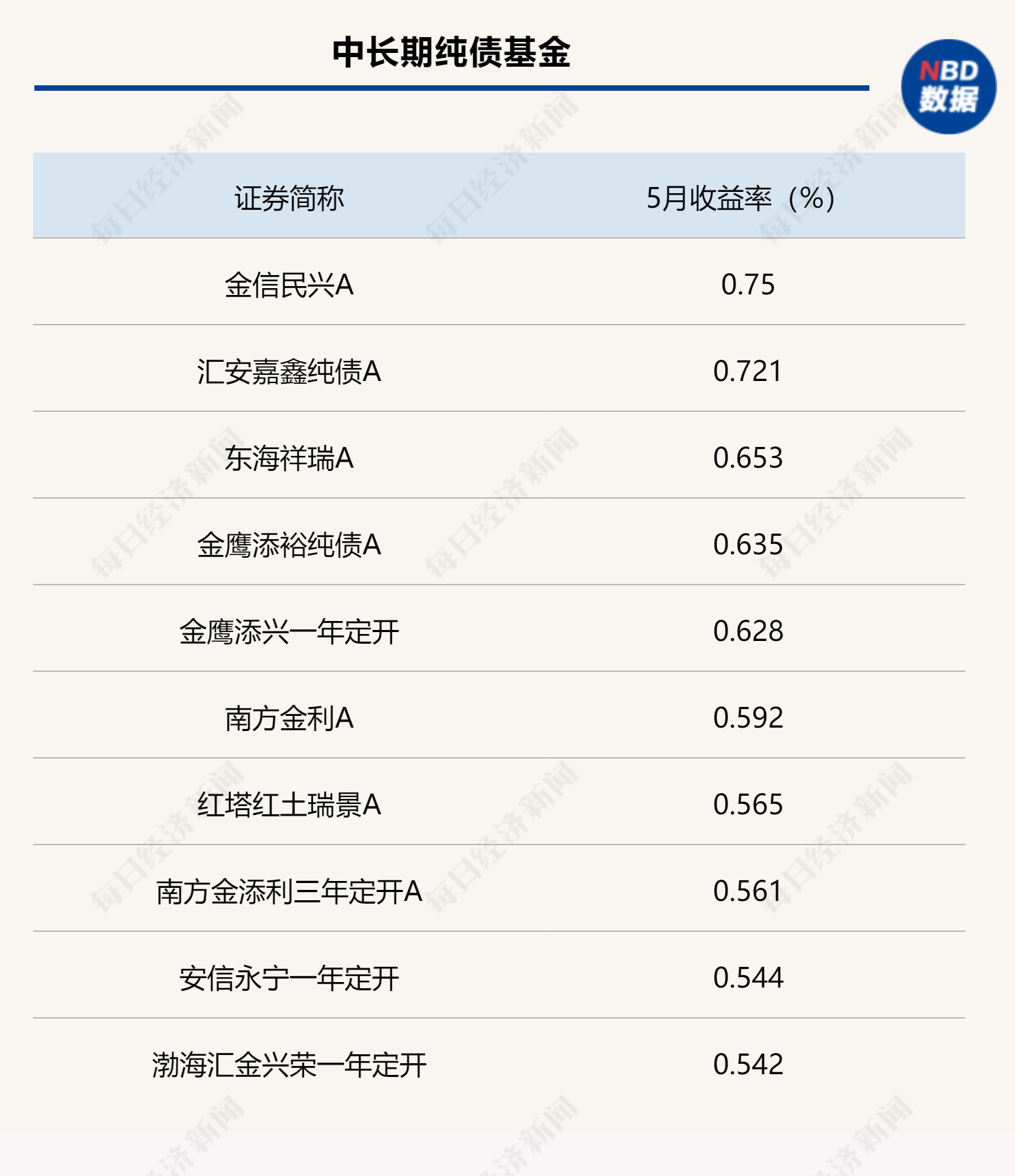
Core Viewpoint - The bond market experienced fluctuations in May, with a tight funding environment and weak market sentiment leading to subdued bullish intentions. However, "fixed income +" funds performed well, ranking first among all bond funds in terms of average performance [1][2]. Bond Market Performance - In May, many institutional investors awaited adjustments in monetary policy following the "double reduction," but the market's positive impact was limited. The bond market showed a noticeable decline compared to previous performance, with pure bond funds generally yielding low returns [2]. - According to Wind statistics, the top-performing pure bond fund in May was Jin Xin Min Xing A, which recorded a monthly return of 0.75%. Other notable funds included Hui An Jia Xin Pure Bond and Dong Hai Xiang Rui A, with short bond funds showing a higher average monthly performance than medium to long-term pure bond funds [2]. - The average monthly performance for medium to long-term pure bond funds was 0.12%, while short bond funds recorded 0.18%, indicating a significant demand for short-duration bonds in the current market [2]. Market Sentiment and Future Outlook - The overall weak sentiment in the bond market during the first quarter led to increased redemptions from funds and wealth management products. However, as the market stabilizes in the second quarter, fund liabilities may enter a recovery phase, potentially leading to a rebound in scale [3]. - Analysts suggest that the central bank is likely to maintain a loose policy stance, supporting the bond market. The overall environment remains supportive, although the market's risk-reward profile appears limited [3]. Investment Strategy - The configuration of "fixed income +" funds continues to be advantageous, as they allow investors to participate in equity market opportunities while providing stability through bond assets. This type of fund has gained attention in 2023, with a significant increase in issuance and net inflows [4]. - In the first quarter, the issuance of "fixed income +" funds reached 33.9 billion yuan, a 65% increase from the previous quarter, with total market size nearing 2 trillion yuan, reflecting a 5.5% year-on-year growth [4]. - The top 40 "fixed income +" funds had an average pure bond allocation of 46.2%, stock allocation of 14.5%, and convertible bond allocation of 23.1%, with high returns driven by overexposure to technology stocks and reduced positions in financial stocks [4]. Future Market Conditions - Looking ahead, the core factors supporting the bond market remain unchanged, with policies focusing on technology and industrial upgrades expected to benefit medium to high-risk assets. A diversified asset allocation strategy is recommended to enhance yield elasticity [5].