
杠杆策略

Search documents
2025Q4绩优中长期债基季报研究:逆风行情下,纯债基金如何突围?
East Money Securities· 2026-01-29 04:04
1. Report Industry Investment Rating No relevant content provided. 2. Core Viewpoints of the Report - In Q4 2025, the bond market showed an N-shaped trend, with credit products outperforming interest rate products. Credit - type bond funds performed better among various medium - and long - term pure bond funds [2][8]. - The share of medium - and long - term pure bond funds in the whole market declined, while the share of high - performing bond funds slightly expanded marginally [2][17]. - The net value of high - performing bond funds significantly recovered in Q4 2025, with about 80% of the income concentrated in October [2][22]. - In terms of bond allocation, high - performing bond funds increased the allocation of secondary and perpetual bonds and reduced the allocation of national bonds. They also reduced the overall positions in interest rate bonds and credit bonds, with a more significant decline in interest rate bonds [2][28]. - The investment strategies of high - performing bond funds included reducing duration, leverage, and moderately adopting a credit - sinking strategy [2][39]. - In the short term, the 10Y national bond is likely to oscillate between 1.8% - 1.9%, and the coupon strategy may still be effective. In the long term, bonds may be weak assets, and a neutral underlying allocation is recommended [2][54]. 3. Summary According to the Table of Contents 3.1 Overview: Coupon Strategy Slightly Outperforms - In Q4 2025, the bond market showed an N - shaped trend. Credit products performed better than interest rate products. Among medium - and long - term pure bond funds, credit - type bond funds performed more outstandingly. For example, products like Jinxin Minxing A and F安达富利纯债A had stable net value growth in Q4 2025, and their annual net value growth rates were over 3% [2][8][13]. 3.2 Share: Decline in the Share of Medium - and Long - Term Pure Bond Funds in the Whole Market, Marginal Expansion of High - Performing Bond Funds - Affected by performance, the share of medium - and long - term pure bond funds in the whole market continued to shrink. However, high - performing medium - and long - term pure bond funds may have benefited from performance support, with a marginal increase in their shares. Some bond funds, such as Xingquan Wentai A, Chang Sheng Sheng Yu Pure Bond A, and Xingzheng Global Hengyuan A, expanded by over 2.5 billion in a single quarter [2][17][18]. 3.3 Net Value: Significant Recovery of the Net Value of High - Performing Bond Funds in Q4 2025 - In Q3 2025, high - performing bond funds in the sample generally recorded negative returns. In Q4 2025, they significantly recovered their net values, with about 80% of the income concentrated in October. Some high - performing products had a net value increase of over 1.0% in October, while there were slight fluctuations or even slight retracements in November and December [2][22]. 3.4 Bond Allocation: Increase in Secondary and Perpetual Bonds, Decrease in National Bonds 3.4.1 Bond Investment Portfolio: Stable Credit, Decrease in Interest Rate - By the end of Q4 2025, high - performing bond funds in the sample reduced their positions in both interest rate bonds and credit bonds, with a more significant decline in interest rate bonds. The weighted average position of interest rate bonds decreased by 5.57 percentage points to 22.01%, and the weighted average position of credit bonds decreased by 0.23 percentage points to 94.44% [28]. - In terms of interest rate bonds, high - performing bond funds reduced their positions in both national bonds and policy - financial bonds, with a more prominent reduction in national bonds. In terms of credit bonds, although the overall position was basically flat, there was an obvious shift in the preference for internal bond types, with a reduction in enterprise bonds and medium - term notes and an increase in financial bonds (excluding policy - financial bonds) [32]. 3.4.2 Top Five Bond Holdings: Decrease in Concentration, Mainly Increase in Secondary and Perpetual Bonds - In Q4 2025, the concentration of high - performing bond funds in the sample decreased, and the holdings became more diversified. The weighted average concentration of high - performing bond funds was about 20.16%, a decrease of 3.35 percentage points from the end of the previous quarter [33]. - In terms of bond categories, high - performing bond funds mainly increased the allocation of secondary and perpetual bonds and reduced the allocation of national bonds in their top five bond holdings, which was consistent with the overall adjustment direction of their holdings. By the end of Q4 2025, the proportion of secondary and perpetual bonds increased by 6.11 percentage points to 37.24%, while the proportion of national bonds decreased by 5.09 percentage points to 2.79% [35]. 3.5 Investment Strategy: Decrease in Duration, Leverage, and Moderate Credit - Sinking 3.5.1 Duration: Marginal Decrease - In Q4 2025, the duration of the heavy - holding bond portfolio of high - performing bond funds in the sample decreased marginally, indicating a defensive duration management strategy. The duration center of the top five heavy - holding bond portfolios decreased by 0.92 years to 3.09 years. Some bond funds, such as Western Securities Seasonal Steady 90 - Day Rolling A, had a duration of less than 1 year. The duration of Southern Runyuan Pure Bond AB adjusted significantly, decreasing by about 8 years [39]. 3.5.2 Leverage: Decrease - In Q4 2025, high - performing bond funds in the sample generally showed a trend of reducing leverage. The weighted average leverage ratio was 121.09%, a decrease of 4.71 percentage points compared with Q3 2025. Some bond funds, such as Bank of China Pure Bond A, had a relatively high leverage ratio, while others like Xingzheng Global Hengyuan A had a relatively low leverage ratio [46]. 3.5.3 Credit - Sinking: Moderate Sinking - High - performing bond funds in the sample showed a cautious and moderate credit - sinking strategy. They increased their holdings of AA + - rated credit bonds and reduced their holdings of AA - rated credit bonds, with the focus of holdings shifting from low - rated to medium - low - rated bonds [50]. 3.6 Summary and Outlook - In Q4 2025, compared with Q3 2025, high - performing bond funds in the sample showed characteristics such as adjusting bond allocation, reducing duration and leverage, and moderately adopting a credit - sinking strategy. - In the short term, the 10Y national bond is likely to oscillate between 1.8% - 1.9%, and the coupon strategy may still be effective. In the long term, bonds may be weak assets, and a neutral underlying allocation is recommended. The continuation of the bond market rally depends on factors such as the persistence of weak credit demand, the continuation of the equity bull market, and the participation of trading accounts [54][63]. 3.7 Appendix - The selection criteria for medium - and long - term bond funds in the sample include being established before 2024, non - fixed - open and non - closed, with a single - holder share ratio of less than 80% from H2 2023 to H1 2024, and an average fund share of more than 500 million from Q3 2024 to Q1 2025 [67]. - The classification basis for the holding styles of bond funds in the sample includes interest - rate - type, financial - type, credit - type, and balanced - type bond funds [65]. - The selection criteria for high - performing bond funds include ranking among the top 50 in net value growth rate in Q4 2025 and having an average fund share of more than 500 million in the previous three periods [67].
EasyMarkets易信:解析加密波动风险
Xin Lang Cai Jing· 2026-01-22 14:13
Core Insights - The cryptocurrency market recently experienced a rare "long-short squeeze" phenomenon, highlighting the extreme fragility and volatility of market sentiment in the current macroeconomic environment [1][4] - A total of $625 million in leveraged positions were liquidated within 24 hours, affecting approximately 150,000 traders, with long positions losing about $306 million and short positions losing around $319 million [1][4] - The rapid "V-shaped" reversal in Bitcoin's price, dropping below $88,000 and quickly recovering above $90,000, caused significant losses for investors who failed to adjust their positions in time [4] Market Dynamics - Geopolitical tensions and changes in macroeconomic policies are identified as core drivers of the recent volatility, with heightened sensitivity to U.S. trade policies and comments from the president at the Davos Forum [2][4] - The global bond market's turbulence has led to frequent shifts between safe-haven and speculative capital, exacerbating market instability [2][4] - A notable liquidation order of $40.22 million in Ethereum on the Hyperliquid platform underscores the challenges faced by high-leverage operations in a trendless market [2][4] Trading Strategy Recommendations - Investors are advised to focus more on position management rather than solely on leverage ratios, especially as Bitcoin stabilizes around the $90,000 mark [3][5] - With ongoing macroeconomic uncertainties, future volatility is likely to remain high, necessitating a more defensive trading posture [3][5] - Utilizing protective tools offered by trading platforms to hedge against slippage risk is deemed essential for survival and profitability until clearer trend signals emerge [3][5]


中信建投固定收益首席分析师曾羽:2026年或是长周期尾端的利率筑底之年
Zheng Quan Shi Bao Wang· 2026-01-16 04:45
Core Viewpoint - The 2026 Bond Market Annual Forum highlighted expectations for long-term interest rates to remain in a wide range of fluctuations, with potential for a gradual recovery in the macro economy if housing prices stabilize in the next two years [1] Group 1: Interest Rate Trends - Long-term interest rates are expected to experience wide fluctuations at the bottom [1] - A gradual upward trend in the interest rate center is anticipated, driven by a potential stabilization in housing prices and ongoing "anti-involution" efforts [1] Group 2: Investment Strategies - The market environment suggests avoiding unilateral duration strategies, favoring a focus on coupon strategies [1] - Recommendations include using short-duration credit bonds as a base, employing leverage strategies for interest rate arbitrage, and actively managing long-end volatility to enhance returns [1] - There is an emphasis on actively positioning in "fixed income +" opportunities [1]


债券周报 20260111:商品交易再通胀,债市怎么走?-20260111
Huachuang Securities· 2026-01-11 15:37
Group 1: Report Industry Investment Rating No information provided in the content. Group 2: Report's Core View - The bond market experienced a "poor start" at the beginning of 2026 due to multiple factors such as the strong performance of the equity and commodity markets, large - scale government bond issuance at the beginning of the year, and increased redemption pressure on funds. Although some policies are beneficial to the bond market, the market still has concerns about the bond market's performance in January and 2026 [1][2][11]. - The commodity market shows a "re - inflation" trading logic at the beginning of the year, but the sustainability of the commodity price increase remains to be observed. If the actual situation does not meet expectations, it may bring trading opportunities for the bond market [3][39]. - For the bond market strategy, the 10y Treasury bond is close to the high point of the shock range, and the leverage strategy is still effective. The allocation of Tier 2 and perpetual bonds of banks is better than trading [3][4]. Group 3: Summary According to the Directory 1. The bond market experienced a "poor start" - **Reason 1: The strong performance of the equity and commodity markets suppresses the bond market** - The PMI in December rebounded counter - seasonally, and policies were introduced, boosting the opening - year macro - expectations. The Shanghai Composite Index stood above 4000 points, and the Wind All - A Index rose 5.1%. - The expectation of continued fiscal efforts and investment recovery in 2026 led to the warming of re - inflation trading. The Nanhua Industrial Products Index increased by 2.5% month - on - month, with metal varieties being relatively strong [1][12][14]. - **Reason 2: The large - scale issuance of government bonds at the beginning of the year raises concerns about supply** - The issuance scale of key - term government bonds at the beginning of the year was significantly larger than that of the same period last year, causing supply concerns. The current government bond issuance is in line with the neutral issuance speed under a 4% deficit ratio, and there may be room for acceleration in the future. - The bidding for local bonds in the first week of January was not good, and the spread between local bonds and government bonds has exceeded 20bp. Future policies to control bond - issuing costs need attention [19][21][24]. - **Reason 3: Increased redemption pressure and continuous net selling by funds** - At the beginning of the year, the funds for fund volume - boosting flowed back, and the scale of credit bond ETFs decreased rapidly after the New Year. - Since the beginning of the year, affected by factors such as the stock - bond seesaw effect, inflation expectations, and supply concerns, funds have continuously sold bonds net, mainly old - term policy financial bonds within 10 years and inter - bank certificates of deposit [26]. 2. Is the commodity market trading re - inflation? - The commodity market shows a "re - inflation" logic, with strong performance in non - precious metals and mid - upstream sectors such as non - ferrous and black metals. The driving forces include policy - induced macro - expectation improvement, the capital effect of precious metals, and the resonance of risk preferences during the equity spring rally. - Specific factors include the repair of undervalued sectors by speculative funds, the tightening of coal supply, the early - stage production of industrial products after the holiday, and the bottoming - out and recovery of inflation expectations. However, the current trading is mainly at the expectation level, and the sustainability of the commodity price increase remains to be observed [30][33][34]. 3. Bond market strategy: The 10y Treasury bond is close to the high point, the leverage strategy is still effective, and the allocation of Tier 2 and perpetual bonds is better than trading - **The 10y Treasury bond is close to the high point of the shock range, and the 1.9% level has allocation value** - It is expected that the 10y Treasury bond is close to the high point of the shock range, and the 1.9% level is worth allocating. It can be gradually built according to the liability situation. - The 10y Treasury bond fluctuates around OMO + 30 - 50bp as the core range, with an additional 5bp of possible extreme fluctuations. - The first quarter may be the high - point period of the bond market shock, so the current 1.9% level has allocation value [38][43]. - **Can the leverage strategy continue?** - At the beginning of the year, the funds are relatively stable and loose, and the bond market leverage level has increased significantly. The carry - trade spread is still at a relatively high level compared with the same period last year, so the leverage strategy is still effective. - In the middle and late ten - days, factors such as the tax period and government bond payment may cause fluctuations in capital prices, but it is unlikely to tighten significantly. The marginal change of certificate of deposit pricing can be observed, and the leverage level can be adjusted flexibly if necessary [44][47][49]. - **How to participate in the current Tier 2 and perpetual bonds of banks?** - **From the allocation perspective**: Currently, Tier 2 and perpetual bonds within 2 years have no obvious advantages compared with medium - term notes of the same rating. For 2 - 3y bonds, some city and rural commercial bank entities can be appropriately selected for bottom - position allocation. Institutions with stable liability ends can participate in the allocation of 4 - 5y bonds. - **From the trading perspective**: If the holding period is less than 1 month, the 10y interest - rate bond is better than the 5y Tier 2 and perpetual bonds. If the holding period is 3 months, the 5y Tier 2 and perpetual bonds can better reflect the coupon and riding value. Considering the current headwinds in the bond market, the trading strategy is recommended to prioritize 10y interest - rate bonds, and the trading of Tier 2 and perpetual bonds should wait for a favorable market [53][58]. 4. Review of the interest - rate bond market: The stock - bond seesaw and supply concerns lead to a steeper yield curve - **Funding situation**: The central bank conducted net reverse - repurchase withdrawals, and the funding situation was stable and balanced [69]. - **Primary issuance**: The net financing of government bonds, local bonds, and inter - bank certificates of deposit increased, while the net financing of policy financial bonds decreased [74]. - **Benchmark changes**: The term spread of government bonds widened, and the term spread of China Development Bank bonds narrowed [81].
【财经分析】2026年一季度信用债投资——宽松底色下的结构深耕与风险规避
Xin Hua Cai Jing· 2026-01-08 15:05
Group 1 - The core viewpoint of the article indicates that the credit bond market is entering an investment window characterized by both opportunities and challenges, driven by a weak macroeconomic recovery and a continued loose monetary policy [1] - Experts believe that the credit bond investment environment in the first quarter of 2026 will be favorable, but it is essential to focus on structural opportunities while being cautious of liquidity and regulatory changes [1][2] - The core support for credit bond investment in the first quarter is attributed to a loose liquidity environment and a moderate pace of fundamental recovery, with expectations of a downward trend in bond yields [2][3] Group 2 - The scale of open-ended bond funds is expected to exceed 260 billion yuan in the first quarter of 2026, which will alleviate market supply and demand pressure [3] - The investment opportunities in the credit bond market are concentrated in short- to medium-term interest rate strategies and high-quality long-term varieties, with a consensus among brokers on specific targets and strategies [4] - The focus for short-term credit bond strategies is on leveraging the yield spread between bond coupon income and financing costs, particularly for bonds maturing within three years [4][6] Group 3 - Despite a relatively favorable investment environment, risks related to liquidity, regulatory changes, and credit spread repricing remain critical concerns [7][8] - The liquidity changes are highlighted as a direct short-term risk, with potential outflows of funds following the year-end surge, necessitating caution regarding market volatility [7] - The article emphasizes the need for a balanced investment strategy that prioritizes coupon income, structural opportunities, and controlled leverage while closely monitoring liquidity fluctuations and regulatory developments [8]
2026年一季度债券投资策略展望:久期的博弈机会vs票息的稳健价值
Shenwan Hongyuan Securities· 2026-01-06 14:44
Group 1 - The report highlights the potential paths to alleviate the supply-demand imbalance in long-term bonds, indicating that in 2025, long-end interest rate bonds are constrained by low odds, while equity assets exhibit high Sharpe ratios [2][3] - The main contradictions affecting the bond market are identified as the supply-demand imbalance of bonds, policy expectation differences (especially regarding monetary policy), and mid-term expectations of price recovery [2][3] - The supply structure of long-term bonds is changing, with a decrease in net purchases of ultra-long government bonds by funds and insurance [2][3] Group 2 - The report emphasizes that the marginal demand for long-end bonds will return to a range considered "valuable" by institutional investors, leading to a rebalancing of supply and demand [2][3] - It notes that the government bond supply scale will be relatively small before mid-February 2026, which may provide a window for alleviating the supply-demand imbalance in ultra-long bonds [2][3] - The report discusses the policy expectation differences, particularly between reserve requirement ratio cuts and interest rate cuts, indicating that the conditions for these actions are stringent [3][4] Group 3 - The report outlines the impact of new regulations on fund fees and the trend of "deposit migration," which is causing a shift in institutional behavior [4][5] - Insurance institutions are expected to prefer high-dividend assets in their asset allocation, with a projected slowdown in premium growth for 2026 [4][5] - Public funds are experiencing limited benefits from the new fee regulations, as market expectations have already been priced in [4][5] Group 4 - The report contrasts duration strategies with leverage strategies, indicating that the bond market environment in Q1 2026 will differ significantly from that of Q1 2025 [5][6] - It suggests that the effectiveness of leverage strategies will increase under a trend of monetary easing, with opportunities for arbitrage in the bond futures market [5][6] - The report recommends a combination of short-duration credit bonds and long-duration interest rate bonds as a favorable strategy for Q1 2026 [5][6]
对近期债市高波动的几个思考
Shenwan Hongyuan Securities· 2025-12-22 06:15
Core Insights - The recent bond market has exhibited significant volatility, particularly in ultra-long-term government bonds, which have shown some recovery after sharp adjustments [2] - The primary factors influencing the bond market include supply-demand imbalance, policy expectation discrepancies (especially regarding monetary policy), and mid-term inflation expectations [2] - The supply-demand imbalance is particularly evident in long-duration assets, with increased net supply of bonds and a mismatch in the duration of monetary supply [2] Supply-Demand Dynamics - The supply of bonds is skewed towards longer durations while monetary supply is concentrated in the short term, leading to increased volatility in long-duration assets [2] - The demand structure for long-duration assets has changed, with a weakening marginal demand from insurance companies and banks, which may exacerbate supply-demand conflicts [2] - The government bond supply is expected to be smaller in December and the first half of January, which may alleviate some supply-demand imbalances, but future increases in supply should be monitored closely [2] Policy Expectations - Discrepancies in policy expectations, particularly regarding monetary policy, may heighten market sentiment volatility [2] - The call for "flexible and efficient use of various monetary policy tools" suggests stricter conditions for implementation, indicating that any policy action will need to be timely and effective [2] - The potential for a rate cut is anticipated, with the first window for observation likely occurring early in the new year, contingent on liquidity conditions [2] Inflation Expectations - Mid-term inflation expectations are becoming a factor to consider, with anticipated improvements in price levels due to base effects in 2026 [2] - The ongoing trend of "anti-involution" may accelerate price recovery, although current inflation levels are not a primary concern for the bond market [2] Investment Strategies - The report discusses the effectiveness of duration strategies versus leverage strategies, indicating that the latter may be more robust in the current environment [2] - The low-interest-rate environment and decreasing volatility suggest that leverage strategies could provide better returns compared to duration strategies, which have shown poor performance this year [2] - For operational strategies, trading funds are advised to focus on short to medium-duration credit bonds, while allocation funds should seek appropriate entry points in long-duration assets [2]
供需结构、定价权迁移与曲线重定价:30Y国债的前世今生
Shenwan Hongyuan Securities· 2025-12-18 10:44
Group 1 - The core viewpoint of the report indicates that the pricing power of the 30Y government bond has undergone three migrations, driven by the "asset shortage" and improvement in liquidity [1][5][6] - Before 2022, the 30Y government bond received little attention, with its supply significantly lower than that of the 10Y bond, leading to weak liquidity and primarily being purchased by insurance companies [6][12][14] - From 2022 to 2024, the pricing power of the 30Y government bond has shifted towards the trading market, becoming a "barometer" for the bond market, with increased liquidity and active trading [1][14][18] Group 2 - Currently, the 30Y government bond faces challenges related to the alleviation of the "asset shortage" and mismatched supply-demand structure, leading to a re-pricing phase [41][51] - The alleviation of the "asset shortage" is reflected in the improvement of risk appetite and return structures in the equity market, with the Shanghai Composite Index showing a steady rise and reduced volatility since early 2025 [42][46] - The supply-demand contradiction arises from the mismatch between the long-term supply of government bonds and the short-term liquidity provided, resulting in a structural issue where the supply of 30Y bonds exceeds demand [51][60] Group 3 - The report suggests that the pricing power of the 30Y government bond may be returning to the configuration plate, as the trading market's marginal pricing ability has declined due to significant market volatility [66][71] - The transition of pricing power has been characterized by three phases: before 2022, where pricing was dominated by the configuration plate; from 2022 to 2024, where trading power increased; and from 2025 onwards, where there is a potential return to the configuration plate [66][70] - To alleviate the upward pressure on the yield of the 30Y government bond, two main paths are suggested: a price path where the long end adjusts to a perceived "valuable" range, and a liquidity path where market liquidity becomes significantly more accommodative [72][73]
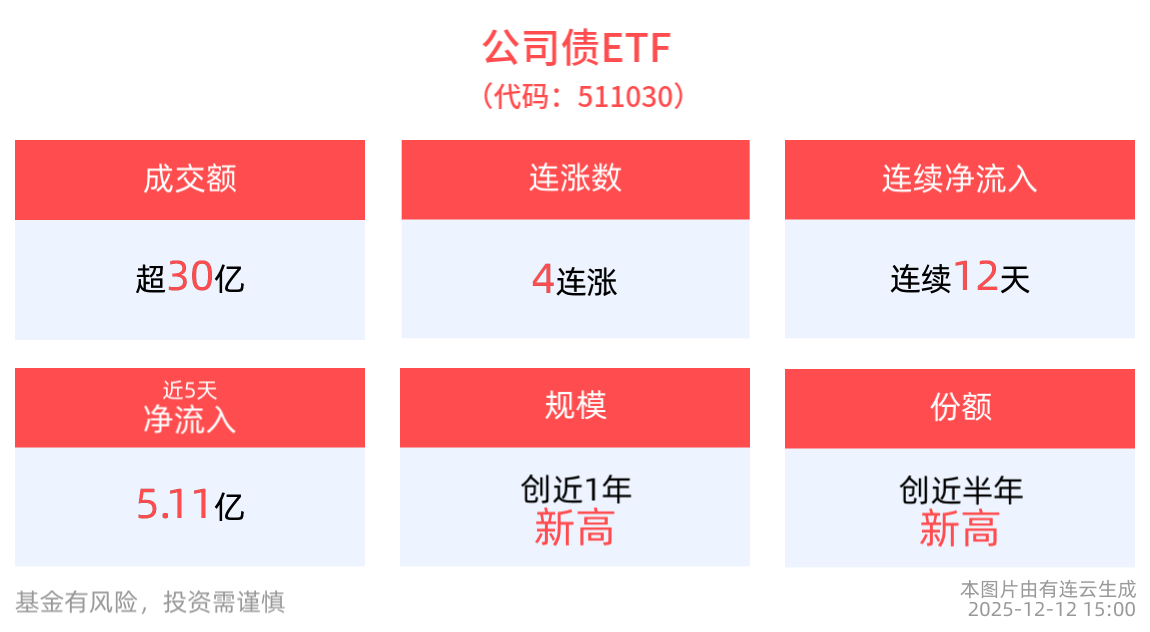
成交额超30亿元,公司债ETF(511030)实现4连涨
Sou Hu Cai Jing· 2025-12-15 02:09
Group 1 - The core viewpoint suggests seizing the certainty of short to medium-term credit bond arbitrage value and focusing on the rebound in valuation cost-effectiveness of component bonds [1] - In a volatile adjustment market with loose liquidity, the coupon strategy may be relatively superior, and it is recommended to pay attention to credit bond participation opportunities around 3 years [1] - The adjustment of component bonds has been significant, influenced by some banks' proprietary redemption of credit bond ETFs, leading to a convergence of premiums with non-component bonds [1] Group 2 - As of December 12, 2025, the company bond ETF (511030) has risen by 0.02%, achieving four consecutive increases, with the latest price at 106.61 yuan, and a year-to-date increase of 1.44% [4] - The trading volume of the company bond ETF was active, with an intraday turnover of 11.31% and a transaction value of 3.065 billion yuan, while the average daily transaction over the past week was 2.574 billion yuan [4] - The latest scale of the company bond ETF reached 27.093 billion yuan, marking a new high in nearly a year, with the latest share count at 254 million, also a new high in the past six months [4] Group 3 - The company bond ETF closely tracks the China Bond - Medium to High Grade Corporate Bond Spread Factor Index, which serves as a performance benchmark for investing in medium to high-grade corporate bonds [5] - The index is based on AAA-rated corporate bonds and is adjusted quarterly, providing a multi-dimensional reflection of the RMB bond market trends [5]
债市日报:11月13日
Xin Hua Cai Jing· 2025-11-13 07:47
Core Viewpoint - The bond market showed slight weakness on November 13, with government bond futures declining across the board, while interbank bond yields rose by approximately 0.5 basis points. The central bank's latest monetary policy report emphasizes stable growth and removes the "preventing capital outflow" statement, maintaining a favorable outlook for the bond market [1][8]. Market Performance - Government bond futures closed lower, with the 30-year main contract down 0.26% at 116.13, the 10-year main contract down 0.1% at 108.41, the 5-year main contract down 0.08% at 105.885, and the 2-year main contract down 0.01% at 102.462 [2]. - Interbank bond yields generally increased slightly, with the 30-year "25 Super Long Special Government Bond 06" yield rising by 0.5 basis points to 2.15%, and the 10-year "25 National Development Bank 15" yield up by 0.35 basis points to 1.876% [2]. International Market Trends - In North America, U.S. Treasury yields varied, with the 2-year yield up 1.67 basis points to 3.568%, and the 30-year yield down 0.29 basis points to 4.665% [3]. - In Asia, Japanese bond yields mostly rose, with the 10-year yield increasing by 1.2 basis points to 1.697% [4]. - In the Eurozone, yields on 10-year bonds generally fell, with the French yield down 4.7 basis points to 3.375% and the German yield down 1.5 basis points to 2.642% [4]. Funding Conditions - The central bank conducted a 1900 billion yuan 7-day reverse repurchase operation at a rate of 1.40%, resulting in a net injection of 972 billion yuan for the day [7]. - Short-term Shibor rates mostly declined, with the overnight rate down 10.0 basis points to 1.315% [7]. Institutional Insights - Huatai Fixed Income noted that recent regulatory measures by the central bank could help open up space for easing and improve the transmission of interest rates from short to long [8]. - CITIC Securities suggested that in the current environment of fluctuating long-term rates, investors should focus on coupon strategies and maintain a flexible approach to enhance returns [9].