
锂原矿

Search documents
解读津巴布韦暂停锂矿出口:严禁第三方贸易商出口 声明未提硫酸锂与深加工 有矿权企业仍可申请出口资格
Mei Ri Jing Ji Xin Wen· 2026-02-26 11:54
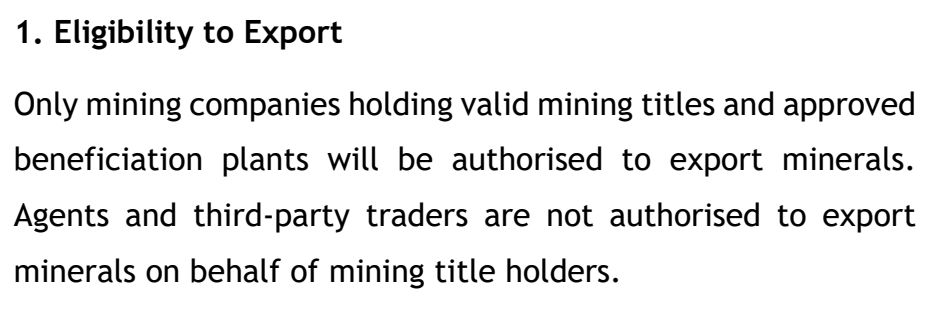
Core Viewpoint - The Zimbabwean government's export suspension on lithium raw materials and concentrates has caused significant fluctuations in the global lithium market, but the actual impact on compliant companies may be limited as the policy aims to regulate illegal exports and enhance local processing capabilities [1][2][4]. Group 1: Market Reaction - Following the announcement, shares of major lithium companies reacted positively, with SQM rising by 3.68% and ALB by 4.84%, while A-share lithium stocks showed mixed results, with Salt Lake Co. hitting a temporary limit up [1][2]. - The sudden nature of the announcement caught many industry players off guard, indicating the importance of Zimbabwe as a key lithium supplier in Africa [2][3]. Group 2: Policy Details - The Zimbabwean Ministry of Mines announced an immediate suspension of all unprocessed minerals and lithium concentrates for export, affecting all shipments in transit [4][6]. - Only companies holding valid mining rights and approved processing plants are permitted to export, while third-party traders are explicitly banned from the export chain [4][9]. Group 3: Compliance and Future Expectations - Companies with proper mining rights and export licenses are expected to face limited impacts, with a recovery in export activities anticipated within a short timeframe [1][18]. - The policy is seen as a corrective measure to address illegal export practices, with a long-term trend towards local processing of lithium resources being emphasized [1][19]. Group 4: Industry Trends - The construction of local refining facilities is viewed as an inevitable trend, as the majority of profits in lithium mining come from the refining stage [19]. - Companies like Huayou Cobalt are leading in local processing initiatives, while others are still in the planning stages [19][20].

突发大动作!津巴布韦宣布:暂停锂精矿和原矿出口!这对中国影响有多大?
Sou Hu Cai Jing· 2026-02-26 11:04
Core Viewpoint - Zimbabwe has announced a complete suspension of lithium concentrate and raw lithium ore exports, impacting a significant portion of China's lithium imports and raising concerns about the potential disruption to the new energy industry chain in China [1][3]. Group 1: Event and Background - Zimbabwe is the fourth largest lithium producer globally, accounting for 10% of the world's total lithium production, and is China's second-largest source of lithium concentrate imports [3]. - In 2025, China imported 7.75 million tons of lithium concentrate, with 1.2 million tons (15.5%) coming from Zimbabwe, which has seen a 191% year-on-year increase in exports to China in 2024 [3]. - This is not the first time Zimbabwe has tightened its policies; it previously banned raw lithium ore exports in 2022 and imposed an export tax on lithium concentrate in 2025, with the full ban on concentrate exports initially set for 2027 [3]. Group 2: Reasons for the Ban - Zimbabwe aims to retain more value from its lithium resources by transitioning from being a raw material exporter to a processing nation, thereby keeping profits within its borders [5]. - The country is motivated by the desire to avoid merely selling raw materials while others profit from processing, similar to Indonesia's past actions with nickel exports [5]. Group 3: Impact on China - Short-term impacts include a further widening of the supply-demand gap for lithium, with a projected shortfall of 30,000 to 50,000 tons in 2026, exacerbated by the ban [8]. - Domestic lithium salt manufacturers are already facing low inventory levels, and the loss of nearly 20% of import sources may lead to production cuts for some smaller firms, resulting in a structural price increase for lithium carbonate [9]. - Long-term effects may lead to a more secure and robust new energy industry chain in China, as leading lithium mining companies have already established local processing capacities in Zimbabwe [10][11]. - The ban primarily affects smaller players that do not have localized operations, while larger companies may benefit from a wider competitive moat [11]. - This situation may accelerate China's efforts to achieve self-sufficiency in lithium resources and diversify its sourcing from other countries [12]. - The ban reflects a broader trend of resource-rich countries seeking to gain more control over their value chains in the new energy era, shifting the dynamics of global resource and manufacturing power [14].
冠通期货早盘速递-20260226
Guan Tong Qi Huo· 2026-02-26 02:26
Group 1: Hot News - Trump announced in his State of the Union address that he will bypass Supreme Court rulings and continue to impose tariffs through other legal means, and proposed to replace personal income tax with tariff revenue. He also expressed a preference for diplomatic solutions to the Iranian nuclear issue but will not allow Iran to possess nuclear weapons. However, there were inaccurate data and misleading views in his speech [2] - At the end of January, the national passenger car industry inventory was 3.57 million vehicles, a decrease of 80,000 vehicles month-on-month and an increase of 580,000 vehicles year-on-year. The inventory support for future sales days was 70 days, indicating relatively high inventory pressure [2] - The US Department of Commerce will impose countervailing duties on crystalline silicon solar cell components imported from India, Indonesia, and Laos, with subsidy rates of 125.87%, 104.38%, and 80.67% respectively [2] - Some steel mills in Tangshan have received notices of self - emission reduction during the Two Sessions from March 4th to March 11th, with a blast furnace load reduction of no less than 30%. It is expected that molten iron output will decline in early March [3] - Zimbabwe has suspended the export of lithium concentrates and raw ores to promote local processing business [3] Group 2: Plate Performance - Key focus: Urea, lithium carbonate, platinum, PVC, asphalt [4] - Night session performance: Non - metallic building materials rose 1.95%, precious metals rose 34.48%, oilseeds rose 7.77%, soft commodities rose 2.73%, non - ferrous metals rose 26.86%, coal - coke - steel - ore rose 9.75%, energy rose 2.60%, chemicals rose 10.19%, grains rose 1.12%, and agricultural and sideline products rose 2.55% [4] Group 3: Plate Position - The document shows the changes in the positions of commodity futures plates in the past five days [5] Group 4: Performance of Major Asset Classes - Equity: The Shanghai Composite Index rose 0.72% daily, 0.71% monthly, and 4.49% annually; the S&P 500 rose 0.81% daily, 0.10% monthly, and 1.47% annually; the Hang Seng Index rose 0.66% daily, - 2.27% monthly, and 4.43% annually, etc. [6] - Fixed - income: 10 - year treasury bond futures fell 0.13% daily, rose 0.16% monthly, and rose 0.57% annually; 5 - year treasury bond futures fell 0.10% daily, rose 0.17% monthly, and rose 0.29% annually, etc. [6] - Commodity: The CRB commodity index rose 0.53% daily, - 2.70% monthly, and 4.24% annually; WTI crude oil rose 0.00% daily, 0.72% monthly, and 15.01% annually, etc. [6] - Others: The US dollar index fell 0.24% daily, rose 0.56% monthly, and fell 0.62% annually; the CBOE volatility index rose 0.00% daily, 12.10% monthly, and 30.77% annually [6]
津巴布韦突发禁令!锂矿股高开,金圆股份涨停,永兴材料涨超5%
Ge Long Hui· 2026-02-26 01:36
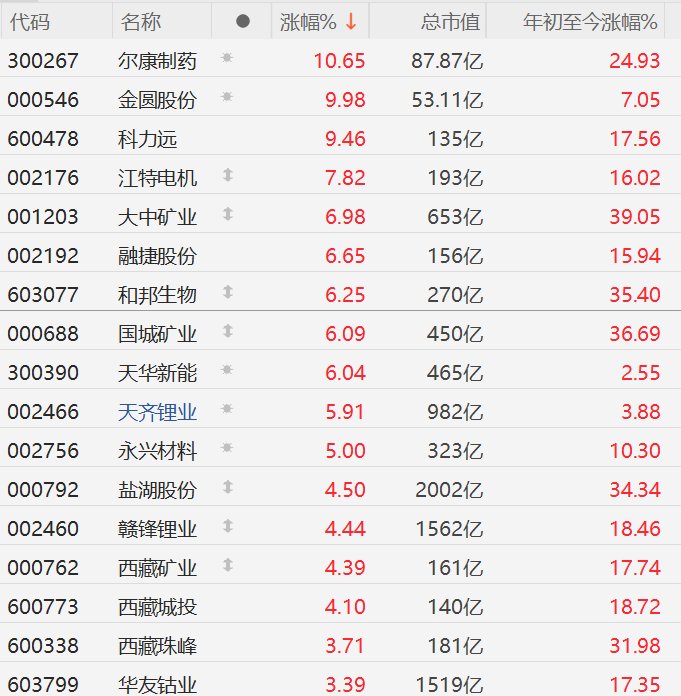
Group 1 - The core point of the news is that Zimbabwe has announced an immediate suspension of all lithium ore and lithium concentrate exports, which has led to a significant increase in lithium-related stocks in the A-share market [1][2] - The suspension aims to strengthen mineral regulation and accountability, allowing only companies with valid mining rights and approved processing plants to export [1][2] - Zimbabwe is the largest lithium exporter in Africa and the second-largest source of lithium concentrate imports for China, with a reported import of approximately 7.75 million tons in 2025, a year-on-year increase of about 39.4% [1] Group 2 - The ban on lithium exports is a significant shift from the previously planned full ban in 2027, causing global disruptions in the lithium supply chain and increasing the short-term supply gap [2] - The price of lithium carbonate surged nearly 12% to 187,700 yuan per ton following the announcement [1][2] - Various lithium-related stocks saw substantial gains, with companies like Jinyuan Co. and Keli Yuan nearing their daily limit up, reflecting strong market sentiment [1][3]





美股锂矿概念股盘前走强
Ge Long Hui A P P· 2026-02-25 09:42
Group 1 - Sigma Lithium shares increased by over 8% [1] - American company Yahua's shares rose by over 4% [1] - Chilean mining and chemical companies, along with Lithium Argentina AG, saw an approximate 4% increase in their shares [1] Group 2 - Zimbabwe has reportedly suspended the export of lithium concentrate and raw ore [1]