
集运指数欧线

Search documents
集运指数欧线周报(EC):地缘情绪仍为主导,PA现货敞口成关注点-20260323
Guo Mao Qi Huo· 2026-03-23 05:46
1. Report Industry Investment Rating - Not provided in the given content 2. Core Viewpoints of the Report - The geopolitical sentiment remains the dominant factor, and the spot exposure of the PA alliance has become a focus. The freight rates of the European container shipping line are expected to enter a wide - range oscillation pattern after a geopolitical impulse upward movement. The operation should adopt an interval oscillation approach, focusing on the core fluctuation range of 1900 - 2100 points, and avoid blind chasing of high prices. [3][4] 3. Summary According to Relevant Catalogs 3.1 Main Viewpoints and Strategy Overview - **Spot Quotations**: In early April, the spot quotations of the European container shipping line were driven by factors such as the cost transmission of the Red Sea detour and the surcharge of fuel surcharges, showing a generally strong trend. The quotations of the four major alliances were significantly differentiated, with the Gemini Alliance leading the increase, the OA Alliance rising steadily, the PA Alliance relatively low, and MSC's independent quotation being strong. [4] - **Political and Economic Factors**: Political and economic factors are bullish. There are multiple geopolitical events, such as Trump's statement about the Strait of Hormuz, reports of oil tanker operators paying for passage rights, and potential military actions and counter - actions in the region. [4] - **Capacity Supply**: The overall supply level shows a monthly upward trend. The supply side needs to focus on two core variables: the redeployment of idle capacity on the Middle East route and the adjustment of route layouts by leading shipping companies under the long - term Red Sea conflict. [4] - **Demand**: The demand for the European container shipping line this week shows a pattern of "rigid demand as the base and structural differentiation". The overall demand is moderately recovering but with limited increments, mainly affected by cargo type structure, regional differences, and geopolitical factors. The supply - demand relationship is in a weak balance. [4] - **Summary and Investment Strategy**: This week, the geopolitical sentiment disturbance and supply - demand game dominate the wide - range oscillation. In the short term, there is no clear unilateral trend. It is recommended to adopt an interval oscillation approach, focus on the 1900 - 2100 point core fluctuation range, and pay attention to the filling progress of the PA alliance, the evolution of the geopolitical situation, and oil price fluctuations. [4] 3.2 Price - The report presents the price trends of various container shipping line indices, including the European line index, the US West line index, and the US East line index, but no specific analysis is provided in the text. [8] 3.3 Static Capacity - **Order Volume**: The report shows the order volume of container ships with different loading capacities over the years, including the proportion of the order book to the fleet for different types of container ships. [11] - **Delivery Volume**: It presents the delivery volume of container ships with different loading capacities over the years, including feeder container ships, intermediate container ships, and large - scale container ships. [14][16] - **Demolition Volume**: The demolition volume of container ships with different loading capacities over the years is shown, including feeder container ships, intermediate container ships, and large - scale container ships. [15][17] - **Future Delivery**: The future delivery volume of container ships with different loading capacities is presented, including the quarterly and annual distribution of future deliveries. [20][22][23] - **Ship - Breaking Price**: The ship - breaking prices of container ships with different loading capacities over the years are shown, as well as the new - building price index and second - hand ship price index. [27][33] - **Existing Capacity**: Information about the existing capacity of container ships is provided, including the total capacity, capacity by loading capacity, the proportion of ships over 25 years old, the idle and retrofit ratio, the average age, and the average age of ship - breaking. [42][45][49] 3.4 Dynamic Capacity - **Ship Schedule**: The report shows the total capacity deployment of container ships from Shanghai to European basic ports, as well as the capacity deployment of different alliances (PA + MSC, GEMINI, OCEAN, MSC) in different weeks. [57][59][61] - **Desulfurization Tower Installation**: Information about the container ships with installed and being - installed desulfurization towers is presented, including the capacity and the number of ships, as well as the average age and duration of desulfurization tower installation and the average speed of container ships. [67][68][71] - **Idle Capacity**: The idle capacity of container ships is shown, including the total idle capacity, idle capacity by loading capacity, and the proportion of idle capacity. [75][76][79]

刚刚,大跳水!市场突传重磅消息!
天天基金网· 2026-03-05 08:53
Market Overview - The market experienced significant volatility in the afternoon, with major stock indices in Dubai and Abu Dhabi dropping by 4.1% and 2.1% respectively, while Hong Kong stocks also saw declines [2] - The shipping index in Europe, which had previously surged over 18%, faced a sharp drop, with losses expanding to 6% [5] - The main crude oil futures contract on the Shanghai Futures Exchange also saw a sharp decline, with gains narrowing to around 6% after hitting the limit up [6] Geopolitical Factors - Iranian military officials stated that the Strait of Hormuz is not being blocked, despite tensions following an attack on a U.S. oil tanker by Iranian forces [8] - The Iranian Revolutionary Guard announced that they would control the passage rules through the Strait during wartime, threatening military action against vessels from the U.S., Israel, and their allies [8] Economic Implications for India - The ongoing conflict in the Middle East could lead to prolonged economic pressures on India, particularly in terms of energy costs and remittances [10] - India, being the largest recipient of overseas remittances, could see a significant decline in funds from the Middle East, which currently accounts for about 3.5% of its GDP [11] - The rising international oil prices due to the conflict could inflate India's energy import bills, as the country relies on imports for approximately 85% of its crude oil [12]


刚刚,大跳水!霍尔木兹海峡,突传重磅!
券商中国· 2026-03-05 08:53
Market Overview - Multiple stock markets experienced a sharp decline, with the Dubai stock market down 4.1% and the Abu Dhabi stock market down 2.1% [1] - The Hong Kong stock market also showed volatility, while Japanese and Korean markets saw a significant reduction in gains [1] - Following a previous surge, the shipping index in Europe dropped sharply, with a decline of up to 6% after an initial increase of over 18% [4][6] Oil Market Dynamics - The main crude oil futures contract on the Shanghai Futures Exchange saw a sudden drop, with gains narrowing to around 6% after hitting the limit up [6] - Oil and gas equipment stocks in Hong Kong, such as Shandong Molong, experienced significant volatility, with a drop of 19% and a subsequent rise of 9% [6] Geopolitical Factors - Iranian military officials stated that the Strait of Hormuz is not blocked, despite tensions following an attack on a U.S. oil tanker by Iranian forces [7] - Iran's Islamic Revolutionary Guard Corps indicated that they would control the passage rules in the Strait during wartime, threatening military action against vessels from the U.S., Israel, and European nations [7] Economic Implications for India - The ongoing conflict in the Middle East poses multiple economic pressures on India, particularly in energy, aviation, and remittances [10] - India, being the largest recipient of overseas remittances, could see a significant decline in funds from the Middle East, which constitutes about 3.5% of its GDP [10][11] - The rising international oil prices due to the conflict could inflate India's energy import bills, as approximately 85% of its crude oil is imported [11]

港股异动 中远海发(02866)午后飙升逾35% 集运指数欧线连续第二日涨停 航运巨头加收附加费
Jin Rong Jie· 2026-03-03 06:10
Core Viewpoint - The stock of China COSCO Shipping Development Co., Ltd. (中远海发) surged over 35%, driven by rising shipping costs due to geopolitical tensions and the company's strong performance in container manufacturing and leasing [1]. Group 1: Market Performance - China COSCO Shipping Development's stock rose by 31.67% to HKD 1.58, with a trading volume of HKD 869 million [1]. - The shipping index in Europe achieved a consecutive second-day limit increase on March 3 [1]. Group 2: Industry Impact - Iran's closure of the Strait of Hormuz has led several international shipping giants to adopt risk-averse measures and increase fees [1]. - Hapag-Lloyd has added a surcharge of USD 1,500 per 20-foot container due to war risks, while CMA CGM has increased the fee to USD 2,000 for bookings in the affected region, further escalating shipping cost pressures [1]. Group 3: Company Strategy - China COSCO Shipping Development focuses on the shipping logistics industry, emphasizing container manufacturing, leasing, and shipping leasing as core businesses [1]. - In the container manufacturing sector, the company maintains high capacity utilization, with notable performance in specialized containers, including an increase in production of open-top and foldable containers year-on-year [1]. - The company's global layout in the container leasing segment has accelerated, covering over 180 ports in more than 43 countries [1]. - In shipping leasing, the company is actively promoting the integration of shipbuilding and finance projects, with an increased proportion of methanol-reserved eco-friendly ship types, aligning with the trend of green transformation in shipping by 2025 [1].

集运指数欧线周报(EC):预计运价将于1月中下旬见顶-20260112
Guo Mao Qi Huo· 2026-01-12 07:08
1. Report Industry Investment Rating - The investment view of the report is "oscillating", indicating that the short - term European line is expected to be volatile, and the main contract's valuation is under pressure after a pull - back [3]. 2. Core View of the Report - The report predicts that the freight rate of the container shipping index for the European line will peak in mid - to late January. Multiple factors, including spot freight rates, political - economic situations, capacity supply, and demand, affect the freight rate trend. The short - term European line shows an oscillating pattern, and there is a risk of further downward movement in freight rates [1][3]. 3. Summary by Relevant Catalogs 3.1 Main Views and Strategy Overview - **Spot freight rates**: They have a positive impact. Maersk's quotes in the fourth week of January are differentiated. Some shipping companies like Hapag - Lloyd and EMC have different price trends, with some showing price drops and others maintaining high prices but with weakened price - holding power [3]. - **Political - economic factors**: They are considered neutral. The US Supreme Court's potential ruling on Trump's global tariff policy, the trend of "shadow fleet" tankers in the US - Venezuela situation, and the peak shipping season in the Asia - Europe route with increased capacity deployment are all influencing factors [3]. - **Capacity supply**: It has a negative impact. The weekly average capacity has been increasing from 2025 to 2026, with 270,000 TEU in November 2025, 300,000 TEU in December 2025, and 313,000 - 321,000 TEU in January 2026 [3]. - **Demand**: It has a positive impact. At the end of 2025, the container shipping demand for the European line remained strong, with continuous growth in booking volume and high fleet loading rates, supported by pre - Spring Festival stocking and European importers' replenishment needs [3]. - **Trading strategy**: It is recommended to adopt a wait - and - see approach for both unilateral and arbitrage trading, and pay attention to geopolitical disturbances and domestic and international macro - policy disturbances [3]. 3.2 Price - The report presents price trends of various shipping routes in the spot market, including the European line index, the US - West line index, and the US - East line index, through charts [6]. 3.3 Static Capacity - **Order volume**: The report shows the order volume of container ships with different loading capacities over a long - term period, including the proportion of the order book to the fleet and new - order volumes [11]. - **Delivery volume**: It presents the delivery volume of container ships with different loading capacities from 2020 - 2025 [14][16]. - **Demolition volume**: It shows the demolition volume of container ships with different loading capacities from 2020 - 2025 [15][17]. - **Future delivery**: It forecasts the future delivery volume of container ships with different loading capacities from 2023 - 2029, including quarterly and annual data [20][22][23]. - **Ship prices**: It includes the scrap price, new - building price, and second - hand price of container ships with different loading capacities, and their price indices [27][29][33]. - **Existing capacity**: It shows the existing capacity of container ships in terms of TEU, proportion, age, and idle/retrofit ratio, including data for different loading capacities and age groups [42][45][46]. 3.4 Dynamic Capacity - **Ship schedule**: It shows the capacity deployment of different alliances (PA + MSC, GEMINI, OCEAN, etc.) on the Shanghai - European basic port route from week 13 to week 28 [57][59][61]. - **Desulfurization tower installation**: It presents the situation of container ships with installed and being - installed desulfurization towers, including the number of ships, TEU, and average age and duration of installation, as well as the average speed of container ships [67][68][71]. - **Idle capacity**: It shows the idle capacity of container ships in terms of TEU, number of ships, and proportion, and the situation of hot - idle and desulfurization - tower - retrofit ships [75][76][79].
商品日报(11月4日):商品市场普跌 红枣重挫超5% 集运欧线逆势涨超3%
Xin Hua Cai Jing· 2025-11-04 11:44
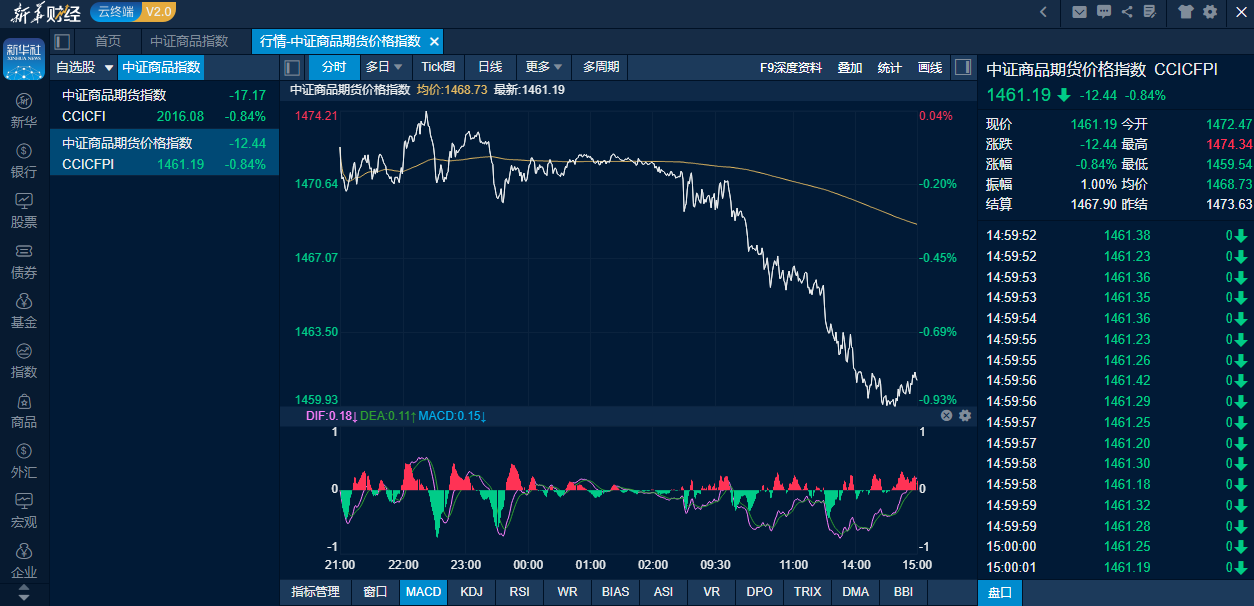
Group 1: Commodity Market Overview - The domestic commodity futures market showed a general decline on November 4, with most active commodities closing lower. The China Securities Commodity Futures Price Index closed at 1461.19 points, down 12.44 points or 0.84% from the previous trading day [1] - The chemical sector experienced widespread weakness, with multiple products such as coking coal, coke, and ethylene glycol dropping over 2%. Other products like methanol, soda ash, liquefied petroleum gas, and rubber fell more than 1% [1][6] Group 2: Specific Commodity Performance - Red dates and lithium carbonate were the weakest performers of the day, with red dates dropping over 5% and lithium carbonate declining over 4%, ranking first and second in terms of decline [1] - The shipping index for Europe saw a contrary increase, closing with a nearly 4% gain, leading the commodity market [2] Group 3: Shipping and Soybean Meal - The shipping index for Europe experienced a significant rise, with a 3.82% increase, driven by strong market sentiment and expectations for price increases during the shipping peak season [2] - Soybean meal continued its upward trend, recording a 1.55% increase, attributed to concerns over supply shortages as domestic imported rapeseed stocks were depleted [3] Group 4: Fresh Fruits and Lithium Carbonate - Fresh fruit futures, particularly red dates, saw a sharp decline of 5.55%, attributed to a supply-demand imbalance following the holiday season, with red dates falling below 10,000 yuan per ton [4] - Lithium carbonate prices fell over 4%, reversing gains from the previous weeks, influenced by high production levels and renewed supply pressures from the resumption of mining operations in Jiangxi [5]
集运指数欧线周报(EC):运价持续下跌,10跌破1200点-20250915
Guo Mao Qi Huo· 2025-09-15 09:23
1. Report Industry Investment Rating - The investment view of the container shipping index is "oscillation", and the trading strategy for unilateral trading is also "oscillation", with an arbitrage strategy of 10 - 12 reverse - spread rolling operation [3] 2. Core View of the Report - The container shipping index shows continuously falling freight rates, approaching the cost line. Spot freight rates are bearish, with the September - lower market FAK freight rate center at 1750. Political and economic factors are neutral, and the supply and demand of shipping capacity are also neutral. It is expected that the offline freight rate will drop to the low point in May this year in late October, and shipping companies will start to sign contracts to support prices after the cargo volume rebounds in November [3] 3. Summary According to Relevant Catalogs 3.1 Main Views and Strategy Overview - **Spot Freight Rates**: Bearish. The September - lower prices of GEMINI dropped to 1600, OA to 1800, PA to 1700, and MSC to 1750. The fourth - quarter long - term contract negotiation has begun, and shipping companies are still cautious about long - term quotes below the current FAK level, while PSS may be reduced or cancelled in the fourth quarter [3] - **Political and Economic Factors**: Neutral. There are multiple events such as the meeting between Baysent and Chinese Vice - Premier He Lifeng, MSC's adjustment of its US route network, Trump's plan to urge G7 to impose high tariffs on India and China's purchase of Russian oil, and the US experiencing a stagflation - like situation [3] - **Shipping Capacity Supply**: Neutral. The weekly average shipping capacity deployment in July was 300,000, 315,000 in August, 305,000 in September, and 270,000 in October. There are changes in overtime ships and cancellations of sailings, with about 12% of planned voyages (85 out of 720) cancelled between weeks 38 - 42, and 65% of the cancellations concentrated in weeks 40 - 41 [3] - **Demand**: Neutral. The overall loading rate is still lower than the same period in the past two years, and there is a significant difference in the decline rate of the loading rate from China to Europe compared to that from Asia to Europe. The loading rate of GEMINI has rebounded due to significant price cuts, while the loading rates of the other two major alliances continue to decline [3] - **Summary**: In the European shipping market, based on EPMI data, the cargo volume will bottom out in October and turn around in November. From late September to late October, shipping companies will "grab goods", but the "ROLLINGPOOL" strategy in the off - season may intensify the decline in freight rates. It is expected that the offline freight rate will return to the low point in May this year in late October, and shipping companies will start to sign contracts to support prices after the cargo volume rebounds in November. The suspension of some shipping capacity during the National Day holiday will not be restored after the holiday, and the reduction of ships in the off - season has limited impact on the market [3] 3.2 Price - The spot market has slow demand recovery, high supply, a new alliance established, and falling prices in the off - season [5] 3.3 Static Shipping Capacity - **Order Volume**: There are data on the order volume of container ships with different loading capacities over the years, including various types of container ships such as those with 8,000 - 11,999 TEU, 12,000 - 16,999 TEU, etc. [15] - **Delivery Volume**: There are data on the delivery volume of container ships with different loading capacities over the years, including feeder container ships, intermediate container ships, etc. [18] - **Demolition Volume**: There are data on the demolition volume of container ships with different loading capacities over the years, including various types of container ships [19] - **Future Delivery**: There are data on the future delivery volume of container ships with different loading capacities, including quarterly and annual data [24] - **Ship - Breaking Price**: There are data on the ship - breaking prices of container ships with different loading capacities over the years, including various types of container ships [31] - **New - Building Ship Price**: There are data on the new - building ship price index and the new - building prices of container ships with different loading capacities over the years [32] - **Second - Hand Ship Price**: There are data on the second - hand ship price index and the second - hand prices of container ships with different loading capacities over the years, including 13,500 TEU, 15,500 TEU, etc. [40] - **Existing Shipping Capacity**: There are data on the existing shipping capacity of container ships, including the total capacity, capacity by loading capacity, the capacity of ships over 25 years old, and the proportion of idle and retrofitted ships [46] 3.4 Dynamic Shipping Capacity - **Shipping Schedule**: There are data on the shipping capacity deployment of container ships from Shanghai to European basic ports, including the total shipping capacity deployment and the shipping capacity deployment of different alliances such as PA + MSC, GEMINI, OCEAN, etc. [60] - **Desulfurization Tower Installation**: There are data on the number and proportion of container ships with desulfurization towers installed, those being installed, and the average age and duration of desulfurization tower installation [71] - **Average Speed**: There are data on the average speed of container ships, including the overall average speed and the average speed of container ships with different loading capacities [74] - **Idle Shipping Capacity**: There are data on the idle shipping capacity of container ships, including the total idle capacity, idle capacity by loading capacity, and the proportion of idle ships [79]
集运指数欧线周报(EC):运价持续下跌,不断接近成本线-20250901
Guo Mao Qi Huo· 2025-09-01 06:57
Report Industry Investment Rating - The investment view is "oscillating weakly", and the trading strategy is "unilateral: oscillating weakly; arbitrage: 10 - 12 reverse spread rolling operation" [3] Core View of the Report - The freight rate of the container shipping index has been continuously falling and is approaching the cost line. Spot freight rates are bearish, with the September FAK freight rate center in the market at 2000 - 2200. Political and economic factors are neutral, and the container ship order book has reached 10 million TEU. The supply of shipping capacity is neutral, and the demand is also neutral. The OCEAN's September freight rate reduction rhythm has accelerated, which may put pressure on MSK to reduce prices to attract cargo. In the short term, the freight rate may fall below 1300, and the price of the 12 - contract is likely to show an oscillatingly weak operating trend [3] Summary According to Relevant Catalogs Part One: Main Views and Strategy Overview - **Spot Freight Rates**: Bearish. The September prices of GEMINI, OA, PA, and MSC have all decreased, with the market FAK freight rate center in September at 2000 - 2200 [3] - **Political and Economic Factors**: Neutral. There are events such as the threat of revenge from the Yemeni Houthi armed forces, the extension of the exclusion list measures in the US - China trade investigation, the EU's proposed tariff on US goods, the container ship order book reaching 10 million TEU, and the US government's plan to expand national security tariffs [3] - **Shipping Capacity Supply**: Neutral. The subsequent shipping capacity deployment shows different levels in different months, and there is a transfer of ships from the US line to the European line in September [3] - **Demand**: Neutral. The overall loading rate is lower than the same period in the past two years, and the OA alliance's loading rate has a relatively large decline, resulting in a relatively large price reduction recently [3] - **Summary and Strategy**: The OCEAN's freight rate reduction may put pressure on MSK. In the short term, the freight rate may fall below 1300, and the 12 - contract price is likely to be oscillatingly weak. The trading strategy is unilateral oscillating weakness and 10 - 12 reverse spread rolling operation [3] Part Two: Price - **Spot Market**: The demand recovery is slow, the supply is high, a new alliance has been established, and the price is falling in the off - season [5] Part Two: Static Capacity - **Order Volume**: There are data on container ship order volumes in different loading capacities and time periods [15] - **Delivery Volume**: Data on container ship delivery volumes in different loading capacities and time periods are presented [18][20] - **Future Delivery**: Information on future container ship deliveries in different loading capacities, time periods, and quarterly seasonality is provided [24][26][27] - **Shipbreaking Price**: Data on shipbreaking prices of container ships in different loading capacities and new - building prices, including indices and prices in different loading capacities, are shown [31][33] - **Second - hand Ship Price**: Information on second - hand container ship prices, including indices and prices of ships with different loading capacities and ages, is presented [37][39][41] - **Existing Capacity**: Data on the existing capacity of container ships, including total capacity, capacity in different loading capacities, the proportion of ships over 25 years old, idle and retrofit ratios, average age, and shipbreaking average age, are provided [46][49][53] Part Three: Dynamic Capacity - **Ship Schedule**: Data on the total shipping capacity deployment from Shanghai to European base ports, as well as the capacity deployments of different alliances and shipping companies, are presented [60][61][63] - **Desulfurization Tower Installation**: Information on container ships with installed, being installed, and the average age and duration of desulfurization tower installation, as well as average speed and idle capacity, is provided [71][72][79]
集运指数欧线周报(EC):现货运价震荡,关注新一轮关税-20250707
Guo Mao Qi Huo· 2025-07-07 08:37
1. Report Industry Investment Rating - The investment view on the container shipping industry is neutral, suggesting short - term observation [3] 2. Core View of the Report - The spot freight rate of the container shipping index is fluctuating, and attention should be paid to the new round of tariffs. Multiple factors such as shipping company operations, political - economic situations, supply and demand of shipping capacity, and market sentiment all have an impact on the market [3] 3. Summary According to Relevant Catalogs 3.1 Main Views and Strategy Overview - **Spot Freight Rate**: The situation varies among different alliances and time periods. In early July, the overall price range is 2900 - 3600, with a central price of 3200. In late July, prices in some alliances have increased. The overall impact on the freight rate is neutral [3] - **Political and Economic Factors**: Trump plans to impose tariffs ranging from 10% - 20% to 60% - 70%, starting on August 1st. The probability of the Fed cutting interest rates before September has dropped from 98% to about 80%. OPEC + will increase oil production by 548,000 barrels per day in August. There are also trade frictions between China and the EU. The overall impact on the market is neutral [3] - **Shipping Capacity Supply**: At the beginning of July, new ships were delivered, and the shipping capacity of some routes returned to the European line, with a weekly capacity of 314,000 TEU, a 12% increase compared to June. Port strikes in Europe have led to about a 15% loss of effective shipping capacity. There is congestion at ports in Asia. The overall impact on the market is neutral [3] - **Demand**: There was continuous over - booking in early July, but the subsequent peak - season inventory demand in Europe is expected to be weaker than expected, and the cargo volume support is insufficient. The overall impact on the market is neutral [3] - **Market**: This week, affected by Maersk's flat - opening in the third week of July being higher than market expectations, the market fluctuated upward. The main contract has recovered from a deep discount state, but the upward trend is expected to be limited [3] - **Investment and Trading Strategies**: The investment view is short - term observation. The trading strategy is to hold a long position in the 12 - 4 spread arbitrage while remaining on the sidelines for single - side trading [3] 3.2 Price - The spot market has slow demand recovery, high supply, the establishment of new alliances, and price drops in the off - season [5] 3.3 Static Shipping Capacity - **Order Volume**: There are order volume data divided by different loading capacities over the years, including the proportion of the order book to the fleet for different types of container ships [16][17] - **New Orders**: New order volume data are presented for different loading capacities of container ships from 2022 - 2025 [18][19] - **Delivery Volume**: Delivery volume data for different loading capacities of container ships from 2020 - 2025 are shown, as well as demolition volume data [24][25] - **Future Delivery**: Future delivery volume data are provided, including data by quarter and by loading capacity from 2023 - 2029 [30][32] - **Ship - breaking Price**: Ship - breaking price data for different loading capacities and the new - building price index and second - hand ship price index of container ships are presented [37][43] - **Existing Shipping Capacity**: Data on the existing shipping capacity of container ships, including the proportion of ships over 25 years old, idle and retrofit ratios, average age, and ship - breaking average age, are provided [52][58] 3.4 Dynamic Shipping Capacity - **Shipping Schedule**: The total shipping capacity deployment from Shanghai to European base ports is shown, including the capacity deployment of different alliances such as PA + MSC, GEMINI, and OCEAN [66][67] - **Desulfurization Tower Installation**: Data on container ships with installed desulfurization towers, those being installed, average installation age and duration, and average speed are presented [77][83] - **Idle Shipping Capacity**: Data on idle shipping capacity, including the amount, proportion, and breakdown by loading capacity, are provided [88][89]