雪王咖啡

Search documents
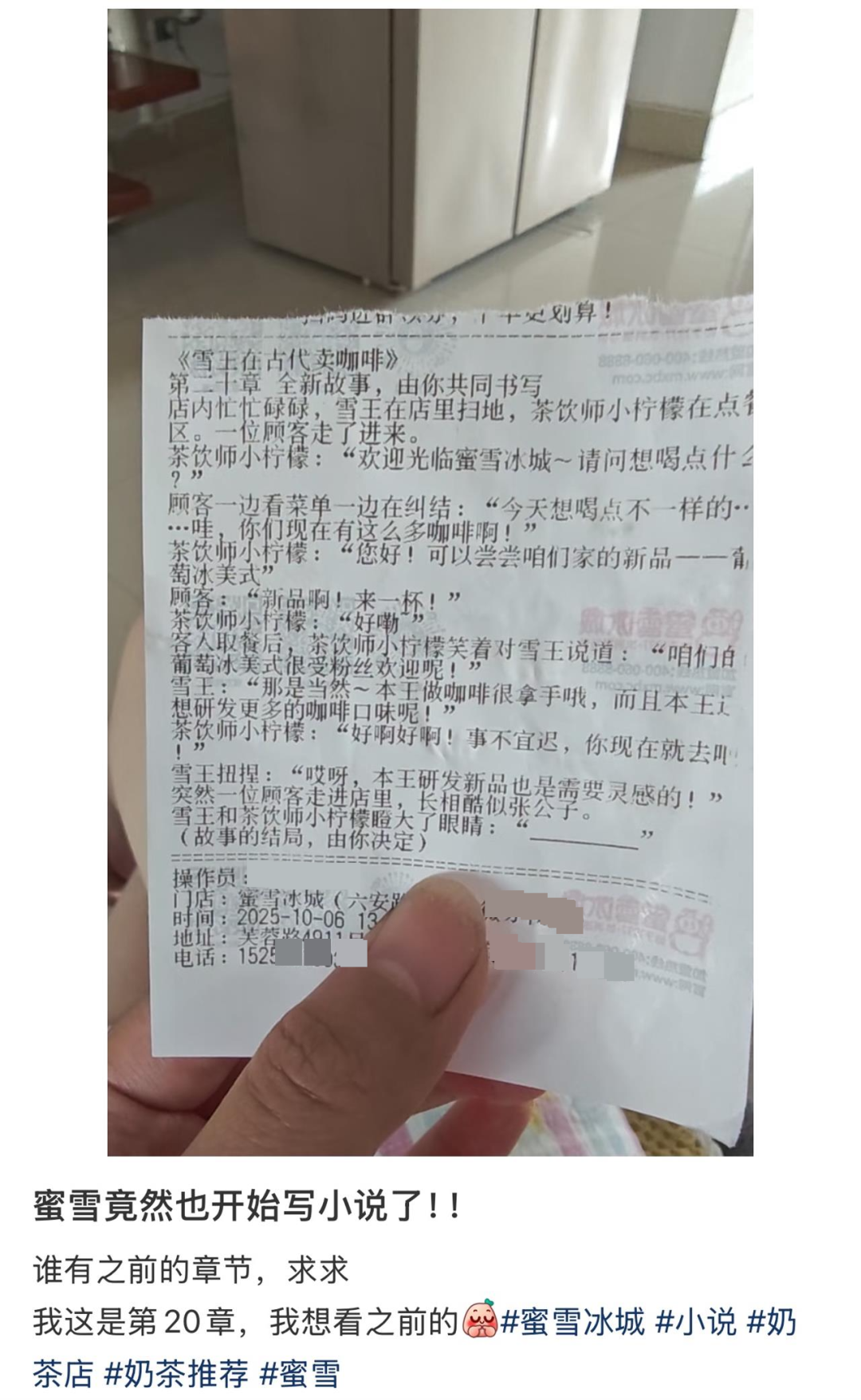
蜜雪冰城小票藏连载小说《雪王在古代卖咖啡》,网友晒单追更,同名短剧已在多平台上映
Qi Lu Wan Bao· 2025-10-09 08:43
Core Points - The article discusses a new marketing initiative by the company Mixue Ice City, which involves printing a serialized novel titled "The Snow King Sells Coffee in Ancient Times" on customer receipts, starting from September [2][28] - The initiative aims to enhance brand interaction and maintain customer engagement through storytelling, aligning with the brand's characteristics and consumer interests [2][28] - The novel consists of 20 chapters, with one chapter released daily from September 17 to October 6, and will enter a cyclical update phase to ensure customers can access the complete story [2][28] Group 1 - The initiative of printing novels on receipts began in September and is a company-wide effort [2] - Staff indicated that the inclusion of novel content on receipts may vary by store, depending on receipt paper availability [2] - The serialized novel is designed to create a fresh and engaging experience for customers, promoting the brand's narrative [2][28] Group 2 - The first update cycle of the novel ran from September 17 to October 6, with plans for continuous updates thereafter [2] - The company has also produced a short drama based on the novel, which was released on various video platforms [28] - The short drama consists of six episodes, each under six minutes, and was completed by July 10 [28]


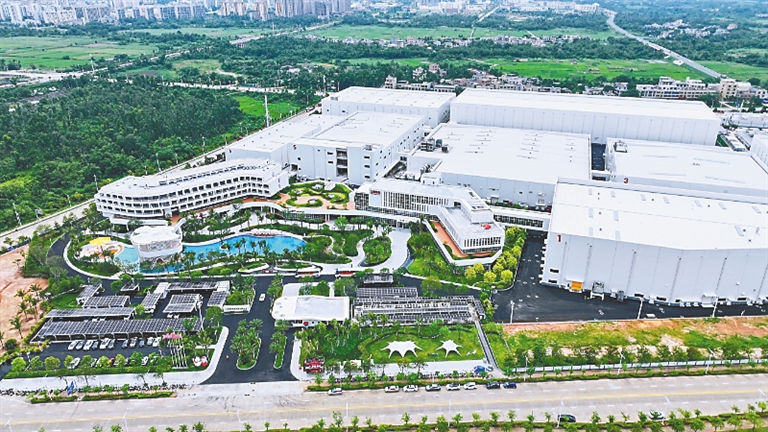
央视网《超级工厂》走进蜜雪冰城海南工厂,揭秘咖啡制作全过程
Hai Nan Ri Bao· 2025-08-12 01:11
Core Viewpoint - The news highlights the advanced manufacturing processes and quality control measures implemented by Mixue Ice City at its Hainan factory, showcasing its commitment to producing high-quality coffee products through intelligent manufacturing techniques [3][4]. Group 1: Manufacturing Process - The Hainan factory features a temperature-controlled warehouse for green coffee beans, capable of storing 4,200 tons, ensuring freshness [3]. - A central control room manages the entire coffee production process, including cleaning, screening, roasting, and blending [3]. - The factory employs a giant grinder, costing 4 million yuan, which allows for low-temperature grinding, preserving over 98% of the coffee's aroma [3]. Group 2: Quality Control - The coffee tasting area conducts an average of 389 rounds of cup testing daily, with professional tasters evaluating each batch based on a standardized scoring system [3]. - The tasting process includes assessing dry aroma, wet aroma, and flavor to ensure consistent quality and flavor stability [3]. Group 3: Business Development - In May 2022, Mixue Group established a supply chain headquarters in Ding'an, covering approximately 288 acres and involving multiple food production categories [4]. - The coffee production line alone has an annual capacity of 22,000 tons, positioning Ding'an as a leading coffee production base in the province [4]. - The factory aims to achieve "zero carbon" and "lighthouse factory" certifications, with projected annual revenue exceeding 3 billion yuan upon reaching full production [4]. Group 4: Local Collaboration - The establishment of the factory is a result of successful local business collaboration, with a local company, Le Ye, acting as a bridge to facilitate Mixue's entry into Hainan [4][5]. - The Ding'an government played a proactive role in supporting the project, providing land and policy assistance to expedite the factory's establishment [5].
蜜雪想再造一个“蜜雪
Jing Ji Guan Cha Wang· 2025-08-01 11:34
Core Insights - The article discusses the rapid expansion of the coffee brand Lucky Coffee, which aims to reach 10,000 stores by 2025, having already established 7,000 stores as of July 2023. The competitive landscape has changed significantly since the establishment of its parent company, Mixue Ice City, which also had a similar growth trajectory [1][2][3]. Expansion Strategy - Lucky Coffee has lowered the franchise entry barriers, offering a support policy that reduces the first-year franchise fee to 17,000 yuan. In key provinces and high-potential locations, franchise fees and management costs are waived. In major cities, total subsidies can reach up to 34,000 yuan per store [2][3]. - The company has doubled its market personnel to over 400 to accelerate store openings, with each market team responsible for 1,000 to 3,000 stores [2][3]. Historical Context - Lucky Coffee was incubated by Mixue Group in 2017 and became an independent brand after a full acquisition in 2020. The initial goal was to replicate the success of Mixue Ice City, which had reached 7,000 stores at that time [3][4]. - The brand's vision focuses on providing high-quality, affordable coffee globally, which led to significant price reductions for its products [3][4]. Market Positioning - Lucky Coffee initially targeted third to fifth-tier cities, filling a market gap where few chain coffee shops existed. This strategy positioned it among the top three brands in terms of store count by 2020 [7]. - The competitive landscape has intensified, with major players like Luckin Coffee and Kudi rapidly expanding their presence in the market [8][9]. Financial Performance - In 2022, Lucky Coffee experienced rapid growth, increasing its store count from 465 to 2,301, driven by the introduction of popular products and effective marketing strategies [6]. - The average single-cup price is around 7 yuan, providing a competitive edge against price wars initiated by rivals [8][9]. Supply Chain and Operational Efficiency - Lucky Coffee has adopted cost-saving measures, such as using semi-automatic coffee machines instead of more expensive fully automatic ones, which helps keep franchise costs lower [12]. - The brand benefits from a shared supply chain with Mixue Group, enhancing operational efficiency and reducing costs [15][16]. Future Outlook - The coffee market in China is expected to grow significantly, with per capita coffee consumption projected to increase. Lucky Coffee aims to leverage this growth potential to expand its store network further [15]. - Despite the competitive pressures, Lucky Coffee believes it has a strong foundation due to its backing from Mixue Group and its established supply chain [16].
7家消费公司拿到新钱,影石上市首日涨超270%,智能眼镜销量暴涨|创投大视野
3 6 Ke· 2025-06-14 12:39
Group 1: Investment Activities - Bepei Technology completed Pre-A round investment led by Shunwei Capital, raising nearly $10 million in total funding [1] - Shiok Burger announced Pre-A round financing led by AC Ventures, with existing shareholders increasing their stakes, achieving profitability after 12 months of growth [2] - Feixiong Lingxian completed nearly 100 million yuan in C round financing, providing comprehensive services in the frozen goods supply chain [3] - Wuxian Exploration secured 16 million yuan in angel round financing, focusing on innovative fruit tea products [4] - Maiba obtained 10 million yuan in angel round financing, offering a 24-hour self-service KTV model [5] - Renren Rental completed several hundred million yuan in D1 round financing, leveraging blockchain and AI technologies for a circular rental service platform [6] - Jason Entertainment received strategic investment from Hengdian Capital, focusing on IP copyright operations and content investment [7] Group 2: Corporate Developments - Ximalaya confirmed acquisition rumors by Tencent Music, maintaining brand independence and operational continuity post-acquisition [8] - Yingshi Technology debuted on the Sci-Tech Innovation Board, with a first-day stock price increase of over 270%, achieving a market cap exceeding 70 billion yuan [9] Group 3: Market Trends - Nova Coffee partnered with Lawson convenience stores to enhance market penetration, launching promotional offers and coffee products [12] - The second-hand market is shifting towards trust-based competition, with the opening of "Super Zhuangzhuang," a multi-category second-hand store [13] - The smart glasses market is experiencing significant growth, with global shipments expected to reach 12.8 million units by 2025, and China's market projected to exceed 2.75 million units [13][14] - In the restaurant sector, consumer preferences are shifting towards higher-rated establishments, with a 15.4% increase in average dining orders and a notable rise in the share of high-quality dining options [15]

7家消费公司拿到新钱,影石上市首日涨超270%,智能眼镜销量暴涨|创投大视野
36氪未来消费· 2025-06-14 12:28
Group 1: Investment Activities - Bepei Technology completed a Pre-A round investment led by Shunwei Capital, with total financing amounting to nearly 10 million USD [3] - Shiok Burger announced its Pre-A round financing led by AC Ventures, expanding to 13 stores in Singapore since its launch in December 2023, achieving profitability [4] - Feixiong Lingxian completed nearly 100 million C round financing, providing comprehensive services in the frozen goods supply chain [5] - Wuxian Exploration completed 16 million RMB angel round financing, focusing on innovative fruit tea products [6] - Maiba completed 10 million RMB angel round financing, offering a 24-hour self-service KTV model [7] - Renren Rental announced several hundred million D1 round financing, leveraging blockchain and AI technologies for a circular rental service platform [8][9] Group 2: Corporate Developments - Himalaya confirmed acquisition rumors by Tencent Music, maintaining its brand and operational independence post-acquisition [11] - Yingshi Technology debuted on the Sci-Tech Innovation Board, with a first-day increase of over 270%, and a market capitalization exceeding 70 billion RMB [12][13] - Gu Ming launched a new coffee product, "Good Light Coconut Latte," as part of its expansion into the coffee market [14] - Nova Coffee partnered with Lawson convenience stores to enhance brand penetration, offering promotional deals [15] - Zhuanzhuan opened its first multi-category second-hand circular warehouse store, emphasizing trust in the second-hand market [16][18] Group 3: Market Trends - The smart glasses market is experiencing significant growth, with global shipments expected to reach 12.8 million units by 2025, and China's market projected to exceed 2.75 million units [18] - In the restaurant sector, consumer preferences are shifting towards higher-rated establishments, with a 15.4% increase in average dining orders and a 13.7 percentage point rise in the consumption rate of high-quality restaurants [19]