
零担货运服务

Search documents
Saia(SAIA) - 2025 Q4 - Earnings Call Transcript
2026-02-10 16:02
Financial Data and Key Metrics Changes - Fourth quarter revenue reached a record $790 million, a slight increase of 0.1% compared to the previous year [10][14] - Adjusted operating ratio for the fourth quarter was 91.9%, deteriorating from 87.1% a year ago due to increased self-insurance costs [17][18] - Diluted earnings per share decreased to $1.77 from $2.84 in the same quarter last year [18] - Operating income for the full year 2025 was $352.2 million, with an adjusted operating income of $337.7 million [18] Business Line Data and Key Metrics Changes - Shipments per day decreased by 0.5% year-over-year, while tonnage per day declined by 1.5% [9] - Revenue per shipment excluding fuel surcharge decreased by 0.5% to $297.57 [14] - Despite volume declines, revenue per shipment excluding fuel surcharge increased by 1.1% sequentially from the third quarter [11] Market Data and Key Metrics Changes - Southern California region experienced an 18% volume decline compared to the prior year, impacting overall revenue [10] - The company reported a cargo claims ratio of 0.47% for the fourth quarter, a record low [12] Company Strategy and Development Direction - The company has invested over $2 billion in capital over the last three years to expand its national network, which is expected to drive future growth [7][23] - Focus on optimizing network performance through technology investments and enhancing customer service capabilities [23][24] - The company aims to achieve a return on its investments while continuing to manage inflationary costs [25] Management's Comments on Operating Environment and Future Outlook - Management expressed optimism about the potential for market share gains despite a challenging macroeconomic environment [5][22] - The company anticipates that improvements in macroeconomic conditions could lead to better performance in 2026 [24] - Management noted that while inflationary pressures remain, ongoing investments in safety and technology are expected to mitigate some costs [20][22] Other Important Information - The company reported a 21% reduction in preventable accident frequency and a 10% decline in lost-time injuries year-over-year [20] - The company has excess capacity of approximately 20%-25% in its network, positioning it well for future volume increases [77] Q&A Session Summary Question: Can you discuss monthly tonnage data and its impact on sequential margin seasonality? - Management provided monthly shipment data, indicating fluctuations in tonnage and shipments, with expectations for improved performance in Q1 [28][29] Question: What is the tonnage backdrop for the expected operating ratio improvement? - Management indicated that positive macro data could lead to tonnage growth, contributing to improved operating ratios [37][38] Question: How do new terminals impact profitability and operating ratios? - New terminals are currently a drag on overall operating ratios but are expected to improve as they mature [44][46] Question: What is the overall pricing environment and how does it relate to customer recognition of investments? - Management emphasized the importance of maintaining pricing initiatives and noted that the national network enhances customer retention [52][56] Question: What are the expectations for tonnage and pricing in a flat market? - Management believes that even in a flat market, the company can gain market share through its national network and service quality [92][93]

Saia(SAIA) - 2025 Q4 - Earnings Call Transcript
2026-02-10 16:02
Financial Data and Key Metrics Changes - Fourth quarter revenue reached a record $790 million, a slight increase of 0.1% compared to the previous year [10][14] - Adjusted operating ratio for the fourth quarter was 91.9%, deteriorating from 87.1% a year ago, primarily due to increased self-insurance costs [7][18] - Diluted earnings per share for the fourth quarter were $1.77, down from $2.84 in the same quarter last year [18] Business Line Data and Key Metrics Changes - Shipments per day decreased by 0.5% year-over-year, while tonnage per day declined by 1.5% compared to the fourth quarter of 2024 [9] - Revenue per shipment, excluding fuel surcharge, decreased by 0.5% to $297.57 [14] - Despite volume declines, revenue per shipment excluding fuel surcharge increased by 1.1% sequentially from the third quarter [11] Market Data and Key Metrics Changes - Southern California region experienced an 18% volume decline compared to the prior year, impacting revenue by an estimated $4 million for the quarter [10][11] - The company reported a cargo claims ratio of 0.47% for the fourth quarter, a record low [12] Company Strategy and Development Direction - The company has invested over $2 billion in capital over the last three years to expand its national network, which is expected to drive long-term growth [7][23] - The focus remains on optimizing network performance and enhancing customer service through technology investments [24][25] - The company aims to achieve a return on its investments while continuing to manage inflationary costs [25] Management's Comments on Operating Environment and Future Outlook - Management expressed optimism about the potential for market share gains and improved operating ratios as macroeconomic conditions stabilize [22][24] - The company is prepared for a potential uplift in demand, with excess capacity of approximately 20%-25% in its system [77] - Management noted that while the macro environment remains uncertain, they are positioned to capitalize on opportunities as they arise [22][24] Other Important Information - The company reported a 6.1% increase in fuel surcharge revenue, which constituted 15% of total revenue [14] - Total operating expenses increased by 5.6% in the fourth quarter, driven by rising salaries, wages, and benefits [17] Q&A Session Summary Question: Can you discuss monthly tonnage data and its impact on sequential margin seasonality? - Management provided monthly shipment data, indicating fluctuations in tonnage and shipments, with expectations for improved performance in Q1 [28][29] Question: What is the tonnage backdrop for the expected operating ratio improvement? - Management indicated that positive macro data could lead to tonnage growth, contributing to improved operating ratios [37][38] Question: How do new terminals impact profitability and operating ratios? - New terminals are currently a drag on overall operating ratios but are expected to improve as they mature [44][46] Question: What is the overall pricing environment and how does it relate to customer recognition of investments? - Management emphasized the importance of maintaining pricing initiatives and noted that the national network enhances their value proposition [52][56] Question: What are the expectations for tonnage and pricing in a flat freight market? - Management believes they can continue to gain market share through strong service and customer relationships, even in a flat market [92][93]
ArcBest Corporation (ARCB): A Bull Case Theory
Yahoo Finance· 2026-02-07 17:11
Company Overview - ArcBest Corporation is a century-old logistics operator with a unionized less-than-truckload (LTL) network and an asset-light brokerage and managed transportation business, operating 239 service centers across North America [2] - Approximately 56% of its ~15,000 employees are represented by the Teamsters, making it the last publicly traded predominantly unionized LTL carrier [2] Financial Performance - For 2024, ArcBest's revenue is projected at $4.53 billion, with the asset-based LTL segment contributing $3.33 billion (74% of total revenue) and the asset-light logistics segment contributing $1.20 billion [3] - The LTL segment has a 10.2% EBITDA margin, while the logistics segment has a 3-4% EBITDA margin [3] - The company has a collective bargaining agreement that ensures predictable 4.2% annual labor cost escalations through mid-2028 [3] Market Dynamics - The North American LTL market is valued at $85 billion, with the top 10 carriers controlling 75% of the revenue [4] - The liquidation of Yellow in 2023 removed approximately 9-10% of national capacity, benefiting ArcBest by redistributing assets to more rational operators and improving rate discipline [4] Industry Outlook - Despite a freight recession from 2023-2025, industry pricing has remained rational, and a modest manufacturing rebound could quickly normalize volumes [5] - ArcBest's higher-cost structure due to unionization creates significant operating leverage, with potential for earnings recovery if tonnage or oversized freight mix improves [5] Investment Thesis - ArcBest's shares are trading near their liquidation value of $50-$84 per share, based on terminal, fleet, and brokerage assets, presenting asymmetric upside potential [6] - A mid-cycle recovery could drive 2028 EPS to $10-12, while normalization in shipment weights could push EPS to $18-20, indicating a potential 2-3x upside [6] - Catalysts for growth include industrial recovery, tonnage normalization, terminal monetization, and potential mergers and acquisitions [6]



ArcBest flags margin pressure in Q4
Yahoo Finance· 2025-11-05 19:49
Core Insights - Weak demand is anticipated to pressure ArcBest's margins in Q4, potentially leading its asset-based unit to near-breakeven operating results and post-pandemic lows [1] - The company reported adjusted earnings per share of $1.46, exceeding consensus estimates by 9 cents but down 18 cents year-over-year, with consolidated revenue of $1.05 billion slightly above expectations [2] Performance Indicators - The asset-based unit, including ABF Freight, experienced volume increases but faced incremental costs that impacted margins; tonnage turned negative year-over-year in October, deviating from normal seasonal trends [3] - Shipments per day rose 4% year-over-year in Q3, while weight per shipment decreased by 2%, resulting in a 2% increase in tonnage; however, overall weakness in manufacturing and housing sectors led to lower shipment weights [3] - Tonnage showed a positive trend through Q3, increasing by 1.3% in July, 2.4% in August, and 3.3% in September, but October tonnage was down 1% year-over-year [3][5] Market Conditions - The Purchasing Managers' Index (PMI) fell 40 basis points in October to 48.7, indicating continued contraction in manufacturing activity, although demand indicators showed slight improvement [5] - The pricing environment remains rational with elevated bid activity; contract renewals increased by 4.5% in the period, and ABF implemented a 5.9% general rate increase across multiple tariff codes [6][7]
安能物流深夜公告,将从港交所退市
Guo Ji Jin Rong Bao· 2025-10-29 05:59
Core Viewpoint - Aneng Logistics, a leading player in China's less-than-truckload (LTL) market, is set to be privatized and delisted from the Hong Kong Stock Exchange, with a valuation of approximately HKD 14.3 billion (USD 1.84 billion) as part of a proposal by a consortium including Da Cheng Capital, Temasek, and True Light Capital [1][2][3] Group 1: Privatization Details - The consortium's proposal includes a cash offer of HKD 12.18 per share, representing a premium of 48.54% over the last closing price of HKD 8.20 before unusual trading activity [3] - The consortium holds approximately 52.40%, 23.80%, and 23.80% stakes in the company, respectively, and has received irrevocable commitments from the CEO and COO, who collectively hold about 35.74% of the shares [2][3] - The privatization price is final, and the offeror does not reserve the right to increase the price [3] Group 2: Business Context - Aneng Logistics operates a vast network with over 38,000 freight partners, covering over 99.6% of China's counties and towns [2] - The company has faced challenges due to macroeconomic factors and increased competition in the LTL sector, prompting the need for strategic measures that may impact short-term financial performance [4] - In the first half of 2025, Aneng Logistics reported revenue of CNY 5.625 billion, a year-on-year increase of 6.4%, and an adjusted net profit of CNY 476 million, up 10.7% [4] Group 3: Rationale for Delisting - The decision to delist is driven by the need to focus on core business operations without the pressures of short-term market expectations and stock price volatility [4][5] - Since its listing in November 2021, Aneng Logistics' stock price has struggled to exceed the initial offering price, leading to limited capital-raising capabilities [5] - The delisting is expected to allow the company to save costs associated with maintaining its public listing and reallocate resources to enhance operational efficiency [5] Group 4: Future Plans - Post-privatization, the consortium plans to continue existing operations and explore new strategic growth opportunities while maintaining the current workforce [6]
Knight-Swift Transportation (KNX) - 2025 Q3 - Earnings Call Transcript
2025-10-22 21:32
Financial Data and Key Metrics Changes - The company's GAAP earnings per diluted share for Q3 2025 were $0.05, down from $0.19 in Q3 2024, while adjusted EPS was $0.32 compared to $0.34 in the prior year, reflecting a 5.9% year-over-year decrease primarily due to a $0.10 negative impact from loss contingencies and claims accruals [15][16][30] - Revenue, excluding fuel surcharge, increased by 2.4%, while operating income declined by $31.1 million or 38.2% year-over-year, largely due to $58 million of unusual items [15][16] - The consolidated adjusted operating ratio was 93.8%, flat year-over-year and sequentially [16] Business Line Data and Key Metrics Changes - The LTL segment held steady at 20% of consolidated revenue, its highest share since entering this segment in 2021, with revenue excluding fuel surcharge increasing by 21.5% year-over-year [17][20] - The truckload segment experienced a 2.1% revenue decline year-over-year, driven by a 2.3% decrease in loaded miles, while revenue per loaded mile improved slightly [18][19] - The logistics segment saw a revenue decline of 2.2% year-over-year, driven by a 6.2% decline in load count, but adjusted operating income grew by 1.9% [24] Market Data and Key Metrics Changes - The freight markets are still grappling with uncertainty, with many shippers hesitant to take risks, leading to deviations from normal seasonal patterns [5][6] - There are signs of tightening capacity due to regulatory enforcement, which may impact supply-demand dynamics in 2026 [10][25] - The intermodal segment improved its adjusted operating ratio by 160 basis points year-over-year, despite an 8.4% revenue decline [26] Company Strategy and Development Direction - The company is adopting the AAA Cooper brand across its entire LTL business to enhance service delivery and operational efficiency [11] - The strategy includes leveraging technology to foster connectivity and optimize capacity across different service lines [17][48] - The company anticipates that ongoing regulatory changes will create a more favorable environment for carriers, particularly in the truckload business [10][25] Management's Comments on Operating Environment and Future Outlook - Management expressed caution regarding fourth-quarter expectations due to uncertainties in volume build and demand trends [5][6] - The company is optimistic about future opportunities, citing stable demand across truckload brands and a focus on quality service [7][10] - Management noted that while there is some softness in LTL demand, bid discussions are encouraging, and they are prepared to manage costs effectively [46][52] Other Important Information - The company expects full-year net cash capex to be between $475 million and $525 million, with an effective tax rate on adjusted results projected between 23% and 24% for Q4 [30] - The company is focused on improving margins through cost control and operational efficiencies, particularly in the LTL and truckload segments [11][60] Q&A Session Summary Question: Clarification on adjusted EPS and regulatory impacts on capacity - Management confirmed that the adjusted EPS of $0.32 reflects normal seasonal patterns and that regulatory enforcement may lead to capacity reductions, but the full impact is still uncertain [33][35][38] Question: Insights on LTL margins and synergy opportunities - Management acknowledged softer demand in LTL but highlighted encouraging bid discussions and potential for leveraging synergies between truckload and LTL operations [44][48][49] Question: Cost-cutting initiatives and their impact - Management detailed ongoing cost-cutting initiatives across segments, emphasizing improvements in fixed and variable costs, and expressed optimism for future margin improvements [55][60][67]

摩根士丹利首予安能物流“增持”评级 目标价11.7港元 看好零担快运龙头成长潜力
Zhi Tong Cai Jing· 2025-09-17 02:10
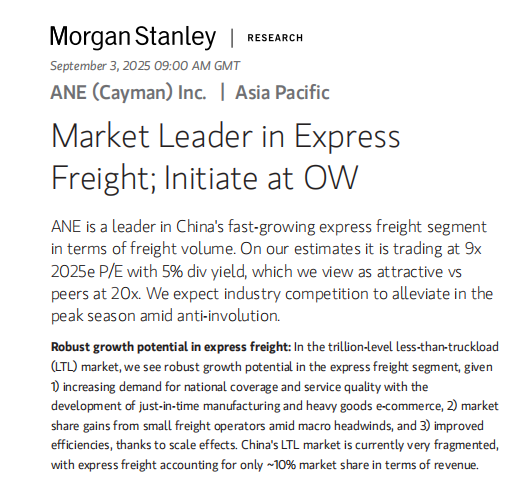
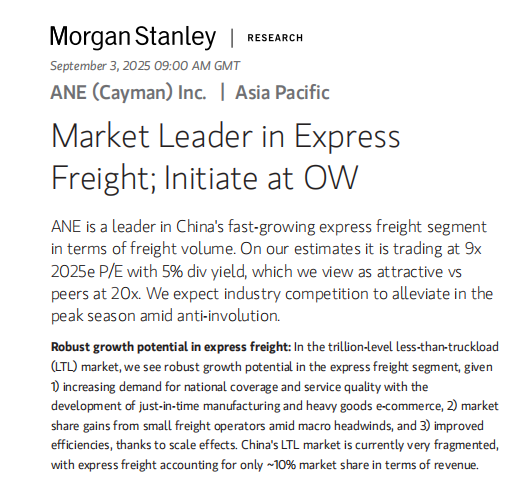
Core Viewpoint - Morgan Stanley initiated coverage on Aneng Logistics (09956) with an "Overweight" rating and a target price of HKD 11.7, indicating a potential upside of 44% from the closing price of HKD 8.10 as of September 2 [1] Company Performance - Aneng Logistics demonstrated robust growth in the first half of 2025, with total LTL freight volume reaching 6.82 million tons, a year-on-year increase of 6.2%; revenue of CNY 5.625 billion, up 6.4%; and adjusted net profit of CNY 476 million, reflecting a 10.7% increase, with a stable gross margin of 15.6% [3] - The company is expected to achieve a freight volume of 14.15 million tons in 2024, representing an 18% year-on-year growth [4] - Aneng Logistics' net asset return (ROE) is projected to reach 30% in 2024, significantly higher than the industry average of 10%, driven by an asset turnover rate exceeding 200% [4] Industry Outlook - The LTL market in China is projected to reach CNY 1.7 trillion by 2024, characterized by a highly fragmented landscape where 90% of revenue is held by 200,000-300,000 small and local freight companies [3] - The express freight segment, a high-margin niche, is expected to grow at a compound annual growth rate (CAGR) of 8% from 2024 to 2027, with its market share increasing from 9% to 11% [3] - The logistics industry is undergoing accelerated consolidation, with leading companies likely to capture market share through a siphoning effect [3] Competitive Advantages - Aneng Logistics is leveraging its industry leadership by optimizing its product structure, focusing on high-margin small and light goods, which have significantly higher prices and profit margins compared to bulk freight [4] - The company achieved a 25.2% year-on-year increase in total ticket volume, with mini ticket freight volume growing by 23.9% and small ticket LTL volume increasing by 14.0% in the first half of 2025 [4] - Aneng Logistics is positioned as a typical "value stock" with a stable dividend policy, expected to enhance its market share amid the exit of smaller players in the industry [5]
摩根士丹利首予安能物流“增持”评级,目标价11.7港元,看好零担快运龙头成长潜力-财经-金融界
Jin Rong Jie· 2025-09-08 02:14
Core Viewpoint - Morgan Stanley initiated coverage on Aneng Logistics (ANE, 9956.HK) with an "Overweight" rating and a target price of HKD 11.7, indicating a potential upside of 21.75% from the current price of HKD 9.61 as of September 5 [1]. Company Summary - Aneng Logistics demonstrated robust growth in the first half of 2025, with total LTL freight volume reaching 6.82 million tons, a year-on-year increase of 6.2%. Revenue was CNY 5.625 billion, up 6.4%, and adjusted net profit was CNY 476 million, reflecting a 10.7% increase, with a stable gross margin of 15.6% [3]. - The company is positioned as a leader in the Chinese LTL market, with a projected freight volume of 14.15 million tons in 2024, representing an 18% year-on-year growth. By mid-2025, it aims to cover 99.6% of towns nationwide, significantly outperforming peers [4]. - Aneng Logistics focuses on optimizing its product structure, emphasizing high-margin small and light goods, which have shown significant growth in volume. The number of mini small tickets increased by 23.9%, and small LTL ticket volume grew by 14.0%, leading to a total ticket count increase of 25.2% to 90.572 million [4]. - The company's return on equity (ROE) is projected to reach 30% in 2024, well above the industry average of 10%, driven by an asset turnover rate exceeding 200% and a net profit margin of 7.2% [5]. Industry Summary - The LTL market in China is expected to reach CNY 1.7 trillion by 2024, characterized by a highly fragmented landscape with 200,000 to 300,000 small and local freight companies capturing 90% of the revenue. The express segment, which has higher margins, currently accounts for only 10% [3]. - The express market is anticipated to grow at a compound annual growth rate (CAGR) of 8% from 2024 to 2027, with Aneng Logistics' market share projected to increase from 9% to 11% during this period. Industry forecasts suggest that this share could reach 35% by 2030 [3].
安能物流上半年300公斤以下货量增长18.2%
Mei Ri Jing Ji Xin Wen· 2025-08-21 13:56
Core Viewpoint - The logistics industry is experiencing a shift towards effective scale growth, with a trend against "involution" becoming prominent, as highlighted by Aneng Logistics' CEO during the earnings call [1] Financial Performance - In the first half of 2025, Aneng Logistics achieved a total freight volume of 6.82 million tons, a year-on-year increase of 6.2% - The company's revenue reached 5.625 billion yuan, up 6.4% year-on-year, while adjusted net profit was 476 million yuan, reflecting a 10.7% increase - Gross profit stood at 880 million yuan, with a gross margin of 15.6% [1][2] Market Competition - The express delivery market remains highly competitive, with price wars being a common strategy among major players - Aneng Logistics has managed to maintain a leading market share in the franchise-based express logistics sector despite aggressive pricing strategies from competitors like Zhongtong [3][4] - The average weight per shipment decreased from 89 kg in the first half of 2024 to 75 kg in the first half of 2025, indicating a shift in freight structure [2] Strategic Adjustments - The company is actively monitoring competitive dynamics and adjusting pricing policies accordingly, with a focus on maintaining a balance between market share and profitability [3][4] - Aneng Logistics plans to invest in over 200 smart driving vehicles and more than 100 electric heavy trucks in the second half of 2025 to enhance operational efficiency [6] Technological Advancements - The company is exploring the application of automation and smart logistics technologies to reduce costs and improve efficiency - Aneng Logistics has deployed automated sorting lines in several distribution centers, resulting in a 6% reduction in cost per kilogram and improved sorting efficiency [5][6] - The company is also testing the use of unmanned delivery vehicles in specific scenarios, although regulatory challenges regarding road rights remain a concern [5]
安能物流上半年营收56.25亿元,发布上市后首次分红方案
Guo Ji Jin Rong Bao· 2025-08-19 13:10
Core Insights - Aneng Logistics reported a revenue of 5.625 billion yuan for the first half of 2025, representing a year-on-year growth of 6.4% [1] - The adjusted net profit for the same period was 476 million yuan, up 10.7% year-on-year [1] - The company continues to focus on a strategy of "effective scale growth with emphasis on quality and profit," aiming to enhance product competitiveness [1] Financial Performance - Revenue for the first half of 2025: 5.625 billion yuan, a 6.4% increase year-on-year [1] - Adjusted net profit: 476 million yuan, a 10.7% increase year-on-year [1] - Gross profit and gross margin reached 880 million yuan and 15.6%, respectively [1] Operational Metrics - Total freight volume for the first half of 2025 was 6.82 million tons, a 6.2% increase year-on-year [1] - The volume of shipments weighing less than 300 kg increased by 18.2%, with mini shipments (under 70 kg) and small shipments (70-300 kg) growing by 23.9% and 14.0%, respectively [1] - Total number of shipments increased by 25.2% to 90.6 million, while the average weight per shipment decreased from 89 kg in the first half of 2024 to 75 kg in the first half of 2025 [1] Pricing Strategy - The unit price for transportation services decreased from 441 yuan/ton in the first half of 2024 to 413 yuan/ton in the first half of 2025 due to an active pricing strategy [1] - The unit prices for value-added services and delivery services increased by 12.6% and 3.7%, respectively, adding 21 yuan/ton and 8 yuan/ton [1] Service Improvements - As of the end of the first half, Aneng Logistics served over 6.8 million terminal customers [2] - Average delivery time shortened by 5.3% year-on-year, with a service fulfillment rate improvement of 2.8 percentage points to 76.3% [2] - The average number of lost shipments decreased by 50% per 100,000 items, and complaints dropped by 46% per 100,000 shipments [2] Network Expansion - As of the end of the first half, Aneng Logistics operated 81 self-owned distribution centers, optimizing the distribution structure to enhance operational efficiency [2] - The number of network points exceeded 38,000, maintaining the largest scale in the industry, with a rural coverage rate of 99.6% [2] Dividend Announcement - Aneng Logistics announced its first dividend post-listing, with a mid-term dividend payout ratio of 50% [2] - The dividend decision reflects the company's strong performance, healthy cash flow, and confidence in future growth, signaling a commitment to sustainable shareholder returns [2]