采购经理人指数

Search documents
U.S. Services-Sector Activity Continues to Rise in February
WSJ· 2026-03-04 15:41
Core Insights - The Institute for Supply Management's purchasing managers index for services providers increased to 56.1 from 53.8, indicating growth in the services sector [1] - All four subindexes have remained in expansion territory for the third consecutive month, reflecting sustained positive momentum in the services industry [1] Summary by Category Purchasing Managers Index - The purchasing managers index for services providers rose to 56.1, up from 53.8, signaling an improvement in service sector activity [1] Subindexes Performance - All four subindexes are in expansion territory for the third month in a row, suggesting a broad-based growth across different areas within the services sector [1]


分析:欧元仍然受外部因素牵制
Xin Lang Cai Jing· 2026-02-24 11:11
Core Viewpoint - The fundamental environment for the euro appears relatively favorable, but its movement is still driven by external factors [1][2] Economic Indicators - The European Central Bank seems content to keep interest rates unchanged, and inflation in the eurozone is slowing down [1][2] - Recent Purchasing Managers' Index data indicates that the manufacturing sector is stabilizing [1][2] Market Outlook - Despite the favorable fundamentals, the euro remains constrained by external factors, particularly given the light economic calendar within the eurozone in the short term [1][2] - The euro is expected to continue trading around current levels, with a current exchange rate of 1.1784 USD [1][2]
XPO’s January tonnage bucks negative trend
Yahoo Finance· 2026-02-05 19:49
Core Insights - XPO experienced a significant increase in share price, rising over 11% following a January tonnage surprise, marking the end of an 18-month decline in year-over-year tonnage [1] Group 1: Manufacturing and Economic Indicators - Manufacturing data indicated a positive shift in industrial activity for the first time in 12 months, with the Purchasing Managers' Index reaching 52.6 in January, a 470 basis point increase from December [2] - The new orders subindex surged by 970 basis points to 57.1, the highest since February 2022, signaling potential future growth [2] Group 2: Company Growth Initiatives - XPO implemented growth programs, adding 10,000 local accounts, which now represent 25% of its LTL revenue, with plans to increase this to over 30% [3] - The company is expanding its grocery consolidation services and has gained new customers in the healthcare sector [3] Group 3: Financial Performance - XPO's fourth quarter showed a 0.8% increase in LTL revenue to $1.165 billion, with revenue per shipment rising by 3.3% to $394.78 [5] - Adjusted EBITDA for the fourth quarter increased by 10.6% year-over-year to $272 million, with a consolidated revenue of $2.011 billion, up 4.7% [5][6] - The adjusted earnings per share (EPS) for the fourth quarter was reported at $0.88, exceeding consensus estimates by 12 cents [7]

德国经济年初增长势头增强
Shang Wu Bu Wang Zhan· 2026-01-31 04:06
Core Insights - The German economy shows unexpected growth momentum at the beginning of the new year, with the composite PMI rising to 52.5, exceeding market expectations and remaining above the expansion threshold of 50 [1] Group 1: Economic Indicators - The services sector is the main driver of growth, with its PMI reaching 53.3, indicating robust growth [1] - The industrial sector's PMI has improved but remains in the contraction zone at 48.7, suggesting a lag in the manufacturing recovery [1]
原油情绪共振 加元走势偏强
Jin Tou Wang· 2026-01-08 13:57
Group 1 - The USD/CAD exchange rate continues to rise, driven by market concerns over potential Venezuelan oil returning to the market, which could intensify competition for North American oil supplies, thereby putting pressure on the Canadian dollar [1] - Despite signs of improvement in Canadian economic data, the USD remains stable ahead of key U.S. employment data, supporting a short-term strong trend for USD/CAD [1] - The core driver of the exchange rate's upward movement is the market's reassessment of the global oil supply landscape, particularly after the U.S. signaled a potential restart of Venezuelan oil imports, raising concerns about increased global oil supply and competition for Canadian oil [1] Group 2 - Canada's latest Purchasing Managers' Index (PMI) has shown a significant improvement, returning to the expansion zone, indicating a notable recovery in domestic business activity [2] - The market is cautiously awaiting Canada's trade balance data to further assess the impact of external demand on the economy [2] - The overall performance of the USD remains stable, with the U.S. economy showing some resilience, although weak employment indicators are leading to a cautious market stance ahead of key data releases [2] Group 3 - Technically, the USD/CAD exchange rate is in a bullish trend, consistently trading above key short- and medium-term moving averages, with strong buying momentum evident [2] - The recent price action has confirmed sustained buying interest, with the RSI indicator in a strong zone, suggesting that upward potential has not yet been fully realized [2] - Key resistance and support levels are identified, with a potential breakthrough of resistance opening new upward movement, while failure to hold support could halt the short-term bullish trend [2]
U.S. Factory Activity Slides Unexpectedly
WSJ· 2026-01-05 15:36
Group 1 - The Institute for Supply Management reported a decline in the purchasing managers index of manufacturing activity to 47.9 in the current month, down from 48.2 in November [1]

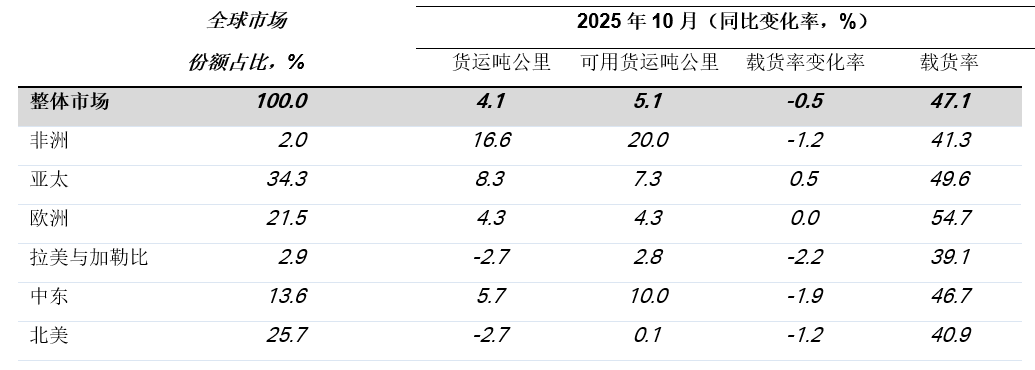
IATA:10月全球航空货运总需求同比增长4.1%
智通财经网· 2025-12-04 11:33
Core Insights - The International Air Transport Association (IATA) reported a 4.1% year-on-year increase in global air freight demand (measured in cargo tonne-kilometers, CTK) for October 2025, with international demand growing by 4.8% [1] - Available cargo tonne-kilometers (ACTK) increased by 5.1% year-on-year, with international capacity rising by 6.4% [1] - October marked the eighth consecutive month of growth in air freight demand, setting a new monthly record [1] - Despite a six-month decline in the Asia-North America trade route, significant growth was observed in intra-Asia, Middle East-Europe, and Europe-Asia routes, indicating a shift in air freight dynamics [1] Air Freight Market Performance - Global air freight trade grew by 5.3% year-on-year in September, while global industrial production increased by 3.7%, marking the fastest growth since March 2025 [1] - In October, despite a drop in crude oil prices, aviation fuel prices rose by 2.5%, with the aviation fuel crack spread nearly double that of the previous year [1] Regional Performance - Asia-Pacific airlines saw an 8.3% increase in air freight demand and a 7.3% increase in capacity [4] - European airlines experienced a 4.3% increase in demand and a corresponding 4.3% increase in capacity [4] - Middle Eastern airlines reported a 5.7% increase in demand and a 10.0% increase in capacity [4] - North American airlines faced a 2.7% decline in demand, the worst performance among all regions, with a slight capacity increase of 0.1% [4] - Latin American airlines also saw a 2.7% decline in demand, with a 2.8% increase in capacity [4] - African airlines had the strongest growth, with a 16.6% increase in demand and a 20.0% increase in capacity [4] Trade Route Analysis - The Asia-North America route declined by 1.4%, marking six consecutive months of decrease [5] - The Europe-Asia route grew by 11.7%, continuing a 32-month growth streak [5] - The Middle East-Asia route increased by 11.5%, maintaining an eight-month growth trend [5] - Intra-Asia routes grew by 9.0%, continuing a 24-month growth streak [5] - The Europe-North America route increased by 2.6%, marking 21 months of growth [5] - The Africa-Asia route grew by 10.9%, continuing a four-month growth trend [5]
日本PMI显示经济温和扩张 服务业连续五个月成为增长主要动力
Sou Hu Cai Jing· 2025-12-03 03:37
Core Viewpoint - The private sector output in Japan continues to expand moderately, driven primarily by the service industry, which has contributed to growth for the past five months [1] Group 1: Economic Indicators - The November index for optimism regarding future activity and employee recruitment reached its highest level since early 2025 [1] - There is an acceleration in new order growth, with businesses expressing confidence that orders and commercial activities will continue to increase in the coming year [1] Group 2: Future Outlook - Optimism regarding future activities has risen to its highest point since January, with businesses expecting demand to remain robust [1] - The key focus in the coming months will be to observe whether the government's new economic stimulus plan translates into further improvements in demand and output growth [1]
美媒:日企因关税逆风削减投资,企业情绪正在降温
Huan Qiu Shi Bao· 2025-12-01 22:58
Group 1 - Japanese companies are reducing investments due to the adverse effects of tariffs, with non-software capital spending declining by 0.3% in the last quarter, marking the first decrease in five quarters [1] - The decline in corporate spending reflects increased caution among Japanese firms in response to challenges posed by U.S. tariff policies, with a fixed import tariff of 15% on all Japanese goods implemented in September [1] - The impact of U.S. tariffs on industries such as automotive is significant, with profits in the transportation machinery sector dropping by 14.0% from July to September [1] Group 2 - Japan's manufacturing activity has contracted for the fifth consecutive month, with the PMI recorded at 48.7 in November, indicating weak demand [2] - New orders in the manufacturing sector continue to decline, extending a downward trend that has lasted for two and a half years [2] - Rising inflation pressures are evident, with overall input costs for Japanese companies increasing at the fastest rate in six months, primarily due to rising labor and raw material costs [2]
Juno markets 外匯:美国经济数据降温,美联储下一步是降息吗?
Sou Hu Cai Jing· 2025-11-28 02:45
Group 1 - The recent performance of the US dollar remains weak, with the dollar index fluctuating around 99.50, reflecting market expectations for a potential interest rate cut by the Federal Reserve [1] - Market expectations for a 25 basis point rate cut at the December Federal Reserve meeting have surged to over 87%, up from 39% a week prior, indicating a significant shift in sentiment [3] - Initial jobless claims in the US fell to 216,000 for the week ending November 22, a decrease of 6,000 from the previous week, outperforming market expectations [3] - The Producer Price Index (PPI) for September increased by 2.7% year-on-year, consistent with expectations, while the core PPI declined from 2.9% to 2.6%, slightly below market forecasts [3] - Retail sales in September grew by 0.2% month-on-month, a slowdown from the 0.6% increase in August, indicating a more cautious consumer spending attitude [3] - The consumer confidence index for November dropped by 6.8 points to 88.7, reflecting a notable decline in household sentiment [3] - Federal Reserve Governor Christopher Waller emphasized a focus on labor market performance and indicated that inflation is "not a major issue," suggesting an openness to rate cuts [3] Group 2 - In Australia, private capital expenditure rose by 6.4% quarter-on-quarter in Q3, significantly higher than the 0.2% growth in Q2 and above market expectations of 0.5% [4] - The Consumer Price Index (CPI) in Australia for October increased by 3.8% year-on-year, surpassing market expectations of 3.6% [4] - The preliminary manufacturing Purchasing Managers' Index (PMI) for November in Australia was 51.6, up from 49.7, indicating expansion in the manufacturing sector [4] - The services PMI increased from 52.5 to 52.7, and the composite PMI rose from 52.1 to 52.6, suggesting ongoing economic activity expansion [4] - The Reserve Bank of Australia indicated a balanced policy stance in its November meeting minutes, suggesting that strong economic data could lead to an extended period of current interest rates [4]