
风电材料

Search documents
嘉兴又一家民企成功上市
Sou Hu Cai Jing· 2026-01-29 13:04
Core Viewpoint - Zhejiang Zhenstone New Materials Co., Ltd. officially listed on the Shanghai Stock Exchange, marking it as the first new A-share listed company from Zhejiang in 2026 and adding to the growing number of listed companies in Jiaxing [1][3] Group 1: Company Overview - Zhenstone has over 20 years of experience in the new energy composite materials sector and aims to leverage its public offering to enhance R&D and production in wind power, photovoltaics, and new energy vehicles [3][4] - The company has established a diversified product system covering multiple clean energy sectors, becoming a leader in niche markets, with over 85% of its revenue coming from wind power products [4][6] Group 2: Future Development Plans - The company plans to strengthen its leading position in wind power materials while focusing on new markets such as photovoltaic frames and composite materials for new energy vehicles, aiming to create a "second growth curve" for sustainable development [3][4] - Zhenstone's new materials industrial park in Jiaxing is fully operational, with plans to become the largest production base for fiberglass and composite materials globally, emphasizing high-quality development in the composite materials industry [6]

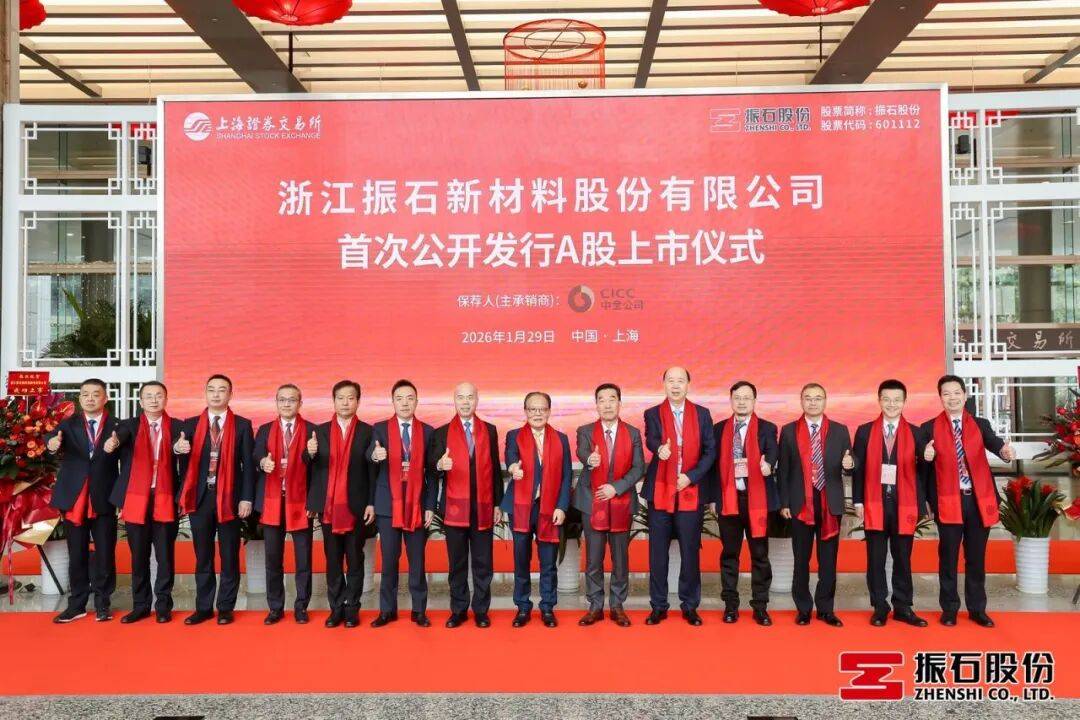
刚刚,桐乡新增一家A股上市公司!
Sou Hu Cai Jing· 2026-01-29 03:31
Core Viewpoint - Zhejiang Zhenstone New Materials Co., Ltd. has officially listed on the Shanghai Stock Exchange, marking it as the first A-share listed company from Zhejiang in 2026 and adding a significant player to the "Tongxiang sector" in the capital market [2] Company Overview - Zhenstone achieved a remarkable IPO process, completing the key journey in just 146 days from acceptance to approval, setting a record for the shortest approval time among IPO projects subjected to on-site inspections in 2025 [4] - The company has focused on high-performance composite materials for over 20 years, becoming a leader in the wind power new materials sector, with over 85% of its revenue coming from wind power products [6] Market Position and Strategy - Zhenstone's products are exported to over 50 countries and regions, capturing more than 35% of the global market share in its niche [6] - The company is actively diversifying its growth by entering emerging fields such as photovoltaics and new energy vehicles, becoming a core supplier for several leading industry players [8] Future Outlook - The listing is viewed as a new starting point for Zhenstone, which aims to strengthen its leadership in wind power materials and explore new growth areas in photovoltaic frames and composite materials for new energy vehicles [10] - The listing of Zhenstone is a milestone for Tongxiang enterprises, reflecting the vibrant capital market activity in the region, with a total of 11 listed companies and a market capitalization exceeding 340 billion yuan [10] Government Support - The local government has provided strong support for the listing process, facilitating services and establishing a regular communication mechanism with stock exchanges to assist companies in meeting regulatory requirements [10] - Tongxiang is actively attracting high-quality enterprises in key industries such as new materials and digital economy, fostering a healthy ecosystem for nurturing and guiding companies towards listing [12][13]
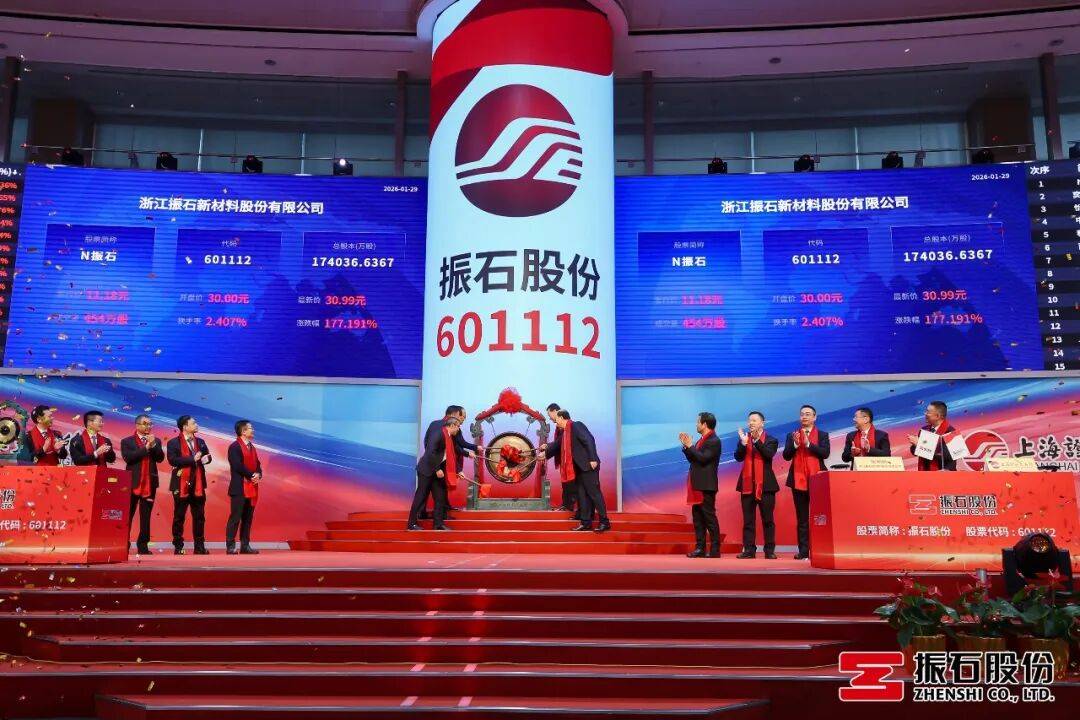
嘉兴又一家企业成功上市
Sou Hu Cai Jing· 2026-01-29 03:20
Core Viewpoint - The successful listing of Zhenstone Co., Ltd. marks a new starting point for high-quality development, focusing on innovation and expansion in the wind power, photovoltaic, and new energy vehicle sectors [2][3]. Group 1: Company Development - Zhenstone Co., Ltd. has established a diversified product system covering multiple clean energy sectors, including wind power, photovoltaic, and new energy vehicles, becoming a leader in niche markets [3]. - The company aims to leverage its successful public offering to enhance its research and development capabilities and scale production in the renewable energy sector [2]. Group 2: Market Position and Strategy - During the 14th Five-Year Plan period, Zhenstone has aligned its operations with the dual carbon goals, achieving significant breakthroughs in capacity, technology, and market share, with over 85% of its revenue coming from wind power products [3]. - The company plans to solidify its leading position in wind power materials while also focusing on new markets such as photovoltaic frames and composite materials for new energy vehicles, aiming to create a "second growth curve" [2]. Group 3: Infrastructure and Innovation - The new materials industrial park in Qiantang Economic Development Zone is fully operational, set to become the largest production base for fiberglass and composite materials globally, promoting high-quality development in the composite materials industry [5]. - The park features 100% green electricity supply for wind power fabrics and incorporates advanced automation technologies, highlighting the company's commitment to intelligent manufacturing [5].
东海证券晨会纪要-20251231
Donghai Securities· 2025-12-31 06:39
Group 1: AI-Driven Chemical Industry - The integration of AI in the chemical industry is expected to create investment opportunities across four key areas: research, production, operations, and supply chain management, leading to a data-driven and optimized system [5][6] - The demand for new chemical materials is driven by the energy consumption of AI data centers, with a projected compound annual growth rate of 44.8% in IT energy consumption from 2022 to 2027 [6] - The renewable energy generation in China is currently about 35%, with a future target of nearly 90%, emphasizing the need for green energy materials [7] - The new energy storage plan aims for a scale of 180 million kilowatts by 2027, with significant investments expected in lithium battery storage [8] - The manufacturing sector is poised for growth, particularly in high-end electronic resins and specialty engineering plastics, as domestic companies catch up with international standards [9] - The cooling materials market is projected to exceed $7 billion by 2034, with a compound annual growth rate of over 10% from 2024 to 2034, driven by the demand for AI-related cooling solutions [11] Group 2: Refrigeration Equipment Industry - The refrigeration and air conditioning industry in China is at a critical turning point, transitioning from a growth phase to a stable development phase dominated by replacement demand [12] - Strategic acquisitions in the HVAC sector are becoming common as companies seek to establish local distribution networks and adapt to market differences [13] - The commercial refrigeration sector, particularly in data center cooling, is highlighted as a growth area due to increasing demand for energy-efficient solutions [14] - Investment recommendations include focusing on leading companies in household refrigeration, specialized cooling solutions, and upstream components benefiting from data center demands [14]
AI智变化工:双向赋能下化工新材料产业升级与投资机遇(附66页PPT)
材料汇· 2025-12-30 14:50
Macro Foundation: Strong Policy Guidance - Major countries view AI as a strategic core technology, with China promoting deep integration of AI with the real economy through its "New Generation Artificial Intelligence Development Plan" and the U.S. ensuring its leadership in AI through the "National Artificial Intelligence Initiative" [3][4] - Various countries have introduced policies to actively layout artificial intelligence, including the U.S. proposing a unified federal standard for AI regulations, China setting clear goals for AI integration by 2030, and the EU establishing a comprehensive AI regulatory framework [5][6] Chemical Industry Policy - The Ministry of Industry and Information Technology in China has issued a "Stabilizing Growth Work Plan for the Petrochemical Industry (2025-2026)", focusing on innovation, efficiency, demand expansion, and collaboration, with AI becoming a key driver for industry transformation [6][7] New Materials Policy - Governments worldwide are implementing targeted policies for new materials, aiming to break through critical bottlenecks and secure future technological advantages [9][10] - China has established a "New Materials Big Data Center" plan, aiming to create a comprehensive data-driven innovation paradigm in the materials sector by 2035 [12][13] AI and Chemical Industry Integration - AI is expected to deeply integrate into the entire lifecycle of the chemical industry, creating a data-driven, intelligent decision-making, and continuously optimizing system [15][16] - Major chemical companies are increasingly adopting AI technologies to enhance production efficiency and product quality, with examples including collaborations with tech firms for smart factory initiatives [17][18] Demand and Application of AI - The demand for AI is driving significant growth in the AI server market, with projections indicating a rise from $125.1 billion in 2024 to $222.7 billion by 2028 [37][38] - The energy consumption of AI data centers is expected to double by 2025, highlighting the increasing energy demands associated with AI advancements [45][46] Renewable Energy and AI - The share of renewable energy in China's total power generation is projected to reach 88% by 2050, with significant growth in wind and solar energy contributing to the energy needs of AI [51][52] - The development of a new power system centered on renewable energy is crucial for reducing the carbon footprint of AI computing [51][52] Market Trends in Chemical Materials - The chemical materials sector is evolving towards "smart material systems" that integrate multiple functionalities, driven by the demands of embodied intelligence products [35][36] - The market for embodied intelligence products is expected to reach 400 billion yuan by 2030, with significant growth anticipated in the robotics and drone sectors [30][31]

国际复材(301526) - 301526国际复材投资者关系管理信息20251031
2025-10-31 01:12
Financial Performance - In the first three quarters of 2025, the company achieved a total revenue of 6.413 billion CNY, a year-on-year increase of 19.01% [1] - The net profit attributable to shareholders reached 273.53 million CNY, reflecting a significant year-on-year growth of 273.53% [1] - For Q3 2025, the revenue was 2.260 billion CNY, with a year-on-year growth of 18.30%, while the net profit was 42 million CNY, up 167.66% year-on-year [1] Cost and Profitability Challenges - The decline in Q3 profitability was primarily due to increased period expenses, including higher sales and R&D costs, alongside significant financial expenses from exchange rate fluctuations [2] - The company plans to enhance cost control and focus on high-end product structure transformation to improve profitability [2] Market Position and Outlook - The company holds a core supplier position in the wind power materials sector, with over 30% of its production capacity dedicated to wind power products [3] - The global wind power market is expected to add 150 GW of new capacity in 2025, which is anticipated to drive demand for glass fiber [3] - National policies are expected to create new opportunities in the wind power market, with a target of no less than 12 million kW of new installed capacity during the 14th Five-Year Plan [3] Overseas Operations - The company has established production bases in Brazil, Bahrain, and Morocco, with trade subsidiaries in the USA, Netherlands, and Hong Kong, maintaining stable relationships with overseas clients [4] - As of the first three quarters of 2025, the Brazilian operation has significantly reduced losses but has not yet achieved profitability due to market demand decline and production fluctuations [4] Future Projects and Industry Trends - The company is progressing on a new fine yarn project, aiming for completion and production by the end of 2025 [5] - The glass fiber industry is responding to national "anti-involution" policies, promoting supply-demand balance and high-quality development, despite challenges from trade barriers and rising manufacturing costs [5]