
马年挂饰

Search documents
“年货节”吸引台湾消费者热购大陆年货
Xin Hua She· 2026-02-16 08:58
Core Insights - The cross-border e-commerce exports to Taiwan have seen a significant increase, particularly during the pre-Spring Festival shopping season, with over 200,000 packages shipped to Taiwan before the holiday [1][2] - The peak period for cross-border e-commerce to Taiwan typically starts from "Double Eleven" and continues until after the Spring Festival, driven by affordable products, efficient logistics, and diverse promotional activities [2] Group 1: Market Dynamics - Taiwanese consumers are increasingly purchasing mainland Chinese New Year goods through cross-border e-commerce platforms, with popular items including daily necessities, small appliances, festive decorations, and children's toys [1] - The volume of packages shipped during the "Double Eleven" period reached approximately 300,000, indicating a strong demand for mainland products among Taiwanese consumers [2] Group 2: Logistics and Regulatory Support - The Fuzhou Customs has implemented a series of refined customs clearance measures to ensure efficient logistics during peak shopping periods, allowing for quick delivery of goods to Taiwanese consumers [2] - Fuzhou City has developed an action plan for a comprehensive pilot zone for cross-border e-commerce, aiming to establish three new maritime routes to Taiwan by 2027 and encouraging companies to set up collection warehouses in Matsu [2]
台北百年老街飘年味
Xin Lang Cai Jing· 2026-02-02 21:08
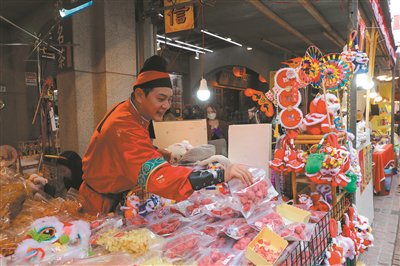
Core Viewpoint - The Taipei Lunar New Year Market on Dihua Street has reopened, showcasing a vibrant atmosphere filled with traditional foods and cultural elements, reflecting the historical significance of the area and its evolution into a festive hub for the New Year celebrations [3][4][5]. Group 1: Historical and Cultural Significance - Dihua Street, established in the mid-19th century, is known for its Baroque architecture and has historically served as a central hub for goods in Taiwan [3]. - The market aims to provide a complete traditional cultural experience, with vendors dressed in traditional attire and offering insights into the history of their products [4]. Group 2: Market Offerings and Customer Engagement - The market features a variety of food stalls selling traditional New Year ingredients such as abalone, fish roe, dried scallops, and mushrooms, alongside festive decorations like red couplets and Year of the Horse ornaments [3][4]. - Vendors are actively engaging customers with promotions and tastings, creating a lively shopping experience [4][5]. Group 3: Modern Adaptations and Attractions - To attract younger crowds, the market has collaborated with popular local IP "Bailan Cat," featuring a giant inflatable mascot and wealth symbols for photo opportunities [4]. - The Taipei City Government's initiative for a "smoke-free New Year Market" enhances the shopping environment, making it more comfortable for visitors [5].

市文物局局长张立新:将启动琉璃河遗址申遗前期工作
Xin Jing Bao· 2026-01-25 23:15
Core Viewpoint - Beijing is focusing on cultural heritage preservation and utilization, particularly in relation to the central axis and archaeological sites, with significant plans for the upcoming years [1][2][4]. Group 1: Cultural Heritage Protection and Utilization - The successful application for the Beijing central axis as a UNESCO World Heritage site has led to the implementation of protective regulations and action plans, including 45 key tasks for the next three years [2][4]. - In 2025, the completion of the protection and display project for the Xianlong Altar is planned, along with the establishment of heritage markers at 15 sites along the central axis [2][3]. - The promotion of cultural heritage through exhibitions and volunteer programs aims to enhance public engagement and awareness, with 1,286 volunteers recruited for the central axis protection efforts [3][4]. Group 2: Museum Development and Cultural Innovation - By 2025, it is projected that over 100 million visitors will attend museums in Beijing, with ongoing reforms to improve service quality and visitor experience [5][6]. - The establishment of the Great Wall Museum is set for 2026, alongside legislative efforts to enhance museum regulations and deepen institutional reforms [6]. - The "Beijing Museum Season" will feature various cultural activities and exhibitions, integrating modern technologies like VR and AR to enrich visitor experiences [5][10]. Group 3: Archaeological Projects and Future Plans - The archaeological work at the Liuli River site has been recognized nationally, and efforts will continue to advance its application for World Cultural Heritage status [7][9]. - Plans for 2026 include extensive archaeological explorations and research at the Liuli River site, focusing on understanding the historical urban layout and significant findings related to the Yan state [9]. - The preservation and promotion of Yunju Temple as a significant cultural site will be prioritized, with efforts to support its application for the World Memory Heritage status [8][9]. Group 4: Cultural Products and Market Expansion - The "Beijing Museum" cultural brand has gained popularity, with successful product launches generating significant sales, such as the "Tian Gong Zao Jing" refrigerator magnet [10]. - In 2026, the focus will be on upgrading cultural products and expanding their market reach, with initiatives like the "Cultural Heritage in Beijing" series [10][11]. - Collaborative events and exhibitions will be organized to integrate cultural products into broader commercial and tourism activities, enhancing public engagement [10][11].