
马应龙痔疮膏

Search documents
中药材价格&中药OTC数据更新
2025-12-29 01:04
Summary of Conference Call on Traditional Chinese Medicine Industry Industry Overview - The conference call focuses on the Traditional Chinese Medicine (TCM) industry, specifically the pricing of medicinal materials and the over-the-counter (OTC) market dynamics [1][3]. Key Points and Arguments - **Price Decline of Medicinal Materials**: The price of natural cow bile has decreased from over 1.4 million yuan per kilogram to 1.1 million yuan, indicating weak demand impacting upstream production companies [1][3]. - **Performance of OTC Products**: Data from nearly 100,000 small and medium-sized chain pharmacies, representing 20% market share, shows that products related to cold relief, such as Lianhua Qingwen capsules and pediatric Chiqiao Qingre granules, performed well in November, expected to drive growth in Q4 and Q1 of the following year [1][3]. - **Stability in Orthopedic and Digestive Products**: Sales of orthopedic and digestive products, such as Lingzhi Pharmaceutical's hemorrhoid ointment and Yunnan Baiyao's plaster preparations, remain stable. Yunnan Baiyao's Qixue Kang has maintained high double-digit growth since Q4 2024 due to academic promotion in grassroots medical institutions and chain pharmacies [1][3]. - **Pressure on Qi and Blood Supplement Products**: Products like Mayinglong hemorrhoid ointment and some from Jianmin Group face growth pressure, but this is expected to ease by December this year and into next year [1][3]. - **Healthy Inventory and Cash Flow Management**: Companies with excellent inventory management and stable cash flow, such as Mayinglong and Jiangzhong, have maintained positive growth since January, with no historical burdens [1][3][4]. - **Long-term Price and Demand Relationship**: There is a close relationship between medicinal material prices and demand. The decline in prices since Q3 of last year reflects weakened demand in Q1 and Q2, which has begun to impact the upstream raw materials market [1][5]. Additional Important Insights - **Focus on Stable Companies**: Investors are advised to pay attention to companies with stable operations, good cash flow, and effective inventory control, as well as the stabilization of medicinal material prices and the recovery of the OTC market [2][4]. - **Monitoring Market Dynamics**: Continuous monitoring of medicinal material price stabilization and monthly OTC data recovery is crucial for assessing the overall recovery of the OTC market [5].
冲击连续20日净申购,中药ETF(159647)涨近1%
Xin Lang Cai Jing· 2025-10-16 02:49
Group 1 - The China Traditional Chinese Medicine Index (930641) has increased by 0.61% as of October 16, 2025, with notable gains from companies such as Darentang (600329) up 4.09% and Yiling Pharmaceutical (002603) up 3.22% [1] - The National Medical Products Administration has released a draft for public consultation aimed at accelerating post-marketing research and evaluation of traditional Chinese medicine injections, with a goal of "actively evaluating some, mandating evaluations for others, and legally eliminating some" [1] - The market is expected to return to high-growth sectors as the third quarter earnings reports approach, with strong performance anticipated in medical devices and traditional Chinese medicine companies [2] Group 2 - The top ten weighted stocks in the China Traditional Chinese Medicine Index as of September 30, 2025, include Yunnan Baiyao (000538) and Pien Tze Huang (600436), collectively accounting for 55.08% of the index [3] - The current holding ratio of traditional Chinese medicine stocks is approximately 0.37%, the lowest historically, indicating a potential opportunity for reallocation in the sector [2] - The demand for over-the-counter traditional Chinese medicine products remains strong, with some products experiencing double-digit growth [2]
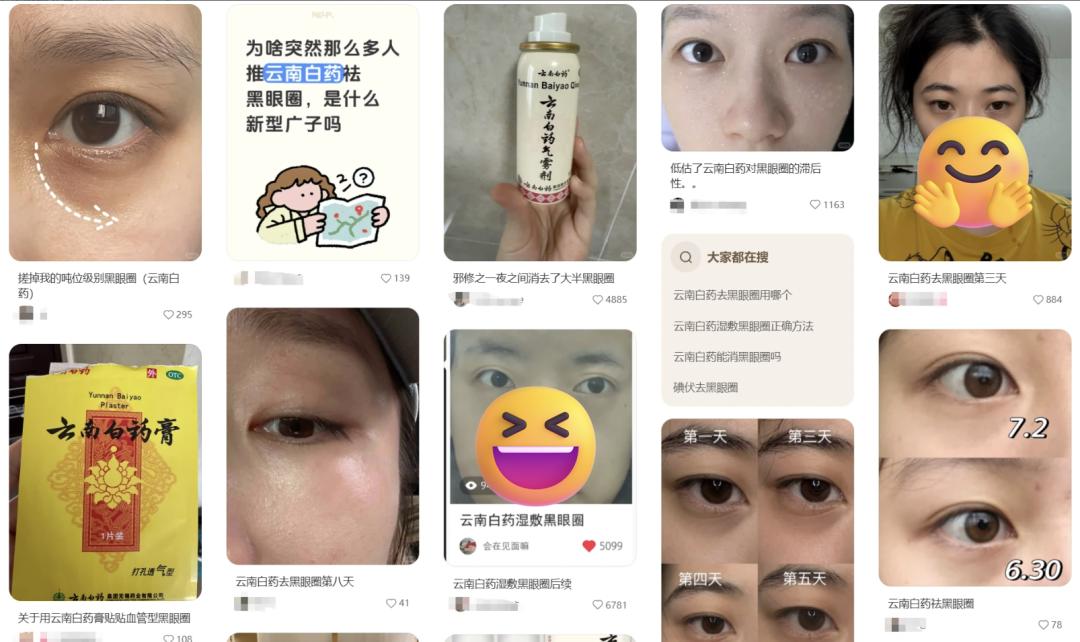
云南白药湿敷黑眼圈替代海蓝之谜?不想被贵妇眼霜收割的熬夜打工人都在玩“邪修”
3 6 Ke· 2025-08-08 08:18
Core Viewpoint - The article discusses the rise of unconventional methods, referred to as "邪修" (xie xiu), for addressing common issues like dark circles under the eyes, particularly among young people, highlighting the popularity of using products like Yunnan Baiyao as alternatives to expensive eye creams [1][3][41]. Group 1: Unconventional Methods - The term "邪修" describes unconventional practices that have gained traction online, such as using Yunnan Baiyao for treating dark circles instead of traditional eye creams [1][3]. - Users have shared various methods, including applying Yunnan Baiyao in different forms (spray, powder, ointment) directly to the skin around the eyes, often with claims of quick results [5][7][11]. - The article notes that these methods are often seen as more accessible and relatable compared to high-end skincare products, appealing to a demographic that values cost-effectiveness [5][41]. Group 2: Product Popularity and Perception - Yunnan Baiyao has become a popular choice among users, with claims of significant improvements in dark circles, leading to its comparison with expensive eye creams [3][5]. - The article highlights that the effectiveness of these unconventional methods is often debated, with some users experiencing adverse effects, indicating a lack of scientific backing for these practices [13][46]. - The perception of traditional skincare products is challenged, as users question the value of expensive creams when cheaper alternatives seem to provide similar results [5][32][41]. Group 3: Cultural Context and Trends - The rise of "邪修" reflects a broader cultural trend where individuals seek quick fixes for common beauty concerns, often influenced by social media and peer recommendations [1][50]. - The article suggests that the popularity of these methods is partly due to the pressures of modern life, where traditional self-care practices like adequate sleep are often neglected [29][32]. - The discussion around dark circles and skincare highlights a societal obsession with appearance, leading to the exploration of various unconventional remedies [32][48].


创新长坡厚雪,医药新章甫开——医药行业2025年度中期投资策略
2025-07-11 01:05
Summary of the Pharmaceutical Industry Conference Call Industry Overview - The conference call focuses on the pharmaceutical industry in China, specifically the performance and outlook of listed pharmaceutical companies in 2025 [1][4]. Key Points and Arguments Financial Performance - In Q1 2025, the overall revenue of domestic listed pharmaceutical companies decreased by 4.2% year-on-year, with net profit attributable to shareholders down by 8.7% and non-recurring net profit down by 10% [3][4]. - Despite the revenue and profit pressures, the industry shows signs of marginal improvement, indicating a potential recovery phase for profitability [4]. Sector Performance - The CXO (Contract Research Organization), medical services, pharmaceutical distribution, and retail sectors outperformed the industry average in revenue growth, with CDMO (Contract Development and Manufacturing Organization) revenue increasing by 13% year-on-year [1][5]. - The CXO sector also saw a notable increase in non-recurring net profit, up by 23% year-on-year, highlighting its strong performance [5]. Valuation Trends - The valuation premium of the pharmaceutical industry has been recovering since early 2025, reaching nearly 45% by June, which is considered to be at a historical mid-low level [7][8]. - Public funds have shown a renewed interest in the sector, suggesting a potential new allocation cycle [7][8]. Innovation and Global Expansion - The "innovation going global" trend is supported by policy backing, industry changes, and performance improvements. The number of Chinese innovative companies participating in overseas academic conferences has increased significantly [9]. - Key players like BeiGene and Hutchison China MediTech have improved cash flow and entered profitability cycles, further driving the trend of innovation going global [9]. Investment Strategies - The mid-term investment strategy for the pharmaceutical industry focuses on two main lines: innovation going global and domestic demand recovery. Key areas of interest include innovative drugs and their upstream supply chains, particularly in the CXO sector [2]. - Attention is also drawn to domestic sectors with lower tariff exposure and the gradual rollout of hospital equipment upgrades, particularly in electrophysiology and orthopedics [2]. Opportunities in Traditional Chinese Medicine (TCM) - The TCM sector is highlighted for its innovative drug opportunities and brand OTC (over-the-counter) products. The decline in raw material prices is expected to alleviate inventory pressures and improve gross margins [14]. - Companies like Yiling Pharmaceutical are advancing multiple pipelines into clinical stages, which could support long-term growth [14]. Medical Device Market Insights - The medical device market is expected to grow significantly, with a projected investment increase of over 25% by 2027 compared to four years prior, driven by ongoing equipment upgrades and hospital recovery [18]. - High-value consumables are particularly recommended for investment due to their growth potential [17]. Home Healthcare Market - The home healthcare device market is gaining attention due to an aging population and increasing health awareness. Key products include blood glucose meters and respiratory devices, with significant growth expected in the coming years [19]. New Consumption Trends in Healthcare - The healthcare new consumption sector is advised to focus on retail market transformations, such as the evolution of pharmacy chains, which may improve long-term revenue expectations [20]. Additional Important Insights - The pharmaceutical industry has faced a challenging environment since mid-2020, but recent trends indicate a potential recovery phase [7]. - The funding landscape for innovative drug development has improved, reducing the likelihood of cash flow constraints in the near future [10]. - The "borrowing ship" model for overseas expansion allows Chinese companies to leverage foreign patents and rights, providing stable cash flow through upfront payments and milestone rewards [13].
关税扰动下,如何布局医药板块
2025-06-18 00:54
Summary of Conference Call on Pharmaceutical Sector Industry Overview - The conference call focuses on the pharmaceutical sector, particularly the impact of tariffs on innovative drugs and the performance of traditional Chinese medicine (TCM) [1][2][5]. Key Points and Arguments Impact of Tariffs on Innovative Drugs - Innovative drugs are minimally affected by tariffs due to the "borrowing ship" model, which allows companies to avoid customs duties by licensing patents to U.S. firms [2]. - For example, even with a 100% tariff on certain oncology products from Hehuang Pharmaceutical, the valuation impact is only 1% to 2% [1][2]. Future Development of Innovative Drug Sector - The future growth of the innovative drug sector relies heavily on business development (BD) logic. The second half of 2025 may see a divergence in market performance, with companies that can deliver on BD continuing to rise, while those that cannot may face declines [3][4]. - A significant increase in conflict of interest agreements is expected in 2025, which will transition into service contracts requiring about two quarters to digest, indicating sustained BD activity throughout the year [4]. Export Dynamics - China's exports of pharmaceutical products to the U.S. are relatively low, with medical devices and diagnostic reagents making up over 30% of total exports, while ordinary drugs account for less than 20% [5]. Performance of Traditional Chinese Medicine (TCM) - The TCM market is showing signs of improvement in Q2 2025, with the high base effect from Q1 diminishing. The third quarter is expected to see accelerated performance due to a lower base from the previous year’s anti-corruption measures in healthcare [6]. - Key stocks to watch include Zhaoli Pharmaceutical, which has a high degree of certainty in procurement and performance completion [6]. Biopharmaceutical Sector Stability - The biopharmaceutical sector, particularly vaccines and blood products, is expected to maintain stable growth. Investors are encouraged to focus on the long-term potential of these companies based on their existing business foundations [3][8]. Additional Important Insights - The overall valuation in the innovative drug sector is currently around three times price-to-sales (PS) ratio, with expectations to correct to five times PS, indicating significant upside potential [4]. - Retail performance for TCM products is strong, with notable sales growth for products like Ma Ying Long hemorrhoid ointment and Yunnan Baiyao's Qi Xue Kang [6]. This summary encapsulates the key insights from the conference call regarding the pharmaceutical sector, highlighting the resilience of innovative drugs against tariffs, the promising outlook for TCM, and the stability of the biopharmaceutical industry.