内需复苏

Search documents
长城基金汪立:关注内需价值、新兴科技、大金融三大方向
Xin Lang Cai Jing· 2026-02-26 04:48
Core Viewpoint - The A-share market is expected to stabilize and rebound, supported by multiple positive factors including declining risk-free rates, comprehensive domestic demand policies, and improving export expectations [1][4]. Group 1: Market Conditions - The A-share market welcomed a "good start" with all three major indices opening higher on the first trading day after the holiday [1][4]. - Factors supporting the market include a decline in risk-free rates and ongoing capital market reforms, which create a favorable liquidity environment for A-shares [1][4]. - Domestic demand policies are being prioritized, with expectations for traditional domestic demand sectors to gradually improve, supported by both policy and fundamental factors [1][4]. Group 2: Economic Outlook - The outlook for China's economy in 2026 is expected to improve significantly, driven by breakthroughs in domestic new technology industries and accelerated globalization [1][4]. - The focus of economic work is shifting towards domestic demand, with expectations of recovery in consumption, rising prices, and stabilization in the real estate sector [1][4]. Group 3: Investment Strategies - Emerging technology is identified as a key investment theme, with value stocks also expected to see a resurgence [1][4]. - Specific sectors to focus on include consumer services, food and beverage, and building materials within the domestic demand space, as well as internet, media, computing, robotics, electronics, and military industries in the emerging technology sector [2][5]. - The financial sector, particularly brokerage and insurance, is highlighted as a stabilizing force in the market, benefiting from the ongoing growth in wealth management demand [2][6].
马年投资锦囊|招商证券张夏:A股慢牛行情持续,看好内需复苏与科技自立等主线
Sou Hu Cai Jing· 2026-02-23 09:17
Core Viewpoint - The A-share market is expected to continue a slow bull market in 2026, driven by a recovery in corporate earnings and moderate valuation expansion, with the Shanghai Composite Index projected to rise between 10% and 15% [1]. Group 1: Market Dynamics - The current upward cycle of the A-share market is transitioning from a liquidity-driven phase to a profitability-driven phase, with key indicators such as PPI recovery signaling substantial improvements in corporate earnings [5]. - Daily trading volume in the A-share market has remained above 2 trillion yuan since 2026, indicating strong market activity [5]. - A net inflow of approximately 1.56 trillion yuan is anticipated in 2026, supported by favorable conditions in the past two years and a high return rate environment [5]. Group 2: Fund Supply and Demand - Public funds are expected to continue their recovery trend, with potential improvements in active fund redemptions if they can overcome profitability challenges [5]. - Insurance funds are projected to see improved premium income, supported by policies encouraging increased stock market investments [5]. - Private equity funds are likely to attract high-net-worth individuals, contributing significant incremental capital to the market [5]. - The appreciation of the renminbi is expected to attract foreign capital inflows, further supporting A-share valuations [5]. Group 3: Investment Opportunities - Investment strategies for the year should focus on two main themes: domestic demand recovery and technological self-sufficiency, creating a dual-driven growth pattern [6]. - The recovery of the consumer services sector is anticipated to be driven by multiple factors, including policy support and economic recovery, leading to a shift towards high-value experience consumption [6]. - In the realm of technological self-sufficiency, the domestic AI chip market is expected to surpass foreign competitors, driven by both external pressures and internal demand for AI [6]. - Key areas for self-sufficiency include integrated circuits, industrial mother machines, and foundational software [6].



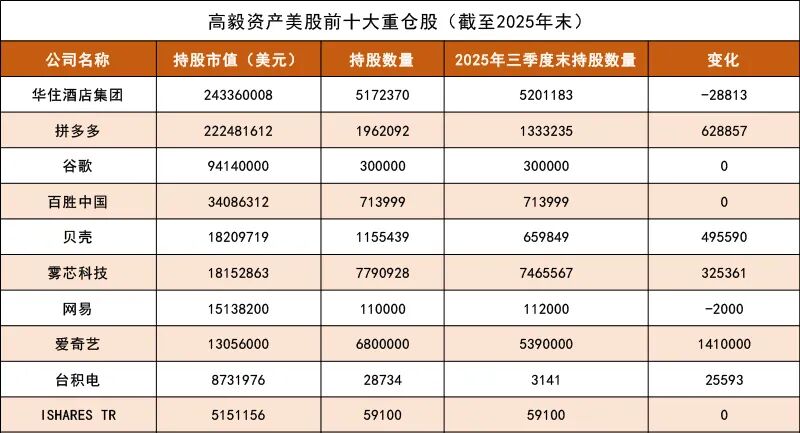
高毅资产美股持仓曝光
Shang Hai Zheng Quan Bao· 2026-02-15 01:17
Group 1 - Gao Yi Asset's latest US stock holdings were disclosed, showing a total market value exceeding $600 million across 13 companies as of the end of 2025 [1][3] - The top ten holdings are dominated by Chinese concept stocks, with significant increases in positions for Pinduoduo and Beike, and a new investment in Yixian E-commerce [1][3][9] - The largest holding is Huazhu Hotels Group, which has consistently been the top position for multiple quarters [4][9] Group 2 - Huazhu Hotels Group reported a hotel revenue of 30.6 billion yuan for Q3 2025, a year-on-year increase of 17.5%, with over 12,000 hotels in operation [5] - Pinduoduo saw a revenue of 108.28 billion yuan in Q3 2025, with a year-on-year growth of 9%, marking a decline in growth rate [7] - The overall sentiment in the private equity sector is optimistic regarding domestic demand recovery in 2026, with expectations for opportunities in consumer and real estate sectors [10][11] Group 3 - The real estate cycle's impact on consumption is diminishing, and domestic demand is being driven by growth in other sectors [12] - Increased social capital activity is expected to positively influence economic recovery, supported by proactive policy signals [12][13] - Analysts suggest that the turning point for domestic demand is approaching, with opportunities emerging in sectors like hospitality and consumer goods [11][13]


财信证券袁闯:估值驱动行情延续 节后把握结构性机会
Zhong Guo Zheng Quan Bao· 2026-02-14 01:18
Core Viewpoint - The A-share market is influenced by multiple factors, showing characteristics of valuation-driven and structural differentiation, with an upward trend expected to continue post-Spring Festival [1][2]. Market Dynamics - The A-share market is experiencing a clear upward trend supported by improving corporate earnings, increased willingness of residents to invest, and ongoing policies to optimize industry competition [2]. - Short-term market fluctuations are expected due to seasonal effects, particularly around the Lunar New Year, but the overall upward trend remains intact [2][4]. Market Structure Characteristics - Historical data shows that since 2009, the average spring market rally lasts 57 days with an average increase of over 20%, with value blue-chip sectors performing well before the Spring Festival [3]. - The equity market is currently in a bullish window until early March 2026, with a focus on risk management and strategic positioning [3]. Post-Spring Festival Outlook - The A-share market is anticipated to continue its upward trend post-Spring Festival, supported by macroeconomic recovery, stable policy environment, and regulatory measures to prevent overheating [4]. - There is potential for a "red envelope market" if consumer data exceeds expectations, reinforcing cyclical sector support [4]. Investment Strategies - The investment logic post-Spring Festival will focus on "value supporting growth," with a shift from low-risk to high-risk preferences, emphasizing technology and cyclical sectors [7]. - Five key investment themes are recommended: 1. AI industry chain focusing on application development and performance-driven investments [7]. 2. High dividend yield assets, particularly in stable cash flow sectors like home appliances and banking [7]. 3. Sectors benefiting from policy-driven improvements, such as coal, steel, and lithium [7]. 4. Core areas of domestic demand recovery, including health, sports, and travel industries [8]. 5. Investment opportunities in strategic and industrial metals, anticipating a rebound in prices [8].
估值驱动行情延续 节后把握结构性机会
Zhong Guo Zheng Quan Bao· 2026-02-13 22:45
Group 1 - The A-share market is influenced by multiple factors, showing characteristics of valuation-driven and structural differentiation, with a clear upward trend expected to continue post-Spring Festival [2][4] - The core support for the market's upward trend includes improving corporate earnings prospects, increased willingness of residents to invest, and ongoing policies to optimize industry competition [2][4] - The market is expected to experience a "red envelope market" post-Spring Festival, driven by the current market's duration and upward amplitude being significantly lower than the average of previous uptrends [4][7] Group 2 - The investment logic post-Spring Festival will focus on "value supporting growth," with a shift from low-risk to high-risk preferences, emphasizing technology and cyclical price increases [7] - Five key investment themes are suggested: 1. The artificial intelligence industry chain, focusing on application rather than hardware [7][8] 2. High dividend assets, particularly in stable cash flow sectors like white goods and banking [7][8] 3. Anti-involution sectors benefiting from improved competition, such as coal and steel [7][8] 4. Core areas of domestic demand recovery, including health and tourism sectors [7][8] 5. Investment opportunities in strategic and industrial metals, expected to see a rebound in 2026 [7][8] Group 3 - The market structure shows significant calendar effects and valuation-driven characteristics, with the average increase of the Wind All A Index being over 20% during the spring market since 2009 [3] - The equity market is currently in a bullish window until early March 2026, with a strategy of "rapid gains and risk control" [3][4] - The bond market is experiencing downward pressure on yields, with the 10-year government bond yield expected to fluctuate between 1.80% and 1.85% [3]
财信证券袁闯: 估值驱动行情延续 节后把握结构性机会
Zhong Guo Zheng Quan Bao· 2026-02-13 20:31
Core Viewpoint - The A-share market is expected to continue its upward trend post-Spring Festival, driven by a combination of trend inertia, seasonal effects, and policy environment support [3] Market Characteristics - The A-share market is influenced by multiple factors, exhibiting a complex overall pattern characterized by clear trends, numerous short-term disturbances, and significant structural differentiation [1] - The core driving force for the market's upward trend is the self-propelling nature of the market, supported by regulatory measures to mitigate risks and prevent overheating [1][3] - Key support for the market's upward movement includes improving corporate profit outlooks, increased willingness of residents to invest savings, and ongoing policies to optimize industry competition [1][2] Short-term Market Dynamics - Short-term market fluctuations are influenced by holiday effects, with some funds opting to secure profits before the Lunar New Year, leading to a temporary decrease in trading activity [2] - The performance of U.S. tech giants, Federal Reserve policy, and geopolitical events indirectly affect the rotation of A-share industries [2] Investment Strategy - Post-Spring Festival, the investment logic will focus on "value supporting growth," with a shift from low-risk to high-risk preferences, emphasizing technology and cyclical price increases [5] - Five main investment lines are suggested: 1. AI industry chain focusing on application breakthroughs [5] 2. High dividend assets in stable cash flow sectors [5] 3. Anti-involution sectors benefiting from improved competition [5] 4. Core areas of domestic demand recovery, particularly in health and travel sectors [6] 5. Investment opportunities in strategic and industrial metals [6] Market Outlook - The market is expected to experience a "red envelope market" post-Spring Festival, with potential for further expansion due to the current market's performance being below historical averages [3] - The growth of the A-share market is anticipated to be independent of the overall yearly trend, with a focus on technology growth while balancing risks across multiple sectors [6]
估值驱动行情延续节后把握结构性机会
Zhong Guo Zheng Quan Bao· 2026-02-13 20:23
Core Viewpoint - The A-share market is expected to continue its upward trend post-Spring Festival, driven by a combination of trend inertia, seasonal effects, and policy environment support [3] Market Characteristics - The A-share market is influenced by multiple factors, exhibiting a complex overall pattern characterized by clear trends, numerous short-term disturbances, and significant structural differentiation [1] - The core support for the market's upward trend includes improving corporate profit prospects, increased willingness of residents to invest, and ongoing policies to reduce competition [1][2] Short-term Market Dynamics - The pre-Spring Festival period has led to a temporary decline in market activity as some funds opted to secure profits amid uncertainty, but this has not altered the core market trend [2] - Historical data shows that since 2009, the average spring market rally has lasted 57 days with an average increase of over 20% [2] Investment Strategy - Post-Spring Festival, the investment logic will focus on "value supporting growth," with a shift from low-risk to high-risk preferences, emphasizing technology and cyclical sectors [4] - Five key investment themes are recommended: 1. Artificial intelligence industry chain, shifting focus from hardware to application [5] 2. High dividend yield assets, particularly in stable cash flow sectors like white goods and banking [5] 3. Anti-involution sectors benefiting from improved competition dynamics, such as coal and steel [5] 4. Core areas of domestic demand recovery, focusing on sectors with strong growth potential like health and tourism [6] 5. Investment opportunities in strategic and industrial metals, anticipating a rebound in prices [6] Market Outlook - The market is expected to experience a "red envelope market" post-Spring Festival, with potential for further expansion if consumer data exceeds expectations [3] - The overall market is projected to maintain a "stable and upward" characteristic, with limited downside potential for indices [3]
A股“马上赚钱”?最新解读来了
Zhong Guo Ji Jin Bao· 2026-02-12 07:06
Core Viewpoint - The A-share market is expected to maintain a "slow bull" pattern in the Year of the Horse, supported by multiple favorable factors such as global liquidity easing, steady domestic economic recovery, improving corporate profits, and a supportive policy environment [1][5][8]. Market Outlook - The overall market is anticipated to continue a stable upward trend, potentially achieving a "three consecutive annual gains" for the first time in years, driven by corporate profits, market confidence, and a shift in deposit allocation [5][6]. - The market style is expected to transition from liquidity-driven to profit-driven, highlighting opportunities in technology growth, cyclical recovery, high-end manufacturing exports, and domestic demand recovery [1][3][8]. Sector Opportunities - Key investment themes include: 1. AI industry chain bottlenecks, particularly in infrastructure such as power, storage, and cooling [14]. 2. High-end manufacturing with global competitiveness, especially in engineering machinery, power equipment, and new energy vehicles [14][15]. 3. Cyclical leaders benefiting from supply-demand improvements due to policies against "involution" [14][15]. - The technology growth sector remains a core focus, with ongoing trends in AI and semiconductor hardware expected to drive investment opportunities [12][19]. Economic and Policy Environment - The macroeconomic environment is viewed as stable, with systemic risks being low. The expectation of a positive macro policy in 2026 is anticipated to alleviate supply-demand imbalances [7][8]. - The overall investment environment is expected to improve, with a gradual increase in incremental capital entering the market, driven by the performance of active equity funds [7][8]. Market Style Evolution - The market is likely to experience a "rebalancing" of styles, with both technology and cyclical sectors coexisting and presenting investment opportunities [11][12]. - The anticipated economic recovery may lead to a significant "high-low switch," where funds shift from high-valued sectors to those at historical lows [12][18]. Risks and Challenges - Potential risks include slower-than-expected domestic economic recovery, geopolitical tensions, and fluctuations in AI-related narratives that could impact market stability [23][24][25].
宏观数据动态点评:春运“火”,长假“旺”?
Guolian Minsheng Securities· 2026-02-10 15:05
Group 1: Spring Festival Travel Dynamics - The 2026 Spring Festival travel period is expected to see a record high in total passenger flow, driven by a 9-day holiday, favorable weather, and robust transportation capacity[4] - Daily passenger flow peaks during the travel period may also reach historical highs, with metro ridership in key cities remaining at elevated levels[4] - The trend of "reverse travel" is emerging, where more parents are traveling to cities where their children reside, reflecting a shift in family travel dynamics[4] Group 2: Consumer Behavior and Market Trends - Despite the surge in travel, the recovery pace of bulk commodities and some offline service consumption remains cautious and differentiated[4] - The rental car market is booming, with orders for Haier rental cars increasing by over 80% year-on-year as of January 28, 2026[4] - International flight capacity is rapidly recovering, with popular destinations shifting from Japan to Thailand and South Korea for outbound travel during the Spring Festival[4] Group 3: Economic Implications - The contrasting trends of high travel activity and moderate consumer spending may provide insights for policy direction in upcoming national meetings[4] - The retail sales of categories like automobiles and home appliances remain subdued despite the early allocation of 62.5 billion yuan for "trade-in" incentives, indicating a need for further policy support[4] - The overall consumer sentiment during the Spring Festival is expected to influence economic performance in the early part of the year[4]
罕见!600亿,大面积涨停!
凤凰网财经· 2026-01-29 13:23
Group 1 - The core viewpoint of the article highlights a significant rebound in the liquor sector, particularly in the stock prices of major brands like Kweichow Moutai, which surged by 8.6% with a trading volume exceeding 26 billion yuan [1][3] - The white liquor market has seen a notable increase in the prices of Feitian Moutai, with the original box (53 degrees/500ml) for 2026 rising by 55 yuan and the loose bottle increasing by 20 yuan compared to January 26 [1][3][6] - A report from Huashan Securities indicates that the consumer sector has experienced a rare decline over the past five years, leading to a shift in market consensus and a potential limited downside for leading consumer companies post-2026 [1][2][6] Group 2 - The article discusses the anticipated implementation of policies aimed at boosting domestic demand, with the National Development and Reform Commission and the Ministry of Finance set to roll out large-scale equipment updates and consumption replacement policies in early 2026 [2][7] - Analysts suggest that the focus on domestic demand will be crucial for economic recovery, with expectations that policies will support both physical and service consumption [2][8] - The article notes that the consumer sector, including durable goods and daily retail, has shown positive growth, indicating a potential recovery in domestic demand [7][8]