2年期UST SOFR互换利差

Search documents
美联储“鸽派暂停”意味着什么?大摩:未来降息路径将更多由通胀驱动
Hua Er Jie Jian Wen· 2026-01-29 13:55
Core Viewpoint - The Federal Reserve implemented a "dovish pause" during the January FOMC meeting, signaling a shift in the future rate cut path, which will now depend more on inflation data rather than solely on labor market weakness [1][5] Economic Outlook - FOMC members showed greater consensus on the economic outlook, with Powell noting stronger economic performance compared to December, supported by resilient consumer spending, expanding business investment, fiscal support expectations, favorable financial conditions, and ongoing AI-related capital expenditures [5] - The only weak area identified was the housing market [5] Rate Cut Logic - The logic for future rate cuts has fundamentally changed, with a shift towards being "inflation-based" rather than "employment-based" as the risk of job losses diminishes [5][6] - Morgan Stanley expects the Fed to maintain patience until clearer signs of inflation deceleration appear, likely later in the year, before considering rate cuts [5][6] Market Strategy - Morgan Stanley's rate strategists recommend maintaining a neutral position on U.S. Treasury durations and curves, while continuing to favor 2-year UST SOFR swap spreads [8][9] - In the foreign exchange market, the firm predicts a weaker dollar, but notes that the Fed's policy is unlikely to be the main driver of dollar depreciation, with more focus shifting to international monetary policies and related intervention risks [9] MBS Strategy - For agency MBS, Morgan Stanley maintains a neutral stance, citing low volatility as favorable but noting that the option-adjusted spread (OAS) is near its narrowest levels in recent years, with ongoing uncertainty in housing policy [9]

美联储决议前瞻:“暂停”是确定,不确定的是“鹰派还是鸽派暂停”
美股研究社· 2026-01-27 10:44
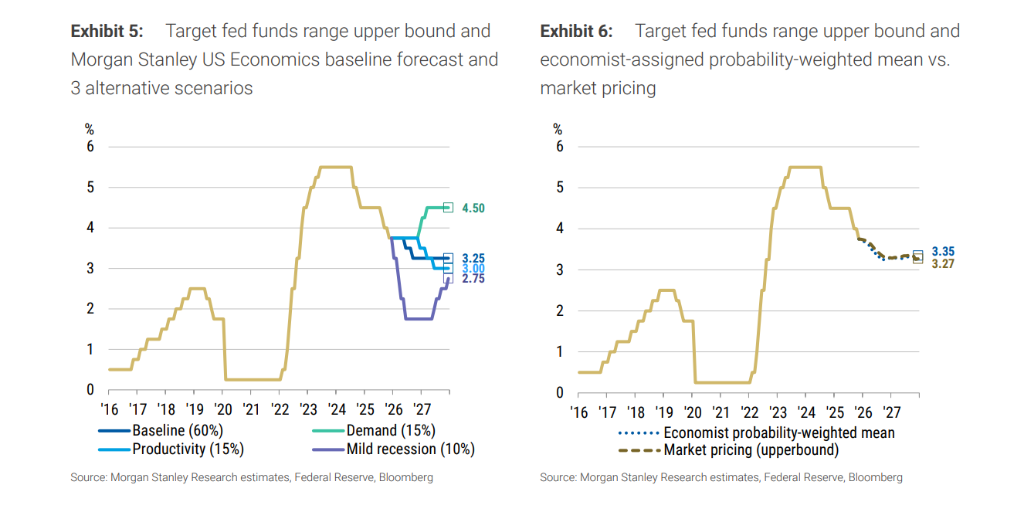
Core Viewpoint - Morgan Stanley anticipates that the upcoming January FOMC meeting will maintain interest rates unchanged, focusing on the tone of the statement [2][5] Group 1: Interest Rate Outlook - The Federal Reserve is expected to keep the federal funds rate target range at 3.50%-3.75%, indicating a tactical adjustment rather than a return to a tightening cycle [2] - The statement is likely to upgrade the economic growth assessment from "moderate" to "robust" and remove references to "increased risks to employment," suggesting reduced concerns about the labor market [2] Group 2: Forward Guidance - The key aspect for investors is the forward guidance, with Morgan Stanley predicting the statement will retain language about "considering further adjustments" rather than "any adjustments," indicating a continued dovish stance [3][5] Group 3: Voting Dynamics - There is an expectation of dissenting votes, with predictions that Governor Miran will vote against the decision, advocating for a 50 basis point rate cut [4] Group 4: Economic Context - Powell is expected to justify the pause by referencing recent strong growth data, stable hiring, and a decrease in the unemployment rate to 4.375% [7] - Despite strong activity data, inflation data has not shown the expected effects from tariffs, but the Fed remains confident that inflation will decline later in the year [7] Group 5: Market Strategy - The short-term financing market remains accommodative, with repo rates normalizing below the interest on reserve balances (IORB), indicating an excess of cash in the system [9] - Morgan Stanley recommends a long position on the 2-year UST SOFR swap spread, targeting -14 basis points, based on the loose financing environment and expectations of a steepening front-end curve [10] Group 6: Currency Outlook - Morgan Stanley has revised its outlook for the foreign exchange market, now expecting stronger U.S. economic growth (GDP growth forecast for 2026 raised to 2.4%) and a delay in Fed rate cuts [12] - Despite this, the firm maintains a moderately bearish view on the U.S. dollar due to synchronized global growth and undervaluation of the Japanese yen [13] Group 7: Asset Class Focus - In the mortgage-backed securities (MBS) sector, the significant $200 billion purchase plan by GSEs has led to a substantial narrowing of MBS spreads, prompting a neutral stance from Morgan Stanley [18] - Municipal bonds are considered fundamentally sound but expensive, with low yield ratios compared to corporate bonds, raising concerns about sustainability if the Fed provides ambiguous signals [18]

美联储决议前瞻:“暂停”是确定,不确定的是“鹰派还是鸽派暂停”
华尔街见闻· 2026-01-26 09:42
Core Viewpoint - Morgan Stanley anticipates that the upcoming January FOMC meeting will maintain interest rates unchanged, focusing on the tone of the statement [1][2] Group 1: FOMC Meeting Insights - The Federal Reserve is expected to keep the federal funds rate target range at 3.50%-3.75%, indicating a tactical adjustment rather than a return to a tightening cycle [2] - The statement is likely to upgrade the economic growth assessment from "moderate" to "robust" and remove references to "increased risks to employment," suggesting reduced concerns about the labor market [2][4] - Morgan Stanley predicts a dissenting vote from a board member advocating for a 50 basis point rate cut [2] Group 2: Market Strategy and Liquidity - Despite the Fed's pause on rate cuts, the short-term financing market remains loose, with repo rates normalizing below the interest on reserve balances (IORB), indicating an "excessively ample" cash situation [5] - The Fed is expected to maintain reserve levels by purchasing $40 billion in Treasury bills monthly, with projections for the SOMA account holdings to exceed $600 billion by the end of 2026 [6] Group 3: Currency Outlook - Morgan Stanley has revised its outlook on the foreign exchange market, now projecting a stronger U.S. economy with a GDP growth forecast of 2.4% for 2026, delaying the anticipated rate cuts [8] - Despite this, the firm maintains a moderately bearish view on the dollar due to synchronized global growth and undervaluation of the Japanese yen, which is expected to converge [9] Group 4: Asset Class Focus - In the mortgage-backed securities (MBS) sector, the significant $200 billion purchase plan by government-sponsored enterprises has led to a narrowing of MBS spreads, prompting a neutral stance from Morgan Stanley [11] - The municipal bond market shows solid fundamentals but is considered expensive, with low yield ratios compared to corporate bonds, raising concerns about sustainability if the Fed signals ambiguity rather than a clear dovish stance [11]