2.5D MEMS探针卡

Search documents
公司问答丨强一股份:公司主要产品2D MEMS探针卡面向应用于以SoC、CPU、GPU等为代表的非存储领域
Ge Long Hui A P P· 2026-01-23 08:36
Core Viewpoint - The company is actively expanding its product applications into the storage sector while maintaining its focus on non-storage areas such as SoC, CPU, and GPU [1] Group 1: Product Applications - The main product of the company, the 2D MEMS probe card, is primarily aimed at non-storage applications including SoC, CPU, and GPU [1] - The company has successfully validated 2.5D MEMS probe cards for HBM and NOR Flash, and is developing sample cards for DRAM and NAND Flash [1] Group 2: Capacity Utilization - The company has not disclosed specific details regarding its capacity utilization and encourages stakeholders to pay attention to future announcements for this information [1]
强一股份(688809.SH):已经实现面向HBM、NOR Flash的2.5D MEMS探针卡的验证以及面向DRAM、NAND Flash的2.5D MEMS探针卡样卡研制
Ge Long Hui A P P· 2026-01-23 07:49
Core Viewpoint - The company, Strong One Co., Ltd. (688809.SH), is actively expanding its product offerings in the storage sector, having successfully validated 2.5D MEMS probe cards for HBM and NOR Flash applications, and is developing sample cards for DRAM and NAND Flash [1] Group 1 - The main products of the company are 2D MEMS probe cards, primarily targeting non-storage applications such as SoC, CPU, and GPU [1] - The company is making significant efforts to enter the storage market [1] - Validation of 2.5D MEMS probe cards for HBM and NOR Flash has been achieved [1] Group 2 - The company is in the process of developing sample cards for DRAM and NAND Flash [1]
强一股份预计去年净利润同比增超57.87%
Zheng Quan Ri Bao· 2026-01-22 16:38
Core Viewpoint - Qiangyi Semiconductor (Suzhou) Co., Ltd. forecasts a significant increase in net profit for 2025, projecting a range of CNY 368 million to CNY 399 million, representing a year-on-year growth of 57.87% to 71.17% [2] Group 1: Financial Performance - The company expects a net profit increase of CNY 135 million to CNY 166 million compared to the previous year [2] - The growth is attributed to the company's strategic alignment with the semiconductor industry's cyclical trends and domestic substitution opportunities [2] Group 2: Market Demand and Product Development - There is an explosive growth in global AI computing power demand, coupled with continuous upgrades in the semiconductor supply chain, driving rapid expansion in high-end chip testing demand [2] - Qiangyi Semiconductor, as a leading supplier in the probe card sector, is well-positioned to meet the urgent market demand for higher performance and advanced processes [2] Group 3: Product Portfolio and Revenue Growth - The mature 2D MEMS probe cards are expanding their penetration in the high-end logic chip testing market, serving as a core engine for revenue growth [3] - The 2.5D MEMS probe cards have successfully passed validation from leading storage clients and are contributing stable new revenue [3] - The thin-film probe cards are steadily growing in revenue due to their unique technological advantages, creating a synergistic development across multiple product lines [3] Group 4: Strategic Initiatives - The chairman emphasized that the funds raised from the IPO will support two core projects: enhancing production capacity at the Nantong base and focusing on core material and process R&D at the Suzhou center [3] - The company aims to break overseas monopolies by efficiently allocating production capacity and enhancing the proportion of high-margin products [3] Group 5: Future Outlook - In the short term, the company plans to leverage new capacity at the Nantong base to expand into AI computing and high-end storage sectors while advancing overseas market strategies [4] - Long-term goals include maintaining high R&D investment at the Suzhou center to achieve breakthroughs in 2.5D/3D MEMS technology and core material production, aiming to become a globally competitive leader in the probe card industry [4]

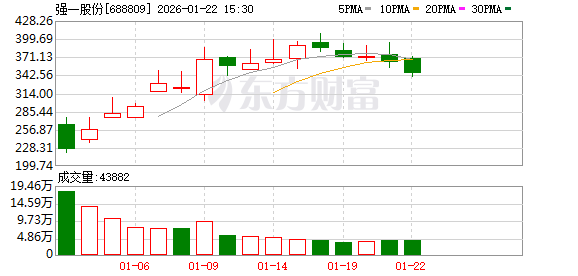
强一股份:2025年净利润同比预增57.87%-71.17%
Di Yi Cai Jing· 2026-01-22 10:37
Core Viewpoint - The company expects a significant increase in net profit for the year 2025, projecting a range of 368 million to 399 million yuan, which represents a year-on-year increase of 134.9 million to 165.9 million yuan, or a growth rate of 57.87% to 71.17% [1] Group 1: Financial Projections - The anticipated net profit for 2025 is between 368 million and 399 million yuan [1] - This projection indicates an increase of 134.9 million to 165.9 million yuan compared to the previous year [1] - The expected growth rate is between 57.87% and 71.17% year-on-year [1] Group 2: Industry Position and Opportunities - The company is positioned as a leading supplier of probe cards in China, capitalizing on the semiconductor industry's cyclical opportunities [1] - Strong demand from major clients in the communication network and AI computing chip sectors is driving robust order growth [1] - The company maintains high capacity utilization rates due to the increasing orders and profitability [1] Group 3: Product Development and Market Strategy - The mature 2D MEMS probe cards are gaining market penetration, leveraging their high density and precision to capture the high-end logic chip testing market [1] - The 2.5D MEMS probe cards have been validated by leading clients in the storage sector and are beginning to contribute additional revenue through small-scale shipments [1] - The optimization of the profit structure is driven by the performance of these products [1]
科创板第600家上市公司来了!强一股份上市首日收涨165.61% 系国产半导体探针卡龙头
Sou Hu Cai Jing· 2025-12-30 08:45
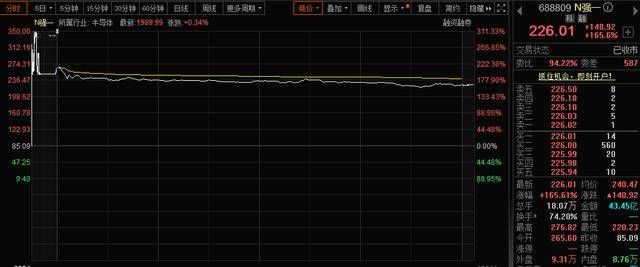
Group 1 - The core viewpoint of the article is that Qiangyi Co., a leading domestic semiconductor probe card manufacturer, successfully listed on the Sci-Tech Innovation Board, bringing the total number of listed companies to 600 [1][6] - Qiangyi Co. issued shares at a price of 85.09 yuan per share with a price-to-earnings ratio of 48.55 times, and on its first trading day, the stock opened at 265.60 yuan, closing with a gain of 165.61% at 226.01 yuan, resulting in a market capitalization of 29.28 billion yuan [1][4] - If investors sold at the highest price of 276.82 yuan during the day, they would have made a profit of 95,900 yuan [1] Group 2 - Qiangyi Co. focuses on the research, design, production, and sales of probe cards, ranking ninth globally in 2023 and sixth in 2024 in the semiconductor probe card industry [3] - The company is expanding into the storage sector, having developed 2.5D MEMS probe cards for HBM and NOR Flash, and is targeting major domestic players like Changxin Memory and Yangtze Memory Technologies [3][5] - Financial performance shows revenue growth from 254 million yuan in 2022 to an expected 950 million to 1.05 billion yuan in 2025, with net profit projected to increase significantly [4]
强一股份(688809) - 强一股份首次公开发行股票并在科创板上市招股说明书
2025-12-24 11:47
本次发行股票拟在科创板上市,科创板公司具有研发投入大、经营风险高、业绩不 稳定、退市风险高等特点,投资者面临较大的市场风险。投资者应充分了解科创板 的投资风险及本公司所披露的风险因素,审慎作出投资决定。 强一半导体(苏州)股份有限公司 Maxone Semiconductor (Suzhou) Co., Ltd. 强一半导体(苏州)股份有限公司 招股说明书 (苏州工业园区东长路 88 号 S3 幢) 招股说明书 保荐人(主承销商) (北京市朝阳区安立路 66 号 4 号楼) 首次公开发行股票并在科创板上市 声 明 中国证监会、交易所对本次发行所作的任何决定或意见,均不表明其对发行人注 册申请文件及所披露信息的真实性、准确性、完整性作出保证,也不表明其对发行人 的盈利能力、投资价值或者对投资者的收益作出实质性判断或保证。任何与之相反的 声明均属虚假不实陈述。 根据《证券法》规定,股票依法发行后,发行人经营与收益的变化,由发行人自 行负责;投资者自主判断发行人的投资价值,自主作出投资决策,自行承担股票依法 发行后因发行人经营与收益变化或者股票价格变动引致的投资风险。 1-1-1 强一半导体(苏州)股份有限公司 招 ...
强一股份/688809/科创板/2025-12-19申购
Xin Lang Cai Jing· 2025-12-19 04:23
Core Viewpoint - The company specializes in wafer testing probe cards, including MEMS and non-MEMS types, which are essential for connecting chips to testing equipment and detecting manufacturing defects [7][33]. Business Overview - The company was established in 2015 and is a non-state-owned enterprise, with CITIC Securities as its sponsor [3][29]. - The main revenue source is from the sales of probe cards, which accounted for 96.67% of total revenue in the first half of 2025 [4][31]. Revenue Composition - In the first half of 2025, the revenue from probe card sales was 358.93 million yuan, with a significant portion coming from 2D/2.5D MEMS probe cards, which represented 88.37% of total sales [4][32]. - The company also generates revenue from probe card maintenance and wafer test board sales, though these contribute a smaller percentage to total revenue [4][31]. Financial Performance - The company's revenue for the first half of 2025 was 374 million yuan, showing a significant increase compared to previous years, with a year-on-year growth of 80.95% from 2023 [17][43]. - The gross profit margin has improved, reaching 68.99% in the first half of 2025, up from 43.12% in 2022 [18][45]. Market Position - The global probe card market was valued at 2.625 billion USD in 2024, with MEMS probe cards holding a market share of approximately 69.77% [20][48]. - The company ranked fifth globally in MEMS probe card sales and fourth in cantilever probe card sales in 2024 [21][48]. Customer Base - The company employs a direct sales model, with major clients including domestic chip design firms and wafer foundries. The top five customers accounted for 82.84% of total sales in the first half of 2025 [9][37]. - The largest customer, referred to as Company B, contributed 25.53% of revenue in the first half of 2025 [41]. Product Details - The company’s MEMS probe cards are used for advanced process chips, with 2D MEMS probe cards being the primary revenue source, accounting for 77.81% of revenue in 2024 [8][35]. - Non-MEMS probe cards, including cantilever and vertical types, are also offered, but their revenue contribution is gradually decreasing [8][36]. Supply Chain - Key materials for production include space transition boards, PCBs, and MEMS probe manufacturing materials, with a significant portion sourced from imports [8][36]. - The company has seen an increasing reliance on KAGA FEI for MLO procurement, with the percentage rising from 11.77% in 2022 to 32.84% in 2025 [8][36].

注册制新股纵览:强一股份:率先实现MEMS探针卡自主量产
Shenwan Hongyuan Securities· 2025-12-15 08:43
Group 1 - The core viewpoint of the report highlights that Qiangyi Co., Ltd. is the only domestic company among the top ten global semiconductor probe card manufacturers, having achieved independent mass production of MEMS probe cards, breaking the monopoly of foreign companies in this field [3][10][18] - The report indicates that the company's AHP score is 2.53, placing it in the upper-middle tier of the AHP model for the Sci-Tech Innovation Board, with expected offline allocation ratios of 0.0285% and 0.0211% for two categories of investors [8][9] - The company has established three major production bases in Suzhou, Hefei, and Shanghai, with a production capacity utilization rate exceeding 94% for its 2D MEMS probe cards and vertical probe cards from 2022 to 2024, serving over 400 clients across the semiconductor industry [15][16][19] Group 2 - The report emphasizes the company's proactive expansion into the storage sector, with its 2.5D MEMS probe cards having completed validation and delivery, and expected sales revenue of 30 to 60 million yuan in 2025 [19][20] - The financial performance comparison shows that from 2022 to the first half of 2025, the company's revenue and net profit have grown at compound annual growth rates of 58.85% and 286.27%, respectively, outpacing comparable companies [24][29] - The gross margin has steadily increased, reaching 68.99% in the first half of 2025, attributed to the rising proportion of MEMS probe card revenue and the company's self-built production lines enhancing product value [31][33] Group 3 - The report outlines the company's fundraising projects, including the Nantong probe card R&D and production project, which aims to enhance product performance and production capacity, thereby improving market position [42][43] - The company plans to issue up to 32.39 million new shares, with net fundraising expected to reach 150 million yuan, aimed at supporting its growth initiatives [54][56] - The report notes that the company has a high customer concentration, with over 80% of revenue coming from a single client, which poses a risk to its financial stability [45]
强一股份IPO:高增长神话下的单一客户隐忧
Sou Hu Cai Jing· 2025-11-11 08:51
Core Insights - Strong Semiconductor (Suzhou) Co., Ltd. has shown impressive financial growth with a net profit increase of 237.56% and a gross margin of 68.99% in the first half of 2025, but this growth is heavily reliant on a single client, Company B, which accounts for 82.83% of its sales [1][2] - The company is preparing for its IPO on the Sci-Tech Innovation Board, having achieved a revenue increase from 254 million to 641 million yuan and a net profit surge from 15.62 million to 233 million yuan from 2022 to 2024 [1][2] Client Concentration Risk - The revenue share from Company B has increased from 50.29% in 2022 to 82.83% in the first half of 2025, indicating a high dependency on a single client, which poses significant risk to revenue stability [2] - Company B is not only a major customer but also an affiliate, with related party transactions exceeding 40% since 2022, raising concerns about the sustainability of revenue if Company B reduces its purchases due to strategic changes [2] Financial Structure Risks - The gross margin has risen sharply from 40.78% in 2022 to 68.99% in the first half of 2025, significantly higher than competitors, raising questions about the fairness of pricing in related transactions [2] - The company faces challenges with cash flow, as operating cash flow has fluctuated dramatically, with accounts receivable reaching 262 million yuan, accounting for 69.87% of revenue in the first half of 2025, indicating high bad debt risk [3] Inventory Concerns - Inventory levels have surged from 41.52 million yuan in 2022 to 112 million yuan in the first half of 2025, with a significant increase in inventory impairment provisions, which could lead to profit erosion if market demand falls short [3] Technological and R&D Challenges - The company lags behind competitors in advanced technology areas like 3D MEMS probe cards, with no significant progress since 2022, while competitors have successfully commercialized similar products [4] - R&D expenditures decreased by 15.5% in 2024, raising concerns about the company's ability to keep pace with rapid technological advancements in the industry [4] Expansion Plans and Capacity Issues - The company plans to raise 1.5 billion yuan for expansion, including increasing production capacity for various probe cards, despite current production rates being below 85% for the past three years [5] - The aggressive expansion plan may lead to overcapacity and financial losses if it does not align with actual market demand, as evidenced by a 73% drop in sales of thin-film probe cards in the first half of 2025 [5] Governance Risks - The company has deep ties with its controlling shareholder, which raises concerns about governance and market competitiveness, especially given past issues with shareholding arrangements [6] - The reliance on a single major client and complex related party transactions could undermine the company's independence and sustainability in the long term [6]
强一股份IPO迷局:82% 、客户依赖关联方输血、产能空转,15 亿募资是圈钱还是豪赌?
Sou Hu Cai Jing· 2025-11-11 08:10
Core Viewpoint - The upcoming IPO of Qiangyi Co., a semiconductor company, raises concerns due to its heavy reliance on a single customer and questionable financial practices, despite impressive growth metrics [2][10]. Group 1: Financial Performance - Qiangyi Co. aims to raise 1.5 billion yuan to enhance production capacity, with projected revenue growth from 254 million yuan in 2022 to 641 million yuan in 2024, and net profit soaring from 15.62 million yuan to 233 million yuan [2]. - The gross profit margin is expected to reach 68.99% in the first half of 2025, significantly higher than competitors like FormFactor and Technoprobe [2]. Group 2: Customer Dependency - The company's sales to a single client, referred to as Company B, increased from 50.29% in 2022 to 82.83% in the first half of 2025, indicating a dangerous level of customer concentration [4]. - Company B is identified as an affiliate, raising concerns about the legitimacy of the revenue generated from this relationship [4]. Group 3: Related Party Transactions - Qiangyi Co. has engaged in transactions with a related party, Nantong Yuan Zhou Li, which has consistently reported losses while supplying Qiangyi Co. [5][6]. - The transfer of assets to Nantong Yuan Zhou Li at a significantly undervalued price has raised questions about the company's financial reporting and the sustainability of its profits [5]. Group 4: Capacity Expansion and Utilization - Despite a decline in production capacity utilization from 100.89% in 2022 to 85.34% in 2025, Qiangyi Co. plans to significantly expand its production capacity [8]. - The planned expansion will incur annual depreciation costs of approximately 83.27 million yuan, which could severely impact profitability if the new capacity is not utilized effectively [8]. Group 5: Supply Chain Vulnerabilities - The company relies heavily on a small number of suppliers, with the top five accounting for 64% of purchases, increasing the risk of supply chain disruptions [9]. - Qiangyi Co.'s business model is heavily focused on probe card sales, which could pose risks if there are technological shifts or competitive pressures in the semiconductor industry [9]. Conclusion - The IPO of Qiangyi Co. highlights potential issues in corporate governance and financial practices, raising critical questions for regulators and investors regarding its sustainability and market competitiveness [10].