半导体周期

Search documents
三星海力士赴美上市背后:存储泡沫正在吹响集结号
美股研究社· 2026-03-29 11:42
Core Viewpoint - The semiconductor industry, particularly in the storage chip sector, is experiencing a peak in profitability and is aggressively seeking financing for capacity expansion, which may signal a dangerous turning point in the industry cycle [1][3][5]. Group 1: Current Industry Dynamics - SK Hynix and Samsung Electronics are pursuing ADR listings to optimize their capital structures, coinciding with record-high spot prices for memory chips and strong financial performance [1][3]. - The demand for high bandwidth memory (HBM) and DDR5 driven by AI applications has transformed storage chips into "strategic scarce resources," leading to unprecedented profit margins [3][5]. - Despite high profits and sufficient cash flow, the industry is rushing to raise capital, with SK Hynix's ADR financing expected to reach up to $10 billion, indicating a potential misalignment with market conditions [3][4]. Group 2: Historical Context and Risks - Historically, when semiconductor companies aggressively finance during peak profitability, it often precedes a downturn, as seen in previous cycles (2017-2018 and 2010) [4][8]. - The current scenario mirrors past cycles where high demand narratives, such as AI, mask underlying supply risks, leading to potential oversupply and price declines [5][8]. - The storage industry is characterized as supply-driven, meaning that decisions made during high price periods can lead to significant imbalances when capacity is released [8][9]. Group 3: Future Implications - The influx of capital from ADRs may exacerbate supply expansion, potentially leading to a supply-demand imbalance as companies invest in new equipment for future capacity [6][7]. - Optimistic market expectations regarding AI-driven storage demand may overlook efficiency improvements that could dampen actual demand, increasing the risk of oversupply [7][9]. - The current environment shows signs of a classic cycle peak, with strong performance, aggressive expansion plans, and overly optimistic market sentiment, raising concerns about future price corrections [9][10].


全球科技硬件调研汇报
2026-03-24 01:27
Summary of Key Points from Conference Call Records Industry Overview - The conference call primarily discusses the global technology hardware industry, focusing on AI computing power, data center market trends, and semiconductor developments, particularly in storage and high-end PCB sectors [1][2][5]. Core Insights and Arguments AI Computing Power - AI computing demand is shifting from training to inference, with the data center market expected to exceed $1 trillion by 2027, driven by a projected 10,000-fold increase in inference computing power compared to the initial version of ChatGPT [1][2]. - NVIDIA's new Veloce computing platform includes Rubin and Rubin Ultra GPUs, Vera CPUs, and BlueField-4 DPUs, designed to optimize performance for inference tasks [2]. High-End PCB Market - The high-end PCB industry is experiencing a surge in both volume and price, with the Rubin platform's design leading to over a 30% increase in PCB value per GPU [1][5]. - The introduction of orthogonal backplanes in ultra-high-density cabinets is expected to significantly enhance interconnectivity, with individual backplane values reaching $30,000 to $40,000 [1][6]. Storage Industry Dynamics - The storage sector is facing supply constraints due to a shortage of clean room space, with NAND prices increasing by over 60% and a shift in production capacity towards HBM and DRAM [1][8]. - The capital expenditure in the semiconductor industry is becoming more targeted, focusing on high-value AI-related production lines and specific core equipment [8]. Technological Innovations - The Groq-3 LPU is introduced as a dedicated chip to address decoding bottlenecks in large model inference, with a focus on low-latency and high-bandwidth requirements [3][4]. - Coherent Lite technology is highlighted for its potential in Scale-across scenarios, offering significant improvements in latency and power efficiency [20]. Additional Important Insights - The semiconductor industry's current cycle is characterized by structural changes, with AI and generative AI driving demand, contrasting with the previous cycle's focus on consumer electronics [7]. - The transition to advanced process nodes (3nm, 2nm) is creating new supply chain challenges, particularly in the production of high-density enterprise storage [7][8]. - The market for optical communication technologies is evolving, with significant interest in CPO and NPO technologies, indicating a shift towards more integrated solutions in data centers [12][15]. Conclusion - The conference call reflects a transformative period in the technology hardware and semiconductor industries, driven by AI advancements and the need for enhanced computing and storage solutions. The insights provided indicate a robust growth trajectory for companies involved in these sectors, particularly those innovating in AI infrastructure and high-performance computing technologies.

新一轮周期来临,关注细分行业机会
Southwest Securities· 2026-03-09 12:00
Investment Rating - The report indicates a positive outlook for the semiconductor industry, particularly in the analog and power semiconductor segments, suggesting a potential investment opportunity as the industry enters a new cycle [1][2]. Core Insights - The price war in the analog chip sector has officially ended, with major companies like Texas Instruments initiating price increases, signaling a profit recovery phase for analog manufacturers [4][9]. - The semiconductor price increase is primarily driven by rising supply chain costs and storage price hikes, leading to increased demand from downstream customers [7][8]. - Domestic power semiconductor manufacturers are expected to benefit from structural supply shortages and geopolitical factors, creating significant opportunities for market share gains [16][18]. - System on Chip (SoC) manufacturers with strong supply chain management and technological adaptability are positioned to capture market share and enhance profitability amid rising storage costs [19][20]. Summary by Sections Analog Chips - The analog chip industry has experienced a bottoming phase with high inventory levels, but recent price increases from leading firms mark the beginning of an upward cycle [9][10]. - Major players like Texas Instruments have initiated multiple price hikes, indicating a recovery in profit margins for domestic analog manufacturers [14]. Power Semiconductors - The market is witnessing a structural shift due to geopolitical tensions and supply shortages, creating a significant gap for domestic manufacturers to fill [16][18]. - Companies such as Nexperia and Dongwei are expected to capture market share in the industrial and automotive sectors due to increased demand and supply chain shifts [18]. System on Chip (SoC) - The report emphasizes the importance of supply chain strength and technological capabilities for SoC manufacturers to navigate rising costs and maintain competitive advantages [19][20]. - Companies that can adapt their products to meet storage needs while managing costs effectively are likely to see improved market positions and profitability [19].
大宗商品向上趋势没完!洪灏年度展望大谈周期,直言应该做些防御性的结构轮动……
聪明投资者· 2026-03-05 00:03
Core Viewpoint - The semiconductor cycle has reached its peak, indicating limited upward potential for the S&P 500. Global liquidity is at a regional high and is likely to retreat. The rebound in commodities has not yet reached its halfway point, and the upward trend remains intact. Growth stocks are currently outperforming, particularly in the Hong Kong and A-share markets, with more room for downward adjustments than upward. Investors should refocus on value stocks in the A-share market [2][4][82]. Group 1: Market Conditions - The global market is at the intersection of long and short cycles, influenced by geopolitical risks, liquidity turning points, and cyclical peaks, which will dominate asset pricing throughout the year [2]. - The U.S. semiconductor cycle has clearly peaked, which is highly correlated with the S&P 500's performance. As the semiconductor cycle approaches its peak, the major U.S. indices have stopped reaching new highs, indicating a depletion of price momentum [19][24]. - Global liquidity indicators suggest that liquidity is nearing a peak and will soon decline, which could negatively impact risk assets [3][38]. Group 2: Commodity Market Insights - The bull market for commodities is not over, with liquidity leading metal prices by about six months. Geopolitical conflicts are providing rigid support for material demand, suggesting that oil and industrial metals still have upward potential [4][62]. - Gold, as a core safe-haven asset, has risen alongside U.S. stocks, signaling potential volatility ahead [5][43]. - The current market conditions indicate that the upward trend in commodity prices has not yet reached its peak, with significant support from geopolitical tensions and material demand [66]. Group 3: Investment Strategies - In the current environment of tightening liquidity and cyclical peaks, a defensive structural rotation is recommended. Investors should focus on capturing certainty during volatility and wait for clearer signals before making aggressive investments [6][73]. - The A-share market is showing better resilience compared to the Hong Kong market, which is facing more significant challenges due to external geopolitical conflicts [75][84]. - The banking sector is expected to outperform the market, as historical patterns suggest that banks tend to recover after reaching low relative performance levels [80]. Group 4: Economic Cycles - The Chinese economic cycle is closely linked to the U.S. semiconductor cycle, with both markets experiencing significant resistance as they approach cyclical peaks [75][78]. - Historical data indicates that the Hang Seng Index's performance is highly correlated with the economic cycle, suggesting that further economic slowdown could present better buying opportunities in the future [84][85]. - The current economic cycle in China is likely to begin its decline from a high point, despite potential policy measures to extend the cycle [85][86].
长江有色:美联储降息强化美指走弱及科技产业链热潮驱动 11日锡价或续涨
Xin Lang Cai Jing· 2026-02-11 03:18
Core Viewpoint - The current market for tin futures is influenced by macroeconomic factors, policy changes, and industry dynamics, with a focus on the upcoming U.S. non-farm payroll data and its impact on interest rate expectations [2][3]. Group 1: Market Performance - Overnight, London tin prices fell by 1.17%, closing at $49,230, a decrease of $585, with a trading volume of 460 contracts and an open interest increase of 5 contracts [1]. - In contrast, the domestic Shanghai tin futures market saw a significant rise, with the main contract closing at 386,250 CNY/ton, up 4,050 CNY, reflecting a 1.06% increase [1]. Group 2: Supply and Demand Dynamics - The supply side is experiencing a contraction due to domestic smelters entering maintenance ahead of the Spring Festival, leading to tight circulation of refined tin and high premiums, while overseas supply remains stable [2]. - Demand from downstream sectors such as electronics and photovoltaics is tapering off as pre-holiday stockpiling concludes, resulting in limited overall support for prices, although some replenishment is still occurring [2]. Group 3: Inventory and Market Sentiment - Global tin inventories are at low levels, maintaining a tight supply situation that supports prices [2]. - The market sentiment is characterized by a "weak external, strong internal" dynamic, with short-term price expectations fluctuating between 387,000 and 392,000 CNY/ton, indicating a potential for continued upward movement in the overall metal market [3]. Group 4: Strategic Recommendations - The company suggests adopting a cautious and defensive strategy with light positions, focusing on tin, nickel, and silver, which are in a tight supply-demand balance, while also considering longer-term investments in gold and copper due to expected liquidity easing and industrial upgrades [3].

金融产品深度报告20260202:纳斯达克100ETF,1月复盘与2月展望
Soochow Securities· 2026-02-02 07:00
Market Performance - The Nasdaq 100 index increased by 1.20% in January 2026, with a total trading volume of approximately $49.061 billion[10] - The index's P/E ratio (PE-TTM) as of January 30, 2026, was 36.15, placing it at the 89.0% historical percentile since 2011, indicating a relatively high valuation[17] - The risk level of the Nasdaq 100 index rose to 75.97 by January 30, 2026, up from 65.29 at the end of December 2025[21] Macro and Policy Analysis - The market faced a tug-of-war between "falling inflation" and "cost stickiness," with CPI showing a decline while core PPI remained stubbornly high, complicating the inflation narrative[24] - Political risks surged mid-January, particularly due to the investigation of Fed Chair Powell and Trump's geopolitical comments, leading to significant market volatility[11] - By the end of January, the nomination of hawkish Kevin Warsh as the next Fed Chair raised concerns about the future independence of monetary policy, contributing to market declines[49] Industry Dynamics - The AI and semiconductor sectors provided a strong earnings foundation, with companies like TSMC reporting better-than-expected results, reinforcing positive market sentiment[50] - Despite strong individual company performances, macroeconomic policy risks overshadowed these positives, indicating that industry benefits were insufficient to alter the overall market trend[51] Key Events Outlook - February 2026 will be critical for the Nasdaq 100 index, with key data releases (non-farm payrolls and CPI) expected to validate or adjust interest rate expectations[6] - The earnings reports from major tech companies will serve as a crucial test for their profitability and AI capital expenditure trends, impacting market valuations significantly[6]
产业经济周报:BD出海加速,AI应用竞赛升级-20260128
Tebon Securities· 2026-01-28 06:49
Market Performance - The market showed mixed performance from January 19 to January 23, with the Shanghai Composite Index rising by 0.84% and the Shenzhen Component Index increasing by 1.11%[5] - The average daily trading volume was 2.80 trillion yuan, a decrease compared to the previous week[5] Healthcare Sector - At the JPM 2026 conference, over 20 Chinese innovative pharmaceutical companies showcased their advancements, with significant business development (BD) transactions reported[16] - In 2025, the value of China's innovative drug patent licensing transactions reached approximately $135.7 billion, a 143% year-on-year increase, with 157 total transactions[20] Consumer Sector - The Qianwen APP integrated with Alibaba's ecosystem, achieving over 100 million monthly active users within two months of launch, marking its entry into the "billion-level club"[25] - This integration allows for a seamless process from search to decision-making and payment, establishing a comprehensive AI application ecosystem[26] Hard Technology Sector - The supply of storage and logic chips remains tight, leading to widespread price increases across the industry[32] - The price of enterprise SSDs continues to rise due to increased demand from AI servers, with NAND Flash supply expected to decrease by 41.7% in 2026[35] High-end Manufacturing - The State Grid announced a total fixed asset investment of 4 trillion yuan for the 14th Five-Year Plan period (2026-2030), a 40% increase from the previous period, averaging 800 billion yuan annually[42] - By 2030, renewable energy generation is expected to account for approximately 30% of total power generation, indicating significant growth potential in the solar and wind sectors[46]


下周大事提醒丨美联储利率决议重磅来袭、科技巨头微软苹果特斯拉财报相继发布
Sou Hu Cai Jing· 2026-01-25 14:03
Core Viewpoint - The upcoming "super earnings week" will see major tech companies like Microsoft, Apple, and Tesla, as well as storage giants Samsung and SK Hynix, release their earnings reports, with a focus on AI technology and the semiconductor cycle [1] Group 1: Earnings Reports - Major tech companies including Microsoft, Apple, and Tesla are set to report earnings, highlighting the significance of AI technology and semiconductor cycles [1] - Storage giants Samsung and SK Hynix will also release their financial results during this period [1] Group 2: Economic Indicators - The Federal Reserve is expected to maintain current interest rates, while the market is watching for potential delays in rate cuts [1] - Key economic data from both the US and China will be released, including US durable goods orders and China's industrial profits [1] Group 3: Geopolitical and Political Events - Geopolitical risks, the selection of the Federal Reserve Chair, and the potential for another government shutdown in the US are expected to continue affecting global risk sentiment [1] - Upcoming events include the EU-India summit, which may announce a trade agreement, and a visit by the UK Prime Minister to China [1]



SMH Vs. SMHX: Why The Next Phase Of The Semiconductor Cycle Looks Different
Seeking Alpha· 2026-01-22 04:52
Core Insights - The VanEck Semiconductor ETF (SMH) has achieved returns of 35-40% since the initiation of a Buy recommendation, benefiting from a market recovery following the lows caused by tariffs in April 2025 [1] Group 1: Analyst Background - The analyst has over 20 years of experience in quantitative research, financial modeling, and risk management, focusing on equity valuation, market trends, and portfolio optimization [1] - Previous experience includes serving as Vice President at Barclays, leading teams in model validation, stress testing, and regulatory finance, which has developed expertise in both fundamental and technical analysis [1] - The analyst collaborates with a research partner to co-author investment research, combining strengths to provide high-quality, data-driven insights [1] Group 2: Research Focus - The research approach emphasizes rigorous risk management and a long-term perspective on value creation [1] - There is a particular interest in macroeconomic trends, corporate earnings, and financial statement analysis, aiming to deliver actionable ideas for investors [1]

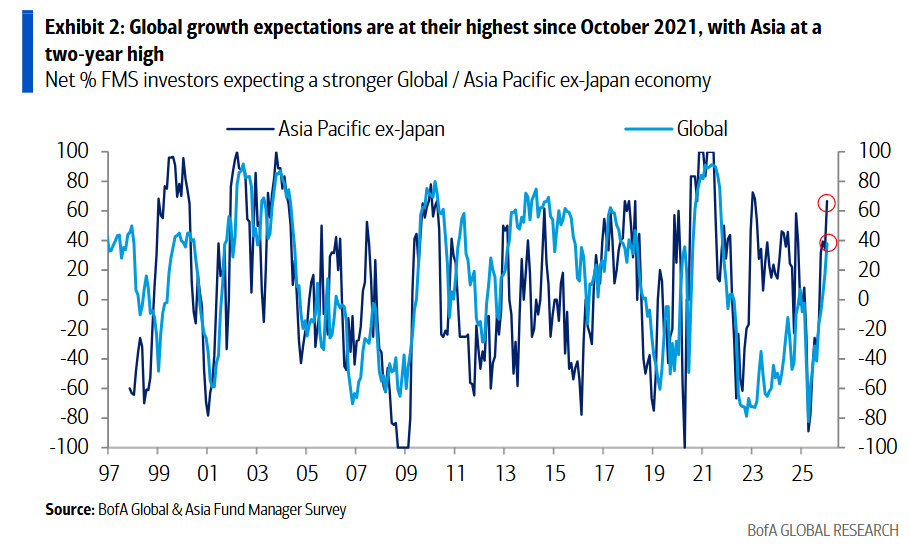
美银亚洲基金经理调查:印度失宠,中国叙事反转,半导体还是“全班最靓的仔”
Hua Er Jie Jian Wen· 2026-01-20 11:57
Group 1: Market Sentiment and Preferences - The latest Bank of America Asia Fund Manager Survey indicates a significant restructuring of market sentiment in the region, with Japan being the most favored market for 27 consecutive months, while India shifted from slight over-allocation to slight under-allocation [1] - The long-term structural narrative for the Chinese market has reversed, with investor optimism reaching the highest level since the survey's inception [1] - The return expectations for the Asia-Pacific region, excluding Japan, have surged to the historical 92nd percentile, marking a two-year high [1] Group 2: Sector Preferences - The semiconductor sector continues to dominate investor preferences, with 54% of respondents over-allocating to this sector, the highest among all industries [3][18] - In the Chinese market, AI and semiconductor themes have reached a record high in popularity, with 66% of respondents listing them as their favorite themes [3][12] - The expectation for a strengthening semiconductor cycle is at a near three-year high, with 58% of respondents anticipating growth in exports from Korea and Taiwan [21] Group 3: Japan's Economic Outlook - Japan maintains a leading position with a net over-allocation ratio of 54%, consistently ranking as the top choice for investors since October 2023 [4] - A majority of respondents (63%) expect Japan's economy to "slightly strengthen," with 21% anticipating a "significant strengthening" [9] - The return expectations for the Japanese market have reached the highest historical quintile, with 33% of respondents expecting returns exceeding 10% in the next 12 months [9] Group 4: China’s Market Dynamics - There is a notable sentiment shift in the Chinese market, with a net 13% of respondents expecting the economy to strengthen, a significant reversal from a net 29% expecting weakness last November [10][12] - The proportion of respondents believing that the Chinese stock market is undergoing a structural valuation adjustment has dropped to 38%, the lowest since the survey began [12] - 83% of respondents expect further easing of China's monetary policy, maintaining a high level of expectation [12] Group 5: Overall Market Valuation and Growth Expectations - A net 63% of respondents expect corporate earnings in the Asia-Pacific region, excluding Japan, to improve, placing this expectation at the historical 84th percentile [22] - Despite high return expectations, respondents generally view regional stock valuations as reasonable, with a net 17% believing that the Asia-Pacific market, excluding Japan, is undervalued [25] - The strengthening global growth outlook is a key driver of optimism, with the economic outlook for the Asia-Pacific region, excluding Japan, reaching a two-year high [25]