43度茅台

Search documents
茅台的-诺曼底时刻
2026-02-11 15:40
Summary of Moutai Conference Call Company Overview - The conference call discusses Moutai, a leading player in the high-end liquor market, particularly focusing on its strategies and market performance in 2026. Key Points Industry and Company Strategy - In 2026, Moutai adjusted its strategy by signing contracts only with distributors for its flagship product, Feitian Moutai, while non-standard products are shifted to online sales. Premium products will only be sold in direct stores to enhance brand control and consumer experience [1][3] - Moutai's sales surged before the Spring Festival, with prices rising to 1,500-1,600 RMB due to concentrated high-end liquor consumption, consumer speculation, and effective customer engagement through the Moutai app [1][5] - The company plans to increase the supply of 500ml Feitian Moutai by over 15%, potentially reaching 20-30%, supported by sufficient old liquor reserves and a growing consumer base [1][8] Market Performance and Sales Dynamics - Moutai's sales in Shanghai increased by approximately 10% compared to the previous year, with distributors completing payments and inventory levels being low [2] - The company is reducing smaller bottle sizes to focus on 500ml packaging, aiming to improve cost-effectiveness and attract a broader consumer base [1][9] - Moutai's market share in the high-end liquor segment is increasing, with other brands facing challenges in the 1,000 RMB and above price range, necessitating differentiation and innovation to compete [1][10] Pricing and Financial Aspects - The factory price of Moutai 1,935 has been reduced by over 100 RMB, enhancing its competitiveness in the market [1][11] - Moutai's financial attributes have diminished since 2022, with prices fluctuating around the company’s guidance price of 1,499 RMB. Investment in physical liquor is not recommended, but collectible cultural liquors may hold value [1][14] Future Outlook - Post-Spring Festival, attention should be paid to the market's purchasing heat and price fluctuations during the May off-season, as well as consumption trends during the Mid-Autumn Festival and National Day [1][12] - The future growth of the liquor industry, particularly for leading brands like Moutai, may be stable but not as explosive as in previous years, depending on factors like income growth and consumer demand for quality products [1][15] Additional Insights - Moutai's shift to online sales for non-standard products carries risks, particularly if consumer demand does not meet expectations, highlighting the need for ongoing market feedback [1][6] - The company is transitioning from a channel-focused approach to a consumer-centric model, adjusting pricing strategies to reflect real market demand [1][7] This summary encapsulates the key insights from the Moutai conference call, providing a comprehensive overview of the company's strategies, market dynamics, and future outlook.

大降价!茅台也扛不住了?
Sou Hu Cai Jing· 2026-01-14 19:50
Core Viewpoint - Moutai is actively stepping down from its "altar" by implementing price reductions and increasing product availability, signaling a shift in its market strategy amidst declining sales growth and changing consumer behavior [2][7][23]. Price Reduction - Moutai plans to lower the "payment price" for several key products, including: - Moutai 1935 from 798 yuan to 668 yuan (a decrease of 16.3%) - Moutai premium from 2969 yuan to 1859 yuan (a decrease of 37.4%) - Moutai 15-year from 5399 yuan to 3409 yuan (a decrease of 36.9%) - 43-degree Moutai from 798 yuan to 739 yuan (a decrease of 7.4%) [3][4][5]. Increased Availability - Starting January 1, 2026, Moutai's iMoutai app will offer a wider range of products, with initial purchase limits set at 12 bottles per person per day, later adjusted to 6 bottles [4][5]. Financial Performance - Moutai's Q3 2025 report showed a total revenue of 1309.04 billion yuan, a year-on-year increase of 6.32%, and a net profit of 646.26 billion yuan, also up 6.25%. However, Q3 revenue growth slowed to 0.56%, marking the lowest quarterly growth in nearly a decade [7][9][10]. Inventory and Contract Liabilities - As of Q3 2025, Moutai's inventory reached 558.59 billion yuan, up 15.83% year-on-year, while contract liabilities decreased by 21.97%, indicating potential concerns about future sales and inventory management [9][10]. Sales Strategy Shift - Moutai is reducing the influence of distributors by increasing direct sales through its platforms, aiming to minimize the profit margins of middlemen. The number of distributors has decreased from 2987 in 2018 to 2143 by the end of 2024 [11][13]. Market Position and Financial Attributes - Moutai has historically been viewed as a financial asset due to its high margins and brand value, but recent price reductions may diminish its perceived financial attributes, impacting consumer behavior and investment sentiment [19][23]. Conclusion - Despite the challenges, Moutai remains a leading player in the Chinese liquor industry, with strong financial metrics and brand equity. However, the shift in pricing strategy and market approach may alter its long-standing reputation as a premium investment product [24].


宏观经济下行与禁酒令双重压力下,白酒行业的挑战与破局路径丨华策酒业评论
Sou Hu Cai Jing· 2025-08-16 06:38
Industry Challenges - The Chinese liquor industry is facing four major shocks: economic cycles, consumption stratification, generational shifts, and policy adjustments, which are more complex than during the "Eight Regulations" period in 2012 [3] - In Q1 2025, national liquor production is expected to decline by 7.2% year-on-year, with 59.7% of companies experiencing profit margin declines and 50.9% reporting reduced revenue [3] Economic Cycle and Consumption Stratification - The high-end price segment of 800-1500 RMB is experiencing price inversion, with products like Moutai 1935 being forced to lower prices to around 700 RMB to boost sales, reflecting a contraction in business banquet demand [3] - The market is witnessing a significant trend of consumption downgrade, with light bottle liquor under 100 RMB growing at a compound annual growth rate of 14%, projected to exceed 150 billion RMB by 2024 [3] Generational Shift in Consumer Behavior - The rise of younger consumers is reshaping market dynamics, with a 22% decline in liquor consumption frequency among the 25-35 age group, favoring lower alcohol content beverages [4] - Traditional drinking culture is declining, with wedding wine consumption dropping from one box per table to two bottles, indicating a shift from "face consumption" to "quality consumption" [4] Competitive Landscape - The concentration of the liquor industry is increasing, with CR6 companies accounting for 87.6% of A-share liquor revenue, highlighting a significant Matthew effect [5] - Emerging categories like low-alcohol and craft beer are growing at over 10% annually, diverting demand from traditional liquor [5] Policy Adjustments - The "ban on alcohol" policy introduced in May 2025 has significantly reduced the share of government consumption from 40% in 2011 to 5% in 2023, impacting major brands like Moutai [6] - The confidence of the capital market in liquor stocks has been shaken, with the liquor index experiencing a cumulative decline of 4.35% from May 19 to June 16 [6] Strategic Transformation - The liquor industry must innovate through product development, scene reconstruction, channel optimization, and global expansion to find new growth in a saturated market [8] Product Innovation - The trend towards lower alcohol content is irreversible, with major brands launching products with lower alcohol levels to attract younger consumers [9] - Luzhou Laojiao has increased its low-alcohol product share from 15% to 50%, indicating a strategic shift towards mid-low alcohol products [9] Scene Reconstruction - Leading companies are enhancing their offerings for various consumption scenarios, such as personal drinking and cultural tourism, to adapt to changing consumer preferences [10] - Moutai 1935 has seen significant sales growth by emphasizing its cultural significance and upgrading product quality [10] Channel Optimization - Companies are balancing online and offline sales channels, with e-commerce platforms like JD and Douyin playing a crucial role in inventory management [11] - Moutai is deepening its direct sales model and collaborating with distributors to stabilize partnerships [11] Global Expansion - In 2024, China's liquor exports are projected to reach 970 million USD, growing by 20.4%, indicating a consensus on the need for internationalization [12] - Major brands are participating in global events to enhance their international presence, adapting products to local consumption habits [12] Manufacturer Relationship Reconstruction - Leading companies are reassessing their relationships with distributors, focusing on shared goals and risk-sharing to alleviate channel pressures [14] - This collaborative approach aims to create a win-win situation, enhancing resilience against market fluctuations [14] Future Outlook - The long-term competitiveness of the liquor industry will depend on three core capabilities: brand rejuvenation, supply chain resilience, and policy responsiveness [15] - Companies must adapt to the preferences of younger consumers and enhance their marketing strategies through social media [16] - Strengthening supply chain efficiency and establishing policy response mechanisms will be crucial for navigating future challenges [17][18]

价格倒挂库存高企 白酒行业如何“反内卷”?
Feng Huang Wang· 2025-08-08 13:24
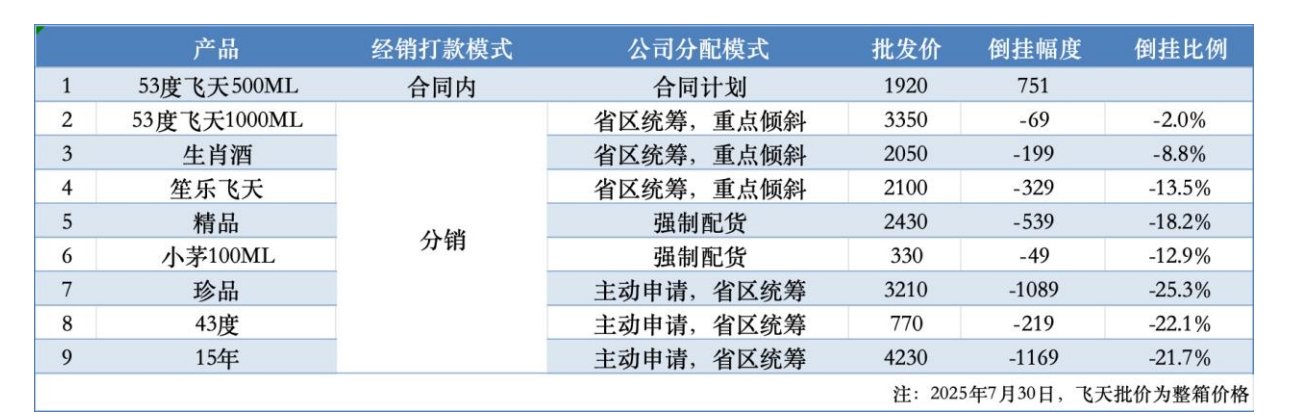
Core Viewpoint - The Chinese liquor industry is facing severe challenges due to weak consumer demand and intensified competition, leading to price declines and increased inventory levels across the sector [1][3][6]. Group 1: Industry Challenges - The liquor industry is experiencing a significant downturn, with over 60% of liquor companies and distributors reporting reduced operating profits in the first half of the year [1][6]. - Channel inventory has reached historical highs, with an average inventory turnover period of 900 days, a 10% increase from the previous year, and a 25% year-on-year rise in inventory levels [3][6]. - Price inversion is becoming more widespread, with over 50% of distributors and retailers reporting increased levels of price inversion, and 40% facing cash flow pressures [3][4]. Group 2: Company-Specific Issues - Even leading companies like Kweichow Moutai are under market pressure, with significant price inversions observed in their non-standard products, exceeding 20% for several items [4][5]. - The core product, 53-degree, 500ml Moutai, saw its price drop from approximately 2180 yuan to 1720 yuan during Q2, with current prices remaining below 1900 yuan [5][6]. Group 3: Competitive Landscape - The industry is witnessing a trend of "involution" where companies are engaging in price wars to survive, which is seen as a short-term solution that does not address the underlying issues of supply and demand imbalance [2][7]. - Major liquor companies are calling for a halt to "involution-style" competition and price wars, advocating for strategies such as reducing supply, enhancing quality, and focusing on niche markets [2][8][9].