
AI智能助理

Search documents
新程启势 聚力争先 上海证券各条线业务节节高,喜迎马年“开门红”
2 1 Shi Ji Jing Ji Bao Dao· 2026-02-27 12:58
Core Insights - Shanghai Securities has achieved a strong start in 2026, aligning with its strategic vision of becoming a "wealth management-oriented brokerage" under the guidance of SBP26, laying a solid foundation for high-quality development throughout the year [1] Group 1: Wealth Management and Client Acquisition - The wealth management division has upgraded its marketing service system, launching a campaign themed "New Journey, Winning Start," resulting in the addition of 32,800 new clients in January, a year-on-year increase of 102% [2] - Online account openings accounted for 9,300 new clients, significantly enhancing the company's online customer acquisition capabilities, which became a key driver for client growth [2] - The net inflow of client assets from new customers in January reached 1.128 billion yuan, with the Shanghai branch ranking first [2] Group 2: Financial Products and Services - The margin trading business opened 217 new accounts in January, with a margin balance increase of 467 million yuan, bringing the total margin balance to 13.616 billion yuan by the end of January [2] - The investment banking division successfully completed the issuance of the "26 Dingcheng 01" bond within three days after obtaining approval, with an issuance scale of 2.1 billion yuan and a record low coupon rate of 2.59% for the same term in the region [2] - The asset management division launched the "Shanghai Securities - Nantong Jinkong Factoring Asset-Backed Special Plan," successfully issuing 800 million yuan, achieving the lowest weighted average interest rate for AA+ rated factoring ABS in Jiangsu Province in the past three years [2] Group 3: Digital Transformation and Technological Innovation - The company has successfully launched the "Shangzhen Zhirong" digital platform and introduced a customer service module on the "Dingtong" app, enhancing digital service capabilities [2] - The financial technology headquarters received six significant technology awards from the Shanghai Stock Exchange and the Shanghai Securities Industry Association, showcasing the company's achievements in technological innovation and practical implementation [3] - The wealth management headquarters won the "Best All-Domain Traffic Operation Pioneer Award" from Sina Finance, highlighting the company's influence in new media branding [3] Group 4: Future Outlook and Strategic Goals - Shanghai Securities is poised for a promising year ahead, with confidence in its ability to achieve high-quality development and fulfill its role as a "gatekeeper" of the capital market, a "service provider" for direct financing, and a "manager" of social wealth [3]
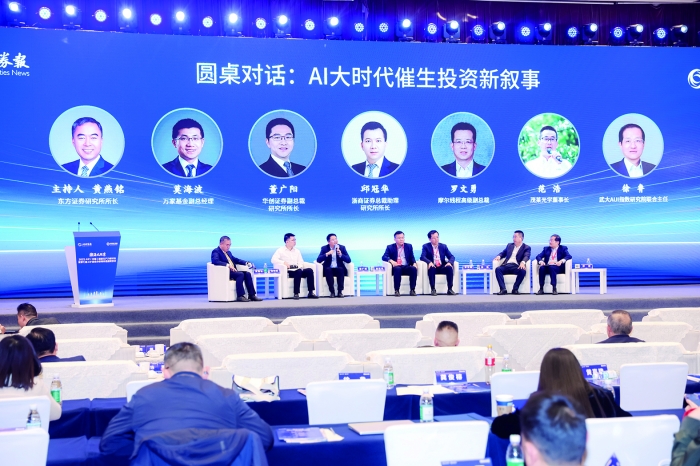
AI大时代催生投资新叙事 多方共话变革机遇与布局路径
Shang Hai Zheng Quan Bao· 2025-12-28 19:10
Core Insights - The roundtable discussion focused on how the AI era is creating new investment narratives and opportunities across various sectors [5] - AI is rapidly transforming industries, enhancing productivity, and changing organizational models, with significant implications for financial services [6] - The investment methodology in the consumer sector is being re-evaluated due to the rise of AI, leading to the emergence of "super consumers" and "super entrepreneurs" [7] Group 1: AI's Impact on Industries - AI is reshaping the development landscape across all industries, with its rapid evolution exceeding expectations [6] - In financial services, AI's impact is categorized into four areas: personalized services, proactive risk management, automated operations, and integrated ecosystems [6] - The distinction between financial technology and AI is highlighted, with AI making finance "smarter" rather than just more convenient [6] Group 2: Consumer Sector Transformation - The consumer investment approach is being transformed by AI, leading to a new era where consumer preferences drive product design [7] - AI applications are increasingly integrated into daily life, enhancing consumer power and enabling lightweight entrepreneurial models [7] - The macro perspective indicates that the AI technology revolution carries value, bubble, and cyclical attributes, with a predicted bubble turning point around 2028 [7] Group 3: Technological Foundations - The growth of the AI industry relies on foundational hard technologies, with domestic companies focusing on semiconductors and precision optics to build a self-sufficient ecosystem [8] - The development of AI chips is aligned with the trend of "full functionality and full ecology," addressing complex application demands [8] - Companies like 茂莱光学 are deeply involved in the optical sector, with over 50% of their business linked to AI, presenting long-term growth opportunities [8] Group 4: Future Investment Opportunities - Experts agree that the AI narrative is far from over, with multiple layers of investment opportunities emerging in computing power, applications, and traditional industry transformations [10] - The A-share market is expected to experience a stable upward trend, with investment opportunities shifting towards mid-cap blue-chip stocks in sectors like cyclical consumption and biomedicine [10] - AI is anticipated to remain a key investment focus in 2026, transitioning from upstream computing power to application algorithms, with a window for explosive applications [10] Group 5: Consumer Demand Evolution - Consumer demands will evolve alongside AI technology, with companies like 泡泡玛特 expected to emerge in various niches [11] - Long-term competitive companies still hold investment value, with a focus on "steady progress" in investment strategies for 2026 [11] - The allocation of financial assets is seen as a means to achieve stability, while technology assets are expected to perform more prominently [11]

AI在房地产领域如何落地?业内专家热议
Di Yi Cai Jing· 2025-12-19 05:41
Core Insights - The real estate industry is rapidly adopting AI technology, moving from general models to vertical applications, with significant potential for transformation in various operational areas [1][2][3] Group 1: AI Adoption in Real Estate - Major real estate companies are integrating AI into investment, land acquisition, customer research, product design, construction, marketing, and services, indicating a pre-explosion phase for AI applications in the sector [1] - AI-driven marketing strategies have shown significant results, with one top company reporting approximately 1,700 units sold through targeted AI marketing efforts this year [1] - The shift from theoretical discussions about AI capabilities to practical applications is occurring faster than expected, with AI tools being tested in specific real estate scenarios [2] Group 2: Impact on Business Models and Operations - The integration of AI is expected to transform the roles, organizational structures, and operational models of real estate companies, shifting them from developers to professional operators [3][4] - AI is facilitating data-driven decision-making in real estate, replacing intuition-based site selection and pricing with algorithm-driven dynamic pricing [4] - The standards for what constitutes a "good house" are likely to change, with smart homes becoming essential rather than just marketing gimmicks [4] Group 3: Challenges in AI Implementation - Data quality is identified as the biggest obstacle to AI implementation in the real estate sector, affecting the entire market rather than individual companies [6] - The low level of digitalization in the real estate industry presents challenges for AI integration, necessitating a foundational shift in digital infrastructure [6] - The year 2026 is anticipated to be a breakthrough year for vertical AI applications in China, with a focus on enhancing data accessibility and understanding within the real estate sector [6][7]
开启数字邮储 i∞纪元|邮储银行以“天地人和”点亮新坐标,以“三维拓扑”绘制新生态
Jing Ji Guan Cha Wang· 2025-12-11 14:13
Core Insights - The China Postal Savings Bank (PSBC) held the 2025 Digital Finance Conference, showcasing its advancements in digital finance and the launch of its mobile banking version 11.0, emphasizing its commitment to technology-driven financial services [1] - The bank's president, Liu Jianjun, highlighted the transformative impact of technology on the banking sector, focusing on AI's role in reshaping traditional financial models and enhancing service delivery [2] Digital Strategy - PSBC has adopted a "Digital Postal Savings" strategy, implementing an "AI+" initiative to optimize financial supply, reduce financing costs, and improve service experiences, maintaining a focus on serving the real economy [2] - The bank has hosted the Digital Finance Conference for three consecutive years, evolving its strategy from initial exploration to practical implementation and now to a new era of digital finance [2] AI Capabilities - PSBC is enhancing its AI capabilities by focusing on data, computing power, and algorithms, establishing a robust AI infrastructure that supports business innovation [3] - The bank has received the People's Bank of China Financial Technology Development Award for three consecutive years, indicating its leadership in financial technology [3] AI2ALL Ecosystem - The "AI2ALL" digital ecosystem aims to integrate AI capabilities across various service dimensions, enhancing internal efficiency and external outreach [4] - PSBC has identified nearly 260 application scenarios for its AI capabilities within the "AI2ALL" framework [4] Operational Efficiency - The bank is utilizing intelligent tools across all operational processes, from front to back office, to enhance organizational efficiency and management precision [5] - In the front office, PSBC is leveraging intelligent marketing tools to provide personalized services, moving away from traditional broad marketing approaches [6] Risk Management - In the middle office, PSBC is using intelligent models to improve risk control and business efficiency, creating a new paradigm that balances business growth with risk management [6] Customer Service Enhancement - PSBC is integrating AI into its service delivery across offline, remote, and online channels, aiming to provide seamless and intelligent customer experiences [7] - The bank has introduced cloud-based services and intelligent outbound calling to enhance customer interaction and responsiveness [7][8] Mobile Banking Innovation - The latest version of PSBC's mobile banking app incorporates AI to redefine financial services, offering personalized features and enhanced security measures [8] - The app has received high ratings in user experience, ranking second in overall evaluation among major banks, with top scores in user experience for three consecutive years [8]

博思软件(300525):业绩短期承压,AI+政务政策有望带动行业回暖
Minsheng Securities· 2025-11-02 14:33
Investment Rating - The report maintains a "Recommended" rating for the company, considering its leading position in the fiscal IT sector and potential benefits from the upcoming digital government construction wave [3]. Core Insights - The company experienced a revenue decline of 7.67% year-on-year, with total revenue reaching 1.148 billion yuan in the first three quarters of 2025. The net profit attributable to shareholders dropped by 78.81% to 0.07 billion yuan [1]. - In Q3 2025, the company reported a revenue of 0.442 billion yuan, down 15.97% year-on-year, and a net profit of 0.049 billion yuan, down 32.45% year-on-year, primarily due to tightened budgets from downstream clients [1][2]. - The overall gross margin improved to 65.9%, an increase of 2.1 percentage points year-on-year, attributed to the company's strategy of enhancing the proportion of sustainable revenue [2]. - The company has embraced AI comprehensively, launching multiple AI+ products across various sectors, including public expenditure services and smart healthcare solutions [2][3]. - Recent government policies have provided strong support for AI+ applications in the public sector, which is expected to drive growth in the industry [3]. Financial Forecasts - The company is projected to achieve net profits of 0.323 billion yuan, 0.380 billion yuan, and 0.433 billion yuan for the years 2025, 2026, and 2027, respectively. The corresponding PE ratios are estimated to be 32, 27, and 24 times [3][4]. - Revenue forecasts for the upcoming years are as follows: 2.229 billion yuan in 2025, 2.581 billion yuan in 2026, and 2.905 billion yuan in 2027, with growth rates of 4.0%, 15.8%, and 12.5% respectively [4][9].
