
AI面试系统

Search documents
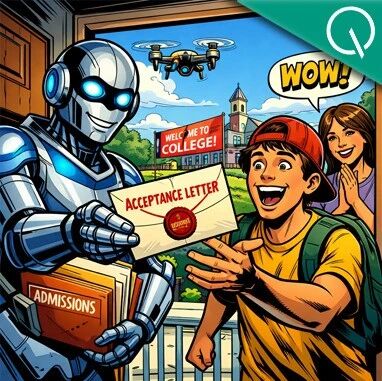
大学开始用AI招生了
3 6 Ke· 2026-01-22 09:09
Core Insights - The use of AI in college admissions has become a reality, with Virginia Tech utilizing AI to review student applications, saving 8,000 hours of manual labor and allowing for earlier admission decisions by one month [1][13]. Group 1: AI in Admissions - AI selection processes are increasingly penetrating various sectors, including higher education, which was previously thought to be immune to such technologies [4]. - Virginia Tech received over 57,000 applications for the 2025 fall semester, significantly exceeding their initial plan to admit approximately 7,085 new students [8]. - The admissions process involves reviewing over 200,000 essays, with each essay typically evaluated by two human reviewers, leading to a substantial workload [9][10]. Group 2: Efficiency vs. Fairness - The "AI + human collaboration" model has emerged, where each applicant's essay is scored by both AI and a human, with a third reviewer involved if there are discrepancies [13]. - Despite the efficiency gains, concerns about fairness have been raised, particularly regarding the potential biases in AI models trained on historical data, which may favor certain backgrounds or writing styles [15]. - The reliance on AI could undermine the diversity and uniqueness that universities strive to promote, as applicants may tailor their submissions to align with AI preferences [15][17]. Group 3: Implications for Students - Students may increasingly turn to AI for assistance in crafting their application materials, raising ethical questions about originality and authenticity [19]. - Some institutions, like Brown University, have implemented restrictions on AI usage, allowing only for grammar and spelling checks, but the potential for "AI vs. AI" scenarios in admissions is evident [19].


大学开始用AI招生了
量子位· 2026-01-22 07:37
Core Viewpoint - The article discusses the increasing use of AI in college admissions, highlighting Virginia Tech's implementation of AI to review student applications, which has significantly reduced manual labor and expedited the admissions process [1][2][10]. Group 1: AI in College Admissions - Virginia Tech has adopted AI to evaluate student admission materials, saving approximately 8,000 hours of manual work and allowing for admission results to be released a month earlier than usual [2][16][17]. - The rise in AI usage for admissions is partly due to the surge in applications following the optional status of SAT/ACT exams, leading to overwhelming workloads for admissions departments [8][9][10]. Group 2: Concerns and Criticisms - Despite the efficiency gains, there are concerns regarding fairness and the potential biases of AI models, which are trained on historical data and may favor certain backgrounds or writing styles [19][20][21]. - Critics argue that reliance on AI could undermine the diversity and uniqueness that universities strive for, as applicants may tailor their submissions to meet AI preferences rather than showcasing their true abilities [23][26]. Group 3: AI's Broader Implications - The article draws parallels between AI in job recruitment and college admissions, suggesting that students may increasingly use AI to craft their application materials, leading to a cycle of "AI versus AI" in the admissions process [27][29][31].
硅谷悖论:AI裁员浪潮下的狂欢与阵痛
Sou Hu Cai Jing· 2025-12-31 18:15
Group 1: Core Insights - The tech industry is experiencing a significant wave of layoffs, with major companies like Amazon and Salesforce announcing substantial job cuts while simultaneously seeing stock price increases, indicating a shift in market perception towards efficiency driven by AI [3][5][6] - The layoffs are characterized as a structural change linked to the rise of AI, with companies reducing workforce numbers to enhance operational efficiency and profitability [4][9] - The wealth concentration among tech billionaires is accelerating, with notable figures like Elon Musk seeing their net worth soar, highlighting the financial benefits of AI advancements for a select few [7][14] Group 2: Layoff Trends - In 2025 alone, global tech companies have cut nearly 100,000 jobs, with the largest monthly layoffs reaching 24,500 positions [3][5] - Amazon has laid off over 27,000 employees since 2022, while Microsoft and Intel have also made significant cuts, reflecting a widespread trend across the tech sector [5][6] - Meta's approach to layoffs, which reportedly involves determining cuts based on code contribution, illustrates a new, harsher evaluation of employee value in the AI era [5][9] Group 3: Market Reactions - The market is reacting positively to layoffs, with companies like Amazon seeing stock prices rise by over 12% following announcements of job cuts, indicating a new capital logic that values efficiency over workforce size [6][11] - The perception of layoffs has shifted from a sign of distress to a strategy for enhancing AI capabilities, with executives presenting these decisions confidently rather than defensively [6][12] Group 4: Value Redefinition - The rise of AI is fundamentally altering how talent is valued, with a stark divide emerging between ordinary and top-tier engineers, where the latter can leverage AI to create exponentially greater value [9][10] - Companies are increasingly prioritizing AI expertise over traditional roles, leading to a significant restructuring of job categories and the elimination of many lower-skilled positions [10][11] Group 5: Economic Implications - AI is reshaping corporate cost structures, with companies like Amazon reporting strong profit growth despite ongoing layoffs, suggesting that AI is becoming a core driver of efficiency and profitability [11][12] - The long-term impact of AI on the labor market is complex, with potential job displacement for lower-skilled workers and a hollowing out of mid-level positions, while also creating new opportunities in AI-related fields [13][14]



AI招聘工具渗透率飙升至77%,顶尖人才争夺升级——2025春招白皮书新趋势
Jin Tou Wang· 2025-06-30 08:34
Group 1 - The core viewpoint of the articles highlights the intensifying competition for top talent in the job market, particularly among graduates from prestigious universities, with a significant influx of 12.22 million graduates in 2025 [1] - The demand for high-quality talent is shifting, especially in technical positions, with master's degree holders in algorithm engineering commanding an average monthly salary of 27K, indicating a growing salary disparity based on educational background [2] - AI recruitment tools have seen a penetration rate of 77%, with over half of companies using AI for initial resume screening, showcasing a trend towards efficiency in the hiring process [1][4] Group 2 - Companies are increasingly focusing on balancing efficiency with the human aspect of recruitment, as 63.7% of firms recognize the limitations of AI in assessing soft skills and values [1] - Students are adapting their strategies to enhance employability, with 37.4% of the 2026 graduates shifting from traditional internships to participating in competitions and engaging in mentor-led projects [3] - The future of campus recruitment is expected to be a complex interplay of data, technology, and human connection, necessitating companies to build a collaborative ecosystem that integrates talent, business, and technology [4]