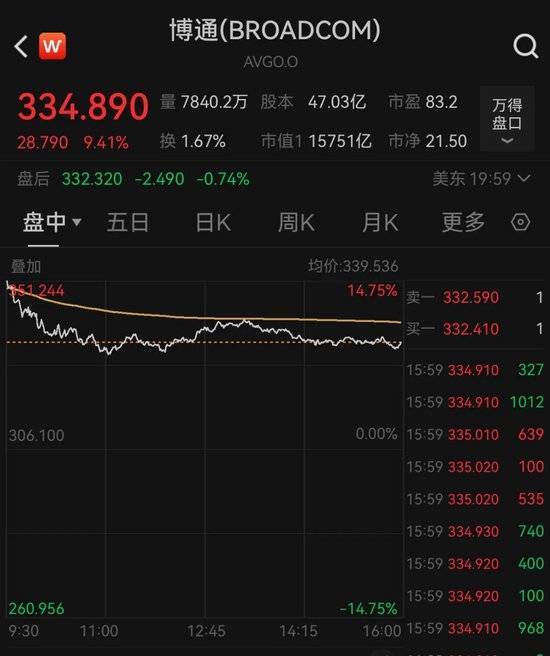
ASIC专用芯片

Search documents
广东发力GPU、FPGA、NPU 攻坚高端AI芯片
是说芯语· 2026-03-12 09:59
Core Viewpoint - The article discusses the comprehensive action plan released by Guangdong Province for the development of high-end artificial intelligence chips, aiming to address the "bottleneck" issues in the semiconductor industry and establish a clear roadmap for high-quality development in this sector [1]. Group 1: Key Focus Areas - The plan emphasizes the development of high-end general-purpose AI chips such as GPU, FPGA, and NPU, which are critical for AI computing power and currently represent a key shortcoming in the industry [3]. - It also highlights the importance of ASIC specialized chips to meet customized computing needs in specific scenarios, aiming for comprehensive coverage of high-end AI chip categories [3]. - The strategy includes a focus on architectural innovation, particularly leveraging the RISC-V open-source architecture as a key breakthrough in chip technology [3]. Group 2: Collaborative Ecosystem - The plan advocates for a collaborative development approach across the entire chip value chain, including research, design, manufacturing, testing, and application [4]. - It aims to enhance the chip development and application ecosystem, facilitating the rapid transformation of technological achievements into practical applications [4]. - The goal is to achieve large-scale application of high-end AI chips in key areas such as artificial intelligence and smart manufacturing, creating a virtuous cycle of "research-manufacturing-application" [4].


年度旗舰报告《Big+Ideas+2026》重磅发布深度解读(附下载)
Sou Hu Cai Jing· 2026-01-26 12:42
Group 1: Core Insights - The report "Big Ideas 2026" by ARK Invest identifies thirteen disruptive technology trends that will reshape the global economy over the next five years, emphasizing the deep integration of five major innovation platforms leading to a "Great Acceleration" era [1][24]. Group 2: Technological Convergence Driving Growth - Five major platforms—Artificial Intelligence, Public Blockchains, Robotics, Energy Storage, and Multiomics—are interdependent, creating network effects that enhance their growth. The "Convergence Network Strength" metric is projected to grow by 35% in 2025, indicating significant interaction among these technologies [2][32]. - The macroeconomic impact of this technological fusion is substantial, with autonomous vehicle fleets, next-gen data centers, and AI agents expected to contribute 1.9 percentage points to the annual growth of the U.S. GDP [2][48]. Group 3: AI Infrastructure Investment Surge - Global investment in data center systems is expected to reach $500 billion by 2025, 2.5 times the average from 2012 to 2023, and is projected to grow to $1.4 trillion by 2030 [2]. - Capital expenditures by large enterprises are anticipated to exceed $500 billion in 2026, three times the level before the ChatGPT boom in 2021 [2]. Group 4: AI as a Consumer Operating System - AI is evolving from a tool to a consumer operating system, with natural language-driven interactions becoming the norm. ChatGPT achieved a 25% penetration rate among smartphone users in just two years, compared to seven years for the internet [4]. - By 2030, AI shopping agents are expected to facilitate $8 trillion in online consumption, generating $900 billion in business revenue [4]. Group 5: Bitcoin's Institutional Transformation - 2025 is projected to be a pivotal year for Bitcoin, transitioning from a speculative asset to a reserve asset, driven by regulatory approvals and institutional adoption [6]. - ARK's valuation model suggests Bitcoin's market cap could reach $16 trillion by 2030, translating to a price of approximately $800,000 per coin [6]. Group 6: Tokenization of Physical Assets - The market for tokenized assets is expected to grow significantly, with stablecoin transaction volumes projected to reach $3.5 trillion monthly by 2025, surpassing traditional payment methods [8]. - By the 2030s, tokenized assets could exceed $11 trillion, representing 1.38% of global financial assets [8]. Group 7: Multiomics and AI in Biology - Multiomics, which integrates various biological data types, is set to revolutionize biology through AI, with costs for whole genome sequencing expected to drop from $1,000 in 2025 to $10 by 2030 [9]. - The FDA's approval rate for AI diagnostic devices is projected to rise from single digits to 30% by 2030, ultimately reaching 100% [9]. Group 8: Reusable Rockets and Space Economy - SpaceX has significantly reduced launch costs, with projections indicating further reductions as reusable rockets become more prevalent [10]. - The satellite communication market is expected to capture 1.2% of global communication spending, with a substantial opportunity for services in remote areas [10]. Group 9: Robotics Evolution - The shift from specialized to general-purpose robots is underway, with significant market opportunities in manufacturing and home services projected to reach $26 trillion [12]. - The "robot as a service" model is expected to lower adoption barriers, allowing users to pay for tasks rather than hardware [12]. Group 10: Distributed Energy and AI - The demand for energy is expected to surge, necessitating a $10 trillion investment in global power infrastructure by 2030 [14]. - The deployment of energy storage solutions must increase by 19 times to meet the needs of AI data centers [14]. Group 11: Autonomous Logistics Transformation - The logistics sector is being reshaped by autonomous delivery systems, with costs for long-distance trucking expected to drop by 60% [15]. - By 2030, revenues from autonomous logistics are projected to reach $480 billion, fundamentally altering e-commerce fulfillment [15]. Group 12: Investment Philosophy - ARK's investment philosophy focuses on identifying critical points of technological convergence that can yield nonlinear returns, emphasizing the importance of companies that effectively integrate these technologies into sustainable business models [17].

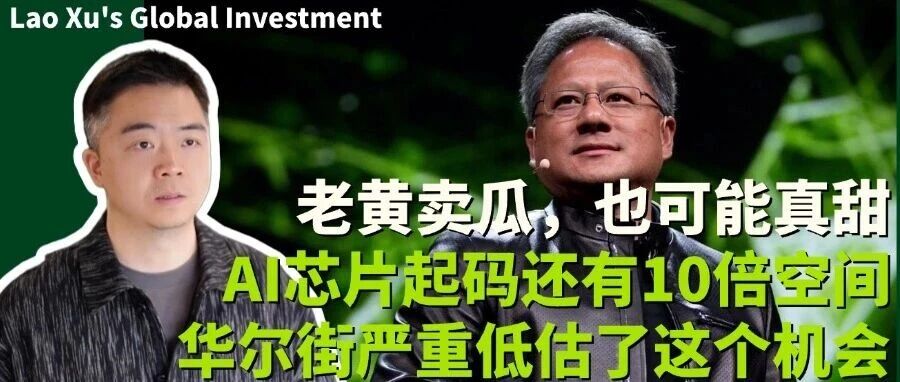
黄仁勋最新访谈:AI芯片还有10倍空间,华尔街严重低估了这个时代
老徐抓AI趋势· 2025-10-17 01:04
Group 1 - The core viewpoint of the article emphasizes the transformative potential of AI and the strategic investment by Nvidia in OpenAI, betting on AI becoming a new utility akin to electricity [3][5][13] - Nvidia plans to invest $100 billion in OpenAI to build a 10GW computing power cluster, which could generate $400 billion in revenue for Nvidia if powered by its chips [5][13] - The article argues that AI chip market has not reached its peak, with a significant shift from CPU to GPU for applications like search and recommendation systems, indicating a major industry upgrade [14][16] Group 2 - Nvidia's CEO highlights that the global GDP is approximately $100 trillion, and investing $10 trillion in AI could significantly enhance productivity, with a substantial portion directed towards AI infrastructure [16][19] - The article discusses the misconception among Wall Street analysts regarding Nvidia's growth potential, suggesting that they fail to recognize the exponential growth pattern of AI technology [20][21] - The competition from ASIC chips is acknowledged, but Nvidia's focus on efficiency over price is emphasized, as energy consumption is the real cost driver in computing power [24][25] Group 3 - The article addresses concerns about AI leading to job losses, arguing instead that AI will create new job opportunities and enhance human capabilities rather than replace them [28][29] - It stresses the importance of understanding the transformative power of AI and the need for investors to remain open-minded and informed about the evolving landscape [29][30] - The article concludes that the current era represents a pivotal moment for investment in AI and hard technology, with the potential for significant returns [30]

博通AI业务狂飙:百亿美元芯片大单到手,ASIC市场前景可期
Sou Hu Cai Jing· 2025-09-07 00:14
Group 1 - Broadcom's latest financial report shows Q3 FY2025 revenue reached $15.952 billion, a 22% year-over-year increase, exceeding the previous guidance of $15.8 billion [1] - Adjusted net profit for the same quarter was $10.702 billion, reflecting a year-over-year growth of 30.15% [1] - AI-related business revenue for the quarter was $5.2 billion, up 63% year-over-year, surpassing the expected $5.1 billion [1] Group 2 - Broadcom's core competitiveness lies in custom ASIC chips for cloud service providers, which are designed for specific AI inference scenarios, gaining favor from tech giants like Google and Meta [3] - The CEO of Broadcom indicated that the record revenue in Q3 was driven by strong growth in custom AI accelerators, networking equipment, and VMware business [3] - Broadcom has received a $10 billion order for XPU chips, with market speculation suggesting the client may be OpenAI [3] Group 3 - The ASIC chip market is thriving, with Marvell reporting Q2 FY2026 revenue of $2.006 billion, a 58% year-over-year increase, driven by data center business revenue of $1.491 billion, which grew 69% [3] - Industry analysis indicates that while NVIDIA dominates the GPU market during the AI training phase, ASIC chips are more competitive in the inference phase due to their energy efficiency [4] - Major North American cloud providers are developing their own ASICs, with predictions that the inference market will surpass the training market as AI applications expand [4] Group 4 - NVIDIA has initiated strategies to respond to the rise of the ASIC market, including the launch of the NVLink Fusion platform to integrate custom ASICs with NVIDIA GPU racks [4] - In the domestic market, companies like Haiguang Information and Moore Threads are competing in the GPU space, while Huawei HiSilicon, Cambricon, Baidu Kunlun, and Alibaba Pingtouge are active in the ASIC sector [4] - The compound annual growth rate for high-end cloud AI accelerators from 2023 to 2028 is projected at 50% for GPUs and 52% for ASICs, with ASIC shipments expected to surpass GPUs by 2028 [4]