CCER(核证自愿减排量)

Search documents
能源强国、新NDC……速览2025年碳中和十大关键词
2 1 Shi Ji Jing Ji Bao Dao· 2026-01-28 09:49
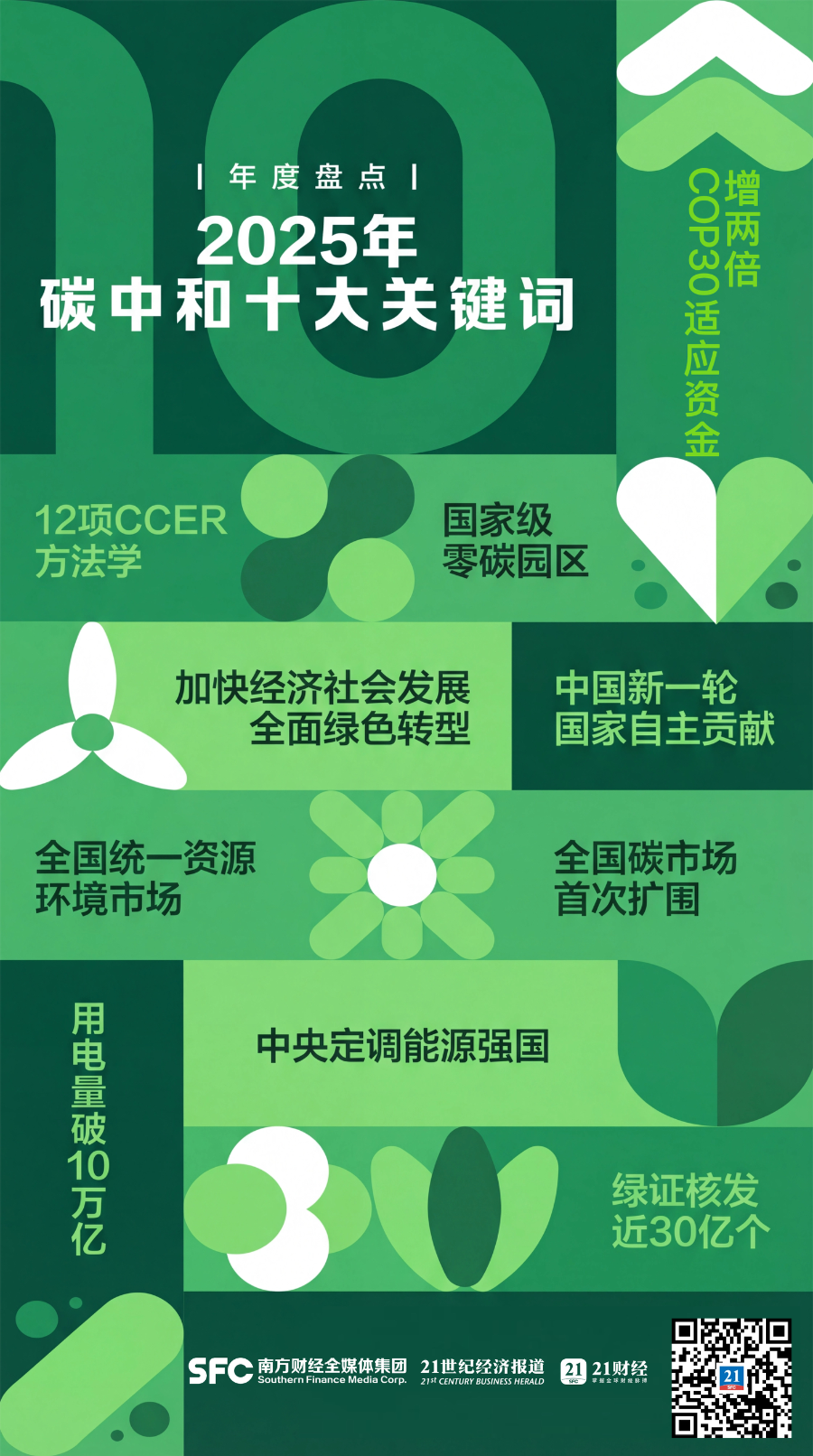
Group 1 - The core viewpoint of the articles emphasizes China's commitment to accelerating a comprehensive green transformation in its economy and society, with a focus on achieving carbon neutrality by 2035 [1][4][5] - The 20th Central Committee of the Communist Party of China has set "accelerating comprehensive green transformation" as a core task for the 14th Five-Year Plan, highlighting the importance of ecological security and green development [4][5] - Key mechanisms for carbon neutrality have made significant progress, including the expansion of the national carbon market to cover steel, cement, and aluminum industries, and the establishment of national zero-carbon parks [1][6][11][13] Group 2 - China's new round of Nationally Determined Contributions (NDC) aims for a 7%-10% reduction in greenhouse gas emissions by 2035, with non-fossil energy consumption reaching over 30% of total energy consumption [6][10] - The national unified resource and environmental market is being developed to enhance market efficiency and promote the marketization of resource and environmental factors [7][8] - The total electricity consumption in China surpassed 10 trillion kilowatt-hours in 2025, marking a significant milestone and reflecting the resilience and vitality of the economy [9][10] Group 3 - The energy power strategy emphasizes energy security, green transformation, and technological self-reliance, with a focus on seven key tasks for energy work in 2026 [10][11] - The first batch of national zero-carbon parks has been established, with 52 parks across various regions, focusing on low-energy, low-pollution, and high-value-added industries [11][12] - The national carbon market has expanded to include three major high-energy-consuming industries, significantly increasing the coverage of carbon emissions [13][15] Group 4 - The issuance of green certificates reached nearly 3 billion in 2025, with international recognition from the RE100 initiative, enhancing the credibility and market demand for Chinese green certificates [16][17] - Twelve new CCER methodologies were implemented in 2025, focusing on key areas for voluntary emission reductions, which is expected to activate the voluntary carbon market [18][19] - The COP30 conference resulted in a commitment from wealthy nations to double funding for climate change adaptation by 2035, although the omission of fossil fuel references in the final text raised concerns [20][21]

CCER累计成交额6.5亿元,林业碳汇、新能源受青睐
2 1 Shi Ji Jing Ji Bao Dao· 2026-01-09 13:25
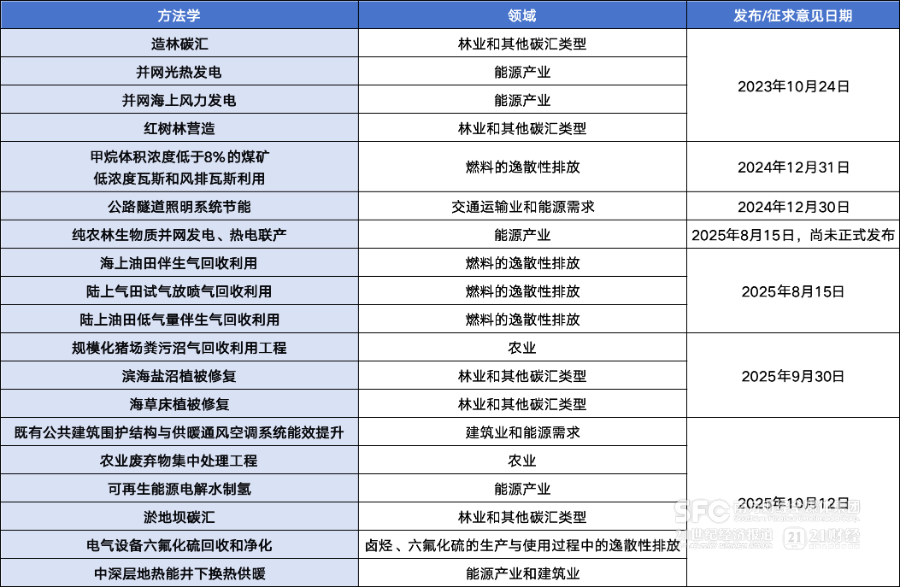
Core Viewpoint - The CCER methodology is undergoing significant expansion, with a total of 18 methodologies expected by the beginning of 2026, aimed at addressing key gaps in China's Nationally Determined Contributions (NDC) for greenhouse gas emissions reduction [1][4]. Group 1: Methodology Expansion - The Ministry of Ecology and Environment has introduced 12 new CCER methodologies in 2025, focusing on renewable energy utilization, energy efficiency improvements, agricultural waste resource utilization, ecosystem carbon sinks, and non-CO2 greenhouse gas reductions [1][4]. - The highest number of methodologies pertains to forestry carbon sinks (5), followed by the energy sector (4) and fugitive emissions [1]. Group 2: Market Development - Since its launch in January 2024, the voluntary greenhouse gas reduction trading market has seen over 5,700 accounts opened by various stakeholders, with a cumulative transaction volume of 921.94 million tons and a transaction value of 650 million yuan, averaging about 70 yuan per ton [3][7]. - The market is expected to facilitate the registration of projects that will achieve approximately 125 million tons of voluntary greenhouse gas reductions [3][7]. Group 3: New Fields and Incentives - The new methodologies incorporate six new fields into the voluntary reduction trading market, including oil and gas field recovery, ecosystem carbon sinks, agricultural waste resource utilization, renewable energy utilization, energy efficiency improvements, and sulfur hexafluoride reductions [4][5]. - The methodologies are designed to support green technologies and new business models, providing clear revenue expectations and reducing initial application costs for green technologies [5]. Group 4: Data Quality and Management - A comprehensive data quality management system is being established, ensuring reliable data acquisition, storage, and calculation, with mechanisms for cross-verification and internal management by project owners [6]. - The methodologies aim to focus on economically feasible projects, simplifying the development process and allowing for the bundling of smaller projects to reduce costs [6]. Group 5: Future Directions - The Ministry of Ecology and Environment aims to create a transparent, unified, and widely participatory voluntary greenhouse gas reduction trading market that aligns with international standards, contributing to carbon neutrality goals and the development of a green economy [8].
全国温室气体的自愿减排交易市场累计成交量已达325万吨
Sou Hu Cai Jing· 2025-10-29 07:00
Core Viewpoint - The national voluntary greenhouse gas emission reduction trading market has successfully registered 31 projects and 15.04 million tons of CCER, with a cumulative transaction volume of 3.25 million tons and a transaction value of 270 million yuan, indicating a rapid development phase for the market [1][4]. Group 1: Market Development - The market has achieved its initial construction goals since its launch in January last year, with active trading of emission reductions and improved participation from market entities [3]. - The market's operational framework has been established across three dimensions: management systems, technical methods, and infrastructure, ensuring the integrity and standardization of voluntary reduction projects and emission reductions [3][4]. - The market has expanded its support to six types of projects, including afforestation carbon sinks and offshore wind power, and has opened a long-term suggestion window for methodology collection from various sectors [3][4]. Group 2: Future Plans - The market aims to accelerate the expansion of supported areas and construct a high-standard methodology system for voluntary emission reduction trading, encouraging exploration of advanced low-carbon technologies [4]. - There is a focus on improving the regulatory mechanism for data quality, enhancing the information technology and intelligence level of data quality supervision, and building the capacity of market entities to provide high-quality carbon credit products [5]. - The market intends to deepen international exchanges and cooperation, aligning with international carbon markets to enhance China's carbon market's global influence [6].