
绿证

Search documents
国家能源局发布最新数据
中国能源报· 2026-03-19 09:48AI Processing
3月19日,国家能源局发布2026年2月全国可再生能源绿色电力证书核发及交易数据。 一、绿证核发情况 2026年2月,国家能源局核发绿证1.98亿个,涉及可再生能源发电项目61.0 2万个,其中可交易绿证1.50亿个,占比75.49%。本期核发 2026年1月可再生能源电量对应绿证1. 55亿个,占比7 8.13%。 | 可再生能源发电类型 | 2月核发绿证数量 | 1-2月核发绿证数量 | | --- | --- | --- | | 风电 | 8469 | 17013 | | 大阳能发电 | 5272 | 10762 | | 常规水电 | 4647 | 8805 | | 生物质发电 | 1258 | 2569 | | 其他可再生能源发电 | 192 | 290 | | 总计 | 19838 | 39440 | 二、绿证交易情况 2026年2月,全国交易绿证7548万个,其中绿色电力交易绿证2996万个。 | 可再生能源发电类型 | 2月交易绿证数量 | 1-2月交易绿证数量 | | --- | --- | --- | | 风电 | 3912 | 8809 | | 大阳能发电 | 3084 | 7290 | ...


国家能源局:1月核发绿证1.96亿个
Mei Ri Jing Ji Xin Wen· 2026-02-14 02:17
Group 1 - The National Energy Administration issued 196 million green certificates in January 2026, involving 832,000 renewable energy generation projects [1] - Of the issued certificates, 151 million are tradable, accounting for 76.79% of the total [1] - The certificates issued correspond to 152 million renewable energy electricity generation for December 2025, representing 77.49% [1]
媒体报道丨2025年全国累计交易绿证9.3亿个,全年交易量超过历年总和
国家能源局· 2026-02-02 05:20
Core Viewpoint - The development of green certificates (绿证) in China is expected to achieve significant growth by 2025, with a projected cumulative transaction of 930 million certificates, representing a year-on-year increase of 120% and surpassing the total transaction volume of previous years [2][3]. Group 1: Market Development - In 2025, China's green certificate market is anticipated to undergo a leap forward, driven by improvements in market design and a combination of mandatory and voluntary consumption mechanisms [3]. - The National Energy Administration (NEA) has implemented specific measures to enhance the green certificate market, including the issuance of guidelines for high-quality market development and the establishment of consumption ratio requirements for key industries [3][5]. - The number of entities participating in green certificate trading reached 111,000, an increase of 87.5% year-on-year, with high-energy-consuming and high-tech enterprises being the main consumers [3]. Group 2: Trading Dynamics - The trading scale of green certificates is expanding, with a cumulative transaction of 930 million certificates expected by 2025, marking a 120% increase compared to the previous year [3]. - The average trading price of green certificates stabilized and rebounded, reaching approximately 4.14 yuan per certificate in the second half of 2025, a 90% increase from the first half [4]. Group 3: International Cooperation - Significant progress has been made in promoting China's green certificates internationally, with the RE100 initiative recognizing Chinese green certificates and their debut at COP30 receiving positive feedback [4]. - The NEA plans to strengthen international cooperation on green certificates, aiming to align Chinese standards with international certification systems and enhance global awareness of China's green certificate initiatives [4]. Group 4: Regulatory Framework - The NEA is working on a new implementation plan for renewable energy consumption targets, which will set minimum consumption ratios for key energy-consuming industries [5]. - This plan is currently undergoing the necessary procedural steps and aims to expand the assessment scope for key industries in line with national energy-saving and carbon reduction policies [5].
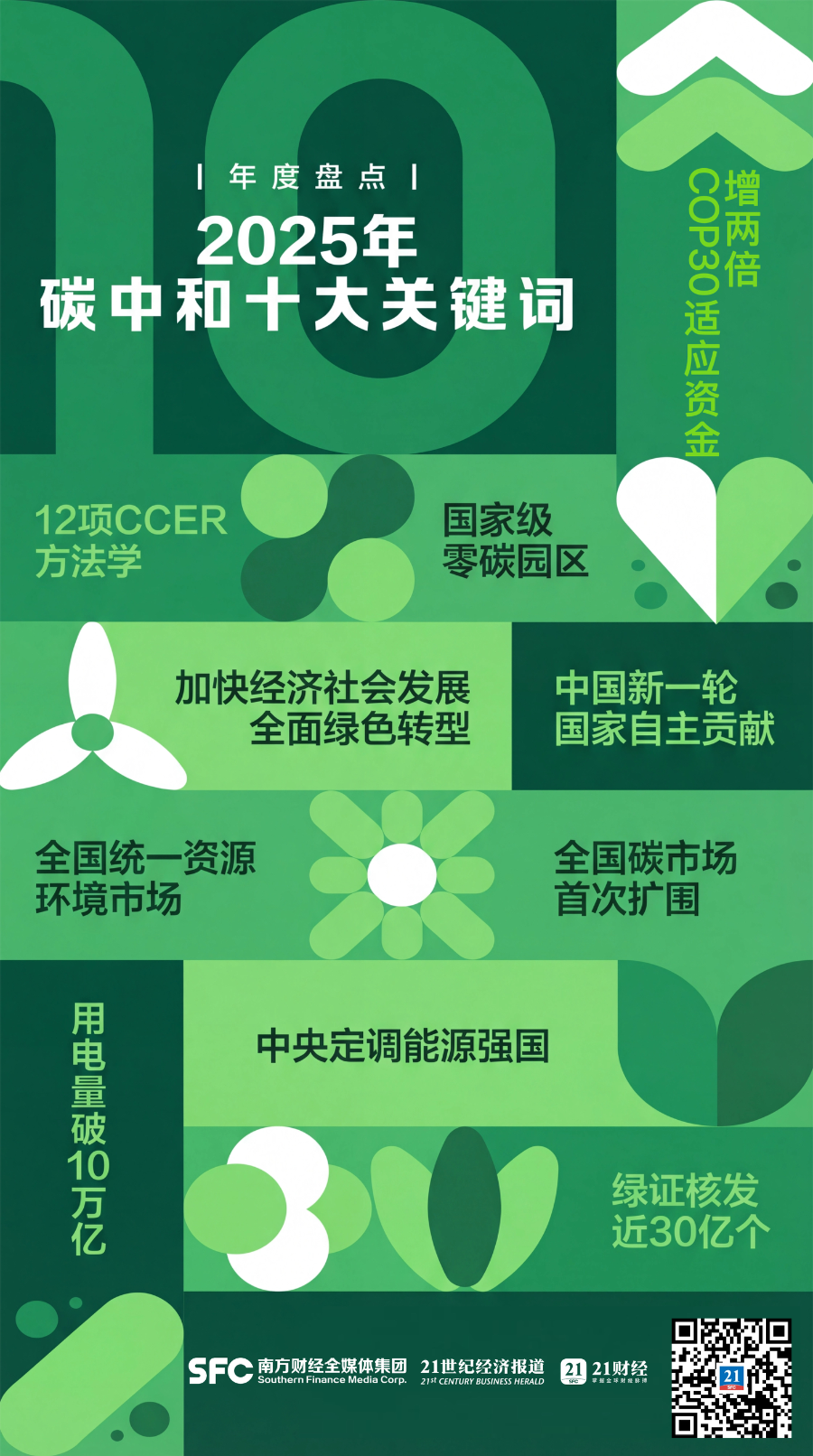
能源强国、新NDC……速览2025年碳中和十大关键词
2 1 Shi Ji Jing Ji Bao Dao· 2026-01-28 09:49
Group 1 - The core viewpoint of the articles emphasizes China's commitment to accelerating a comprehensive green transformation in its economy and society, with a focus on achieving carbon neutrality by 2035 [1][4][5] - The 20th Central Committee of the Communist Party of China has set "accelerating comprehensive green transformation" as a core task for the 14th Five-Year Plan, highlighting the importance of ecological security and green development [4][5] - Key mechanisms for carbon neutrality have made significant progress, including the expansion of the national carbon market to cover steel, cement, and aluminum industries, and the establishment of national zero-carbon parks [1][6][11][13] Group 2 - China's new round of Nationally Determined Contributions (NDC) aims for a 7%-10% reduction in greenhouse gas emissions by 2035, with non-fossil energy consumption reaching over 30% of total energy consumption [6][10] - The national unified resource and environmental market is being developed to enhance market efficiency and promote the marketization of resource and environmental factors [7][8] - The total electricity consumption in China surpassed 10 trillion kilowatt-hours in 2025, marking a significant milestone and reflecting the resilience and vitality of the economy [9][10] Group 3 - The energy power strategy emphasizes energy security, green transformation, and technological self-reliance, with a focus on seven key tasks for energy work in 2026 [10][11] - The first batch of national zero-carbon parks has been established, with 52 parks across various regions, focusing on low-energy, low-pollution, and high-value-added industries [11][12] - The national carbon market has expanded to include three major high-energy-consuming industries, significantly increasing the coverage of carbon emissions [13][15] Group 4 - The issuance of green certificates reached nearly 3 billion in 2025, with international recognition from the RE100 initiative, enhancing the credibility and market demand for Chinese green certificates [16][17] - Twelve new CCER methodologies were implemented in 2025, focusing on key areas for voluntary emission reductions, which is expected to activate the voluntary carbon market [18][19] - The COP30 conference resulted in a commitment from wealthy nations to double funding for climate change adaptation by 2035, although the omission of fossil fuel references in the final text raised concerns [20][21]
长青集团(002616) - 002616长青集团投资者关系管理信息20260128
2026-01-28 06:48
Group 1: Financial Performance - Revenue for the first three quarters of 2025 was 2.723 billion yuan, a slight decrease year-on-year due to a reduction in steam prices from coal-fired heating projects [1] - Non-recurring net profit reached 228 million yuan, an increase of 128.42% year-on-year, attributed to lower fuel costs and an increase in biomass projects benefiting from VAT incentives [1] - The debt-to-asset ratio was 71.72%, a decrease of 2.31% year-on-year, with expectations for further reduction following the early completion of convertible bond conversions [1] Group 2: Investor Interaction - Future fuel price trends are expected to stabilize, although biomass fuel prices have recently increased due to market conditions and adverse weather [2] - The company will prioritize maximizing benefits when deciding on participation in green certificate and CCER transactions, as current regulations prevent simultaneous participation [2] - The company has implemented a mid-term dividend for 2025 and plans to continue following its shareholder return policy while ensuring normal operations and long-term development [2] - The sale of the Zhongshan waste-to-energy project was strategic for early investment recovery and improving liquidity to focus on environmental thermal power business [2] Group 3: Risk and Disclosure - The information shared does not constitute a commitment or guarantee regarding industry or company development by the management [2] - The activity did not involve any undisclosed significant information [3]

土地承包期再延30年试点覆盖7个整省 去年快递业务量完成1989.5亿件
Xin Lang Cai Jing· 2026-01-26 06:39
Group 1 - The second round of land contract extensions for agricultural land has been piloted in 7 provinces, covering 221 counties and 349 townships, benefiting over 25 million farmers [1] - The Ministry of Agriculture and Rural Affairs plans to implement specific measures for the extension of land contracts starting in 2026, ensuring steady progress in agricultural modernization [1] Group 2 - The Ministry of Commerce expressed strong opposition to the EU's classification of certain Chinese companies as high-risk suppliers, which could limit their participation in 5G construction [1] Group 3 - In 2025, a total of 4,119 cases were filed against discipline inspection and supervision personnel, with 3,763 being punished, highlighting ongoing efforts to maintain integrity within the system [2] - The use of the "four forms" of criticism and education led to over 13,900 instances of handling discipline inspection personnel [2] Group 4 - The National Sports Administration has revised the safety production standards for the sports industry, emphasizing strict approval processes and risk assessments for high-risk sports events [4] Group 5 - A new national standard for the Chinese common names of pesticides will be implemented starting January 1, 2027, aimed at reducing misuse and improving market regulation [5] Group 6 - A nationwide policy to provide monthly subsidies of up to 800 yuan for elderly individuals with moderate to severe disabilities has been implemented, covering various types of elderly care services [6] Group 7 - In 2025, the postal and express delivery industry achieved a record business volume of 216.51 billion items, with express delivery volume reaching 198.95 billion items, reflecting significant growth in the sector [7] - The total revenue for the postal industry reached 1.8 trillion yuan, with express delivery revenue at 1.5 trillion yuan, indicating a healthy growth rate [7] Group 8 - The National Development and Reform Commission has allocated 93.6 billion yuan in special long-term bonds to support equipment upgrades across various sectors, driving total investment exceeding 460 billion yuan [7] Group 9 - The Supreme People's Procuratorate has released typical cases of public interest litigation related to personal information protection, indicating a focus on enhancing legal frameworks in this area [8] Group 10 - The Ministry of Education announced that the national college entrance examination will take place on June 7 and 8, 2026, with plans to expand the enrollment scale of quality undergraduate education [9]

东兴证券晨报-20260122
Dongxing Securities· 2026-01-22 10:27
Core Insights - The report highlights that Ningbo Bank achieved a total operating income of 71.97 billion and a net profit attributable to shareholders of 29.33 billion for 2025, reflecting year-on-year growth of 8.0% and 8.1% respectively [6][7] - The annualized weighted average ROE was reported at 13.11%, showing a slight decline of 0.48 percentage points year-on-year [6] - The non-performing loan ratio remained stable at 0.76%, with a provision coverage ratio of 373.2%, which decreased by 2.8 percentage points from the previous period [7][8] Revenue and Profit Analysis - The revenue growth rate showed a slight decline compared to the previous quarters, with net interest income increasing by 10.8% year-on-year, while the growth rate for the previous three quarters was higher [7] - Non-interest income saw a significant increase of 30.7% year-on-year, benefiting from a recovering capital market, particularly in wealth management and custody services [7] - The core revenue, which includes net interest income and non-interest income, grew by 12.5% year-on-year [7] Asset Quality and Credit Growth - Total assets of Ningbo Bank increased by 16.1% year-on-year, with loans growing by 17.4%, indicating a strong growth trajectory in lending [8] - The bank's deposit growth was reported at 10.3% year-on-year, with a notable increase in the proportion of demand deposits [8] - The non-performing loan ratio remained stable, and the provision coverage ratio, although slightly decreased, indicates a robust buffer against potential loan losses [8] Investment Recommendations - Given the high growth in core revenue and stable asset quality, the report projects a net profit growth rate of 8.1%, 9.8%, and 9.9% for the years 2025 to 2027 [9] - The report maintains a "strongly recommended" rating for Ningbo Bank, with a price-to-book ratio of 0.76 times as of January 20, 2026 [9]

十五五-的降碳路径与机遇解读
2026-01-21 02:57
Summary of Key Points from the Conference Call Industry Overview - The focus is on China's carbon emission control system, which includes quotas, Green Certificates, and China Certified Emission Reduction (CCER) [1][3][4]. Core Insights and Arguments - **Carbon Emission Control System**: The system aims to constrain carbon-emitting enterprises, promote green electricity development, and compensate for carbon reduction projects. Key industries currently included are steel, cement, and aluminum smelting, with plans to cover chemical, coking, and paper industries by the end of 2027 [1][3]. - **Quota Management**: The baseline values for quotas are set below equilibrium values, creating pressure for carbon reduction. The government will adjust these values based on actual conditions [1][4]. - **Carbon Price Trends**: The downward trend in carbon prices is a result of government policies providing companies with a buffer to adapt. The annual carbon reduction pressure is estimated at -0.5% [5]. - **Green Certificate Market**: Future plans include linking Green Certificates to corresponding carbon reduction amounts, allowing companies to offset emissions through purchases. Current low prices are due to a two-year validity period, but future policy clarity may stabilize prices [6]. - **Expansion of Quota Management**: The quota expansion plan is gradually progressing, with additional sectors like petrochemicals, civil aviation, and paper expected to be included [7]. - **CCER Issuance Conditions**: Projects must demonstrate significant carbon reduction effects and align with national strategic development to qualify for CCER. Examples include renewable energy projects and infrastructure improvements [8]. Additional Important Insights - **Investment Directions in Environmental Sector**: Key areas include waste incineration, non-electric green energy, and recycling of metals and plastics. Companies like Huanlan Environment and Weiming Environmental are expected to benefit from these trends [10][11][12]. - **Challenges and Opportunities in Steel Industry**: The steel sector, responsible for about 10% of total emissions, faces challenges in reducing carbon intensity due to process limitations. However, production control strategies present opportunities for emission reductions [16][17]. - **Opportunities in Light Industry**: The paper industry can leverage carbon trading through fast-growing forests, with companies like Yueyang Forest Paper leading in carbon credit transactions [18][19]. - **Building Industry's Role in Carbon Reduction**: The construction sector must adopt energy-saving technologies and focus on design optimization to reduce emissions effectively [20]. - **Future Policy Impacts on Cement Industry**: The cement sector, which contributes significantly to carbon emissions, will face stricter regulations and potential production cuts, impacting pricing dynamics [21][22]. - **Advantages of Specific Sub-industries**: Companies that provide energy-efficient materials, such as Luoyang Energy Saving, are positioned to benefit from the overall carbon reduction trend [23]. - **Impact of Dual Control Policies on New Energy**: The dual control policies are expected to accelerate the energy structure transformation, benefiting sectors like wind and solar energy, and enhancing the demand for related technologies [24].
国家能源局:11月核发绿证2.58亿个
Zheng Quan Shi Bao Wang· 2025-12-26 08:31
Core Viewpoint - The National Energy Administration issued 258 million green certificates in November 2025, covering 509,700 renewable energy generation projects, with 150 million tradable certificates, accounting for 58.25% of the total [1] Group 1 - In October 2025, the issuance of green certificates corresponding to renewable energy generation was 225 million, representing 87.17% [1] - From January to November 2025, the total number of green certificates issued by the National Energy Administration reached 2.736 billion, with 1.743 billion being tradable certificates [1]
德勤胡建宇:ESG表现已与资本市场高度绑定
2 1 Shi Ji Jing Ji Bao Dao· 2025-11-26 09:14
Core Insights - The report highlights the increasing importance of ESG performance in capital markets, influencing investors' decisions on stock holdings [1] - The concept of "going global" is emphasized, with ESG becoming a critical factor for Chinese companies expanding overseas [1][2] - Companies face compliance and disclosure pressures related to ESG when entering international markets, particularly in the EU [1][3] Group 1: ESG and International Expansion - ESG is becoming a significant consideration for Chinese companies as they navigate international markets, with over 2,000 companies assisted by Deloitte in expanding across 96 overseas markets [1] - The challenges faced by companies include not only ESG compliance but also the need to integrate local sustainable development requirements into their strategic planning [3] - The financing process for projects, especially in renewable energy, is heavily influenced by ESG standards set by multilateral banks, which can impact project timelines and costs [2] Group 2: Carbon Market and Green Energy - The global carbon market is still fragmented, with ongoing efforts to establish a unified trading system, highlighting the need for international cooperation [3] - Deloitte China has committed to carbon neutrality by purchasing renewable energy certificates, achieving 100% renewable energy usage in its offices [4] - The use of green electricity is expected to increase, with companies primarily acquiring it through green certificates, reflecting their commitment to environmental responsibility [4]