Cirq

Search documents
瞭望 | 量子计算突围路线图
Xin Hua She· 2026-01-26 09:44
Core Insights - The global quantum computing competition is intensifying, with countries like the US, EU, and Japan elevating quantum computing to a national strategy, focusing on legislation, substantial investments, and international collaboration [3][4] - China has made significant strides in quantum computing, establishing itself in the first tier of the industry, but faces challenges in technology breakthroughs, supply chain security, and standardization [1][4] - The success of quantum computing depends on building a sustainable, full-stack ecosystem rather than just the parameters of individual machines [1][7] Investment and Strategic Initiatives - The US has invested approximately $6.078 billion over seven years through the National Quantum Initiative Act, while the EU plans to invest around $1.1 billion from 2018 to 2027 under its Quantum Technology Flagship program [3] - Japan has earmarked 1.05 trillion yen for quantum technology, designating 2025 as the "year of quantum industrialization" [3] - South Korea has allocated 198 billion won for quantum technology in 2025, indicating a global trend towards comprehensive breakthroughs in quantum computing [3] Technological Development - The focus is on six core capabilities: quantum chip systems, quantum computing measurement and control systems, quantum computing environmental support systems, quantum operating systems and software, quantum computing cloud platforms, and quantum application software [3][4] - China is advancing its quantum computing capabilities with a focus on "self-controllable" technology, achieving several independent results in the six core capability areas [4][5] Ecosystem and Collaboration - The US and EU are building ecosystems centered around operating systems, with companies like IBM and Google leading the way in standardization and collaboration [4][5] - China's quantum computing cloud platform is rapidly developing, providing low-cost access to quantum computing for various industries, thus promoting application exploration [5][6] Challenges and Barriers - The core technology barriers in quantum computing stem from its high specialization, requiring significant R&D investment and long-term technical accumulation [8][9] - The ecological barriers arise from the interdependence of hardware and software, with leading global companies creating user stickiness and technological moats [9][10] - Standard barriers are critical for industry dominance, with the US and EU actively working on international standards that could dictate future developments [9][10] Future Directions - Experts suggest that China should focus on three essential capabilities: quantum chips, measurement and control systems, and operating systems, to achieve breakthroughs [11][12] - A coordinated national strategy is recommended to foster innovation and industry cultivation, ensuring that China can compete effectively in the global quantum landscape [11][12] - The development of a shared ecosystem between research and industry is crucial for advancing quantum applications in key sectors like biomedicine and finance [12]


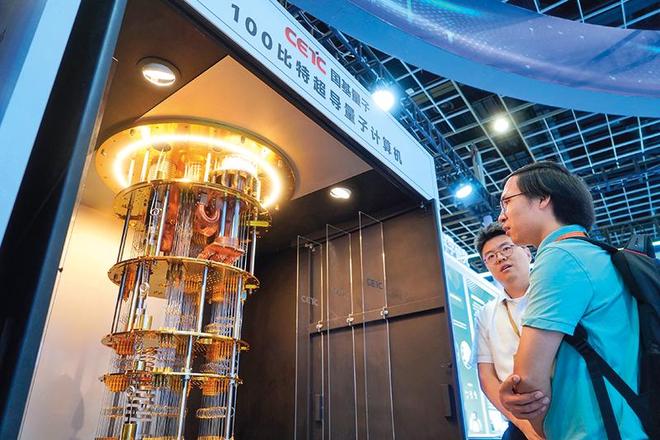
量子操作系统与软件:生态构建的“软核心”
Zhong Zheng Wang· 2026-01-15 03:24
Core Insights - Quantum operating systems and software are essential for driving the quantum computing industry ecosystem, acting as a critical hub that connects hardware and application software development [1][3] - The global competition in quantum computing has shifted from hardware performance to a comprehensive evaluation of the entire technology stack and industry ecosystem, with operating systems playing a pivotal role in determining competitive advantage [1][2] Group 1: Importance of Quantum Operating Systems - The core value of quantum operating systems lies in their ability to efficiently manage and schedule quantum resources, providing a unified development interface and runtime environment for upper-layer applications [2] - Quantum operating systems face higher technical challenges due to the unique properties of quantum bits, such as superposition and entanglement, as well as the fragility of quantum states [2] - Once a quantum operating system achieves market dominance, it creates strong ecosystem stickiness, binding developers and the upstream and downstream of the industry chain, which can have a profound impact on future industry development [2] Group 2: Domestic Developments in Quantum Operating Systems - China has made significant breakthroughs in quantum computing operating systems, with "Benyuan Sinan" being a benchmark achievement, representing the first domestic quantum operating system that integrates quantum and classical computing architectures [3] - The current version 4.0 of this operating system focuses on the integration of quantum computing capabilities and has effectively addressed key challenges in resource management and task scheduling [3] - The accompanying QPanda programming framework covers the entire process from algorithm design to runtime monitoring, significantly lowering the barriers to quantum computing development [3] Group 3: Investment Attributes and Challenges - Quantum operating systems and software possess high barriers to entry, strong demand, and high growth potential, making them a core entry point in the quantum computing ecosystem [4] - The development of these systems requires overcoming challenges related to quantum-classical resource collaboration and multi-hardware adaptation, with significant head effects in a competitive landscape [4] - Despite the promising growth, challenges such as a small ecosystem scale and insufficient hardware-software collaboration in China's quantum computing sector remain significant [4]
What Is the Best Quantum Computing Stock Billionaire Investors Are Buying Right Now?
The Motley Fool· 2025-12-21 05:00
Core Insights - Quantum computing stocks are gaining traction on Wall Street, with significant interest from both pure-play companies and major tech firms exploring quantum AI [1][2] - Alphabet has emerged as a key player in the quantum computing landscape, attracting substantial investments from high-profile institutional investors [2][6] Company Investments in Quantum Computing - Google Quantum AI leads Alphabet's quantum computing initiatives, focusing on scalable, error-correcting systems to tackle complex problems beyond current supercomputers [5] - The company has developed the Willow chip and released Cirq, a software toolkit for quantum algorithm research [5] Institutional Investment Trends - Notable investments in Alphabet include Stanley Druckenmiller's Duquesne Family Office acquiring 102,200 shares, Millennium Management increasing its stake by 66% with 1.4 million shares, and Citadel purchasing 1.2 million shares, raising its stake by 200% [6] - Warren Buffett's Berkshire Hathaway added 17.8 million shares worth approximately $4.3 billion to its portfolio during the third quarter [6] Broader AI Integration - Alphabet's business extends beyond internet services, integrating AI across various segments, including Google Search and Android devices, with its large language model, Gemini [7] - Google Cloud is rapidly growing and profitable, competing effectively with AWS and Microsoft Azure, with potential commercialization of custom chips (TPUs) [8][9] Market Position and Valuation - Alphabet's stock has seen significant appreciation, with a current market cap of $3.7 trillion and a forward price-to-earnings ratio of 29, indicating a compelling investment opportunity despite a high valuation [8][14] - The combination of Alphabet's established AI ecosystem and the potential of quantum computing positions the company uniquely in a competitive market [15]



2 Quantum Computing Stocks That Caught Warren Buffett's Attention -- Should They Catch Yours?
The Motley Fool· 2025-11-29 17:29
Core Insights - Berkshire Hathaway, led by Warren Buffett, has made significant investments in Alphabet and Amazon, indicating a strategic focus on companies with strong growth potential in the AI and quantum computing sectors [1][4][12] Group 1: Berkshire Hathaway's Investment Strategy - Buffett's investment approach emphasizes value and long-term potential, avoiding overvalued stocks and focusing on durable businesses [10][11] - The recent 13F filing revealed a $4.3 billion investment in Alphabet, marking it as the only new stock added to the portfolio in the third quarter [3][4] Group 2: Alphabet's Position and Developments - Alphabet is enhancing its core products through AI, notably in search and cloud computing, with features resembling ChatGPT [5] - The company is developing its own quantum AI stack, including a custom chip called Willow and an open-source quantum software suite named Cirq [6] Group 3: Amazon's AI and Quantum Computing Initiatives - Amazon utilizes AI to refine its e-commerce recommendation algorithms and has invested in the startup Anthropic to bolster its AWS offerings [7][8] - The company has created its own quantum computing chip, Ocelot, and launched a quantum AI platform called Amazon Bracket [9] Group 4: Market Valuation and Future Prospects - Both Alphabet and Amazon are experiencing valuation compression, suggesting that the market may not fully recognize their long-term growth potential in the AI era [14] - The resilience and cash-generating capabilities of Alphabet and Amazon, along with their global brand recognition, make them attractive long-term investment opportunities [15]


Prediction: This Artificial Intelligence (AI) Stock Will Be the Nvidia of Quantum Computing by 2035
The Motley Fool· 2025-10-08 00:00
Core Insights - Nvidia currently leads the AI boom, but Alphabet is positioned to excel in the emerging quantum computing applications [1][2] Group 1: Alphabet's Strengths - Alphabet possesses unmatched depth in research, hardware, and software, creating a powerful ecosystem for both current AI and future quantum applications [2][3] - DeepMind serves as Alphabet's intellectual engine, driving breakthroughs in reinforcement learning and optimization that enhance Google’s products [4] - Alphabet's Tensor Processing Units (TPUs) provide a structural edge in deep learning, integrated into Google Cloud, attracting high-profile clients [5][6] Group 2: Quantum Computing Initiatives - Cirq, Alphabet's open-source quantum programming framework, allows developers to experiment with quantum applications, integrating them into Alphabet's ecosystem [7][8] - Early adopters of Cirq will be positioned advantageously as quantum AI matures, transforming speculative AI into mainstream infrastructure [8] Group 3: Financial Implications - Google Cloud is projected to exceed an annual revenue of $100 billion as enterprises seek alternatives to Nvidia, driven by Alphabet's scalable TPUs [9] - The combined potential of DeepMind and TPUs is valued at nearly $900 billion, with Cirq enhancing Alphabet's first-mover advantage in quantum AI [10] - Over the next decade, Alphabet could redefine its market perception, transitioning from an ad-tech company to a leader in AI infrastructure, potentially adding trillions in market capitalization [11]


Quantum Artificial Intelligence (AI) Could Be the Next $10 Trillion Industry -- 2 Stocks to Own Now
Yahoo Finance· 2025-09-26 16:15
Core Insights - The fusion of artificial intelligence (AI) and quantum computing is anticipated to generate trillions of dollars in economic value over the coming decades [2][9] - Nvidia and Alphabet are positioning themselves as leaders in the integration of AI and quantum computing technologies [2] Nvidia: GPUs, CUDA, and Infrastructure - Nvidia's dominance in the GPU market has been pivotal in the AI revolution, with its chips serving as the backbone for generative AI development [3] - The company is expanding its ambitions beyond just supplying accelerators for large language models (LLMs) and is laying the groundwork for a significant role in quantum computing [3][5] - Nvidia's CUDA software architecture is designed to connect classical computing systems with quantum-inspired research, with its CUDA quantum (CUDA-Q) platform already utilized by academic institutions and integrated with developers like IonQ and Rigetti Computing [4][5] Alphabet: Willow, Cirq, and DeepMind - Alphabet is making direct advancements in quantum computing through its Google Quantum division [7] - The company focuses on Willow, a processor aimed at efficiently scaling quantum workloads, and Cirq, an open-source framework for developing quantum algorithms on Google's infrastructure [8] - Alphabet's internal research lab, DeepMind, allows for rapid testing and refinement of quantum technologies, providing a unique advantage [8]

This Artificial Intelligence (AI) Stock Could Be the Nvidia of Quantum Computing
The Motley Fool· 2025-08-13 00:22
Core Viewpoint - Alphabet is positioned to become a leader in quantum computing, similar to Nvidia's role in AI, with its recent advancements in quantum technology and applications [1][7][11]. Group 1: Alphabet's Quantum Computing Innovations - Alphabet unveiled its quantum processor called Willow, featuring 105 qubits and advanced algorithmic capabilities [5]. - In an experiment, Willow reportedly solved complex computations in under 5 minutes, a task that would take classical supercomputers an estimated 10 septillion years [6]. - The innovations in quantum computing by Alphabet are likened to Nvidia's pioneering work with GPUs, indicating a potential for future commercial applications [7]. Group 2: Strategic Ecosystem Development - Alphabet is developing a comprehensive AI ecosystem, including TensorFlow for machine learning and Cirq for quantum application development [8]. - This strategy mirrors Nvidia's approach, which combines hardware and software to create a self-reinforcing technological advantage [9]. - The company is betting on the eventual exhaustion of classical computing capabilities, positioning itself for a transition to quantum computing [10]. Group 3: Valuation and Investment Potential - Alphabet's stock is currently trading in line with its three-year average forward P/E ratio, suggesting a valuation discount compared to peers [12][14]. - Despite ongoing innovations across various AI sectors, the market has not fully priced in the potential upside from these investments [15]. - The company is seen as a compelling investment opportunity, with expectations of significant valuation expansion as its AI-powered products scale [16].