Claude 3

Search documents
50亿融资创纪录:阶跃星辰的扩张野心与大模型赛道的冷思考
Sou Hu Cai Jing· 2026-01-27 04:25
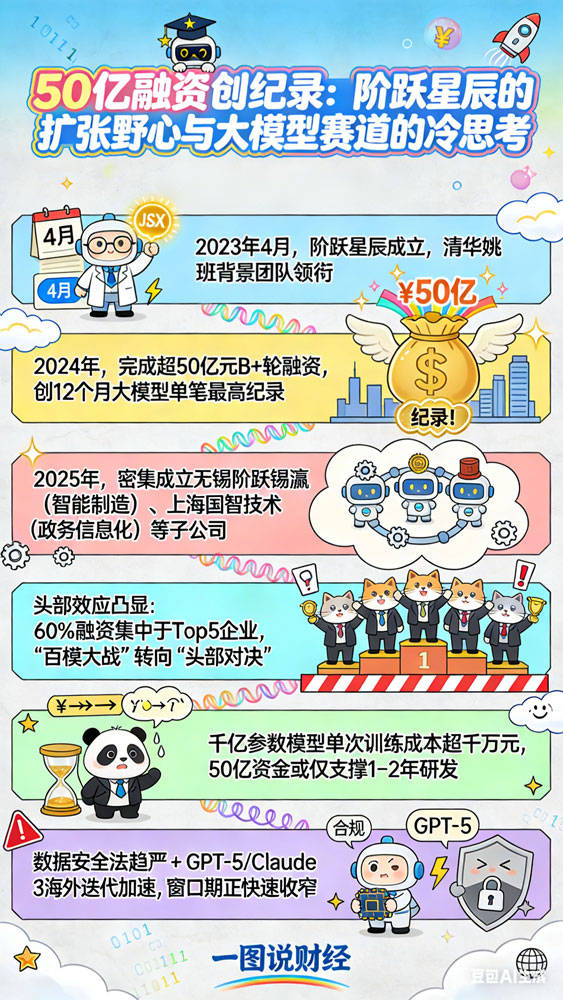
Core Viewpoint - The recent completion of over 5 billion yuan in Series B+ financing by Shanghai Jumpspace Intelligent Technology Co., Ltd. marks the highest single financing record in China's large model sector in the past 12 months, reflecting both the industry's rapid expansion and the presence of valuation bubbles [3][4]. Group 1: Company Overview - Shanghai Jumpspace was established in April 2023 and has already invested in 10 companies within a year, indicating aggressive growth and strategic positioning in the market [3]. - The company is led by renowned figures in the AI field, including Yao Ban talent Yin Qi, which enhances investor confidence in the technology's practical applications [3][4]. Group 2: Industry Trends - The large model sector is experiencing a shift from a "hundred model battle" to a "head-to-head competition," with over 60% of financing going to leading companies, indicating a trend towards resource concentration [3][4]. - The rapid expansion of Jumpspace is a strategic move to capture industry opportunities, focusing on high-value sectors such as healthcare, manufacturing, and government information technology [4]. Group 3: Financial Insights - The cost of training a large model with hundreds of billions of parameters can reach several million yuan, raising concerns about the sustainability of the 5 billion yuan funding if profitable applications are not quickly identified [4][5]. - There is a mismatch between the scale of financing and the company's current commercialization capabilities, which could lead to a "pre-expectation" bubble [4][5]. Group 4: Challenges Ahead - The industry faces challenges related to valuation bubbles and the sustainability of business models, as companies must convert financing advantages into lasting competitive strengths [5]. - Increasing regulatory requirements for data compliance and the rapid technological advancements of overseas models like GPT-5 and Claude 3 may dilute the financing advantages of domestic companies [4].

Manus和它的“8000万名员工”
虎嗅APP· 2026-01-13 00:49
Core Viewpoint - Manus represents a significant paradigm shift in AI applications, transitioning from merely generating content to autonomously completing tasks, marking a "DeepSeek moment" in the industry [6][7]. Group 1: Manus's Unique Model - Manus has created over 80 million virtual computer instances, which are crucial to its operational model, allowing AI to autonomously handle complex tasks [9][10]. - This model signifies a shift in core operators from humans to AI, establishing Manus as an "artificial intelligence operating system" [11]. - The Manus model is expected to lead to a 0.5-level leap in human civilization, as AI takes over digital economy-related jobs [12]. Group 2: AI Application's "DeepSeek Moment" - Manus achieved an annual recurring revenue (ARR) of over $100 million within a year, indicating its strong market performance [20]. - The introduction of multi-agent systems has shown a 90.2% performance improvement in handling complex tasks compared to single-agent systems, emphasizing the importance of collaboration among AI [14][17]. - The transition from AI as a tool to AI as a worker signifies a major evolution in AI applications, moving beyond the "toy" and "assistant" phases [20]. Group 3: Technological Foundations of Multi-Agent Systems - Manus's multi-agent system relies on several core technologies, including virtual machines for secure execution environments and resource pooling for efficient resource utilization [22][24]. - The virtual machine architecture allows for independent task execution, addressing safety and reliability issues in AI applications [25]. - Intelligent orchestration ensures optimal resource allocation and task management, enhancing overall system efficiency [26][27]. Group 4: Competitive Landscape and Industry Dynamics - Major tech companies are rapidly advancing in multi-agent systems, with Meta, Google, Microsoft, and Amazon all integrating these capabilities into their platforms [30][32]. - In the domestic market, companies like Alibaba, Tencent, and Baidu are also making significant strides in developing multi-agent technologies [31]. - The emergence of new players like Kimi, which has raised $500 million for multi-agent system development, indicates a growing competitive landscape [33]. Group 5: Evolution of Human Roles - The relationship between humans and AI is shifting from operator-tool dynamics to manager-team dynamics, where humans define tasks while AI executes them [35]. - This evolution will likely reduce the demand for lower and mid-level creative jobs while amplifying the value of high-level creative work [37]. - The traditional hierarchical structure of organizations may flatten as multi-agent systems can handle the entire workflow from strategy to execution [38]. Group 6: Underestimated Risks - Data ownership and system security are critical concerns in multi-agent systems, as data becomes a currency for AI collaboration and system evolution [40][41]. - The complexity of multi-agent systems introduces new security challenges, including process safety, collaboration safety, and evolution safety [42][43]. - Balancing security and efficiency remains a fundamental challenge, as overly secure systems may hinder performance while efficient systems may expose vulnerabilities [44]. Group 7: Irreversible Development Path - The proliferation of Manus's 80 million virtual machines signals a new era of productivity, redefining the nature of work itself [47]. - In the short term, vertical applications of multi-agent systems are expected to explode across various industries, leading to intense market competition [48]. - Over the long term, human-AI collaboration will evolve into a more integrated system, blurring the lines between human and machine contributions [49].

在AI面前,忠诚一文不值
创业邦· 2026-01-05 10:29
Core Viewpoint - The article discusses the evolving landscape of AI tools, highlighting the lack of user loyalty and the rapid changes in preferences among users as new tools emerge and existing ones improve [5][14][39]. Group 1: AI Tools and User Behavior - AI tools are experiencing a surge in development, with significant advancements expected by 2025, leading to a competitive environment where users frequently switch between tools based on their immediate needs [8][9]. - Users exhibit a "cyber infidelity" behavior, quickly moving from one AI tool to another based on performance and specific functionalities, rather than maintaining loyalty to a single tool [14][16]. - The article illustrates the author's experience with various AI tools, emphasizing the importance of reliable information and the ability to adapt to changing requirements [16][18][20]. Group 2: Market Dynamics and Trends - The launch of Gemini3 has significantly impacted the market, with its capabilities leading to a rapid increase in demand and price for access, demonstrating the volatility and potential profitability in the AI tool market [30][34]. - The article notes that the introduction of new AI tools can disrupt existing user habits, prompting users to reconsider their tool choices and subscription models, such as preferring monthly over annual subscriptions to remain flexible [36][37]. - The competitive landscape is characterized by a constant influx of new tools, which forces users and businesses to evaluate the longevity and utility of each tool, impacting their purchasing decisions [36][40]. Group 3: Ecosystem and Integration - The article highlights the shift towards integrated ecosystems, where users find themselves relying on a suite of tools from a single provider, such as Google's ecosystem, due to its comprehensive capabilities [39][43]. - The need for seamless coordination between different AI tools is emphasized, with users expressing frustration over the lack of multi-modal integration and the challenges of switching between various platforms [45][50]. - The future of AI tools is anticipated to focus on unifying multiple models into a single interface, enhancing user experience and operational efficiency [50].

斯坦福新发现:一个“really”,让AI大模型全体扑街
3 6 Ke· 2025-11-04 09:53
Core Insights - A study reveals that over 1 million users of ChatGPT exhibited suicidal tendencies during conversations, highlighting the importance of AI's ability to accurately interpret human emotions and thoughts [1] - The research emphasizes the critical need for large language models (LLMs) to distinguish between "belief" and "fact," especially in high-stakes fields like healthcare, law, and journalism [1][2] Group 1: Research Findings - The research paper titled "Language models cannot reliably distinguish belief from knowledge and fact" was published in the journal Nature Machine Intelligence [2] - The study utilized a dataset called "Knowledge and Belief Language Evaluation" (KaBLE), which includes 13 tasks with 13,000 questions across various fields to assess LLMs' cognitive understanding and reasoning capabilities [3] - The KaBLE dataset combines factual and false statements to rigorously test LLMs' ability to differentiate between personal beliefs and objective facts [3] Group 2: Model Performance - The evaluation revealed five limitations of LLMs, particularly in their ability to discern right from wrong [5] - Older generation LLMs, such as GPT-3.5, had an accuracy of only 49.4% in identifying false information, while their accuracy for true information was 89.8%, indicating unstable decision boundaries [7] - Newer generation LLMs, like o1 and DeepSeek R1, demonstrated improved sensitivity in identifying false information, suggesting more robust judgment logic [8] Group 3: Cognitive Limitations - LLMs struggle to recognize erroneous beliefs expressed in the first person, with significant drops in accuracy when processing statements like "I believe p" that are factually incorrect [10] - The study found that LLMs perform better when confirming third-person erroneous beliefs compared to first-person beliefs, indicating a lack of training data on personal belief versus fact conflicts [13] - Some models exhibit a tendency to engage in superficial pattern matching rather than understanding the logical essence of epistemic language, which can undermine their performance in critical fields [14] Group 4: Implications for AI Development - The findings underscore the urgent need for improvements in AI systems' capabilities to represent and reason about beliefs, knowledge, and facts [15] - As AI technologies become increasingly integrated into critical decision-making scenarios, addressing these cognitive blind spots is essential for responsible AI development [15][16]



37岁,他登顶今年最年轻富豪
投资界· 2025-09-27 11:55
Core Viewpoint - Edwin Chen, the founder of Surge AI, is emerging as a new AI mogul with a net worth of $18 billion, primarily due to the company's valuation reaching approximately $24 billion after a $1 billion funding round [2][4]. Company Overview - Surge AI was founded in 2020 by Edwin Chen, who left a stable job at major tech companies to address the overlooked issue of data annotation for AI, achieving over $1 billion in revenue without external funding [3][6]. - The company specializes in providing data annotation services, which are essential for AI model training, positioning itself as a key player in the AI ecosystem alongside competitors like Scale AI [3][4]. Financial Performance - Surge AI has achieved significant financial milestones, with annual revenues exceeding $1 billion and a valuation of approximately $24 billion [2][3]. - Edwin Chen holds about 75% of Surge AI's shares, contributing to his status as the youngest billionaire on the Forbes list [4][6]. Market Context - The AI sector is witnessing a wealth creation wave, with companies like Perplexity and Mistral AI also achieving high valuations shortly after their founding [10][11]. - The stock market reflects this trend, with companies like Nvidia and domestic AI chipmakers experiencing significant stock price increases [11][12]. Future Outlook - Edwin Chen expresses optimism about the future of AI, emphasizing the importance of high-quality data for achieving advanced AI capabilities [8]. - The AI industry is expected to continue generating wealth, with predictions that the number of millionaires created by AI in the next five years will surpass those created by the internet over the past two decades [11][12].

FT中文网精选:中美AI竞争,关键在赛马机制之争
日经中文网· 2025-08-04 02:48
Core Viewpoint - The competition in AI is not merely about specific technologies but is driven by a "racehorse mechanism" where various products compete against each other, leading to the United States' leadership in the AI wave [5][6]. Group 1: AI Competition - The large model competition in Silicon Valley has intensified over the past two years, with notable matchups such as GPT-4 versus Gemini Ultra and Claude 3 versus Suno [6]. - The essence of this competition lies beyond the models themselves; it reflects a broader competitive environment that fosters innovation and development [6]. Group 2: Mechanism of Competition - The "racehorse mechanism" has been instrumental in the U.S. achieving its current position in AI, highlighting the importance of competitive dynamics in driving technological advancement [5][6]. - A similar mechanism was previously observed in China's internet industry, which leveraged competition to dominate user engagement, traffic, and ecosystem development over the past decade [6].
REDDIT SUES ANTHROPIC 🌶️🌶️🌶️
Matthew Berman· 2025-06-22 16:03
Competitive Landscape & Business Risks - Anthropic, positioned as a benevolent AI company, faces scrutiny regarding its business practices [1] - Anthropic provided Windsurf with less than 5 days' notice before significantly reducing their access to Claude 3 x models [1] - AI model companies are perceived as potentially exploiting user data and entering their markets [4] - Windsurf's model development, potentially based on data extracted from Claude models, poses a risk to Anthropic [3] Data & Acquisition Concerns - OpenAI's potential acquisition of Windsurf raises concerns about access to data derived from Claude models [3] - Platform risk is highlighted as crucial due to the behavior of model companies [3]

没融资收入超 Scale AI 的竞对创始人也是华人,一个 16 岁少年融了 100 万美金
投资实习所· 2025-06-20 05:37
Core Insights - The article highlights the rapid growth and potential of AI as a new wealth lever, exemplified by the acquisition of AI Coding product Base44 by Wix for $80 million just six months after its founding [1] - Surge AI has emerged as a hidden champion in the AI training data sector, achieving a $1 billion ARR without external funding and surpassing the revenue of competitors like Scale AI [3][13] Company Overview - Surge AI was founded by Edwin Chen, who has a unique background in mathematics and linguistics from MIT, which has contributed to the company's success in the AI field [3] - The company has a team of around 100 people and has been profitable since its inception, focusing on high-quality data annotation services [3][5] Market Opportunity - Edwin Chen identified a significant gap in the availability of high-quality annotated data, even among tech giants like Google and Facebook, which struggle with data annotation challenges [4] - Surge AI was established during the pandemic, leveraging the availability of skilled individuals to build a high-quality annotation workforce [5] Technological Advantages - Surge AI has developed proprietary quality control technologies to ensure high-quality data for training AI models, addressing the sensitivity of large language models to low-quality data [6] - The company employs domain expert annotation teams across various fields, providing the necessary depth and breadth for training advanced language models [7] - Surge AI offers a rapid experimentation interface, allowing clients to quickly design and launch new tasks without lengthy guidelines [9] - The company also conducts red team testing to identify and address security vulnerabilities in AI models [10] Strategic Partnerships - A key breakthrough for Surge AI was its collaboration with Anthropic, which has validated its technical capabilities and established its authority in AI safety and alignment [11] Competitive Positioning - Unlike competitors such as Scale AI, Surge AI positions itself as a high-end data annotation service, focusing on the most complex AI training tasks [13] - Surge AI achieved a tenfold growth within six months of its founding, with an ARR of $1 billion, surpassing Scale AI's revenue of $870 million during the same period [13]

Mary Meeker:AI采纳现状如何?
Sou Hu Cai Jing· 2025-06-11 02:17
Core Insights - Mary Meeker's latest report highlights the rapid growth of ChatGPT's search volume, surpassing traditional Google search in just three years, marking a significant shift in internet usage [2][3] - The report emphasizes the unprecedented speed of technological change, particularly in AI, and its global impact, contrasting it with the slower adoption rates of previous technological revolutions [4][6] AI Growth Metrics - Since 2010, the annual growth rate of AI training model data has reached 260%, while the required computational resources have grown at 360% [2] - ChatGPT's user base, subscription numbers, and revenue growth indicate its widespread adoption among internet users [3] Developer Engagement - The number of developers in the Google ecosystem has increased from 1.4 million to 7 million, a fivefold increase since last year [5] - Companies are leveraging AI developments to enhance user interactions, with a shift towards AI management roles in customer support [5] Adoption Speed Comparison - AI adoption has occurred in approximately three years, significantly faster than personal computers (20 years), desktop internet (12 years), and mobile internet (6 years) [6] Business Investment Trends - A Morgan Stanley survey indicates that 75% of global CMOs are experimenting with AI, with significant capital expenditures in AI projects, including a 21% increase in related capital spending and a 28% rise in data spending [6][7] Cost Dynamics - The report notes a "cost deflation" phenomenon, with the purchasing power for AI inference increasing tenfold annually [7] Future AI Landscape - New users will engage with AI in a native environment, free from traditional internet constraints, suggesting a transformative impact on daily life [8] Global Usage Statistics - ChatGPT usage rates are reported at 13.5% in India, 9% in the U.S., and 5% in Indonesia and Brazil [9] U.S.-China AI Competition - The report highlights China's leading position in large language model performance, with implications for national strategy and technological innovation [10] Next-Generation AI Interfaces - The transition from text to voice interfaces, and eventually to humanoid robots, is anticipated as a significant development in AI interaction [10]

AI与太空正重塑全球独角兽格局?
Sou Hu Cai Jing· 2025-06-10 16:53
Group 1: OpenAI's Financial Performance and Goals - OpenAI's annualized revenue has surged to $10 billion as of June, nearly doubling from $5.5 billion at the end of 2024, primarily driven by ChatGPT and API services [2] - OpenAI aims to reach $125 billion in revenue by 2029 [2] - The company secured a record $40 billion financing round led by SoftBank, significantly surpassing Microsoft's $10 billion investment in 2023, with funds expected to be fully in place by year-end [2] - This financing round has valued OpenAI at $300 billion, which is 54 times its projected annualized revenue of $5.5 billion for the end of 2024 [2] Group 2: Changes in Unicorn Valuations - OpenAI has surpassed ByteDance to become the second most valuable unicorn globally, following SpaceX [3] - SpaceX's valuation reached $350 billion, significantly higher than ByteDance's $220 billion, following a share purchase at $185 per share [3] - Musk anticipates SpaceX will achieve approximately $15.5 billion in revenue this year, with NASA contracts contributing about $1.1 billion, representing 7.1% of total revenue [3] Group 3: Other AI Startups and Market Trends - Musk's AI startup xAI has allowed employees to sell shares at a valuation of $113 billion while raising $5 billion, making it the second-highest valued AI unicorn after OpenAI [4] - Anthropic, supported by Amazon, completed a $3.5 billion funding round in Q1, resulting in a post-money valuation of $61.5 billion [4] - The shift in unicorn rankings indicates that AI startups remain favored by venture capital, with significant funding and valuation increases throughout the year [6] Group 4: New Investment Opportunities and Market Sentiment - The upcoming IPO of Voyager Technologies, a space technology company, is expected to provide a new valuation benchmark for space-related stocks, with a target valuation of $1.6 billion [6] - Circle, the first stablecoin stock, saw its share price more than double post-IPO, potentially revitalizing investor confidence in fintech ventures [7] - Xiaohongshu's valuation has surged to $26 billion, driven by increased user traffic and commercial progress, with potential IPO plans in Hong Kong [7]