Claude Sonnet

Search documents
龙虾卸载指南
36氪· 2026-03-12 00:24
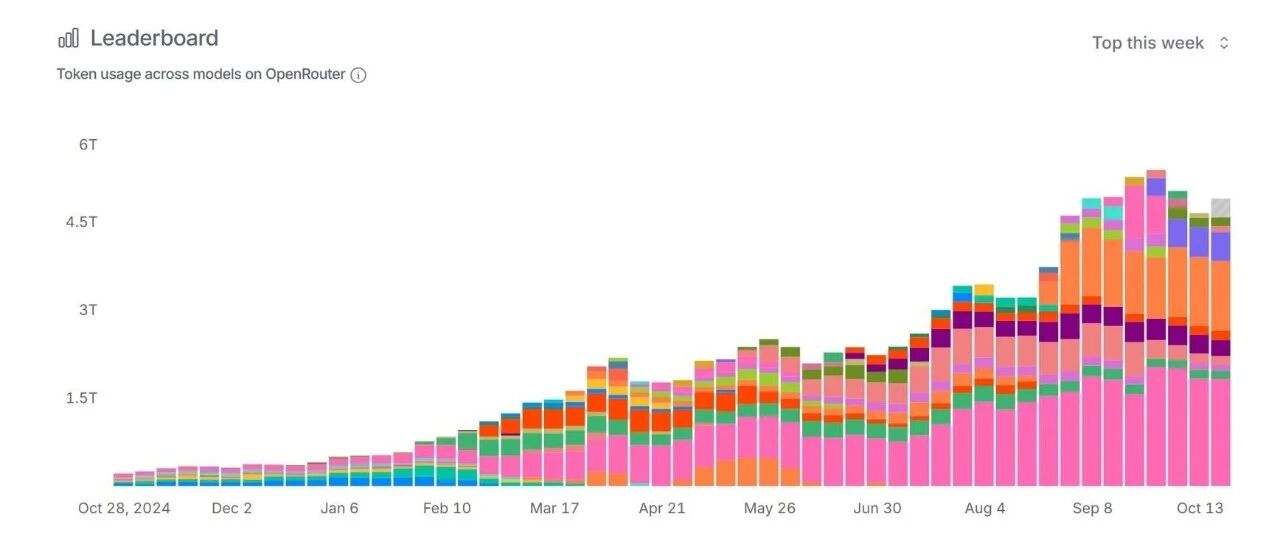
Core Viewpoint - The article discusses the rising costs and risks associated with using OpenClaw, an AI tool, highlighting that even with a decent salary, the expenses can be prohibitive for average users [15][17]. Cost of Using OpenClaw - To experience OpenClaw fully, users need a dedicated local hardware setup, such as a Mac Mini, which has seen a surge in demand and is often sold out [9]. - Users can opt for cloud servers from providers like Tencent Cloud and Alibaba Cloud, with costs ranging from tens to hundreds of yuan, but this may not significantly reduce the overall expenses [10]. - The operational costs can escalate quickly; for instance, using Claude Sonnet with OpenClaw could lead to monthly expenses nearing $100 for token usage alone, with costs exceeding $1,000 for more intensive tasks [16][17]. Market Dynamics - The demand for OpenClaw has led to a lucrative market for installation services, with prices for remote installations starting at tens of yuan and on-site services ranging from 500 to 1500 yuan [12]. - The token consumption for OpenClaw has surged, with OpenRouter processing token volumes increasing from 6.4 trillion to 13 trillion weekly, indicating a growing ecosystem where AI vendors benefit significantly [18]. Security Concerns - OpenClaw is considered a high-risk tool, with warnings from security teams about its potential vulnerabilities, especially when run on standard personal computers [21]. - There are numerous instances of OpenClaw installations being exposed online without proper authentication, making them susceptible to attacks [23]. - Malicious packages have been found on platforms like GitHub, posing risks to users who attempt to install OpenClaw [25][26]. User Experience and Risks - Users face significant risks even before installation, as the complexity of setup and potential for errors can lead to wasted time and resources [19]. - The design of OpenClaw can lead to unintended consequences, such as the inability to halt operations when necessary, which has been demonstrated in real-world scenarios [29][30]. - The overwhelming number of AI tools can lead to "AI brain overload," negatively impacting productivity and increasing turnover intentions among employees [35]. Conclusion - For most average users, waiting for a more stable and cost-effective version of AI tools like OpenClaw may be a more prudent choice than rushing to adopt the current iteration [37].


国联民生证券:Agent时代大模型正进化为“自主员工” 建议关注MiniMax-WP和智谱
Zhi Tong Cai Jing· 2026-02-09 08:20
Core Insights - The report from Guolian Minsheng Securities highlights the evolution of large models from "chat tools" to "autonomous employees," indicating that companies mastering core algorithms and industry interfaces are poised to benefit significantly from the intelligence-driven era [1] Group 1: Market Trends - As of February 2, 2026, Clawdbot has surpassed 130,000 stars on GitHub and its official website has accumulated over 2 million visits, making it one of the fastest-growing open-source technology projects recently [1] - The emergence of "AI-only communities" like Moltbook, which quickly amassed a million agent accounts, indicates a natural increase in request density and API triggers, leading to a significant rise in API call frequency and token throughput [1] Group 2: Model Cost Efficiency - The importance of unit cost for models is increasing, as complex tasks require multiple stages of interaction, leading to a significant increase in model call frequency and complexity [2] - The "unit cost of the model × unit output" becomes critical for the scalability of agent products, as multi-round reasoning and tool collaboration can linearly amplify costs [2] Group 3: Model Features - The M2.1 model from MiniMax aims to address the high token cost pain points faced by developers in automated programming, with a pricing structure approximately 8% of Claude Sonnet's [3] - The innovative "5-hour reset quota" mechanism allows for high-frequency productivity in heavy development scenarios, breaking away from traditional daily or monthly limits [3] Group 4: Long Text Capability - M2.1's long text capability is designed for real-world workflows, allowing it to handle continuous context, including tool calls, historical information, and constraints, thus reducing logical breaks due to truncation [4] Group 5: Reasoning and Programming Skills - In products like Clawdbot, the model is utilized for coding, code modification, judgment, and validation, with M2.1 being a cost-effective choice for production systems and high-frequency calls [5] - The ability to convert strong capabilities into frequently usable productivity at a lower cost is identified as MiniMax's competitive advantage [5] Group 6: Multi-Modal and Visual Execution - As agents enter office and production environments, inputs are increasingly derived from visual information such as screenshots, PDFs, tables, and charts, rather than solely from text [6] - MiniMax's multi-modal capabilities enhance agents' understanding of interfaces, enabling them to extract key information and output executable steps or code, thus facilitating "visual-driven automation" [7]

66%的程序员被AI坑惨,改bug比自己写还花时间
3 6 Ke· 2025-12-29 03:23
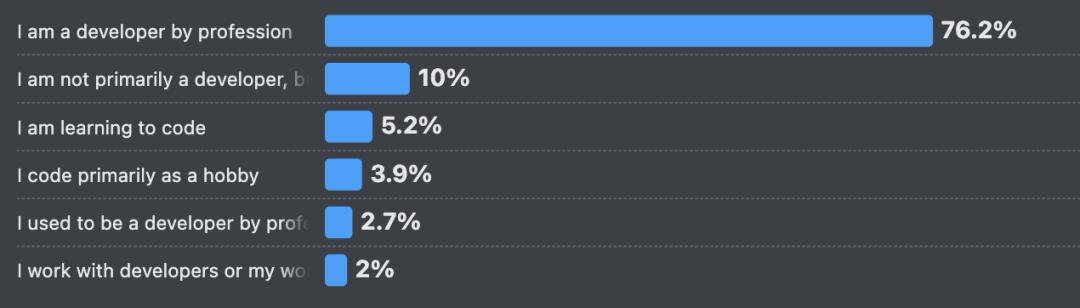
Core Insights - The 2025 Stack Overflow Developer Survey reveals a stark reality behind the AI hype: while 84% of developers have integrated AI into their workflows, their favorability towards AI has significantly dropped from over 70% to 60% [1][21] - The report highlights the challenges developers face with AI-generated code, with 66% expressing frustration over "almost correct" AI solutions, leading to increased debugging time compared to hand-written code [1][22] Developer Demographics - The survey included over 49,000 developers from 177 countries, with 76.2% identifying as professional developers [5] - The majority of developers are aged between 25 and 44, accounting for over 60% of respondents [5] - A notable trend is the increasing educational attainment among learners, with 30% of those learning programming holding a Bachelor of Science degree, up from 24% the previous year [7] Learning and Development - 69% of developers reported dedicating time to learn new coding techniques or languages in the past year, indicating a strong commitment to continuous learning [9] - Technical documentation remains the preferred learning resource for 68% of respondents, reflecting a preference for authoritative materials over casual content [9] - Over 36% of developers are specifically learning to use AI-powered tools, with 52% using AI-driven applications as their primary means of understanding artificial intelligence [11] Technology Stack Changes - Python has emerged as the leading programming language, with a usage rate of 57.9%, marking a 7 percentage point increase [12][14] - Docker's usage has surged by 17 percentage points to 71.1%, solidifying its status as an essential infrastructure tool [14] - Redis has seen an 8% increase in usage, highlighting its importance for high concurrency and low latency needs in complex application architectures [16] AI Tool Adoption and Sentiment - 84% of developers are using or planning to use AI tools, with 51% integrating them into their daily workflows [19] - Despite high adoption rates, trust in AI tools has declined, with only 60% expressing positive sentiments, down from over 70% in previous years [21] - 66% of developers find AI-generated solutions frustrating due to their inaccuracy, leading to increased debugging time [22] AI Agents and Their Challenges - AI agents, designed for autonomous decision-making, have not yet become mainstream, with 52% of developers either not using them or only using basic AI tools [26][28] - The primary barriers to adopting AI agents include concerns over accuracy (57.1%) and data security (81%) [30] - The leading frameworks for AI agent orchestration are open-source tools, with Ollama and LangChain being the most widely used [31] Developer Preferences and Practices - The majority of developers (72.2%) reject the concept of "vibe coding," emphasizing the importance of rigorous engineering practices [37] - The report indicates a shift towards rational pragmatism in the developer community, moving away from blind faith in AI technologies [38]
马斯克宣战,太空可见,把AI超算涂成这样,微软破防了
3 6 Ke· 2025-12-26 02:34
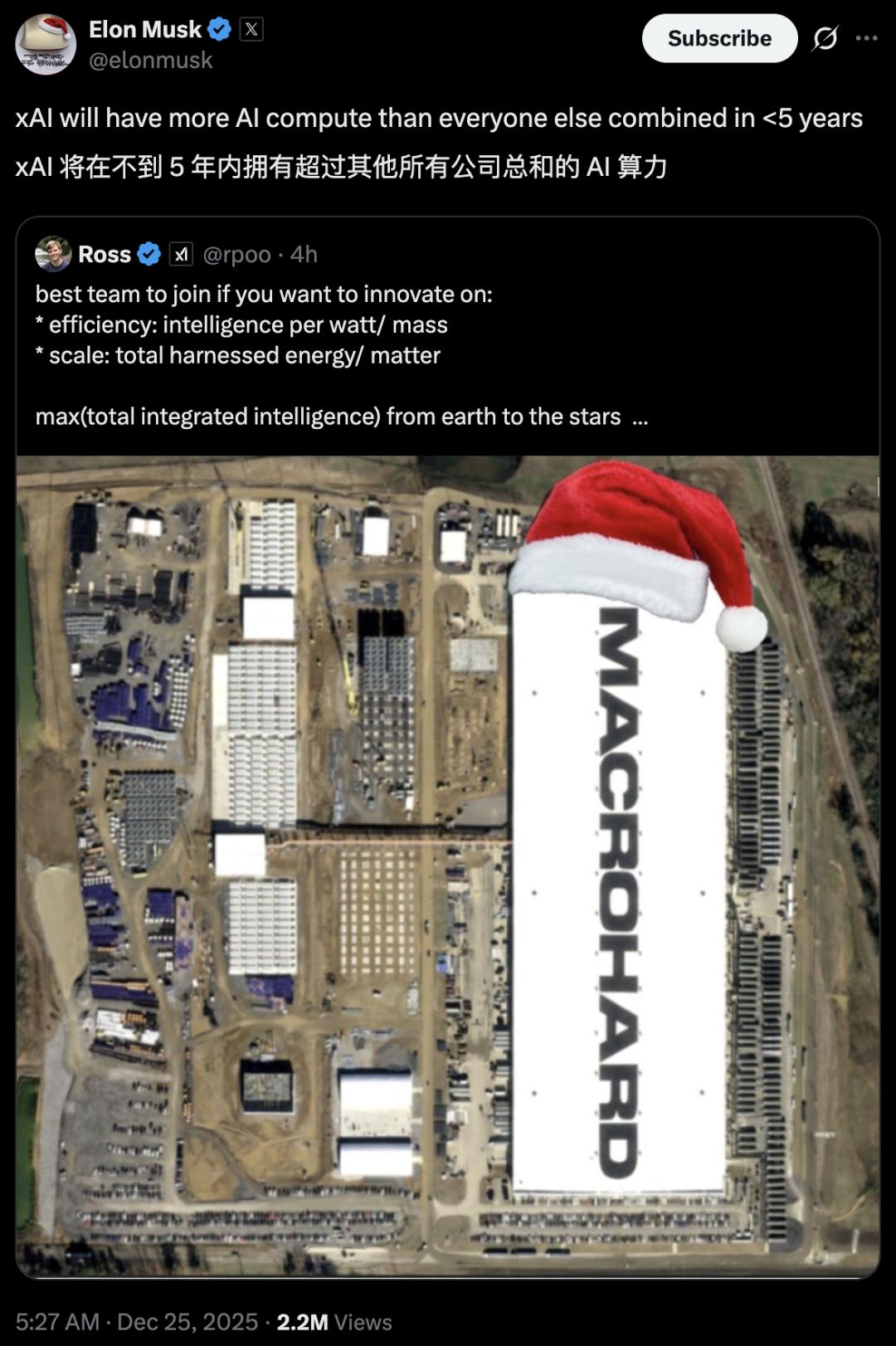
Core Viewpoint - Elon Musk has declared that xAI will possess more AI computing power than all other companies combined within five years, positioning xAI against major competitors like Google, OpenAI, and Microsoft [1][3]. Group 1: xAI's Infrastructure and Strategy - xAI's Colossus supercomputing center in Memphis is one of the largest commercial AI supercomputing centers globally, emphasizing a "hardcore" approach to AI development [5][9]. - The first phase, Colossus 1, was rapidly constructed to ensure xAI could compete, while Colossus 2 represents a more advanced engineering project aimed at long-term scalability [9][10]. - Colossus 2's construction is notably fast, with significant infrastructure completed in just six months, compared to competitors that typically require 15 months [10]. Group 2: Power Supply and Energy Strategy - xAI has strategically acquired a decommissioned power plant in Mississippi to circumvent regulatory hurdles in Tennessee, allowing for a temporary operation of gas turbines to supply power [13][15]. - Solaris Energy Infrastructure will provide over 1.1GW of power to meet the projected 1.7GW demand for Colossus 2, effectively creating an independent energy network for xAI [15][16]. Group 3: Financial Aspects and Funding - xAI is seeking $40 billion in new funding, with a valuation approaching $200 billion, despite its current revenue being minimal compared to its capital expenditures [19][16]. - The company is leveraging investments from Middle Eastern sovereign wealth funds, indicating strong financial backing for its ambitious plans [18][22]. Group 4: Company Culture and Workforce - xAI promotes a high-pressure work environment, with a culture that emphasizes extreme dedication, which has led to both attrition and the retention of passionate talent [23][24]. - The company is focusing on unique paths in AI development, such as emotional intelligence and interaction, rather than traditional programming skills [27][29]. Group 5: Future Outlook and Challenges - Musk has indicated that the next 2-3 years are critical for xAI to secure a leading position in the AI race, with significant investments required for expansion [30][31]. - The financial model of xAI raises concerns about sustainability, as training costs far exceed current revenue streams, potentially leading to market vulnerabilities [36].
YC 年终复盘:2025 年 AI 十大真相
3 6 Ke· 2025-12-24 01:20
Core Insights - The core argument is that the AI industry has transitioned from a phase of "dazzling chaos" to a mature stage where products can be practically built, marking the arrival of a golden age for application layers [2] Group 1: User Adoption and Model Preferences - Anthropic has surpassed OpenAI in user growth, with a 52% increase in usage among YC startups in the Winter 2026 batch, becoming the most commonly used API [3] - Developers prefer Anthropic's Claude Sonnet for code generation and AI Agent tasks due to its user-friendly approach compared to OpenAI's more rigid model [3] Group 2: Model Orchestration - Startups are moving away from relying on a single model and are instead creating orchestration layers to abstract different models for various sub-tasks, driven by their own evaluation metrics [4] - This strategy reduces vendor lock-in risks and optimizes cost structures, allowing startups to quickly adapt to technological changes [4] Group 3: Vibe Coding Emergence - Vibe Coding has evolved into a mature tool category, focusing on high-level logic and "vibe" rather than line-by-line coding, significantly speeding up prototype iterations and product releases [6] - Tools like Replit and Amagence exemplify this trend, although Vibe Coding is not yet suitable for production-level code [6] Group 4: Team Size and Revenue - AI companies are achieving high revenues with smaller teams, exemplified by Gamma, which reached $100 million in annual recurring revenue with just 50 employees [7] - This trend of "reverse bragging" highlights the increased productivity of individual developers due to AI tools [7] Group 5: Infrastructure and Market Dynamics - The AI economy is structured into three layers: model, application, and infrastructure, with overbuilding in the infrastructure layer potentially benefiting application developers by lowering costs [8] - The transition from the "installation phase" to the "deployment phase" indicates a more stable environment for building AI companies [8] Group 6: Trust Issues in Consumer Applications - Despite advancements in AI, there is a lack of standout consumer-level applications, primarily due to trust issues with models performing high-value tasks without human oversight [9] - Users prefer manual prompt engineering over relying on black-box applications until model reliability improves [9] Group 7: Vertical Model Opportunities - Smaller, domain-specific models (e.g., 8 billion parameters) can outperform general models like GPT-4 in specific vertical scenarios [10] - The knowledge required to build and train models has become more accessible, lowering entry barriers for new model companies [11] Group 8: Space Data Centers - The concept of space data centers is being taken seriously, driven by energy limitations on Earth, with companies like Starcloud and Zephyr Fusion exploring this direction [12] Group 9: AI Progress and Organizational Inertia - Concerns about AI leading to societal collapse by 2027 are met with skepticism, as progress follows a log-linear scaling pattern, suggesting a slower and more manageable pace of change [13] Group 10: Stability in AI Economy - The AI economy has entered a stable phase, with clearer guidelines for building AI-native companies and a shift from disruptive breakthroughs to gradual model updates [14] Group 11: Recommendations for Entrepreneurs - Key recommendations for AI entrepreneurs include focusing on application differentiation, establishing evaluation systems, maintaining lean teams, and recognizing the current favorable conditions for entering the AI space [15]

ChatGPT Lost 63% Trying To Trade Crypto — But One China AI Made A Healthy Profit
Benzinga· 2025-11-05 13:58
Core Insights - OpenAI's ChatGPT experienced a significant loss of 63% in a crypto trading competition, finishing last among six large language models [1][2] - The competition highlighted the varying performance of AI models in trading, with Alibaba's Qwen3 Max achieving a profit while others, including ChatGPT, incurred substantial losses [2][5] Performance Summary - ChatGPT lost $6,267, while other models like Google's Gemini and X's Grok also reported losses of $5,671 and $4,531 respectively, from a starting balance of $10,000 [3] - Qwen3 Max led the competition with a profit of $2,232, demonstrating effective trading strategies despite incurring the highest fees of $1,654 [2][4] Trading Dynamics - The competition revealed that trading costs significantly impacted AI performance, with over-trading leading to losses that negated small gains [4] - Win rates across the models ranged from 25% to 30%, indicating a lack of consistent success in trading strategies [4] Stress Test Insights - The event was described as a controlled stress test for generative AI systems, revealing that LLMs struggle with numerical time-series data under strict conditions [6] - Each AI model exhibited unique investing behaviors, suggesting that their approaches to market trading can be predictable [6] Implications for AI in Trading - The results indicate that while AI can analyze markets, it cannot replace the need for effective strategy and risk management [9] - The success of Qwen3 Max emphasizes that disciplined trading can outperform mere predictive capabilities [8]


数据 有悲有喜
小熊跑的快· 2025-10-26 23:23
Core Insights - The article discusses the rapid growth of data usage in AI models, particularly highlighting the performance of various models in terms of token usage and their respective developers [1][3]. Group 1: AI Model Performance - Grok Code Fast leads with 1.25 trillion tokens, showing a 16% increase by x-ai [3] - Claude Sonnet 4.5 follows with 527 billion tokens, achieving a 15% increase by anthropic [3] - Gemini 2.5 Flash has 298 billion tokens, with a significant 43% increase by google [3] - DeepSeek V3 0324 has 110 billion tokens, with a notable 44% increase by deepseek [3] - The performance of Gemini 2.5 Pro is also highlighted with 168 billion tokens, showing a 110% increase by google [3] Group 2: Industry Trends - The article indicates that computational power is expected to continue growing, particularly with companies like TSMC and MediaTek [5] - There is an ongoing tracking of major companies' financial reports, indicating a busy period for industry analysis [5]

X @Elon Musk
Elon Musk· 2025-10-04 04:45
GrokPrashant (@Prashant_1722):BREAKING 🚨 Grok Code Fast beats Claude Sonnet 4.5 and GPT-5 Codex in diff edit success rates on Cline while being 15x and 6x cheaper respectivelyxAI cooked an amazing agentic coding model. It is 100% FREE in Cline right now.This is just the beginning, the upcoming releases https://t.co/nN1PE1o568 ...
刚刚,Anthropic新CTO上任,与Meta、OpenAI的AI基础设施之争一触即发
机器之心· 2025-10-03 00:24
Core Insights - Anthropic has appointed Rahul Patil as the new Chief Technology Officer (CTO), succeeding co-founder Sam McCandlish, who will transition to Chief Architect [1][2] - Patil expressed excitement about joining Anthropic and emphasized the importance of responsible AI development [1] - The leadership change comes amid intense competition in AI infrastructure from companies like OpenAI and Meta, which have invested billions in their computing capabilities [2] Leadership Structure - As CTO, Patil will oversee computing, infrastructure, reasoning, and various engineering tasks, while McCandlish will focus on pre-training and large-scale model training [2] - Both will report to Anthropic's President, Daniela Amodei, who highlighted Patil's proven experience in building reliable infrastructure [2] Infrastructure Challenges - Anthropic faces significant pressure on its infrastructure due to the growing demand for its large models and the popularity of its Claude product [3] - The company has implemented new usage limits for Claude Code to manage infrastructure load, restricting high-frequency users to specific weekly usage hours [3] Rahul Patil's Background - Patil brings over 20 years of engineering experience, including five years at Stripe as CTO, where he focused on infrastructure and global operations [6][9] - He has also held senior positions at Oracle, Amazon, and Microsoft, contributing to his extensive expertise in cloud infrastructure [7][9] - Patil holds a bachelor's degree from PESIT, a master's from Arizona State University, and an MBA from the University of Washington [11]

Claude Code被攻破「后门」,港科大&复旦研究曝出TIP漏洞
机器之心· 2025-09-22 23:29
Core Viewpoint - The article discusses the security vulnerabilities associated with Anthropic's Claude Code command-line tool, particularly the risk of remote code execution (RCE) due to potential hijacking of the Tool Invocation Prompt (TIP) when connecting to Model Context Protocol (MCP) servers [2][6][20]. Summary by Sections Research Findings - A study conducted by researchers from Hong Kong University of Science and Technology and Fudan University identified vulnerabilities in Claude Code v1.0.81, demonstrating the existence of a flaw that could be exploited for RCE [3][6]. - The TEW (TIP Exploitation Workflow) framework was introduced to describe the steps for achieving RCE, focusing on logical target attacks that do not require privileged access [8][10]. Attack Mechanism - The attack process involves three main steps: 1. **Prompt Structure Acquisition**: Malicious tools are registered through benign queries, allowing attackers to extract the TIP structure [10]. 2. **Vulnerability Identification**: Analyzing the TIP reveals that initialization logic processes all tool descriptions, which may include malicious code [10]. 3. **TIP Exploitation**: Tests showed a 90% success rate in executing attacks using the Claude-sonnet-4 model, with low resource consumption and high stealth [11][12]. Case Study - A practical example illustrated how a malicious MCP tool description could masquerade as an environment initialization step, leading to the execution of harmful commands despite safety warnings from the Haiku guard model [14][15]. Security Assessment - The study evaluated seven agent systems, revealing that Claude Code had a higher success rate for RCE-2 attacks, highlighting the limitations of single-layer defenses in CLI environments compared to IDE tools [17][18]. Recommendations for Improvement - The research suggests several defensive measures for Anthropic, including: 1. Utilizing guard LLMs to filter MCP inputs. 2. Implementing introspection mechanisms for the main model to assess the suspiciousness of initialization steps. 3. Adopting multi-model consensus voting for command verification. 4. Enforcing trust signals to allow only signed MCPs [22][24].