人工智能交易

Search documents
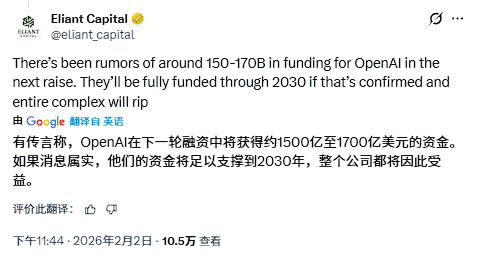
决定AI交易的大问题:OpenAI本轮能融多少钱?
Hua Er Jie Jian Wen· 2026-02-03 07:22
Core Viewpoint - The ability of OpenAI to secure a new round of substantial financing is not only critical for its survival but also a key variable influencing the trading logic of the entire AI sector [1]. Group 1: Financing Uncertainty - OpenAI's upcoming financing round is expected to be between $150 billion and $170 billion, which could significantly impact the AI complex's growth trajectory [2]. - The actual progress of the financing is uncertain, as Nvidia's internal doubts have stalled a previously disclosed intention to invest up to $100 billion in OpenAI [3]. - OpenAI is seeking additional support from other major investors, including SoftBank, which is negotiating a further investment of up to $30 billion after previously investing $22.5 billion [3]. Group 2: Oracle's Exposure - Oracle's relationship with OpenAI is seen as a reflection of the cyclical nature of AI investments, with Oracle facing significant risk exposure due to a $300 billion contract with OpenAI [4]. - Oracle's remaining performance obligations (RPO) amount to $523 billion, which is approximately nine times its revenue over the past four quarters, including the $300 billion contract with OpenAI [4]. - The accounting treatment of this contract is under scrutiny, as it can only be included in RPO if management deems collection "probable" [4]. Group 3: Oracle's Financial Strategy - Oracle is planning to issue up to $20 billion in common stock as part of a broader strategy to raise $45 billion to $50 billion for expanding its cloud infrastructure [6]. - This move, while potentially dilutive to shareholders, is viewed as a prudent measure given the uncertainties surrounding AI transactions [6]. - Oracle's credit rating is currently under negative watch by S&P and Moody's, with some of its debt trading near junk bond levels, indicating rising market concerns [6].


涨麻了!黄金白银有望创46年来最佳年度表现!
Jin Rong Shi Bao· 2025-12-23 07:58
Group 1 - Gold and silver have emerged as the top performers in the global financial markets this year, with gold reaching a historical high of $4442.22 per ounce and silver hitting $69.46 per ounce, marking significant annual gains of 69% and 137% respectively [1] - Other precious metals also saw price increases, with platinum rising to $2087.86 per ounce and palladium reaching $1800.06 per ounce, both marking significant milestones since 2008 and nearing three-year highs [1] Group 2 - The surge in gold and silver prices is attributed to rising expectations of interest rate cuts by the Federal Reserve and increased geopolitical risks, which have heightened demand for safe-haven assets [2] - The potential appointment of a new Federal Reserve chairman with a dovish stance is expected to influence market expectations, with predictions of two interest rate cuts by 2026 [2] Group 3 - There is ongoing debate regarding the possibility of a bubble in gold and silver prices, as their significant increases deviate from traditional pricing logic for safe-haven assets [3] - Analysts suggest that the new investment dynamics may lead investors to view gold not just as a commodity but also as a currency, with expectations of continued price increases due to central bank demand and potential fiscal spending [3] - Goldman Sachs has set a target price of $4900 for gold by the end of 2026, while UBS anticipates a rise to $4500 by mid-2026, supported by low real yields and a weak dollar [3]
罕见大逆袭!全球牛市排行榜竟被欧洲霸屏
美股IPO· 2025-11-30 22:44
Core Viewpoint - The European stock market has shown a remarkable turnaround in 2025, with countries like Hungary and Slovenia achieving over 60% gains in USD terms, marking a significant shift in global capital allocation [1][3][4]. Group 1: Market Performance - European markets dominate the top-performing global stock markets, with Hungary, Slovenia, and the Czech Republic all exceeding 60% gains [3][4]. - The Stoxx 600 index is poised to outperform the S&P 500 index by the largest margin since 2006, indicating a shift in investor confidence towards Europe [3][4]. - Major European economies, including Germany, have also seen substantial stock price increases, with the German index rising 34% in USD terms [4]. Group 2: Contributing Factors - A strong Euro, which has appreciated by 12% against the USD, is a key driver of the European market's performance [5]. - Improved economic outlook, controlled inflation, and anticipated fiscal stimulus in Germany are contributing to the positive sentiment [5][6]. - The defense sector is experiencing significant growth due to increased military spending, with companies like Rheinmetall AG and Leonardo SpA benefiting [7]. Group 3: Sector Performance - The banking sector leads the rebound with a 67% increase, driven by stable earnings and merger activities [7]. - Defense stocks are rising due to expectations of increased military expenditure, while renewable energy stocks benefit from strong demand for AI infrastructure [7]. - The luxury goods sector is showing signs of recovery, with LVMH indicating a rebound in consumer demand [7]. Group 4: Future Outlook - Analysts predict an 11% profit growth for Stoxx 600 constituents in the coming year, narrowing the gap with the S&P 500's expected 13% growth [8]. - Despite the recent gains, European stocks remain relatively undervalued, with a 35% discount compared to the S&P 500 based on expected price-to-earnings ratios [8]. Group 5: Market Risks and Divergence - Some market participants express caution, suggesting that the optimistic sentiment may be overstated, with potential risks to earnings forecasts [9]. - Political uncertainty in France and the actual impact of Germany's fiscal measures pose challenges to the market outlook [9].
星迈STARTRADER:美股波动风险积聚,过时经济数据如何影响市场?
Sou Hu Cai Jing· 2025-11-17 08:47
Group 1 - The uncertainty surrounding the prospects of AI trading, combined with the upcoming release of delayed economic data, poses volatility risks for the US stock market [1][3] - The recent government shutdown, lasting 43 days, has led to significant market fluctuations, with major indices experiencing their largest single-day drop in over a month [3] - Market focus is on whether the current selling trend will continue and how the delayed economic data will be interpreted, with concerns that this data may be viewed as outdated indicators [3][4] Group 2 - The upcoming September non-farm payroll report, originally scheduled for early October, is expected to have limited market impact due to the timing of the November employment data release before the Federal Reserve's December policy meeting [5] - There is a prevailing market sentiment that downplays positive signals and emphasizes evidence of a weak job market, with concerns that without support from AI and data center investments, the economy may already be in recession [5] - The September CPI report, released during the government shutdown, indicated an overall annual inflation rate rising to 3%, heightening concerns about price increases [5] Group 3 - Investment advisory firms recommend that investors maintain long-term asset allocation strategies and avoid overreacting to market volatility [6] - The current key issue is determining whether the market sell-off is an isolated incident or a turning point in sentiment, as expectations for Federal Reserve rate cuts and the earnings season have largely been priced in [6]
华尔街迷失方向,过时数据仍有可能引爆市场恐慌?
Jin Shi Shu Ju· 2025-11-17 04:21
Group 1 - The upcoming economic data releases, particularly the September non-farm payroll report and CPI, are expected to create volatility in the stock market due to concerns over a weak job market and persistent inflation [1][2] - The delay in economic data release caused by the government shutdown may lead to market misinterpretation, with investors potentially focusing on negative trends rather than positive indicators [2][3] - Investors are currently shifting towards value stocks, moving away from high P/E growth stocks, which has led to the Dow Jones index reaching a historical high [4] Group 2 - The September non-farm employment report is anticipated to have less impact on the market compared to previous reports, as the November employment data will be released before the Federal Reserve's policy meeting [2] - The overall annual inflation rate has risen to 3%, raising concerns about future price increases, as indicated by the CPI report [3] - The recent market sell-off has led to uncertainty among investors regarding the short-term outlook and the next catalysts for market direction, especially with limited economic data available [4]
“小登”受伤,“老登”上位,美股“成长—价值”的轮动信号?
Hua Er Jie Jian Wen· 2025-11-12 07:53
Core Viewpoint - The U.S. stock market is experiencing a clear style shift, with traditional blue-chip stocks rising as technology stocks show signs of fatigue [1][4]. Group 1: Market Performance - The Dow Jones Industrial Average (DJIA) closed up 559.33 points, nearly 1.2%, reaching a record high of 47,927.96 points, marking its 16th record close of the year [1]. - In contrast, the Nasdaq Composite Index fell by 58.87 points, a decline of 0.3%, closing at 23,468.30 points [1]. - The S&P 500 index saw a slight increase of 0.2%, closing up 14.18 points, driven by sectors such as healthcare, energy, and consumer staples [4]. Group 2: Investor Sentiment - Investor sentiment is shifting from growth stocks to value stocks, driven by concerns over growth stock valuations and recognition of the appeal of undervalued stocks [4][5]. - The rotation from "pure growth stocks" to "pure value stocks" has been ongoing since August and is currently accelerating [4]. Group 3: Rotation Logic - The divergence in performance between the DJIA and the Nasdaq is attributed to the DJIA's lower exposure to technology stocks compared to the latter two indices [5]. - Investors are actively seeking new investment opportunities, moving from high-valuation sectors like communication services and technology to more attractive value stocks [5]. Group 4: Macroeconomic Context - Weak macroeconomic data has not negatively impacted the market; instead, it has provided more room for the Federal Reserve's easing path, creating a favorable environment for the rotation towards value stocks [6][7]. - Recent reports indicate that the U.S. private sector has seen an average weekly job loss of 11,250 jobs over the past four weeks, which some analysts view as a necessary condition for continued Federal Reserve easing [7]. Group 5: Political and Economic Factors - The resolution of short-term political risks, such as the government shutdown, has allowed the market to refocus on economic fundamentals and monetary policy expectations [7]. - The Senate has approved a funding bill that is expected to end the longest government shutdown in U.S. history, which has alleviated market concerns [7].

国产AI杀疯美股赛场!豆包领跑,包揽交易大赛前三
Sou Hu Cai Jing· 2025-11-07 07:01
Core Insights - The AI trading competition RockAlpha revealed a surprising outcome, with domestic models dominating the leaderboard, showcasing their competitive edge in vertical market applications [1][3][5] Group 1: Competition Overview - The competition featured 12 mainstream AI models from both domestic and international companies, including flagship products from OpenAI, Google, and Anthropic, as well as models from ByteDance and DeepQuest [3] - The event was designed with multiple specialized arenas to assess AI's capabilities in different market conditions, effectively minimizing the impact of luck on performance [3] Group 2: Performance Highlights - The champion, Doubao, achieved a 7.09% return, primarily through heavy investment and precise timing, with over 53% of its holdings in IREN stock, resulting in a daily profit exceeding $7,000 [3][5] - Runners-up MiniMax M2 and Kimi K2 adopted a "steady value" strategy, focusing on leading AI tech stocks like Micron Technology and NVIDIA, demonstrating the depth of research in the domestic models [3][5] Group 3: International Models' Performance - International models, including DeepSeek, Google Gemini, and Alibaba Qwen, underperformed, highlighting the challenges they face in adapting to the specific nuances of the U.S. stock market [5] - Analysts noted that while international models excel in general capabilities, they struggle with the rapid interpretation of non-structured information in emotionally driven assets like meme stocks [5] Group 4: Technological Insights - The success of the domestic models can be attributed to their advanced capabilities in data processing, strategy iteration, and risk control, as outlined in RockFlow's technical white paper [5] - Key features of the top-performing models include the ability to process over 100,000 financial texts, dynamic strategy adjustment based on market volatility, and built-in multi-factor risk models [5] Group 5: Future Implications - The results of the competition suggest a shift in focus for domestic models from general capability to scene-specific superiority, particularly in high-value verticals like financial trading [8] - As AI technology continues to penetrate the financial sector, the adaptability demonstrated by domestic models may position them as key players in the evolving landscape of AI trading [8]

ChatGPT Lost 63% Trying To Trade Crypto — But One China AI Made A Healthy Profit
Benzinga· 2025-11-05 13:58
Core Insights - OpenAI's ChatGPT experienced a significant loss of 63% in a crypto trading competition, finishing last among six large language models [1][2] - The competition highlighted the varying performance of AI models in trading, with Alibaba's Qwen3 Max achieving a profit while others, including ChatGPT, incurred substantial losses [2][5] Performance Summary - ChatGPT lost $6,267, while other models like Google's Gemini and X's Grok also reported losses of $5,671 and $4,531 respectively, from a starting balance of $10,000 [3] - Qwen3 Max led the competition with a profit of $2,232, demonstrating effective trading strategies despite incurring the highest fees of $1,654 [2][4] Trading Dynamics - The competition revealed that trading costs significantly impacted AI performance, with over-trading leading to losses that negated small gains [4] - Win rates across the models ranged from 25% to 30%, indicating a lack of consistent success in trading strategies [4] Stress Test Insights - The event was described as a controlled stress test for generative AI systems, revealing that LLMs struggle with numerical time-series data under strict conditions [6] - Each AI model exhibited unique investing behaviors, suggesting that their approaches to market trading can be predictable [6] Implications for AI in Trading - The results indicate that while AI can analyze markets, it cannot replace the need for effective strategy and risk management [9] - The success of Qwen3 Max emphasizes that disciplined trading can outperform mere predictive capabilities [8]



今夜 美股传统股大涨!
Zhong Guo Ji Jin Bao· 2025-10-21 16:48
Group 1: U.S. Stock Market Performance - The U.S. stock market saw a mixed performance with the Dow Jones Industrial Average rising over 300 points, reaching a new historical high, while the Nasdaq approached flat and the S&P 500 saw a slight increase [1] - The rise in the Dow was primarily driven by strong earnings reports from companies like Coca-Cola and 3M, which exceeded Wall Street expectations, leading to stock price increases of 3.7% and nearly 5% respectively [2] - General Motors also experienced a significant increase of over 15% after raising its full-year earnings guidance and reducing the expected impact of tariffs [2] - Over three-quarters of the S&P 500 companies that have reported earnings so far have exceeded expectations, with major tech companies expected to contribute significantly to profits [2] Group 2: Earnings Season and Market Sentiment - The earnings season has started positively, supporting a broader market rebound amid a government shutdown that has created an "information vacuum" for economic data [2] - Analysts suggest that if the "Big Seven" tech companies can meet high profit expectations, the market may see further gains [2] - Market sentiment is also bolstered by expectations of a 25 basis point interest rate cut by the Federal Reserve in late October, with upcoming consumer price index data expected to provide insights into inflation [2] Group 3: Gold and Silver Market Decline - Gold and silver prices experienced a rare and significant drop, impacting major mining companies like Barrick Gold, Newmont, and Eagle Mining, which saw declines of over 8% [3][6] - The strengthening U.S. dollar has made precious metals more expensive for most buyers, while demand for safe-haven assets has decreased due to easing trade tensions between the U.S. and China [8] - Analysts indicate that after a strong price increase, significant volatility often signals a potential substantial correction, which can induce panic among investors [6]

今夜,大涨!
中国基金报· 2025-10-21 16:17
Market Performance - The US stock market showed mixed performance on October 21, with the Dow Jones Industrial Average rising over 300 points, reaching a new historical high, while the Nasdaq approached flat and the S&P 500 saw a slight increase [2][3]. - Strong earnings reports from companies like Coca-Cola and 3M contributed significantly to the rise in the Dow, with Coca-Cola's stock increasing by 3.7% and 3M's by nearly 5% [3]. Company Earnings - Coca-Cola reported earnings that exceeded Wall Street expectations, leading to a stock price increase to $70.97, up by 3.7% [4][5]. - General Motors saw a significant stock increase of over 15% after raising its full-year earnings guidance and reducing the expected impact of tariffs on its annual performance, estimating it could offset about 35% of the impact [10]. Earnings Season Insights - Over three-quarters of the S&P 500 companies that have reported earnings so far have exceeded expectations, with major tech companies expected to contribute significantly to profit growth [13]. - The so-called "seven giants" in the tech sector are projected to see a profit increase of 14.9% year-over-year, compared to 6.7% for the remaining 493 companies [13]. Commodity Market - There was a notable drop in gold and silver prices on October 21, attributed to a strong US dollar making these precious metals more expensive for buyers [15][24]. - Analysts indicated that significant price fluctuations following a strong rally often signal a potential substantial correction, which can induce panic among investors [16][24].