DobotAtom

Search documents
兴业证券:2026年值得关注的十大产业趋势
智通财经网· 2026-02-18 03:45
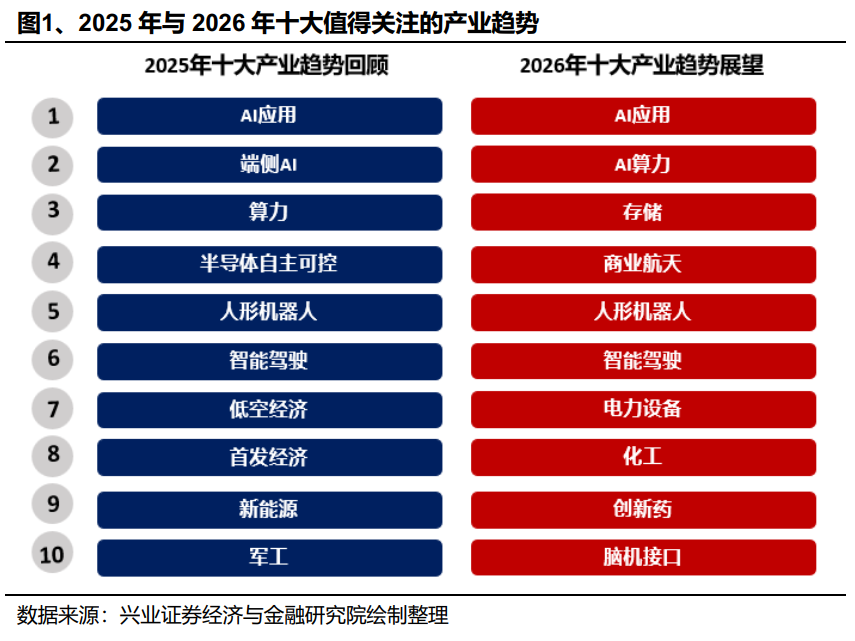
Group 1: AI Applications - The global AI competition is intensifying, with model iterations driving deeper application scenarios, and the focus is on whether significant capital expenditures by tech giants can lead to commercial applications [2][3] - The competitive landscape for AI applications is shifting from dominance by OpenAI to a more multipolar environment, with major players like Google and Meta integrating AI into their ecosystems [3] - In China, AI applications are experiencing a breakthrough, with major tech companies accelerating model iterations and application deployments, leading to a transformation from model landing to scenario monetization [5] Group 2: AI Computing Power - Overseas, major cloud service providers are maintaining high capital expenditures, with a projected increase of 67% in 2026, reflecting a strong demand for AI computing power [7][8] - In China, leading tech companies are increasing capital expenditures and accelerating the iteration of domestic large models, promoting the performance of domestic chips amid tightening supply from foreign sources [9] Group 3: Storage - The demand for storage is entering a new super cycle driven by AI training and inference needs, with AI servers consuming significantly more memory than traditional servers [11][16] - Supply constraints are expected to persist, leading to continued high prices for storage components, as major manufacturers shift production focus to advanced memory types [16] Group 4: Commercial Aerospace - Commercial aerospace is becoming a key battleground in US-China competition, with significant policy support and funding initiatives in both countries to accelerate industry development [19][21] - Domestic companies are achieving breakthroughs in satellite mass production and reusable rocket technologies, transitioning from technical validation to commercialization [22] Group 5: Humanoid Robots - Major overseas companies are ramping up production plans for humanoid robots, benefiting domestic component suppliers, with Tesla aiming for a production capacity of 500,000 units by 2026 [27][30] - Chinese manufacturers are leading in humanoid robot shipments, with significant contracts and production milestones achieved in 2025 [30] Group 6: Intelligent Driving - Domestic policies are expected to facilitate the commercialization of L3 autonomous driving in 2026, with several manufacturers preparing to launch L3 models [32][33] - Tesla's Full Self-Driving (FSD) technology is setting the direction for autonomous driving, with significant advancements in AI capabilities [35] Group 7: Energy Storage - The expansion of AI computing power in North America is driving electricity demand, with domestic power equipment expected to accelerate exports [37][40] - China's "14th Five-Year Plan" includes significant investments in the power grid and energy storage, creating a favorable environment for industry growth [40][43] Group 8: Chemicals - The chemical industry is undergoing a transformation driven by policies aimed at supply-side reform, with a focus on optimizing supply structures and reducing excess capacity [44][47] - New economic sectors are boosting demand for chemical materials, particularly in AI, renewable energy, and robotics, leading to a favorable outlook for new materials [47][48]


【兴证策略】2026年值得关注的十大产业趋势
Xin Lang Cai Jing· 2026-02-18 02:55
Group 1: AI Applications - The global AI competition is intensifying, with significant capital expenditures from tech giants expected to lead to deeper application scenarios in 2026 [1][2] - The competitive landscape for AI applications is shifting from a dominance of OpenAI to a more multipolar environment, with companies like Google and Meta making significant advancements [2] - Domestic AI applications are reaching a tipping point, with major tech companies accelerating their investments and model iterations, leading to a resonance between model development and application penetration [5] Group 2: AI Computing Power - Major cloud service providers in North America are projected to increase their capital expenditures significantly, with a combined guidance of approximately $598.7 billion for 2026, reflecting a 67% year-on-year growth [7][8] - Domestic companies are also ramping up capital expenditures and accelerating the iteration of local models, driven by the need for domestic chip performance improvements [7][8] Group 3: Storage - The demand for storage is entering a new super cycle driven by AI training and inference needs, with AI servers consuming 8-10 times more DRAM and NAND than traditional servers [12][13] - The supply-demand imbalance in the storage sector is expected to persist, with global storage prices rising over 40% in Q4 2025 [13][17] Group 4: Commercial Aerospace - Commercial aerospace is becoming a key battleground in US-China competition, with significant policy support and funding initiatives in place to accelerate the industry [20][21] - Domestic companies are achieving breakthroughs in satellite mass production and reusable rocket technologies, transitioning from technology validation to commercial scale [23] Group 5: Humanoid Robots - Major overseas companies like Tesla and FigureAI are ramping up production plans for humanoid robots, which is expected to benefit domestic component suppliers [25][28] - Chinese manufacturers are leading in humanoid robot shipments, with significant orders and production milestones achieved in 2025 [29] Group 6: Intelligent Driving - The rollout of policies in China is expected to facilitate the commercialization of L3 autonomous driving in 2026, with several manufacturers already launching L3 models [32][33] - Tesla's Full Self-Driving (FSD) technology continues to lead the market, with ongoing enhancements expected to drive the commercialization of Robotaxi services [32] Group 7: Energy Storage - The aging power grid in North America is creating opportunities for domestic power equipment exports, particularly in gas turbines and high-voltage equipment [36][37] - China's "14th Five-Year Plan" includes significant investments in the power grid and energy storage, with a focus on high-value areas [37] Group 8: Chemicals - The chemical industry is undergoing a transformation driven by supply-side reforms, with a focus on optimizing supply structures and reducing excess capacity [41][43] - New economic sectors are driving demand for chemical materials, particularly in AI, renewable energy, and robotics, which are expected to sustain high demand in 2026 [43][46]
彻底火了,又一板块大爆发!有公司今年已猛涨158%
21世纪经济报道· 2025-04-01 04:17
Core Viewpoint - The robotics sector is experiencing significant growth in 2025, emerging as a major investment opportunity following AI, with a notable increase in stock prices among robotics companies, particularly in Guangdong province [1][2][5]. Group 1: Market Performance - As of March 31, 2025, there are 115 listed robotics concept stocks in China, with 98 of them showing price increases [2]. - Guangdong's robotics stocks have outperformed, with the top three companies being Yuejiang and Julun Intelligent, both part of the "Seven Swordsmen" of Guangdong robotics [3][4]. - Yuejiang (2432.HK) has the highest price increase of 157.59%, with a market cap of 24.68 billion HKD, while Julun Intelligent (002031.SZ) increased by 74.85%, with a market cap of 19.11 billion RMB [4][5]. Group 2: Technological Innovation and Application - The surge in stock prices for the "Seven Swordsmen" is driven by technological innovation and industrial development [5][7]. - Yuejiang launched the world's first "dexterous operation + bipedal walking" humanoid robot, DobotAtom, priced below 200,000 RMB, which significantly boosted its stock price [7][8]. - Guangdong robotics companies are already implementing their products in real-world applications, such as Audi's introduction of humanoid robots for production tasks [9][10]. Group 3: Investment and Policy Support - Guangdong is a leading investment hub for robotics, with significant venture capital activity, including 53 financing events in 2024 [14]. - The province is actively promoting the listing and financing of robotics companies, with 28 out of 115 listed companies based in Guangdong [15]. - Recent policies aim to support the robotics industry through various measures, including funding and innovation initiatives [24]. Group 4: Future Outlook - The year 2025 is anticipated to be a pivotal year for humanoid robot production, with expectations for significant market growth [21][26]. - The demand for humanoid robots is expected to increase, with companies like Yuejiang and Ubtech already securing substantial orders from major manufacturers [22][23]. - The Guangdong government is committed to fostering an innovative ecosystem for robotics, with a focus on long-term investments and talent acquisition [24][25].