Dojo 3芯片

Search documents
特斯拉战略转型,未来将以人工智能和机器人为核心,不再追求汽车销售规模
Sou Hu Cai Jing· 2026-01-30 09:04
Core Insights - Tesla announced a strategic shift towards artificial intelligence and robotics as its core business focus, moving away from the pursuit of larger automotive sales volumes and initiating a 100GW solar capacity construction plan [1] Financial Performance - In 2025, Tesla achieved total revenue of $94.827 billion and a net profit of $3.794 billion, representing year-over-year decreases of 2.93% and 46.50% respectively [3] - The company produced approximately 1.655 million electric vehicles and delivered 1.636 million units globally, with record deliveries in the Asia-Pacific market; energy storage installations reached 46.7 GWh, a year-over-year increase of 48.7% [3] Production Highlights - The Shanghai Gigafactory delivered 851,000 electric vehicles in 2025, accounting for 52% of total global deliveries; the Shanghai energy storage facility plans to produce 10,000 Megapacks annually, having already rolled out 2,000 units by the end of 2025 [3] Strategic Plans - CEO Elon Musk stated that the future vision is to achieve "extraordinary wealth for all humanity" rather than just "basic income," with a revised mission to "build an extraordinary world" [4] - For 2026, Tesla plans to exceed $20 billion in capital expenditures, including transforming the Fremont factory's Model S/X production line into a humanoid robot production line, expected to start mass production by the end of 2026 with an annual capacity of 1 million units [4] - The Texas Gigafactory will enhance its local computing power by over 100% in the first half of 2026, and Tesla aims to launch its AI5 and AI6 autonomous driving chips in 2027 and 2028 respectively [4] Market Reactions - Following the announcement of the strategic shift and high investment plans, Morgan Stanley and Goldman Sachs lowered their target prices for Tesla, from $425 to $415 and from $420 to $405 respectively [4]


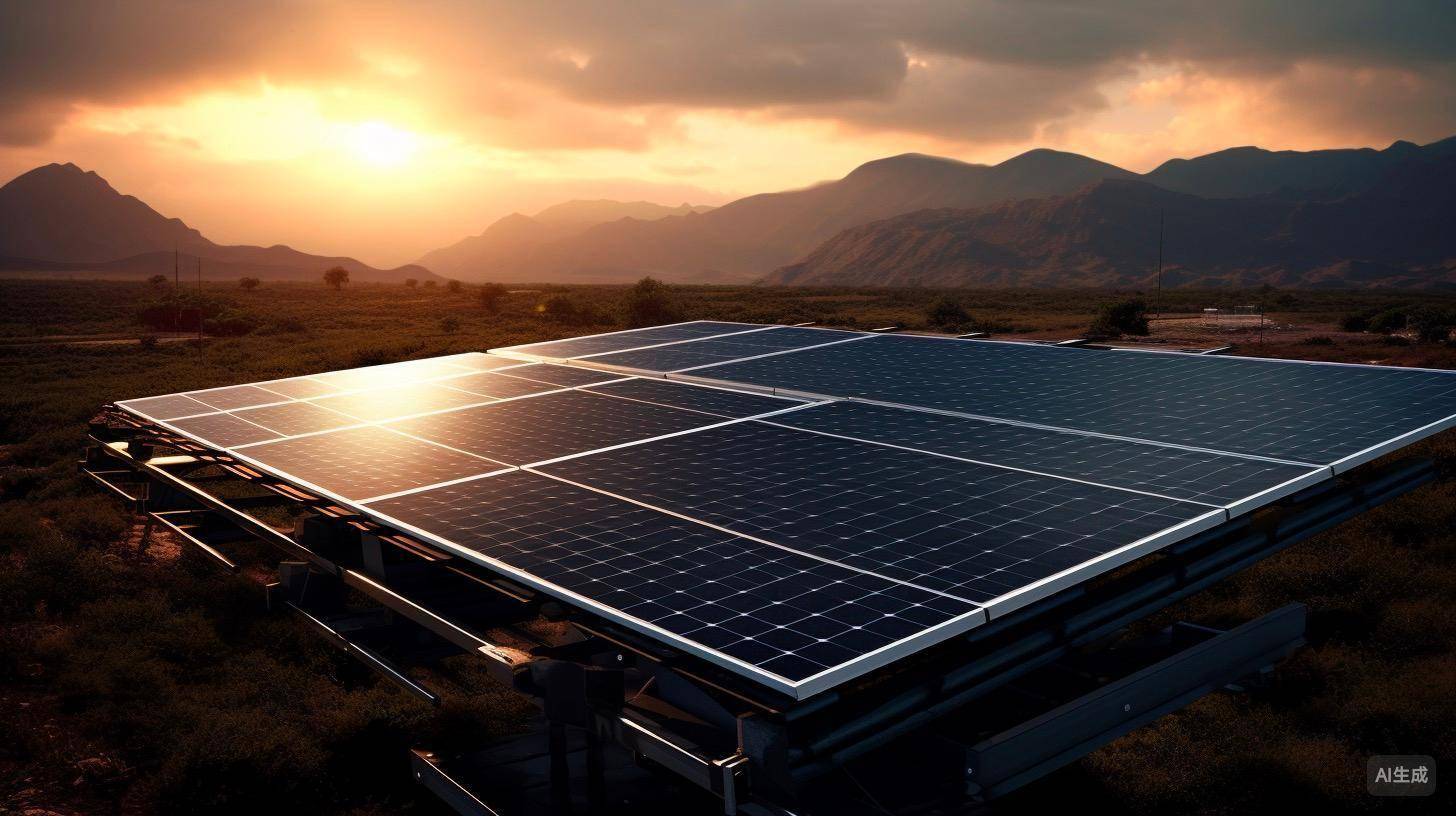
特斯拉要变了!建100GW光伏产能,不再追求汽车规模
2 1 Shi Ji Jing Ji Bao Dao· 2026-01-30 07:52
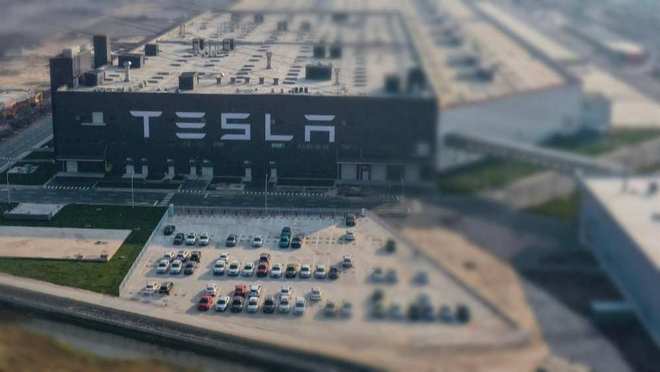
Core Viewpoint - Tesla's recent financial report highlights a shift in focus from traditional automotive manufacturing to a broader strategy encompassing autonomous driving, robotics, and energy solutions [3][4]. Financial Performance - In Q4 2025, Tesla reported revenues of $94.827 billion and a net profit of $3.794 billion, representing year-over-year declines of 2.93% and 46.50% respectively [3]. - The company delivered approximately 1.636 million electric vehicles (EVs) globally, with a production of about 1.655 million EVs, marking a record high in the Asia-Pacific market [3]. Business Developments - Tesla's Shanghai Gigafactory delivered 851,000 EVs in 2025, accounting for 52% of total global deliveries [3]. - The company achieved a record energy storage installation of 46.7 GWh, a year-over-year increase of 48.7% [3]. - Plans for the Shanghai Super Energy Factory include an annual production capacity of 10,000 Megapacks, with 2,000 units already produced by the end of 2025 [3]. Strategic Shift - CEO Elon Musk indicated a strategic pivot towards AI and robotics, aiming to create a "prosperous world" rather than merely increasing vehicle sales [4]. - Tesla's capital expenditure for 2026 is projected to exceed $20 billion, with significant investments in transforming production lines for humanoid robots and enhancing AI training capabilities [4]. Energy Initiatives - Tesla aims to achieve 100 GW of solar panel production capacity, which will support AI data centers and enhance grid capacity through solar and storage systems [6]. - The company plans to start production of Megapack 3 and Megablock at its Houston energy factory in 2026 [5]. Market Reactions - Following Tesla's strategic announcements and investment plans, some investment banks have expressed caution, with Morgan Stanley and Goldman Sachs lowering their target prices for Tesla shares [6].
特斯拉正计划重启Dojo 3芯片研发工作
Xin Lang Cai Jing· 2026-01-19 05:56
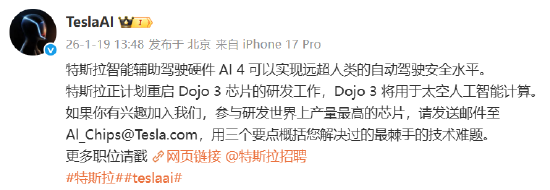
Group 1 - Tesla announced that its AI 4 hardware for smart assisted driving can achieve safety levels far exceeding human capabilities [1][3] - The company plans to restart the development of the Dojo 3 chip, which will be used for space artificial intelligence computing [1][3] - Tesla issued a recruitment notice inviting engineers interested in developing the world's highest production chips to apply, requiring candidates to summarize three key technical challenges they have solved [1][3]
特斯拉计划调整第三代Dojo芯片供应链 三星与英特尔或将参与其中
Huan Qiu Wang Zi Xun· 2025-08-08 04:18
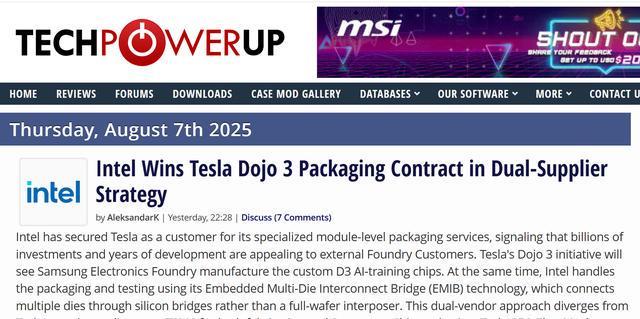
Group 1 - Tesla is considering a comprehensive adjustment to the supply chain for its third-generation self-developed AI ASIC chip, Dojo 3 [1] - The advanced front-end manufacturing process for Dojo 3 may be handled by Samsung's foundry, while the advanced back-end packaging is planned to be managed by Intel [1] - The Dojo 1 chip utilizes 7nm advanced process and InFO-SoW large-area advanced packaging technology, entirely produced by TSMC [2] Group 2 - The second-generation product, Dojo 2, is expected to achieve mass production by TSMC within the year [2] - Elon Musk previously indicated plans to unify AI6 and Dojo 3 into a single architecture, eliminating the development of a standalone Dojo 3 and instead reusing the ASIC Die of AI6 for larger scale [2] - Samsung's Taylor semiconductor plant in the U.S. is expected to provide 2nm process foundry support for the AI6 chip and is also anticipated to support Dojo 3 [2]
特斯拉下一代AI芯片,将亮相
半导体芯闻· 2025-06-06 10:20
Group 1 - The core viewpoint of the article highlights the progress of Tesla's Dojo AI training computer and the upcoming launch of the next-generation AI chip, Dojo 2, later this year. It emphasizes that significant technological advancements require multiple iterations, with Dojo 3 expected to be even better than its predecessor [1] - Tesla AI's latest Dojo technology report indicates that the Dojo supercomputer is facing issues related to manufacturing defects and aging, which lead to silent data corruption (SDC). Unlike traditional system failures, these defects do not manifest immediately but compromise data integrity during training [1] - A defective node can result in erroneous outcomes from weeks of AI model training or significantly slow down convergence speed. More critically, these issues are nearly undetectable after model training is completed, potentially leading companies to deploy AI systems trained on corrupted data without their knowledge [1] Group 2 - The Dojo supercomputer, designed by Tesla, serves as a training ground for artificial intelligence, particularly for Full Self-Driving (FSD) applications. The name "Dojo" pays homage to martial arts training halls [1] - The supercomputer consists of thousands of small computers known as nodes, each equipped with its own CPU (Central Processing Unit) for overall management and GPU (Graphics Processing Unit) for handling complex tasks, such as dividing tasks into multiple parts for simultaneous processing [1]