EC7

Search documents
Buy, Hold or Sell NIO Stock? Key Insights Ahead of Q4 Earnings
ZACKS· 2026-03-06 14:41
Core Insights - NIO Inc. is expected to report a loss of 5 cents per share for Q4 2025, with revenues projected at $4.61 billion, reflecting a year-over-year growth of approximately 71% [1][2] Financial Performance - The loss estimate for Q4 2025 has improved by 2 cents over the past week, compared to a loss of 47 cents in the same quarter last year [2] - For the full year 2025, NIO's revenues are estimated at $12.6 billion, indicating a 38% increase year-over-year, while the projected loss per share is $1.05, an improvement from $1.51 in 2024 [3] - NIO's vehicle deliveries reached a record 124,807 units in Q4 2025, up 72% year-over-year, contributing to the anticipated revenue growth [6][7] Market Position and Competitive Landscape - NIO's delivery growth outperformed competitors, with Li Auto's deliveries falling to 109,194 units, down from 158,696 units a year earlier, and XPeng's deliveries increasing by only 27% [8] - The company has diversified its product portfolio with the introduction of the ONVO and Firefly brands, which have contributed to sales momentum [11] Operational Efficiency - NIO expects to achieve its first adjusted operating profit in Q4 2025, estimated between 700 million and 1.2 billion yuan, a significant turnaround from a loss of 5.54 billion yuan in the same quarter of 2024 [10] - Vehicle margins improved to 14.7% in Q3 2025 from 13.1% in Q3 2024, driven by increased deliveries and cost optimization [9] Growth Strategy - NIO is expanding its market reach by launching more affordable models and targeting various customer segments, which is expected to enhance its competitive edge in the EV market [11][18] - The company has achieved cumulative deliveries of over one million vehicles, with a strong demand trend continuing into 2026 [19] Valuation Metrics - NIO's current forward price-to-sales ratio is 0.53, lower than the industry average of 0.62 and competitors like Li Auto and XPeng [15]


【汽车】春节长假扰动销量,关注财报季业绩表现——新势力2月销量跟踪报告(倪昱婧/邢萍)
光大证券研究· 2026-03-03 23:03
Core Viewpoint - The article discusses the impact of the Spring Festival holiday on February's new energy vehicle (NEV) sales, highlighting the performance of various manufacturers and the upcoming product launches in the industry [4][5][7]. Group 1: February NEV Sales Performance - Li Auto's delivery volume increased by 0.6% year-on-year but decreased by 4.5% month-on-month to 26,421 units [4] - NIO's delivery volume rose by 57.6% year-on-year but fell by 23.5% month-on-month to 20,797 units, with the NIO brand up by 65.8% year-on-year and down by 27.5% month-on-month to 15,159 units, while the Lada brand decreased by 26.4% year-on-year and 14.3% month-on-month to 2,981 units [4] - Xpeng's delivery volume dropped by 49.9% year-on-year and 23.8% month-on-month to 15,256 units [4] Group 2: New Flagship Models Launch - On February 6, Li Auto officially launched the L9 Livis, a flagship SUV featuring an 800V fully active suspension and a self-developed high-performance driving platform [5] - On February 8, Xpeng announced the core parameters of the GX, an AI luxury six-seat flagship SUV, equipped with an 800V high-voltage platform and L4-level autonomous driving capabilities [5] - The flagship models from Li Auto and Xpeng aim to enhance product strength through chassis architecture and intelligent driving features to capture high-end NEV market share [5] Group 3: Financing and Delivery Updates - Tesla's domestic Model 3 delivery cycle has been shortened to 1-3 weeks, with various financing policies extended, including an 8,000 yuan limited-time insurance subsidy [6] - Li Auto maintains delivery cycles for L6/L9 at 1-3 weeks, while the delivery cycle for L8 has been extended to 2-4 weeks [6] - NIO's delivery cycles for several models remain stable, with the new ES8's cycle shortened to 4-5 weeks [6] - Xpeng's delivery cycles for several models have been adjusted, with the G9's cycle extended to 1-5 weeks [6] - Xiaomi's delivery volume exceeded 20,000 units in February, with financing offers continuing [6] - Huawei's Hongmeng Zhixing saw a year-on-year delivery increase of 31.1% but a month-on-month decrease of 51.3% to 28,000 units [6] Group 4: Upcoming Product Launches and Financial Performance - The industry anticipates a surge of new vehicle launches from multiple manufacturers in March and April, with a focus on financial performance amid rising costs [7][8] - Tesla is expected to launch the third-generation Optimus humanoid robot in Q1 2026, presenting potential investment opportunities in components related to domestic and international robot mass production [8]


Tesla or NIO: Which Stock Is Worth Retaining in Your Portfolio?
ZACKS· 2026-02-17 14:46
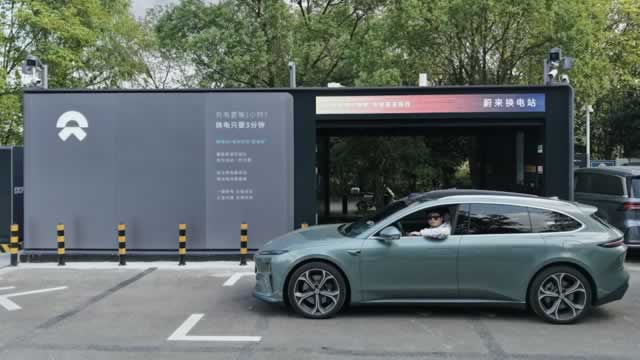
Core Insights - Tesla is facing intensified competition and a decline in market share, with an aging model lineup and CEO Elon Musk's political involvement impacting sales [1][5] - In contrast, NIO is focusing on EV growth in its domestic market and global expansion, showing strong delivery momentum [3][10] Tesla's Position - Tesla's deliveries fell more than 8% in 2025, marking the second consecutive year of decline, raising concerns about demand and pricing power [5] - The energy generation and storage segment achieved record deployments of 14.2 GWh in Q4 and 46.7 GWh for the year, a 49% year-over-year increase [6] - Tesla plans to significantly increase capital expenditures to over $20 billion in 2026, supporting major facilities and AI infrastructure [7][9] - Robotaxi services are expected to expand to seven new U.S. cities, with Musk suggesting autonomous Teslas could reach half of the U.S. population by year-end, pending regulatory approvals [8] NIO's Growth Strategy - NIO delivered 326,028 vehicles in 2025, a nearly 47% increase, and has crossed 1 million cumulative deliveries [10][12] - Vehicle margins improved to 14.7% in Q3 2025 from 13.1% a year earlier, with management targeting a 20% vehicle margin over time [13] - NIO's battery swap technology remains a key differentiator, with over 100 million swaps completed and plans for 1,000 additional swap stations by 2026 [14] - The company is expanding into Central Asia, Australia, New Zealand, and Europe, enhancing user engagement through software upgrades [15] Valuation and Investment Outlook - NIO appears more attractive from a valuation perspective, trading at a lower price-to-sales multiple compared to Tesla, which is above its historical average [16][18] - NIO is positioned for improving fundamentals and valuation comfort, while Tesla faces declining deliveries and heavy capital spending commitments [19]

As NIO Eyes Adjusted Operating Profit in Q4, Is the Stock a Buy Now?
ZACKS· 2026-02-10 15:35
Core Insights - NIO Inc. is showing signs of a turnaround with guidance for its first-ever quarterly adjusted operating profit in Q4 2025, expecting between 700 million and 1.2 billion yuan, a significant improvement from a 5.54 billion yuan loss in Q4 2024 [1][9] Group 1: Financial Performance - Q4 2025 deliveries reached a record 124,807 vehicles, representing a nearly 72% year-over-year increase, with all three brands achieving quarterly highs [3][10] - Vehicle margins improved to 14.7% in Q3 2025, up from 13.1% in Q3 2024, with a target to reach 20% this year [11] - Cumulative deliveries surpassed 1 million units, marking a significant scale milestone for the company [10] Group 2: Market Position and Strategy - NIO is expanding its market reach by launching the more affordable Onvo brand and the high-end Firefly brand, attracting new customers in a competitive EV market [2][9] - The company operates 3,790 battery swap stations globally and plans to add 1,000 more by the end of 2026, enhancing its competitive edge through its Battery-as-a-Service strategy [12] Group 3: Growth Initiatives - NIO is entering new markets, including Central Asia and plans to launch its Firefly sub-brand in Australia and New Zealand by late 2026, while also focusing on European expansion [13] - The latest software upgrades have been rolled out to over 460,000 vehicles, improving user experience and brand loyalty [13] Group 4: Valuation and Analyst Outlook - The stock is trading at a lower price-to-sales multiple compared to the broader industry, making it appear attractive for investment [14] - Analysts have set an average price target of $6.17 for NIO, indicating a potential upside of approximately 26% from current levels [16]
光大证券:1月新能源车表现疲软 各车企购车优惠加码
智通财经网· 2026-02-04 07:41
Core Viewpoint - The report from Everbright Securities highlights the focus on AI transformation in the automotive industry and the pressure from rising upstream raw material prices, particularly for new energy vehicles [1]. Group 1: AI Transformation in Automotive Industry - New energy vehicle companies are actively transitioning towards AI, especially in humanoid robotics. Tesla plans to gradually convert its Model S/X production line for humanoid robots, while Xpeng Motors will start mass production of humanoid robots in 2026. Li Auto has also established a humanoid robot team [1]. Group 2: Raw Material Price Pressure - From the end of 2025, prices for upstream raw materials such as copper, aluminum, and lithium carbonate have been rising, which is expected to pressure the gross profit margins of complete vehicles. The industry is advised to monitor the progress of price pressure digestion along the supply chain [1]. Group 3: January Performance of New Energy Vehicles - In January, the performance of new energy vehicles was weak: - Li Auto's delivery volume decreased by 7.5% year-on-year and 37.5% month-on-month to 27,668 units - NIO's delivery volume increased by 96.1% year-on-year but decreased by 43.5% month-on-month to 27,182 units - Xpeng's delivery volume fell by 34.1% year-on-year and 46.6% month-on-month to 20,011 units [1]. Group 4: New Model Launches - Various automakers launched updated models in January to meet tax requirements and enhance product competitiveness. BYD introduced long-range versions of its models, while Xpeng released several new models with improved cost-performance and intelligence levels [2]. Group 5: Increased Purchase Incentives - Tesla is offering significant purchase incentives, including insurance subsidies and low-interest financing options across its Model 3 and Model Y ranges. Other new energy vehicle companies like Li Auto, NIO, and Xpeng are also providing various financing options and maintaining competitive delivery timelines for their models [3][4]. Group 6: Delivery Performance - In January, Xiaomi delivered over 39,000 vehicles, while Huawei's delivery volume for its smart vehicle line increased by 65.5% year-on-year but decreased by 35.4% month-on-month to 58,000 units [4].

光大证券:1月各车企购车优惠加码 关注AI转型、以及上游原材料涨价压力消化
Zhi Tong Cai Jing· 2026-02-03 07:17
Core Viewpoint - The report from Everbright Securities highlights the focus on AI transformation in the automotive industry, particularly among new energy vehicle (NEV) manufacturers, while also addressing the pressure from rising raw material prices affecting profit margins. Group 1: AI Transformation in Automotive Industry - New energy vehicle companies are actively transitioning towards AI, especially in humanoid robotics, with Tesla planning to convert its Model S/X production line for humanoid robots, Xiaopeng announcing mass production of humanoid robots by 2026, and Li Auto establishing a humanoid robot team [1] Group 2: January NEV Performance - In January, the performance of NEVs was weak, with Li Auto's deliveries down 7.5% year-on-year and 37.5% month-on-month to 27,668 units; NIO's deliveries increased by 96.1% year-on-year but decreased by 43.5% month-on-month to 27,182 units; Xiaopeng's deliveries fell 34.1% year-on-year and 46.6% month-on-month to 20,011 units [1] Group 3: New Model Launches - Various NEV manufacturers launched updated models in January to meet tax requirements and enhance product competitiveness, including BYD's long-range versions of the Qin and Sea models, Xiaopeng's new P7+ and G7 models, and AITO's M7 long-range version [2] Group 4: Increased Purchase Incentives - Tesla is offering significant purchase incentives, including an 8,000 yuan insurance subsidy and low-interest financing for its Model 3 and Model Y vehicles, with delivery timelines ranging from 1 to 6 weeks [3] - Li Auto has maintained short delivery timelines for several models and extended purchase subsidies into February, while NIO and Xiaopeng have also introduced low-interest financing options across their vehicle ranges [4]
Here's Why You Should Retain NIO Stock in Your Portfolio Now
ZACKS· 2025-12-01 15:22
Core Insights - NIO Inc. is positioned for significant growth due to a strong vehicle lineup and expansion beyond luxury models, although challenges such as subsidy phaseouts and rising operating costs may hinder progress [1][6][8] Vehicle Lineup and Growth - NIO's expanding vehicle portfolio, including models like ES6, ET5T, ES8, and others, is driving delivery growth, with expectations of 40,000 ES8 units sold in 2025, primarily in Q4 [2][4] - The introduction of the ONVO brand and Firefly brand is expected to enhance volume, with ONVO's L60 model delivering 33,000 units in its first three months and Firefly delivering over 26,000 units in its first six months [3][8] Margin Improvement - Vehicle margins improved to 14.7% in Q3 2025 from 13.1% in Q3 2024, with expectations to reach 20% overall due to new model launches and cost synergies [4][8] Battery Swap Technology - NIO's battery swap technology, part of its BaaS strategy, provides a competitive advantage, with over 3,641 swap stations and more than 27,000 chargers installed [5] Challenges and Risks - The phaseout of trade-in and replacement subsidies is expected to dampen demand, particularly affecting lower-priced models like ONVO L60 and L90 [6][8] - Rising SG&A expenses, which increased by 1.8% year-over-year, are anticipated to continue due to increased sales and marketing efforts [7][8] - NIO's long-term debt to capital ratio stands at 0.82, significantly higher than the industry average of 0.27, limiting financial flexibility [8][9]
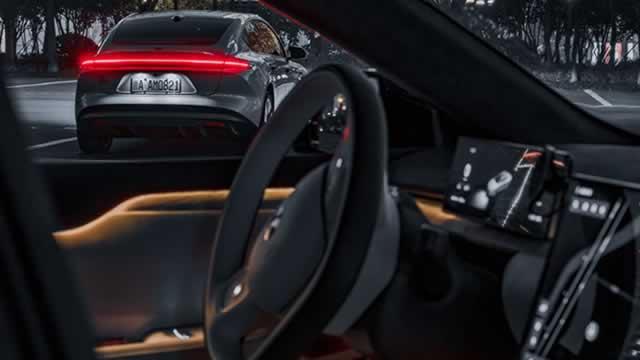
蔚来全系标配100度电池,变相降价3.8万
Guan Cha Zhe Wang· 2025-08-29 05:24
Core Points - NIO announced that all models will now come standard with a 100kWh battery pack, effectively reducing prices by 38,000 yuan through policy adjustments [1][3] - On August 19, NIO had already reduced the price of the 100kWh battery pack from 128,000 yuan to 108,000 yuan, and the permanent upgrade service fee from 58,000 yuan to 38,000 yuan [2] - NIO continues to offer battery rental options for both 75kWh and 100kWh batteries, with monthly fees remaining unchanged at 1,128 yuan and 728 yuan respectively [3] Customer Compensation - NIO will provide a 6,000 yuan renewal voucher to users who received their vehicles between January 1, 2025, and August 28, 2025, applicable for purchasing new NIO vehicles [4] - For users who have not yet received their vehicles, they can choose to purchase at the adjusted prices or the previous prices and benefits if they lock in their orders by August 31, 2025 [4] Purchase Incentives - From now until September 30, 2025, users who lock in orders for new ET5, ET5T, ES6, or EC6 will receive a free charging and discharging kit (or a 4,000 yuan option fund) and five years of free NOP+ usage [5] - Additional incentives include a 9,500 yuan value package for purchasing new ET5 or ET5T, and for ET7 or EC7, users will receive five years of free battery swaps (240 swap vouchers), five years of interest-free financing, and three years of free NOP+ usage [6] Points Adjustment - Starting September 1, 2025, the basic repurchase points for NIO brand will be adjusted to 20,000 from the previous 24,000 [7]
蔚来:即日起全系标配100kWh长续航电池包,起售价不变
Xin Lang Cai Jing· 2025-08-29 03:29
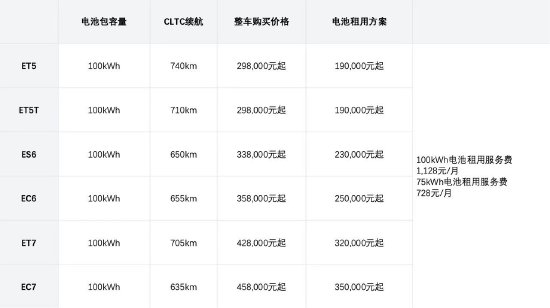
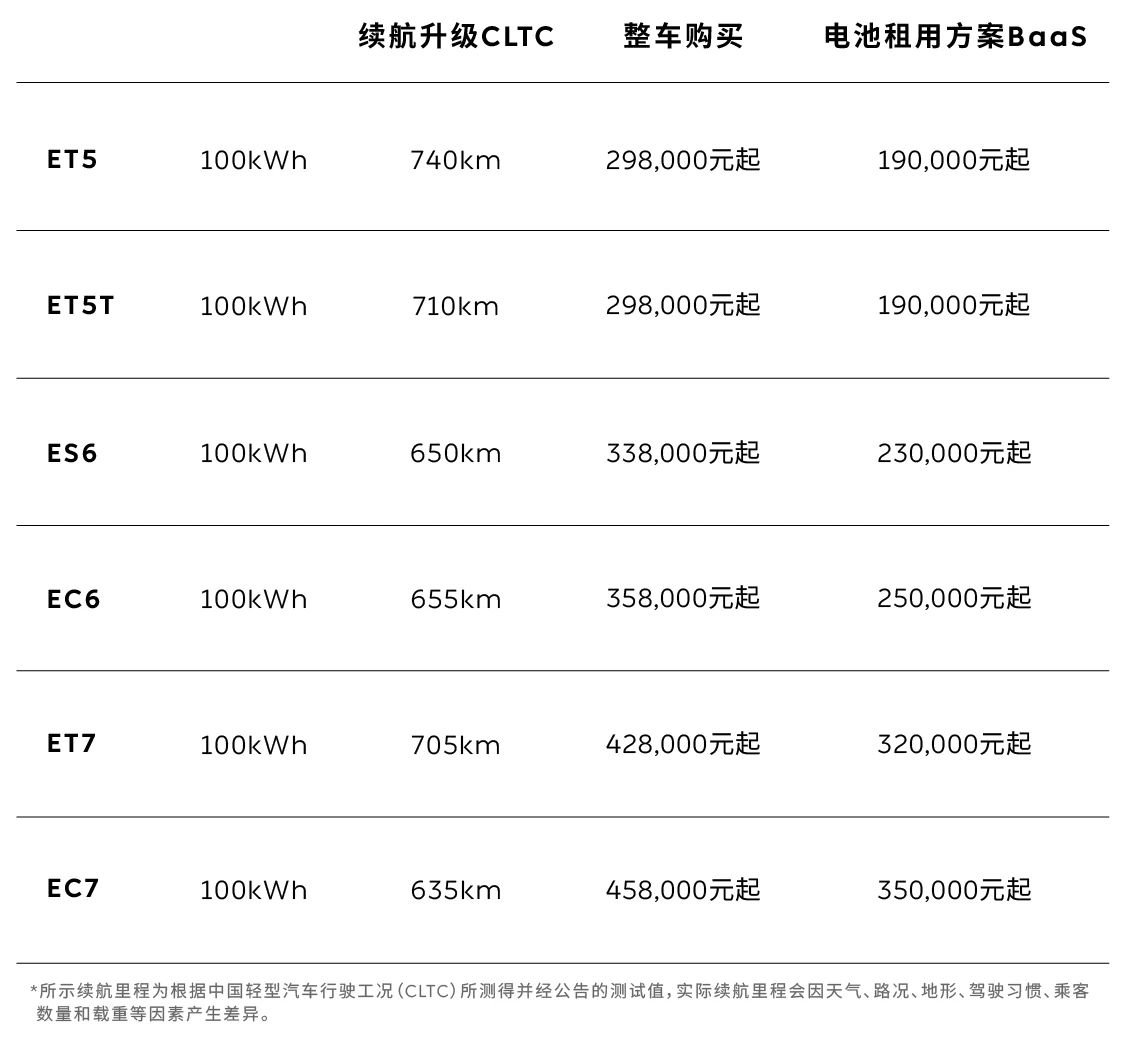
Core Insights - NIO has announced that all models will now come standard with a 100kWh long-range battery pack, maintaining the same starting price while adjusting related purchase benefits [1] - The company is also offering battery rental options, with a monthly service fee of 1128 yuan for the 100kWh battery and 728 yuan for the 75kWh battery [1] Pricing and Specifications - ET5: 100kWh battery, 740km range, starting price 298,000 yuan for purchase, 190,000 yuan for battery rental [2] - ET5T: 100kWh battery, 710km range, starting price 298,000 yuan for purchase, 190,000 yuan for battery rental [2] - ES6: 100kWh battery, 650km range, starting price 338,000 yuan for purchase, 230,000 yuan for battery rental [2] - EC6: 100kWh battery, 655km range, starting price 358,000 yuan for purchase, 250,000 yuan for battery rental [2] - ET7: 100kWh battery, 705km range, starting price 428,000 yuan for purchase, 320,000 yuan for battery rental [2] - EC7: 100kWh battery, 635km range, starting price 458,000 yuan for purchase, 350,000 yuan for battery rental [2]
直击车展|蔚来宣布全系标配100kWh长续航电池包,整车售价不变
Xin Lang Cai Jing· 2025-08-29 03:24
Core Points - NIO has announced that all its models will now come standard with a 100kWh long-range battery pack, while maintaining the option for a 75kWh battery rental plan, allowing for flexible user choices [1] - The introduction of the 100kWh battery pack aims to simplify the purchasing decision for users and enhance the competitiveness of NIO's entire model lineup, facilitating a transition to an all-electric era in the automotive industry [1] Pricing and Specifications - The following are the updated specifications and pricing for NIO's models: - ET5: 100kWh battery, CLTC range of 740km, starting price of 298,000 yuan, battery rental starting at 190,000 yuan [1] - ETST: 100kWh battery, CLTC range of 710km, starting price of 298,000 yuan, battery rental starting at 190,000 yuan [1] - ESB: 100kWh battery, CLTC range of 650km, starting price of 338,000 yuan, battery rental starting at 230,000 yuan, with a rental fee of 1,128 yuan/month for the 100kWh battery and 728 yuan/month for the 75kWh battery [1] - EC6: 100kWh battery, CLTC range of 655km, starting price of 358,000 yuan, battery rental starting at 250,000 yuan [1] - ET7: 100kWh battery, CLTC range of 705km, starting price of 428,000 yuan, battery rental starting at 320,000 yuan [1] - EC7: 100kWh battery, CLTC range of 635km, starting price of 458,000 yuan, battery rental starting at 350,000 yuan [1]