
Exynos Auto芯片

Search documents
韩国自动驾驶的突围之路:借道中韩合作,冲刺 2027
3 6 Ke· 2026-02-05 10:18
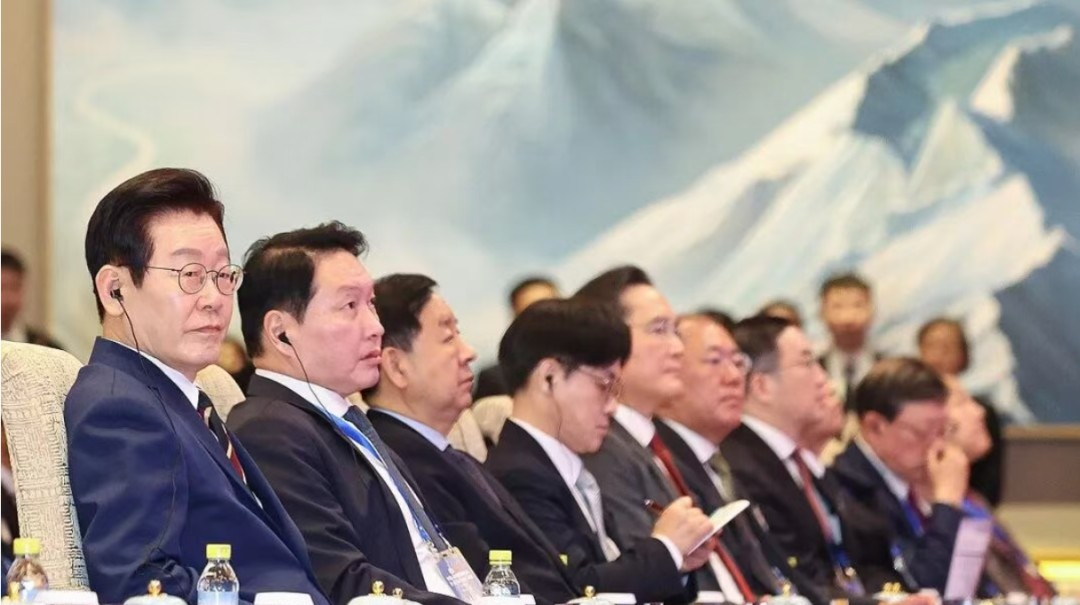
Core Insights - The article highlights the significant collaboration between South Korea and China in the autonomous driving sector, marked by the signing of 32 cooperation agreements during a business forum in Beijing [1][13]. - South Korea aims to achieve Level 4 (L4) autonomous driving commercialization by 2027, positioning itself among the top three global players in the industry [4][16]. Group 1: South Korea's Strategic Framework - South Korea has developed a comprehensive strategy for autonomous driving that includes top-level design, roadmaps, and pilot implementations since 2013 [4]. - Recent policies include the "Plan to Enhance the Competitiveness of the Autonomous Vehicle Industry," which aims for L4 commercialization by 2027, and the designation of Gwangju as the first "city-wide" autonomous driving test city [4][5]. - The government has introduced a regulatory framework that allows for relaxed regulations for Level 3 (L3) and L4 vehicles, empowering local governments to designate pilot areas [5]. Group 2: Commercialization and Application Scenarios - South Korea has seen rapid advancements in autonomous driving applications across various sectors, including public transport and logistics [6][10]. - Seoul is set to launch a daytime autonomous bus route by September 2025, featuring fully automated vehicles without drivers [6]. - The logistics sector has expanded significantly, with autonomous freight trucks now covering 5,224 kilometers of highways, and plans for robot and drone deliveries by 2026 and 2027, respectively [10]. Group 3: Technological Advancements and Infrastructure - South Korea's strength in autonomous driving is supported by its robust capabilities in semiconductors, communications, and automotive manufacturing [9]. - The country is embracing "Physical AI," integrating sensors, vehicle control, and road infrastructure with AI to minimize discrepancies between simulation and real-world conditions [11]. - The establishment of cooperative intelligent transport systems (C-ITS) has been a key focus, with extensive infrastructure already in place to enhance safety and efficiency [12]. Group 4: Sino-Korean Collaboration - The collaboration between Chinese and South Korean companies marks a shift from isolated technical exchanges to a more integrated ecosystem [13]. - Notable partnerships include Lenovo's collaboration with SWM for L4 Robotaxi development and the strategic alliance between Mushroom Carlink and LG Electronics for autonomous vehicle deployment [13]. - This partnership leverages China's data accumulation and cost control expertise alongside South Korea's regulatory framework and supply chain advantages [14]. Group 5: Challenges and Strategic Responses - Despite rapid progress, South Korea faces challenges in transitioning from experimental technologies to large-scale industrial applications [15]. - Issues such as accident liability, data privacy, and public acceptance of autonomous vehicles remain critical hurdles [15]. - South Korea's dual strategy of "open cooperation and technological breakthroughs" aims to address these challenges while enhancing its competitive position in the global market [16]. Group 6: Future Outlook - The collaboration between South Korea and China is seen as a pivotal moment in the global autonomous driving landscape, potentially reshaping industry dynamics [17]. - The next two years are expected to be a "harvest period" for Sino-Korean cooperation in autonomous driving, with the potential emergence of a new global leader in the sector [17].

三星芯片,利润飙升
半导体芯闻· 2026-01-05 10:13
Core Viewpoint - Samsung Electronics is expected to report record-high quarterly profits for Q4 last year, driven by increased demand for advanced storage semiconductors and general memory due to investments in AI infrastructure [1][2]. Group 1: Financial Performance Expectations - Samsung Electronics is projected to achieve a revenue of 89.217 trillion KRW and an operating profit of 16.455 trillion KRW for Q4, marking a year-on-year increase of 17.7% and 153.4% respectively [1]. - IBK Securities forecasts an operating profit of 21.746 trillion KRW for Q4, while Daol Investment Securities predicts 20.4 trillion KRW, both exceeding the previous record of 17.570 trillion KRW set in Q3 2018 [1]. Group 2: Market Dynamics and Pricing - The significant driver for Samsung's performance is the surge in general DRAM memory prices, with the average contract price for PC DRAM products rising from 9.3 USD at the end of last year to an expected 1.35 USD by the end of 2024, indicating a nearly sevenfold increase [2]. - Despite the growing demand for general memory due to AI investments, supply constraints in high-bandwidth memory (HBM) are expected to persist, leading to continued shortages [2]. Group 3: Semiconductor Business Outlook - Samsung's DRAM business is anticipated to achieve an operating profit margin exceeding 50%, while NAND business margins are expected to reach 20% [2]. - The next-generation AI semiconductor business, including HBM4, is gaining momentum, with expectations of stable supply and increased market share from approximately 10% last year to 30% this year [2]. Group 4: System-on-Chip and Foundry Business - The system-on-chip (LSI) and foundry segments are expected to benefit from recent contracts, including a 23 trillion KRW deal with Tesla and potential orders from AMD for 2nm chips [3]. - Samsung's advancements in chip design, such as the Exynos 2600 processor for Galaxy S series and Exynos Auto chips for BMW, indicate a positive trajectory for the semiconductor division [3]. - Analysts predict that if the system semiconductor sector stabilizes after the recovery of storage semiconductors, Samsung's performance could surpass its peak levels [3].
全球大公司要闻 | Meta宣布收购AI智能体公司Manus
Wind万得· 2025-12-30 22:44
Group 1 - Changxin Technology has applied for an IPO on the Sci-Tech Innovation Board, planning to issue no more than 10.622 billion shares, with a financing amount of 29.5 billion yuan [2] - Meta has officially announced the acquisition of AI company Manus for up to several billion dollars, marking its third-largest acquisition since inception, enhancing its AI technology and ecosystem [2] - Kweichow Moutai announced the launch of a new 53-degree, 500ml Feitian Moutai liquor in 2026, with a production volume set to prevent speculation and stabilize the market [2] Group 2 - TSMC announced that its 2nm semiconductor will start mass production in Q4 2025, with a 30% improvement in energy efficiency and a 15% performance increase compared to the 3nm N3E process [3] - Mingde Bio plans to acquire Bikaier from Bluefan Medical, which is expected to constitute a major asset restructuring, enhancing its competitiveness in the healthcare industry [5] - Xiaomi is accelerating its automotive product matrix expansion, planning to launch at least four new models by 2026, indicating a dual-line strategy of "pure electric + range extender" [5] Group 3 - Amazon plans to invest up to $50 billion to build AI and high-performance computing systems for U.S. government agencies, starting construction of data centers in 2026 [7] - Nvidia is in talks to acquire Israeli AI startup AI21 Labs for up to $3 billion, while also purchasing $5 billion in Intel shares to integrate RTX GPUs with Intel processors [7] - Tesla's global production of electric vehicles reached 9 million, with nearly half of the capacity contributed by China, although Q4 delivery is expected to decline by 15% year-on-year [7] Group 4 - SoftBank has completed a total investment commitment of $40 billion in OpenAI, with the last tranche of $22 billion to $22.5 billion recently disbursed [9] - NEC has announced the cessation of development for 4G and 5G wireless base stations, marking its exit from the global base station market [9] - Samsung Electronics, along with SK Hynix, has received U.S. export licenses for chip manufacturing equipment to China, ensuring stable operations in the Chinese market [9] Group 5 - Vodafone has completed the acquisition of German cloud service company Skaylink for €175 million, aimed at enhancing its capabilities in the European cloud computing market [12] - BMW has begun sourcing Exynos Auto chips from Samsung for its new iX3 electric vehicle, expanding their collaboration into software-defined vehicles [12] - Mercedes-Benz has invested 1.34 billion yuan in Chongqing Qianli Technology to integrate its autonomous driving business onto a unified platform [13]

