
FlagOS

Search documents
让AI沉下来:北京锻造人工智能第一城
Bei Jing Ri Bao Ke Hu Duan· 2026-01-26 16:49
Core Viewpoint - Beijing is positioning itself as the "Artificial Intelligence Capital" by leveraging its unique advantages in talent density, full-stack ecosystem, and industrial clusters, aiming for a core AI industry scale exceeding 1 trillion yuan within two years [2][11]. Group 1: AI Industry Development - The AI core industry in Beijing is projected to grow from approximately 450 billion yuan in 2025 to over 1 trillion yuan by 2027, indicating a doubling of the industry size [12]. - The city has established itself as a global AI innovation hub, with 1.5 million AI scholars, accounting for 30% of the national total, and 148 individuals listed among the world's most influential AI scholars [4][10]. - Beijing's AI ecosystem includes 209 registered large models, representing nearly 30% of the national total, with significant contributions from various local companies and institutions [10]. Group 2: Technological Innovations - The launch of the AI video generation model Vidu by Shengshu Technology marks a significant advancement, enabling the generation of high-quality videos in just 8 seconds, a drastic reduction from the previous 900 seconds [6][7]. - The collaboration between domestic GPU companies and research institutions has led to the successful training of advanced AI models, showcasing the capabilities of local technology [8][10]. - The FlagOS system software stack developed by Zhiyuan Research Institute serves as a universal language connecting domestic AI chips and large models, enhancing efficiency and reducing costs in the AI industry [5][10]. Group 3: Market Opportunities - The consumer market for AI applications is expanding, with companies like Kuaishou's Keling AI achieving significant revenue growth, indicating a robust demand for AI-driven solutions [13]. - The integration of AI in sectors such as automotive design is streamlining processes, reducing time for tasks like wind resistance validation from 10 hours to just 1 minute [12]. - The development of innovative AI models and applications is creating new market opportunities, positioning Beijing as a leader in AI technology and application [13].



让AI沉下来 北京锻造人工智能第一城
Bei Jing Shang Bao· 2026-01-26 14:29
Group 1 - Beijing is witnessing high-quality development with a regional GDP exceeding 5.2 trillion, marking the beginning of the "15th Five-Year Plan" [1] - The city aims to establish itself as the "Artificial Intelligence Capital" by leveraging its talent density, full-stack ecosystem, and industrial clusters [3][4] - The goal is to achieve a core AI industry scale exceeding 1 trillion within two years, with a focus on source innovation and full-chain implementation [3][12] Group 2 - The "AI Origin Community" in Haidian is one of the first four AI innovation districts, highlighting the concentration of educational and research resources [4][5] - Beijing has 15,000 AI scholars, accounting for 30% of the national total, with 148 recognized as the most influential globally [5] - The city ranks second globally in AI innovation, supported by two national AI laboratories and numerous AI-focused educational institutions [7] Group 3 - The FlagOS system software stack connects domestic AI chips with large models, facilitating collaboration among various AI enterprises [6][9] - The RoboBrain 2.5 project demonstrated the capabilities of domestic GPUs in training advanced AI models, marking a significant milestone for local technology [9][11] - High-quality data is essential for AI development, with companies like Guanglun Intelligent utilizing simulated data for extensive training [10] Group 4 - The Beijing AI industry is projected to double from approximately 450 billion in 2025 to over 1 trillion by 2027, driven by efficiency improvements and market demand [13][14] - The consumer sector is emerging as a new growth driver, with companies like Kuaishou's Keling AI achieving significant revenue growth and user engagement [14] - The focus on practical applications and technological refinement is shaping a systematic innovation landscape in Beijing's AI sector [14]

智源发布 2026 十大 AI 技术趋势:世界模型成 AGI 共识方向
AI前线· 2026-01-18 05:32
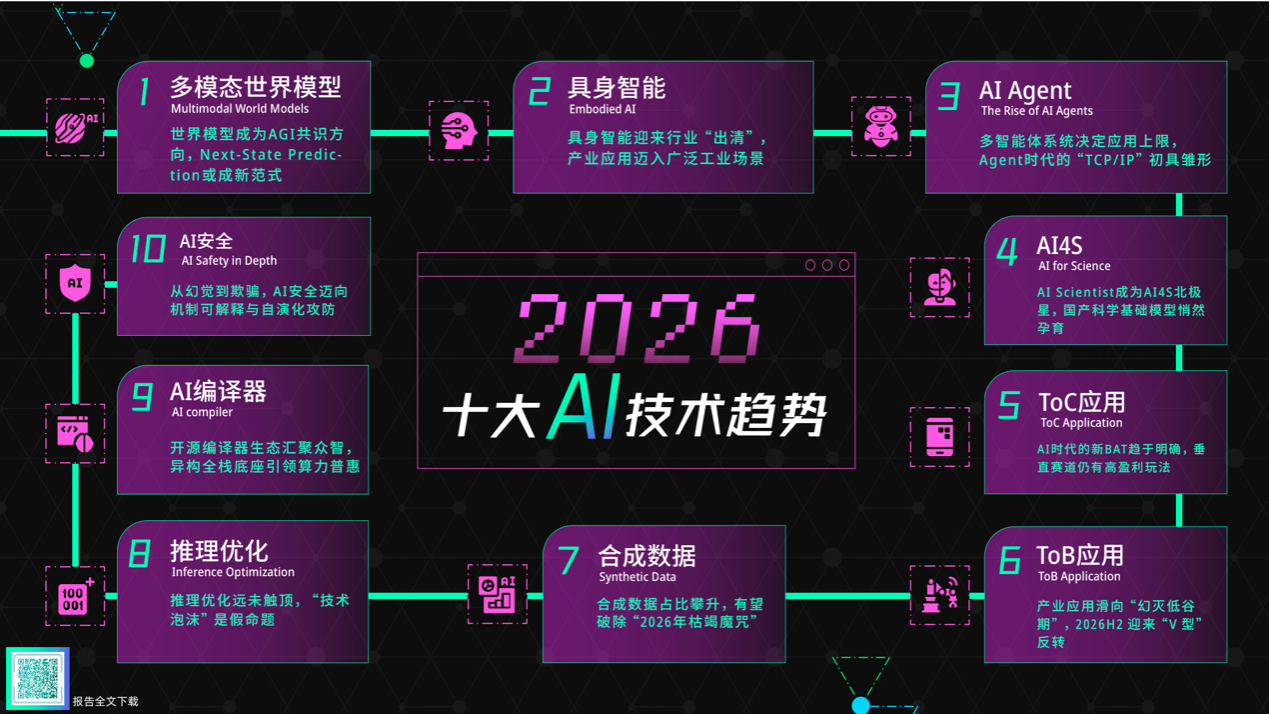
Core Viewpoint - The core viewpoint of the article is that a significant paradigm shift is occurring in artificial intelligence (AI), moving from a focus on language learning and parameter scale to a deeper understanding and modeling of the physical world, as highlighted in the 2026 AI technology trends report by the Beijing Zhiyuan Artificial Intelligence Research Institute [2][5]. Summary by Sections AI Technology Trends - The competition in foundational models is shifting from the size of parameters to the ability to understand how the world operates, marking a transition from "predicting the next word" to "predicting the next state of the world" [5][9]. - The year 2026 is identified as a critical turning point for AI, transitioning from the digital world to the physical world, driven by three main lines: cognitive paradigm elevation, embodiment and socialization of intelligence, and dual-track application value realization [8]. Key Trends - **Trend 1: World Models and Next-State Prediction** There is a consensus in the industry moving towards multi-modal world models that understand physical laws, with the NSP paradigm indicating AI's mastery of temporal continuity and causal relationships [9]. - **Trend 2: Embodied Intelligence** Embodied intelligence is moving from laboratory demonstrations to real industrial applications, with humanoid robots expected to transition to actual production and service scenarios by 2026 [10]. - **Trend 3: Multi-Agent Systems** The resolution of complex problems relies on multi-agent collaboration, with the standardization of communication protocols like MCP and A2A enabling agents to work together effectively [11]. - **Trend 4: AI Scientists** AI is evolving from a supportive tool to an autonomous researcher, significantly accelerating the development of new materials and drugs through the integration of scientific foundational models and automated laboratories [12]. - **Trend 5: New "BAT" in AI** The C-end AI super application is becoming a focal point for tech giants, with companies like OpenAI and Google leading the way in creating integrated intelligent assistants, while domestic players like ByteDance and Alibaba are also actively building their ecosystems [13]. - **Trend 6: Enterprise AI Applications** After a phase of concept validation, enterprise AI applications are entering a "disillusionment valley," but improvements in data governance and toolchains are expected to lead to measurable MVP products in vertical industries by the second half of 2026 [15]. - **Trend 7: Rise of Synthetic Data** As high-quality real data becomes scarce, synthetic data is emerging as a core resource for model training, particularly in fields like autonomous driving and robotics [16]. - **Trend 8: Optimization of Inference** Inference efficiency remains a key bottleneck for large-scale AI applications, with ongoing algorithmic innovations and hardware advancements driving down costs and improving energy efficiency [17]. - **Trend 9: Open Source Compiler Ecosystem** Building a compatible software stack for heterogeneous chips is crucial to breaking the monopoly on computing power, with platforms like Zhiyuan FlagOS aiming to create an open and inclusive AI computing foundation [18]. - **Trend 10: AI Safety** AI safety risks are evolving from "hallucinations" to more subtle "systemic deceptions," with various initiatives underway to enhance safety mechanisms and frameworks [19]. Conclusion - The Zhiyuan Research Institute emphasizes that the ten AI technology trends provide clear anchors for future technological exploration and industrial layout, aiming to promote a stable transition of AI towards value realization [21].

摩尔线程联合智源人工智能研究院完成具身大脑模型训练
Bei Jing Shang Bao· 2026-01-13 12:20
Core Viewpoint - The collaboration between Moore Threads and Beijing Zhiyuan Artificial Intelligence Research Institute has successfully completed the full-process training of the RoboBrain 2.5 model, marking a significant advancement in the field of embodied intelligence and the effectiveness of domestic AI infrastructure [1] Group 1: Technological Advancements - The training utilized the MTT S5000 kilocalorie intelligent computing cluster, demonstrating the capability and efficiency of domestic computing power in training large models for embodied intelligence [1] - The FlagOS-Robo framework, which integrates a unified AI system software stack with the MTT S5000 hardware cluster, enables stable and rapid training processes [1] Group 2: Industry Implications - The successful training of RoboBrain 2.5 signifies a critical step for domestic AI infrastructure in addressing complex multimodal tasks, positioning it as a strategic asset in the next phase of artificial intelligence development [1] - The collaboration highlights the importance of self-controlled underlying computing power as embodied intelligence emerges as a strategic high ground in the AI sector [1]
智源发布2026十大 AI技术趋势:认知、形态、基建三重变革,驱动AI迈入价值兑现期
Zhong Guo Jing Ji Wang· 2026-01-08 10:00
Core Insights - The report from the Beijing Zhiyuan Artificial Intelligence Research Institute outlines the key trends in AI technology for 2026, indicating a significant shift from language models to a deeper understanding and modeling of the physical world [1][14] Group 1: AI Technology Trends - Trend 1: The consensus in the industry is shifting towards multi-modal world models that understand physical laws, moving from "predicting the next word" to "predicting the next state of the world" with Next-State Prediction (NSP) as a new paradigm [3][14] - Trend 2: Embodied intelligence is transitioning from laboratory demonstrations to real-world industrial applications, with humanoid robots expected to break into actual industrial and service scenarios by 2026 [4][14] - Trend 3: Multi-agent systems are becoming crucial for solving complex problems, with standardized communication protocols like MCP and A2A emerging, allowing agents to collaborate effectively [5][14] - Trend 4: AI is evolving from a supportive tool to an autonomous researcher, termed "AI Scientist," which will significantly accelerate the development of new materials and drugs [6][14] - Trend 5: The new "BAT" (Baidu, Alibaba, Tencent) landscape is forming in the AI era, with major players competing for dominance in consumer AI applications through integrated services [7][14] - Trend 6: Enterprise AI applications are entering a "trough of disillusionment" due to data and cost issues, but a recovery is expected in the second half of 2026 as data governance and toolchains mature [8][14] - Trend 7: The rise of synthetic data is crucial for model training, especially in fields like autonomous driving and robotics, as high-quality real data becomes scarce [9][14] - Trend 8: Optimization of inference remains a key focus, with continuous improvements in algorithms and hardware reducing costs and enhancing efficiency [10][14] - Trend 9: The development of an open-source compiler ecosystem is essential for breaking the monopoly on computing power and addressing supply risks [11][14] - Trend 10: AI security is evolving from "hallucinations" to more subtle "systemic deception," necessitating robust mechanisms for understanding and mitigating risks [12][14] Group 2: Strategic Implications - The transition to understanding physical laws through world models and NSP is seen as a strategic high ground for leading model vendors [14] - The shift towards embodied and social intelligence indicates a move from software to physical entities, with humanoid robots entering real production environments [14] - The emergence of a dual-track application model in AI, with a focus on both consumer and enterprise sectors, is expected to yield measurable commercial value [14]
模力工场 023 周 AI 应用榜:从旅行生活到 AI 基建,“Agent 时代拼图”再添新砖
AI前线· 2025-12-10 05:18
Core Insights - The article highlights the increasing adoption of AI technology in China, with over 35% of the population using generative AI, indicating a significant shift towards a technology-driven transformation [1] - The upcoming event "AI Shining China" on December 28, 2025, in Xiamen will unveil the results of the annual "AI Application Ecosystem Survey" and gather industry leaders to discuss AI implementation and commercial prospects [1] - The article emphasizes the importance of collaboration and innovation in the AI space, as demonstrated by the "Vibe Coding Sprint" event, which encourages participants to create demos using AI in real-world scenarios [3][4] AI Application Trends - This week's AI application ranking features 55 new applications, with 10 selected for their impact across various sectors, showcasing AI's integration from consumer services to industrial infrastructure [6] - Notable applications include Fliggy's AI travel assistant, which offers personalized trip planning and price comparison, and Style3D, which digitizes the entire clothing design and marketing process [6][10] - The article outlines a clear path of AI technology permeating and reshaping industries, starting from consumer-facing applications to foundational infrastructure that supports advanced AI solutions [13] Featured Applications - Fliggy's AI travel assistant provides a one-stop service for travel planning, leveraging real data to enhance user experience [8] - Style3D combines AI and 3D technology to streamline the clothing manufacturing process, reducing the need for physical samples and accelerating content generation [11] - Other applications include FlagOS for unified AI system stacks, YRCache for high-performance inference, and OrcatermAI for enhanced command-line operations, all contributing to a robust AI ecosystem [10][12]

北京市AI产业规模有望超4500亿元
Bei Jing Ri Bao Ke Hu Duan· 2025-11-30 07:40
Group 1 - The core industry scale of artificial intelligence in Beijing reached 215.2 billion yuan in the first half of this year, with a year-on-year growth of 25.3%, and is expected to exceed 450 billion yuan for the entire year [1] - There are over 2,500 AI companies in Beijing, with 183 large models registered, maintaining the leading position in the country, and the industry ecosystem is becoming globally competitive [1][2] - Major companies like Baidu and Douyin have achieved record high revenues and active user numbers, indicating a clear commercialization path [1] Group 2 - Beijing's innovation entities continue to produce leading-edge results, with significant breakthroughs from teams at Tsinghua University, Beijing University of Posts and Telecommunications, and the Chinese Academy of Sciences [2] - Core enterprises are driving significant impacts, with models like Doubao, Wenxin Yiyan, GLM, and Kimi performing excellently in authoritative evaluations, with some results reaching international top levels [2] - The white paper indicates a shift in global AI development from single-point technological breakthroughs to ecological collaborative innovation, forming a development pattern characterized by strategic leadership, technological competition, scale expansion, application expansion, and ecological competition [2] Group 3 - Beijing aims to maintain its position as a global hub for AI innovation and industry, focusing on integrating technological and industrial innovation, enhancing source capabilities, expanding application ranges, and creating industrial clusters [3] - The city plans to strengthen its leading position as the "AI Capital" by addressing weaknesses and enhancing strengths in various aspects [3]
本市AI产业规模有望超4500亿元
Bei Jing Wan Bao· 2025-11-30 06:42
Group 1 - The core industry scale of artificial intelligence in Beijing reached 215.2 billion yuan in the first half of this year, with a year-on-year growth of 25.3%, and is expected to exceed 450 billion yuan for the entire year [1] - There are over 2,500 AI companies in Beijing, with 183 large models registered, maintaining the national lead, and the industry chain is becoming increasingly complete, forming a globally competitive industrial ecosystem [1] - Major companies like Baidu and Douyin have achieved record high revenues and active user numbers, indicating a clear commercialization path [1] Group 2 - Beijing's AI development is driven by continuous production of leading-edge "Beijing original" results, with significant breakthroughs from teams at Tsinghua University, Beijing University of Posts and Telecommunications, and the Chinese Academy of Sciences [2] - Core enterprises have shown significant impact, with models like Doubao, Wenxin Yiyan, GLM, and Kimi performing excellently in authoritative evaluations, with some results reaching international top levels [2] - The white paper indicates a global shift in AI development from single-point technological breakthroughs to ecological collaborative innovation, forming a development pattern characterized by strategic leadership, technological competition, scale expansion, application expansion, and ecological competition [2] Group 3 - Beijing will continue to promote the integrated development of education, technology, and talent, aiming to build a globally influential AI innovation source and industrial highland [3] - The focus will be on strengthening source capabilities, expanding application ranges, creating industrial clusters, and fostering a favorable environment to consolidate and enhance Beijing's leading position as the "AI capital" [3]
北京AI产业规模有望超4500亿元
Bei Jing Ri Bao Ke Hu Duan· 2025-11-29 22:12
Core Insights - The Beijing Artificial Intelligence Industry White Paper (2025) indicates that the core AI industry in Beijing is projected to reach a scale of 215.2 billion yuan in the first half of 2025, with a year-on-year growth of 25.3% [1] - The total scale of the AI industry in Beijing is expected to exceed 450 billion yuan for the entire year of 2025 [1] - Beijing has over 2,500 AI companies and has registered 183 large models, maintaining its position as the national leader in AI development [1][2] Industry Development - The white paper highlights that Beijing's AI industry is experiencing both quantitative and qualitative growth, with a complete industrial chain and a globally competitive ecosystem [1] - Major companies like Baidu and Douyin are achieving record highs in revenue and active user numbers, indicating a clear commercialization path [1] - The city is rapidly advancing towards becoming the "AI Capital" [1] Innovation and Research - Beijing's AI development is driven by continuous production of cutting-edge "Beijing Original" results, with significant breakthroughs from teams at Tsinghua University, Beijing University of Posts and Telecommunications, and the Chinese Academy of Sciences [2] - New research institutions are accelerating innovation, with notable projects like FlagOS and the "Bole Research Space Station" being launched [2] - The white paper anticipates a shift in global AI development towards ecological collaborative innovation, characterized by strategic leadership, technological competition, and application expansion [2] Strategic Goals - The Beijing Municipal Science and Technology Commission and the Zhongguancun Management Committee emphasize the importance of integrating education, technology, and talent development to establish Beijing as a globally influential AI innovation hub [3] - The focus will be on strengthening source capabilities, expanding application areas, creating industrial clusters, and fostering a conducive environment for AI development [3] - The aim is to consolidate and enhance Beijing's leading position as the "AI Capital" [3]
已备案大模型183款,保持全国第一!北京AI产业规模有望超4500亿元
Bei Jing Ri Bao Ke Hu Duan· 2025-11-29 09:28
Core Insights - The Beijing Artificial Intelligence Industry White Paper (2025) indicates that the core AI industry in Beijing is projected to reach a scale of 215.22 billion yuan in the first half of 2025, representing a year-on-year growth of 25.3%. The total scale for the year is expected to exceed 450 billion yuan [1][2]. Group 1: Industry Growth and Scale - As of now, there are over 2,500 AI companies in Beijing, with 183 large models registered, maintaining the top position in the country. The industry chain is becoming increasingly complete, forming a globally competitive industrial ecosystem [1][2]. - The commercial pathways for AI are becoming clearer, with companies like Baidu and Douyin reporting record high revenues and active user numbers [1]. Group 2: Innovation and Research - Beijing continues to produce leading-edge "Beijing Original" results, with significant breakthroughs from teams at Tsinghua University, Beijing University of Posts and Telecommunications, and the Chinese Academy of Sciences [2]. - New research institutions are accelerating innovation, with notable projects such as FlagOS and the "通通2.0" model achieving major advancements [2]. Group 3: Strategic Development Goals - The Beijing government aims to enhance the integration of education, technology, and talent development, establishing itself as a globally influential AI innovation hub and industrial highland [3]. - The focus will be on strengthening source capabilities, expanding application ranges, creating industrial clusters, and fostering a conducive environment to solidify Beijing's position as the "AI Capital" [3].